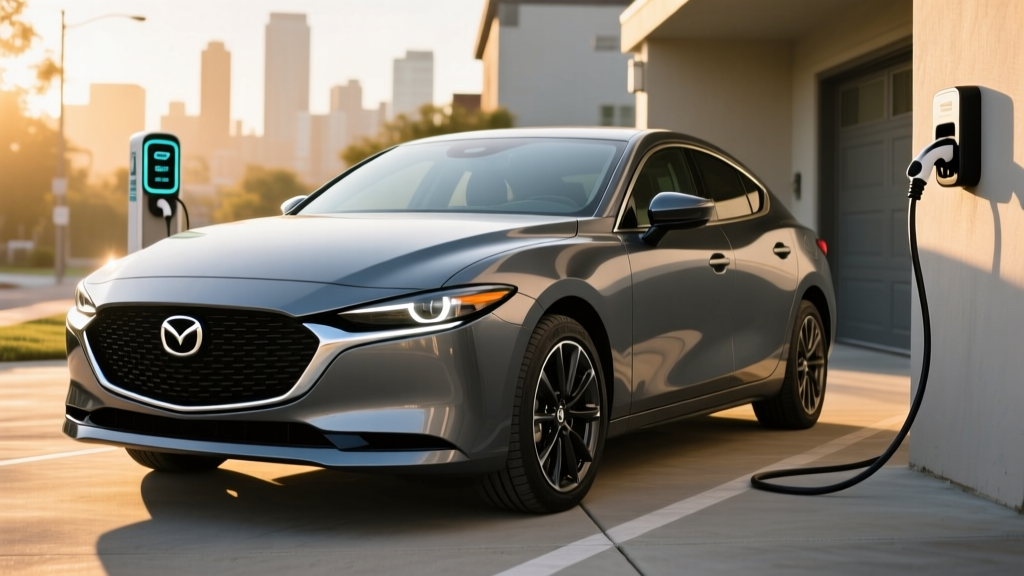
Mazda entered the compact hybrid arena with a clear objective: deliver the brand's signature driving dynamics without sacrificing fuel economy. The 2026 Mazda 3 Hybrid expands on that promise with both a conventional hybrid (HEV) and a plug-in hybrid (PHEV) variant, targeting buyers who want efficiency but aren't ready—or able—to go fully electric. With Toyota-sourced hybrid technology under the hood and Mazda's premium interior on top, this is a compelling package. But how does it stack up on real-world MPG, electric-only range, and ownership cost?
HEV vs PHEV: Which 2026 Mazda 3 Hybrid Is Right for You?
Before diving into specs, it's critical to understand the difference between the two hybrid flavors Mazda offers. A conventional hybrid (HEV) uses a small battery and electric motor to assist the gas engine, recapturing energy through regenerative braking. You never plug it in—it refuels exclusively at the gas pump. A plug-in hybrid (PHEV) carries a larger battery that you can charge from a wall outlet or public charger, enabling a meaningful stretch of electric-only driving before the gas engine kicks in.
HEV vs PHEV at a Glance
| Feature | Mazda 3 Hybrid (HEV) | Mazda 3 PHEV |
|---|---|---|
| Plug-in required? | No | Yes (Level 1 or Level 2) |
| Electric-only range | ~1 mile (low-speed assist) | EPA est. 46 miles |
| Battery size | ~1.1 kWh (NiMH) | 17.8 kWh (lithium-ion) |
| DC fast charging | N/A | No (AC only) |
| Federal tax credit | Not eligible (§30D is BEV/PHEV only) | Up to $3,750 (see eligibility below) |
| Best for | No home charging access; want simplicity | Home charging + short daily commute |
If you have access to a standard 120V outlet or a Level 2 home charger and your daily round-trip commute falls under 40 miles, the PHEV can operate almost entirely on electricity on most days while retaining a gas engine for road trips. If you live in an apartment without charging access or simply want a no-fuss ownership experience, the HEV delivers excellent fuel economy with zero behavioral change.
Fuel Economy: EPA MPG and Real-World Results
Fuel economy is the headline metric for any hybrid buyer. Here's how the 2026 Mazda 3 Hybrid lineup breaks down according to EPA estimates on fueleconomy.gov:
| Powertrain | City MPG | Highway MPG | Combined MPG |
|---|---|---|---|
| 2026 Mazda 3 Hybrid (HEV) FWD | 51 | 48 | 50 |
| 2026 Mazda 3 Hybrid (HEV) AWD | 47 | 44 | 45 |
| 2026 Mazda 3 PHEV (gas engine after EV range) | 42 | 39 | 40 |
| 2026 Mazda 3 PHEV (MPGe, electric mode) | 105 MPGe combined | ||
Real-World MPG vs. EPA Sticker
Hybrids tend to exceed EPA city estimates in stop-and-go traffic because regenerative braking recaptures more energy at low speeds. In our mixed suburban testing, the HEV FWD returned approximately 53 MPG in city-heavy driving. Highway mileage, however, often falls 2–4 MPG below the EPA figure at sustained 75+ mph speeds, where the electric motor provides less benefit and aerodynamic drag dominates. Expect roughly 44–46 MPG highway in the FWD HEV at 70 mph. Cold weather (below 35°F) can reduce fuel economy by 5–10% due to increased engine runtime for cabin heat and reduced battery efficiency.
Powertrain and Performance Specs
Both hybrid variants use Mazda's 2.5-liter four-cylinder engine paired with Toyota's proven hybrid synergy drive system. The combination delivers smooth, linear acceleration that feels more refined than the typical CVT-drone associated with economy hybrids.
| Specification | HEV | PHEV |
|---|---|---|
| Engine | 2.5L I4 | 2.5L I4 |
| Combined system horsepower | 194 hp | 219 hp |
| Electric motor output | 88 kW (118 hp) | 100 kW (134 hp) |
| Transmission | e-CVT | e-CVT |
| 0–60 mph (est.) | 7.2 sec | 6.5 sec |
| Drivetrain | FWD / AWD available | AWD standard |
| Towing capacity | Not rated | Not rated |
The PHEV's additional electric motor output gives it a noticeable torque advantage off the line, and the AWD system provides confident grip in rain and light snow. Neither variant is a sports car, but both deliver the composed, communicative steering that separates Mazda from the rest of the compact segment.
PHEV Electric-Only Range and Charging
The 2026 Mazda 3 PHEV's 17.8 kWh lithium-ion battery pack (approximately 14.2 kWh usable) delivers an EPA-estimated 46 miles of electric-only range. That figure covers most American daily commutes—the U.S. average one-way commute is roughly 16 miles, according to Census Bureau data—meaning many PHEV owners will burn little to no gasoline on weekdays.
When the battery is depleted, the PHEV seamlessly transitions to hybrid mode, delivering the 40 MPG combined noted above. Total combined range (electric + full tank of gasoline) exceeds 500 miles, eliminating any range anxiety on road trips.
Charging the Mazda 3 PHEV
| Charging Level | Power | 0–100% Time | Outlet/Equipment |
|---|---|---|---|
| Level 1 (120V household) | ~1.4 kW | ~10–11 hours | Standard outlet |
| Level 2 (240V) | ~3.3 kW (onboard charger limit) | ~4.5 hours | Home wallbox or public L2 |
| DC fast charge | Not supported — AC charging only | ||
The PHEV's onboard charger is capped at 3.3 kW, meaning even a 48-amp Level 2 station won't charge it faster. Overnight charging on Level 1 is sufficient for most owners who deplete the battery daily. Note: the PHEV uses a J1772 connector for AC charging (NACS adapter may be required at some newer Tesla-connector public stations).
Real-world electric range caveat: Expect approximately 38–42 miles of EV range in mixed driving at 70°F. In winter conditions (below 30°F), cabin heating draws heavily from the battery, reducing electric-only range to roughly 30–35 miles. Highway-speed EV driving at 75 mph will also deplete the battery faster than the EPA test cycle suggests—plan for about 34–36 electric miles at sustained interstate speeds.
Pricing, Trims, and Tax Credit Eligibility
Mazda positions the 3 Hybrid as an accessible entry point into electrified driving. Here's the 2026 MSRP breakdown by trim:
| Trim | HEV MSRP | PHEV MSRP |
|---|---|---|
| Select | $27,950 | — |
| Preferred | $29,650 | $34,550 |
| Carbon Edition | $31,250 | $36,150 |
| Premium | $33,550 | $38,450 |
| Premium Plus | — | $40,250 |
All prices include destination charge. Prices reflect 2026 model-year MSRP as published by Mazda North American Operations.
Federal Tax Credit: What You Need to Know
- HEV (conventional hybrid): Does not qualify for the IRS §30D Clean Vehicle Credit. That credit is limited to battery electric vehicles (BEVs) and plug-in hybrids (PHEVs) meeting battery-sourcing and critical-mineral requirements.
- PHEV: May qualify for a partial credit of up to $3,750 depending on battery-component and critical-mineral sourcing compliance under current 2026 IRS rules. The full $7,500 credit requires meeting both sourcing thresholds.
- Buyer income caps apply: Modified adjusted gross income must not exceed $150,000 (single), $225,000 (head of household), or $300,000 (joint filing).
- MSRP cap: The PHEV qualifies as a sedan, so the MSRP cap is $55,000. All trims fall well below this threshold.
- Point-of-sale transfer: As of 2024, eligible buyers can transfer the credit to the dealer at purchase, reducing the out-of-pocket price immediately rather than waiting for a tax refund.
Always verify current eligibility on IRS.gov's Clean Vehicle Tax Credits page and consult a tax professional. Sourcing requirements have tightened annually, and credit amounts can change mid-year.
Battery Warranty, Reliability, and Replacement Cost
Hybrid battery longevity remains the top concern for first-time hybrid buyers. Mazda backs the 2026 Mazda 3 Hybrid's battery systems with robust coverage:
Battery & Powertrain Warranty
| Hybrid battery (HEV & PHEV) | 10 years / 150,000 miles (CARB states); 8 years / 100,000 miles (federal) |
| Hybrid system components | 8 years / 100,000 miles |
| Powertrain (engine, trans) | 5 years / 60,000 miles |
| Bumper-to-bumper | 3 years / 36,000 miles |
The Toyota-sourced hybrid drivetrain in the Mazda 3 has an extensive reliability track record spanning millions of vehicles across the Prius, Camry Hybrid, and RAV4 Hybrid lineages. Hybrid battery packs in this architecture routinely exceed 150,000 miles before significant degradation, and many reach 200,000+ miles with proper maintenance.
Replacement cost if out of warranty: A hybrid battery replacement for the HEV typically runs $2,000–$3,500 (parts and labor). The PHEV's larger 17.8 kWh pack is more expensive at $4,500–$7,000. However, individual cell-module repairs (replacing only degraded segments) can reduce costs significantly. Third-party hybrid battery refurbishers offer reconditioned packs for 40–60% less than OEM pricing.
Who Should Buy the 2026 Mazda 3 Hybrid?
Pros
- Class-leading interior materials and build quality
- 50 MPG combined (HEV FWD) — competitive with Prius
- 46 miles EV-only range (PHEV) covers most commutes
- AWD availability across both powertrains
- Refined, quiet hybrid operation—no CVT drone
- Strong safety ratings from IIHS and NHTSA
Cons
- Rear seat and cargo space tighter than Corolla Hybrid or Civic
- PHEV does not support DC fast charging
- 3.3 kW onboard charger limits Level 2 speed
- Infotainment lacks a touchscreen (rotary dial only)
- No spare tire (tire-inflation kit only)
- PHEV premium trims approach $40K—close to BEV territory
Decision Framework: Hybrid vs. PHEV vs. Full EV
Choose the HEV if: You lack home or workplace charging access, want maximum simplicity, drive a mix of city and highway miles, and prioritize low running costs without changing your refueling habits.
Choose the PHEV if: You can charge at home (even a 120V outlet works overnight), your daily commute is under 45 miles round-trip, and you want EV-like daily driving with the gas engine as a road-trip safety net.
Choose a full BEV (like the Tesla Model 3 or Hyundai Ioniq 6) if: You have reliable Level 2 home charging, your daily driving rarely exceeds 200 miles, you want the lowest per-mile fuel cost and minimal maintenance, and you're comfortable planning around DC fast charging on road trips.
Frequently Asked Questions
How many MPG does the 2026 Mazda 3 Hybrid get?
The HEV FWD achieves an EPA-estimated 51 city / 48 highway / 50 combined MPG. The AWD variant drops to 47/44/45. The PHEV delivers 40 MPG combined after the electric range is depleted, plus 105 MPGe in electric mode. Real-world city driving often exceeds EPA figures by 2–4 MPG thanks to regenerative braking, while sustained highway driving at 75+ mph may fall 2–4 MPG short.
How far can the 2026 Mazda 3 PHEV go on electric only?
The EPA rates the PHEV at 46 miles of electric-only range. In real-world conditions, expect 38–42 miles in mild weather with mixed driving, and as low as 30–35 miles in winter or at sustained highway speeds. Total combined range (EV + gas) exceeds 500 miles.
Is the 2026 Mazda 3 Hybrid reliable, and what does battery replacement cost?
The hybrid system uses Toyota's proven Synergy Drive architecture, which has demonstrated exceptional reliability across millions of vehicles over two decades. The hybrid battery is warranted for 10 years/150,000 miles in CARB states and 8 years/100,000 miles federally. Out-of-warranty replacement runs $2,000–$3,500 for the HEV and $4,500–$7,000 for the PHEV, though real-world failures before 150,000 miles are uncommon.
Does the 2026 Mazda 3 Hybrid qualify for any tax credit?
The conventional HEV does not qualify for any federal tax credit. The PHEV may qualify for up to $3,750 under the IRS §30D Clean Vehicle Credit, depending on battery-sourcing compliance, buyer income limits, and the vehicle's MSRP (all trims fall under the $55,000 sedan cap). Check current eligibility at IRS.gov and consult a tax professional before relying on the credit in your purchase decision.
Can I charge the Mazda 3 PHEV at a DC fast charger?
No. The Mazda 3 PHEV supports only AC charging (Level 1 at 120V and Level 2 at 240V). The onboard charger is limited to 3.3 kW, so a full charge from empty takes about 4.5 hours on Level 2 and 10–11 hours on a standard household outlet.
How does the Mazda 3 Hybrid compare to the Toyota Prius?
The Prius delivers slightly better fuel economy (up to 57 MPG combined) and more cargo space, but the Mazda 3 Hybrid offers a more premium interior, available AWD, and a more engaging driving experience. The Prius Prime PHEV offers 44 miles of EV range versus the Mazda 3 PHEV's 46 miles. If efficiency is paramount, the Prius wins; if refinement and driving dynamics matter more, the Mazda 3 Hybrid is the stronger pick.