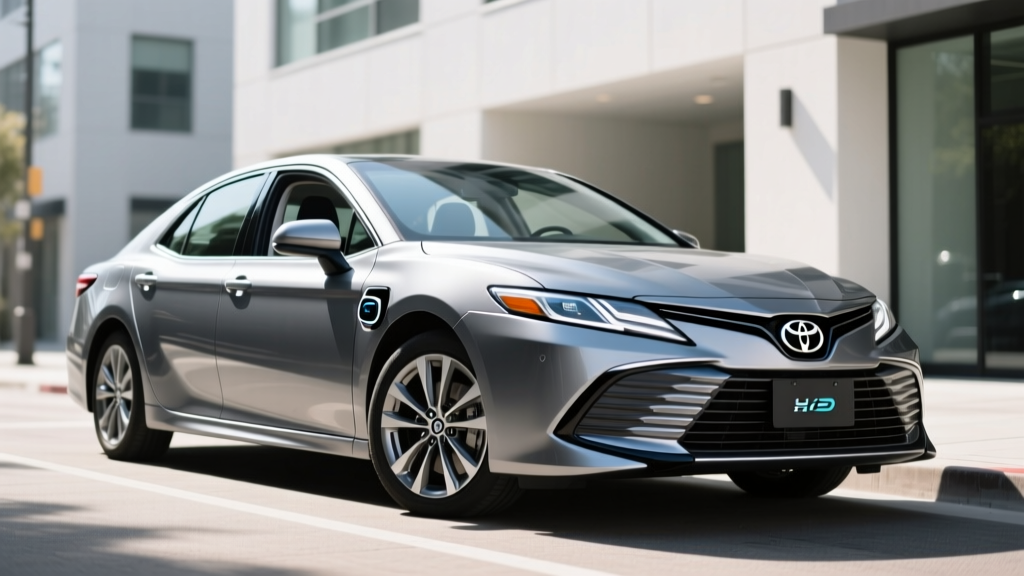
Toyota made the Camry exclusively a hybrid starting with the 2025 model year, and the 2026 Hybrid Camry continues that strategy with no gasoline-only option. Every trim pairs a 2.5-liter four-cylinder engine with Toyota's fifth-generation hybrid system, delivering front-wheel or electronic all-wheel drive with combined output reaching 232 horsepower. For buyers researching the hybrid Camry as a daily commuter, this is the most efficient midsize sedan Toyota has ever sold — and one of the few that consistently beats its EPA city estimate in real-world stop-and-go driving.
This review covers the 2026 Camry Hybrid's exact fuel economy figures, powertrain specs, battery warranty, pricing by trim, and how it compares to plug-in hybrids and full EVs so you can decide whether it fits your driving pattern.
HEV vs PHEV: What Kind of Hybrid Is the Camry?
Before examining specs, it is essential to understand what the Camry Hybrid is — and what it is not. The Camry Hybrid is a conventional hybrid (HEV), not a plug-in hybrid (PHEV). You never plug it in. The battery charges through regenerative braking and the gasoline engine. There is no electric-only driving range to manage, no charging cable, and no home charger requirement.
Camry Hybrid (HEV) vs a Plug-In Hybrid (PHEV)
| Feature | Camry Hybrid (HEV) | Typical PHEV (e.g., Prius Prime) |
|---|---|---|
| Plug-in charging | No — never plugs in | Yes — Level 1 or Level 2 |
| Electric-only range | 0 miles (EV mode limited to ~1 mile at low speed) | 25–44 miles typical |
| Battery size | ~1.1 kWh (small, self-charging) | 13–18 kWh usable |
| Federal tax credit (§30D) | Not eligible | Up to $7,500 if sourcing/income rules met |
| Home charger needed | No | Recommended for PHEV benefit |
| Best for | Drivers without charging access who want maximum MPG | Drivers with home charging and short commutes |
If you were hoping for a Camry PHEV with plug-in electric range, Toyota does not currently offer one. The Prius Prime fills that role in Toyota's lineup. The Camry Hybrid's advantage is simplicity: drive it like any gasoline car and let the hybrid system handle efficiency automatically.
Fuel Economy: EPA Ratings and Real-World MPG
The 2026 Camry Hybrid is available with front-wheel drive (FWD) or electronic all-wheel drive (AWD). The FWD models achieve higher fuel economy, while the AWD system — which adds a rear electric motor — costs roughly 2–3 MPG combined.
| Drivetrain | City MPG | Highway MPG | Combined MPG |
|---|---|---|---|
| FWD (LE, SE, XLE) | 51 | 44 | 47 |
| AWD (LE, SE, XLE, XSE) | 49 | 43 | 46 |
Source: EPA Fuel Economy
Real-World MPG vs EPA Sticker
The Camry Hybrid is one of the rare vehicles that exceeds its EPA city rating in real-world urban driving. Hybrid systems recapture the most energy in stop-and-go traffic where regenerative braking is constant. Expect 52–55 MPG in city commuting during mild weather. Highway cruising at 75+ MPH yields closer to 40–42 MPG because the engine runs more frequently without regenerative opportunities. In cold weather (below 30°F), expect a 5–8% reduction across the board as the engine runs longer to heat the cabin and warm the battery. On a 400-mile road trip at highway speeds, plan for roughly 38–41 MPG.
With a 13.2-gallon fuel tank, the FWD Camry Hybrid delivers a theoretical maximum range of approximately 620 miles on a full tank at combined EPA efficiency. Real-world mixed driving typically yields 550–600 miles between fill-ups.
Powertrain Specs: Horsepower, Engine, and Hybrid System
The 2026 Camry Hybrid uses Toyota's fifth-generation hybrid synergy drive, pairing a 2.5-liter Dynamic Force four-cylinder engine with one or two electric motor-generators depending on drivetrain.
| Specification | FWD | AWD |
|---|---|---|
| Combined horsepower | 208 hp | 232 hp |
| Gas engine | 2.5L 4-cyl, 184 hp | 2.5L 4-cyl, 184 hp |
| Front electric motor | 100 kW (134 hp) | 100 kW (134 hp) |
| Rear electric motor | None | 30 kW (40 hp) |
| Hybrid battery | ~1.1 kWh lithium-ion | ~1.1 kWh lithium-ion |
| Transmission | eCVT | eCVT |
| 0–60 MPH | ~7.2 sec | ~6.9 sec |
| Drivetrain | FWD | Electronic AWD (eAWD) |
The AWD system is not a traditional mechanical setup with a driveshaft. Instead, the rear electric motor engages independently when the system detects front-wheel slip or during hard acceleration. This approach avoids the parasitic drivetrain losses of mechanical AWD, which is why the fuel economy penalty is so small.
Acceleration is adequate for merging and passing — the AWD's 6.9-second 0–60 time is competitive with turbocharged midsize sedans — but this is not a performance car. The eCVT delivers smooth, linear power without the gear hunting of a traditional automatic. Engine noise under hard acceleration is noticeable but well-insulated in the XLE and XSE trims with acoustic glass.
Pricing by Trim and Tax Credit Eligibility
The 2026 Camry Hybrid starts under $30,000 for the LE trim, making it one of the most affordable hybrid midsize sedans available. Pricing increases through the lineup with added features and AWD availability.
| Trim | FWD MSRP | AWD MSRP | Key Features |
|---|---|---|---|
| LE | $29,495 | $30,995 | 8" touchscreen, TSS 3.0, wireless CarPlay/Android Auto |
| SE | $31,095 | $32,595 | Sport-tuned suspension, 18" alloy wheels, paddle shifters |
| XLE | $34,095 | $35,595 | Leather-trimmed seats, 12.3" display, heated front seats, ambient lighting |
| XSE | N/A | $37,195 | Sport + premium, 19" wheels, panoramic roof available |
All prices include destination charge. Prices reflect 2026 model-year MSRP from Toyota.
Federal Tax Credit: Not Eligible
The Camry Hybrid is a conventional HEV and does not qualify for the federal §30D Clean Vehicle Credit (up to $7,500). That credit is reserved for plug-in electric vehicles (BEVs and PHEVs) with sufficient battery capacity and compliant battery sourcing. However, the Camry Hybrid's low starting price means many buyers pay less out of pocket than a tax-credit-eligible PHEV or EV after factoring in home charging installation costs. Check IRS guidelines for current credit eligibility rules if you are also cross-shopping plug-in vehicles.
Hybrid Battery Warranty and Replacement Cost
Hybrid battery longevity is the top concern for buyers considering a Camry Hybrid, especially on the used market. Toyota's warranty coverage is among the strongest in the industry.
Camry Hybrid Battery Warranty
- Hybrid battery: 10 years / 150,000 miles (whichever comes first)
- Hybrid system components (inverter, motor-generators, control module): 8 years / 100,000 miles
- Basic vehicle warranty: 3 years / 36,000 miles
- Powertrain warranty: 5 years / 60,000 miles
In California and states adopting CARB emissions standards, the hybrid battery warranty extends to 10 years / 150,000 miles under emissions warranty provisions.
Toyota's hybrid batteries have demonstrated exceptional longevity in real-world use. The Prius, which uses a similar hybrid architecture, regularly reaches 200,000+ miles on the original battery. The Camry Hybrid's lithium-ion pack is smaller and less stressed than a full EV battery because it operates within a narrow state-of-charge window (roughly 40–80%), avoiding the deep discharge cycles that accelerate degradation in larger batteries.
If the hybrid battery does require replacement outside of warranty, expect to pay between $2,000 and $4,000 for a new OEM battery pack at a Toyota dealership. Refurbished and aftermarket options are available for $1,000–$2,000. Given the 10-year/150,000-mile warranty and the proven durability of Toyota's hybrid system, unplanned battery replacement is a low-probability event for most owners.
Camry Hybrid vs PHEV vs Full EV: Which Fits Your Drive?
The Camry Hybrid competes not just against other hybrids but against plug-in hybrids like the Toyota Prius Prime and full battery-electric vehicles like the Tesla Model 3 or Hyundai Ioniq 6. Here is a decision framework based on your driving pattern:
Choose the Camry Hybrid (HEV) If:
- You do not have access to home or workplace charging
- Your commute is longer than 40 miles round-trip (exceeds most PHEV electric ranges)
- You frequently take road trips over 300 miles and want minimal fuel stops
- You want the lowest upfront cost with no charging infrastructure investment
- You live in an apartment or rent and cannot install a charger
Choose a PHEV (e.g., Prius Prime) If:
- You have home Level 2 charging and a commute under 40 miles
- You want to drive most weekdays on electricity but need gas for weekend trips
- You qualify for the $7,500 federal tax credit (check income and sourcing rules on IRS.gov)
Choose a Full EV (e.g., Tesla Model 3, Ioniq 6) If:
- You have reliable home charging and your daily driving is under 250 miles
- You want zero tailpipe emissions and the lowest per-mile fuel cost
- You qualify for federal and state EV incentives
- You are comfortable planning DC fast-charging stops on road trips
The Camry Hybrid's total cost of ownership is compelling even without tax credits. At 47 MPG combined and $3.25/gallon gasoline, annual fuel cost for 15,000 miles is approximately $1,037. A comparable gasoline-only midsize sedan at 28 MPG combined would cost roughly $1,741 per year — a savings of over $700 annually with the Camry Hybrid. Compared to a full EV charging at $0.14/kWh average home electricity, the EV costs roughly $525/year, but the EV buyer must also absorb higher purchase price, potential home charger installation ($500–$2,000), and possibly higher insurance premiums.
Pros and Cons of the 2026 Camry Hybrid
Pros
- Best-in-class city MPG (51 EPA; 52–55 real-world)
- No plug-in charging required — works with existing gas infrastructure
- 10-year / 150,000-mile hybrid battery warranty
- AWD available with minimal MPG penalty
- Strong standard safety suite (TSS 3.0)
- Competitive starting price under $30,000
- Proven Toyota hybrid reliability track record
Cons
- No plug-in or electric-only driving capability
- No federal tax credit eligibility
- Highway MPG drops to ~40–42 real-world at 75+ MPH
- eCVT engine drone under hard acceleration
- Rear seat headroom slightly reduced vs prior generation
- No spare tire (tire repair kit only)
Is the 2026 Hybrid Camry Reliable?
Toyota's hybrid powertrain is one of the most thoroughly proven in the automotive industry. The hybrid synergy drive architecture has been in continuous production since 1997, and the Camry Hybrid specifically has been sold in the US since 2007. The fifth-generation system in the 2026 model uses fewer moving parts than a conventional automatic transmission — the eCVT contains no belts, clutches, or torque converter — reducing potential failure points.
Toyota Safety Sense 3.0 comes standard on every trim, including pre-collision braking with pedestrian detection, lane departure alert with steering assist, full-speed adaptive cruise control, and lane tracing assist. The Camry consistently earns top ratings from both IIHS and NHTSA.
Long-term reliability data from the prior-generation Camry Hybrid shows battery failure rates well under 5% within the warranty period. The most common maintenance items are identical to any gasoline car: brake pads (which last longer than average due to regenerative braking), tires, coolant changes, and engine oil. Toyota recommends hybrid system coolant replacement at 100,000 miles and inverter coolant at 100,000 miles.
Frequently Asked Questions
How many MPG does the 2026 Hybrid Camry get?
The FWD Camry Hybrid achieves 51 city / 44 highway / 47 combined MPG per the EPA. The AWD version is rated at 49 city / 43 highway / 46 combined. In real-world city driving, owners frequently report 52–55 MPG thanks to regenerative braking in stop-and-go traffic. Highway driving at 75+ MPH typically yields 40–42 MPG.
Does the Camry Hybrid need to be plugged in?
No. The Camry Hybrid is a conventional hybrid (HEV) and never requires plug-in charging. The battery recharges through regenerative braking and the gasoline engine. You fuel it exactly like a standard gasoline car.
Does the Hybrid Camry qualify for any tax credit?
No. The federal §30D Clean Vehicle Credit applies only to plug-in electric vehicles (BEVs and PHEVs) with battery capacity of at least 7 kWh and compliant critical-mineral sourcing. The Camry Hybrid's ~1.1 kWh battery and lack of plug-in capability make it ineligible. Some states or local utilities may offer minor rebates for hybrid purchases — check your state energy office for current programs.
How long will the Camry Hybrid battery last and what does replacement cost?
Toyota warranties the hybrid battery for 10 years or 150,000 miles. Real-world data from Toyota's hybrid lineup shows most batteries lasting well beyond 200,000 miles. If replacement is needed, a new OEM battery costs $2,000–$4,000 at a dealership. Refurbished options are available for $1,000–$2,000. The narrow state-of-charge operating window (40–80%) significantly reduces degradation compared to full EV batteries.
Is the Camry Hybrid better than a full EV for my commute?
It depends on charging access and commute distance. If you cannot charge at home, the Camry Hybrid is the clear winner — it requires zero infrastructure changes. If you have home charging and a commute under 40 miles, a PHEV like the Prius Prime lets you drive on electricity daily while keeping gas flexibility. A full EV offers the lowest per-mile cost but requires charging planning for road trips and a higher upfront investment.
Does the Camry Hybrid have AWD?
Yes. Electronic all-wheel drive (eAWD) is available on all trims. The system uses a dedicated 30 kW rear electric motor that activates on demand for traction in rain, snow, or hard acceleration. AWD adds approximately $1,500 to the MSRP and costs only 1–2 MPG combined compared to FWD.