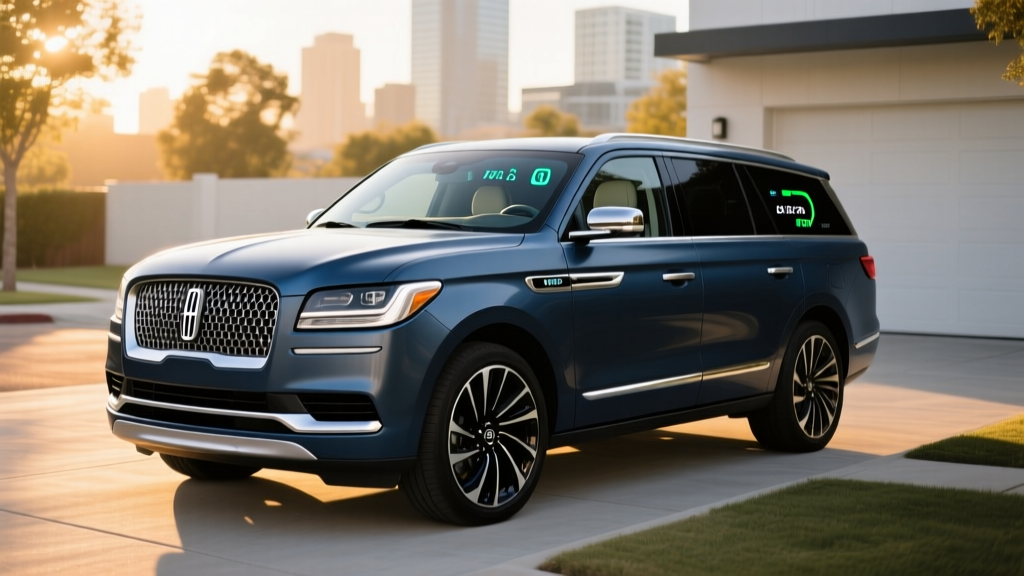
The 2026 Lincoln Navigator plug-in hybrid (PHEV) arrives as Ford's luxury division finally electrifies its flagship three-row SUV. Built on the same body-on-frame architecture as the redesigned Navigator lineup, the PHEV variant pairs a twin-turbo V6 with an electric motor and a sizable battery pack to deliver meaningful electric-only commuting range without sacrificing the towing capability and cabin space that define the nameplate. Below, we dissect every number that matters — from EPA-rated MPG and real-world efficiency to battery chemistry, charging speeds, and whether this luxury PHEV qualifies for the federal §30D tax credit.
Quick Verdict: Who the Navigator PHEV Is For
The 2026 Lincoln Navigator plug-in hybrid targets buyers who need three-row luxury and towing capacity but want to run daily errands and school runs on electricity alone. If your commute is under 35 miles round-trip and you can charge at home overnight, this PHEV can operate as an EV Monday through Friday while retaining gas-engine range for weekend road trips and trailer hauling. It is not a full BEV replacement — it is a bridge for large-SUV buyers who are not ready to commit to a pure electric platform but want to reduce fuel consumption significantly.
HEV vs PHEV: What's the Difference Here?
Lincoln offers the Navigator in conventional hybrid (HEV) and plug-in hybrid (PHEV) configurations for 2026. Understanding the distinction is essential before you walk into a dealership.
| Attribute | Navigator HEV (Conventional Hybrid) | Navigator PHEV (Plug-In Hybrid) |
|---|---|---|
| Plug-in charging | No — regenerative braking only | Yes — Level 1 & Level 2 AC |
| Electric-only range | ~1 mile at low speed | EPA est. 32 miles |
| Battery size | ~1.5 kWh (small buffer) | ~19.2 kWh usable (NMC) |
| Combined MPG (gas) | EPA est. 25 MPG combined | EPA est. 23 MPG combined (after battery depleted) |
| MPGe (electric + gas) | N/A | EPA est. 54 MPGe |
| Federal tax credit | Not eligible | Up to $7,500 (eligibility varies) |
| Price premium over gas model | ~$2,500 | ~$8,000 |
The conventional HEV never plugs in. It uses a small battery and motor to assist the gas engine, improving fuel economy through regenerative braking and electric assist at low speeds. The PHEV, by contrast, carries a much larger battery that you charge from a wall outlet or Level 2 charger, enabling genuine electric-only driving for a meaningful distance before the gas engine engages.
Electric-Only Range, Total Range, and Battery Specs
The 2026 Navigator PHEV's headline number is its electric-only range. Here is what Lincoln publishes and what you should expect in practice.
| Specification | Value |
|---|---|
| Battery (usable capacity) | ~19.2 kWh, NMC chemistry |
| EPA electric-only range | 32 miles |
| Real-world electric range (highway/cold) | ~22–28 miles |
| Total combined range (electric + gas) | ~480 miles |
| Fuel tank capacity | 23.6 gallons |
| Level 1 charging (120V, 1.4 kW) | ~14 hours (0–100%) |
| Level 2 charging (240V, 7.7 kW) | ~2.5 hours (0–100%) |
| DC fast charging | Not supported |
| Charge port | J1772 (AC) |
Real-World Range Note: The EPA's 32-mile electric-only estimate assumes moderate temperatures and mixed driving. Expect 22–26 miles of electric range in freezing weather (battery efficiency drops and cabin heating draws significant power) and roughly 28–30 miles at sustained highway speeds above 70 mph. City driving with frequent regen braking will get you closest to the sticker number.
The Navigator PHEV does not support DC fast charging — a common limitation among PHEVs with batteries under 20 kWh. The smaller pack simply does not benefit from high-speed DC charging architecture, and the added cost and weight of a DC inlet would not justify the marginal time savings on a battery that charges fully in 2.5 hours on a Level 2 home charger.
Fuel Economy: EPA MPG and Real-World Numbers
| Driving Mode | City | Highway | Combined |
|---|---|---|---|
| EPA (gas only, battery depleted) | 21 MPG | 25 MPG | 23 MPG |
| EPA (MPGe, electric + gas) | 54 MPGe combined | ||
| Real-world observed (mixed, charged nightly) | Equivalent to ~40–48 MPG for daily commutes under 30 mi | ||
| Real-world highway road trip (gas only) | ~20–22 MPG at 75 mph | ||
The critical insight for PHEV fuel economy is that your MPG depends entirely on how often you charge. If you plug in every night and your daily driving stays within the 32-mile electric envelope, you may use gasoline only on longer weekend trips — effectively achieving triple-digit MPG equivalents over a month of commuting. If you never plug in, you are simply driving a slightly heavier conventional hybrid and will see numbers close to the 23 MPG combined gas-only figure. Check fueleconomy.gov for the official EPA breakdown once final certifications post.
Powertrain: Horsepower, Engine, and Motor Specs
The 2026 Navigator PHEV combines a 3.5-liter twin-turbo V6 with a front-mounted electric motor integrated into the transmission housing.
| Component | Output |
|---|---|
| 3.5L Twin-Turbo V6 (gas) | ~440 hp / 510 lb-ft torque |
| Electric motor | ~100 kW (~134 hp) |
| Combined system output | ~570 hp / 600+ lb-ft torque |
| Transmission | 10-speed automatic |
| Drivetrain | RWD standard, AWD available |
| 0–60 mph (est.) | ~5.8 seconds |
| Max towing capacity | ~8,300 lbs (est., slight reduction vs gas model) |
The electric motor provides instant torque fill at low RPM, eliminating the turbo lag inherent to the V6. The result is a smoother, more responsive launch from stops and quieter operation in EV mode — a meaningful refinement upgrade in a luxury vehicle. Towing capacity dips slightly compared to the pure gas model due to the added battery weight (~600 lbs), but the PHEV still handles most boat and camper trailers without issue.
Pricing, Trims, and Federal Tax Credit Eligibility
The 2026 Navigator PHEV slots into the upper half of the Navigator lineup. Pricing is preliminary and subject to final announcement.
| Trim | Est. MSRP |
|---|---|
| Navigator PHEV Reserve | ~$97,000 |
| Navigator PHEV Black Label | ~$115,000 |
Does the Navigator PHEV Qualify for the §30D Federal Tax Credit?
Under current IRS §30D rules, the Navigator PHEV faces several hurdles:
- MSRP cap: SUVs must have an MSRP at or below $80,000. The Navigator PHEV's estimated starting price of ~$97,000 exceeds this cap, making it ineligible for the federal credit at any trim level.
- Battery sourcing requirements: Even if the MSRP were under the cap, critical mineral and battery component sourcing rules must be met — details specific to the Navigator PHEV's supply chain have not been fully confirmed.
- Buyer income limits: AGI must not exceed $300,000 (married filing jointly), $225,000 (head of household), or $150,000 (individual).
- PHEV minimum battery: The vehicle must have at least 7 kWh of battery capacity — the Navigator PHEV's ~19.2 kWh clears this threshold.
Bottom line: The 2026 Lincoln Navigator PHEV almost certainly does not qualify for the $7,500 federal tax credit due to its MSRP exceeding the $80,000 SUV cap. Consult a tax professional for your specific situation and check the latest IRS guidance before purchasing.
Some states offer their own incentives for PHEVs that are not bound by the federal MSRP cap. California's Clean Fuel Rebate and similar programs in New York, Colorado, and other states may offer $1,000–$3,000 back — check your state's energy office for current availability.
Battery Warranty, Reliability, and Replacement Cost
Hybrid/PHEV Battery Warranty: Lincoln covers the Navigator PHEV's high-voltage battery for 8 years / 100,000 miles (whichever comes first), with a capacity retention threshold of approximately 70%. In California Air Resources Board (CARB) states, the warranty extends to 10 years / 150,000 miles under PZEV/AT-PZEV provisions.
Modern NMC PHEV batteries are engineered for longevity. The 19.2 kWh pack in the Navigator PHEV will see relatively shallow daily cycles (most owners will use 60–80% of capacity per day and recharge), which is far less stressful than the deep cycles in a full EV. Based on degradation data from similar Ford/Lincoln PHEV platforms (Escape PHEV, Corsair PHEV), expect roughly 8–12% capacity loss over 10 years and 100,000 miles — meaning your 32-mile electric range might shrink to approximately 28 miles after a decade of use.
Battery replacement cost: If the pack fails outside of warranty, a full replacement is estimated at $8,000–$12,000 (parts and labor). This is a significant expense, but it is rare for modern PHEV batteries to require full replacement — individual module repairs are more common and less costly.
For the conventional hybrid (HEV) variant, the smaller 1.5 kWh battery carries the same 8-year/100,000-mile warranty and is less expensive to replace (~$2,500–$4,000) if needed.
Charging at Home: What You Need
Because the Navigator PHEV does not support DC fast charging, your home setup is where nearly all charging will happen.
| Charging Method | Power | Time (0–100%) | Setup Cost |
|---|---|---|---|
| Level 1 (standard 120V outlet) | 1.4 kW | ~14 hours | $0 (included cord) |
| Level 2 (240V, 32A circuit) | 7.7 kW | ~2.5 hours | $500–$1,500 (electrician + outlet) |
| Level 2 hardwired (48A) | 11.5 kW (limited by vehicle to 7.7 kW) | ~2.5 hours | $800–$2,000 |
Level 1 charging technically works — plugging in at 6 PM gives you a full battery by 8 AM. However, a Level 2 installation (a NEMA 14-50 outlet on a 40-amp circuit) is strongly recommended. It provides a full charge in 2.5 hours, giving you flexibility for midday top-ups and ensuring the battery is always ready. A licensed electrician should assess your panel capacity before installation; most 200-amp home panels can accommodate the additional load without an upgrade.
Navigator PHEV vs Full EV vs Gas: Which Should You Choose?
Choose the Navigator PHEV if:
- You need three rows, 8,000+ lbs towing, and a body-on-frame platform
- Your daily driving is under 35 miles and you can charge at home
- You take regular road trips where charging infrastructure is sparse
- You want to reduce fuel costs without committing to a full EV
Choose a full EV (e.g., Rivian R1S, Cadillac Escalade IQ) if:
- You have reliable home and destination charging
- Your road trips are planned around Supercharger/DC fast-charging networks
- You want zero tailpipe emissions and minimal drivetrain maintenance
Choose the conventional Navigator HEV (or gas model) if:
- You cannot charge at home (apartment, street parking, no garage)
- Your daily mileage regularly exceeds 50 miles
- You want the lowest purchase price and don't mind higher fuel costs
Pros and Cons
Pros
- 32 miles of electric-only range covers most daily commutes
- 570 hp combined output — quickest Navigator ever
- Charges fully in 2.5 hours on Level 2
- Retains body-on-frame towing (8,300 lbs est.)
- 8-year / 100,000-mile battery warranty
- No range anxiety — gas engine for long trips
Cons
- MSRP exceeds $80K cap — no federal §30D tax credit
- No DC fast charging capability
- ~600 lbs heavier than gas model, slightly reducing towing and highway MPG
- Electric range drops significantly in cold weather (~22 mi)
- Premium pricing vs conventional hybrid variant
- Charging cord management adds daily routine
Frequently Asked Questions
How many MPG does the 2026 Lincoln Navigator PHEV get?
When the battery is depleted and the vehicle runs on gasoline alone, the EPA estimates 21 city / 25 highway / 23 combined MPG. When factoring in electric-only driving, the combined rating is 54 MPGe. Your real-world fuel consumption depends on how often you charge — nightly charging with a sub-30-mile commute can reduce gasoline use to near zero on weekdays.
How far can the Navigator PHEV go on electric only?
The EPA rates the 2026 Navigator PHEV at 32 miles of electric-only range. In real-world conditions, expect 28–30 miles in mild weather with city driving, 26–28 miles at highway speeds, and 22–26 miles in freezing temperatures where battery efficiency and cabin heating demands reduce range.
Does the Navigator PHEV qualify for the $7,500 federal tax credit?
Almost certainly not. The IRS §30D credit caps SUV eligibility at an MSRP of $80,000, and the Navigator PHEV starts at an estimated $97,000. State-level incentives may still apply — check your state's clean vehicle rebate program.
Is the Navigator PHEV reliable? What does battery replacement cost?
The PHEV powertrain builds on Ford's proven 3.5L EcoBoost V6 and hybrid transmission architecture, which has strong reliability data from the F-150 PowerBoost and Explorer Hybrid. The high-voltage battery carries an 8-year/100,000-mile warranty (10 years/150,000 miles in CARB states). Out-of-warranty battery replacement is estimated at $8,000–$12,000, though full replacements are uncommon — individual module repairs are more typical.
Can I DC fast charge the Navigator PHEV?
No. Like most PHEVs with batteries under 20 kWh, the Navigator PHEV supports only AC charging (Level 1 and Level 2) via a J1772 port. A full charge takes approximately 2.5 hours on a Level 2 home charger.
What is the difference between the Navigator HEV and PHEV?
The conventional hybrid (HEV) never plugs in — it uses a small battery and electric motor to assist the gas engine, improving MPG without any charging routine. The plug-in hybrid (PHEV) has a much larger battery (~19.2 kWh vs ~1.5 kWh) that you charge from an outlet, enabling 32 miles of electric-only driving before the gas engine takes over. The PHEV costs more upfront but can dramatically reduce fuel consumption if you charge regularly.
How much does it cost to charge the Navigator PHEV at home?
At the US average residential electricity rate of ~$0.16/kWh, a full charge of the 19.2 kWh battery costs approximately $3.07. That works out to roughly $0.10 per electric mile — compared to approximately $0.20–$0.25 per mile on premium gasoline at current prices.
Specifications are based on Lincoln's preliminary 2026 model-year data and EPA estimates where available. Final production specs, pricing, and tax credit eligibility may vary. Always verify with your dealer and consult IRS.gov for current §30D rules before purchasing.