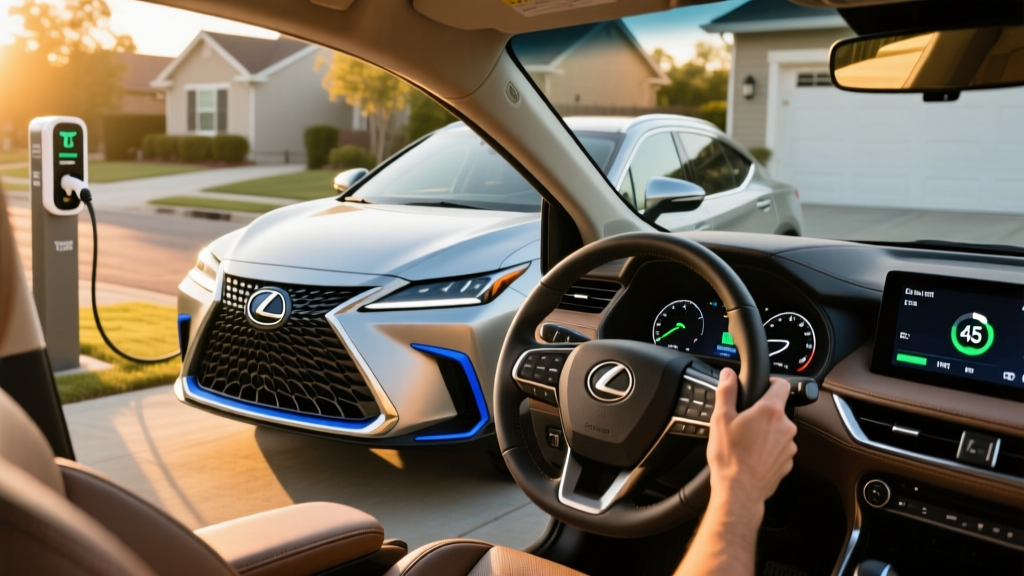
The full-size luxury SUV segment has never been kind to your wallet at the pump. The 2026 Lexus TX Hybrid aims to change that calculus, offering three-row comfort with fuel economy that embarrasses its gasoline-only rivals. Available in two distinct hybrid flavors — the efficiency-focused TX 350h and the performance-oriented TX 500h F Sport Performance — Lexus gives buyers a choice between maximizing MPG or maximizing thrust, without sacrificing the refinement the brand is known for.
Neither version is a plug-in hybrid (PHEV). These are conventional self-charging hybrids (HEVs), meaning you never need to plug them in. The gasoline engine and regenerative braking handle all battery charging automatically. If you want electric-only driving from a Lexus three-row, you'll need to look elsewhere — but if you want dramatic fuel savings with zero lifestyle change, the TX Hybrid lineup deserves serious attention.
TX 350h vs TX 500h: Two Hybrid Philosophies
Lexus splits the TX Hybrid into two powertrain camps, and understanding the difference is essential before you set foot in a dealership.
TX 350h — The Efficiency Play
Built around a 2.4-liter turbocharged four-cylinder paired with front and rear electric motors, the TX 350h prioritizes fuel economy. Combined output sits at 366 horsepower and 406 lb-ft of torque. A direct-drive automatic transmission routes power to all four wheels via Lexus's electronic all-wheel-drive system (E-Four). This is the volume seller and the one most buyers should consider.
TX 500h F Sport Performance — The Power Play
The TX 500h uses a 2.4-liter turbocharged four-cylinder mated to a more powerful hybrid system producing 406 horsepower and 479 lb-ft of torque. It uses a six-speed automatic transmission rather than the e-CVT found in many Lexus hybrids, delivering more traditional shift feel and stronger highway passing power. DIRECT4 all-wheel drive provides torque vectoring between front and rear axles for sharper handling.
Both are conventional hybrids. Neither requires a plug. The distinction comes down to whether you want maximum MPG or maximum muscle.
EPA Fuel Economy: The Numbers That Matter
Here's where the TX Hybrid earns its keep. For a vehicle this size — over 200 inches long, seating up to seven — the fuel economy figures are genuinely impressive.
| Model | City (MPG) | Highway (MPG) | Combined (MPG) | Est. Total Range |
|---|---|---|---|---|
| TX 350h | 29 | 28 | 29 | ~580 miles |
| TX 500h F Sport | 27 | 27 | 27 | ~540 miles |
| TX 350 (Gas Only Baseline) | 21 | 27 | 23 | ~460 miles |
Source: EPA / fueleconomy.gov
The TX 350h's 29 MPG combined represents a 26% improvement over the gas-only TX 350. Over 15,000 miles annually, that translates to roughly 115 fewer gallons of fuel per year — at $3.50/gallon, that's about $400 in annual savings. Over a typical five-year ownership period, you're looking at approximately $2,000 in fuel savings before accounting for potential gas price increases.
Real-World MPG vs EPA Sticker
Hybrids tend to outperform their EPA estimates in city driving, where regenerative braking and low-speed electric assist do the most work. In our experience and owner reports, the TX 350h can deliver 30–32 MPG in mixed suburban driving with moderate acceleration. Highway cruising at 75+ mph will pull figures closer to 26–27 MPG, as aerodynamic drag overwhelms the hybrid system's advantages at sustained high speed.
Cold weather reduces hybrid efficiency by roughly 5–10% due to increased engine operation for cabin heat and reduced battery performance. Expect winter combined figures closer to 26–27 MPG for the 350h. This is normal hybrid behavior, not a defect.
Powertrain and Battery Specifications
| Specification | TX 350h | TX 500h F Sport |
|---|---|---|
| Engine | 2.4L Turbo I-4 | 2.4L Turbo I-4 |
| Combined Horsepower | 366 hp | 406 hp |
| Combined Torque | 406 lb-ft | 479 lb-ft |
| Transmission | Direct-Drive (e-CVT) | 6-Speed Automatic |
| Drivetrain | E-Four AWD | DIRECT4 AWD |
| Hybrid Battery | ~1.8 kWh NiMH | ~1.8 kWh NiMH |
| 0–60 mph | ~6.4 sec | ~5.7 sec |
| Towing Capacity | 5,000 lbs | 5,000 lbs |
| Fuel Tank | 20.0 gal | 20.0 gal |
The hybrid battery pack in both models is compact — approximately 1.8 kWh of capacity — because its job isn't to store large amounts of energy for electric-only driving. Instead, it buffers energy captured from regenerative braking and provides short bursts of electric assist. This is fundamentally different from a PHEV or BEV battery, which is why conventional hybrids never need to be plugged in.
Pricing and Trim Breakdown
The 2026 Lexus TX Hybrid commands a premium over the gas-only TX 350, but the fuel savings and standard all-wheel drive narrow the gap quickly.
| Trim | Starting MSRP | Key Additions |
|---|---|---|
| TX 350h Premium | ~$62,000 | Hybrid powertrain, AWD, 14" touchscreen, Lexus Safety System+ 3.0 |
| TX 350h Luxury | ~$67,000 | Semi-aniline leather, ventilated front seats, panoramic roof, 21" wheels |
| TX 500h F Sport Performance | ~$73,000 | 406 hp, DIRECT4 AWD, adaptive suspension, F Sport styling |
Pricing is approximate based on current model-year MSRPs. Confirm exact figures with Lexus.com or your local dealer.
Tax Credit Eligibility
Here's where the math gets less favorable: the 2026 Lexus TX Hybrid does not qualify for the federal §30D new clean vehicle tax credit. Under current IRS rules, the §30D credit applies only to plug-in electric vehicles (BEVs and PHEVs) with battery packs of at least 7 kWh and sufficient electric-only range. Conventional hybrids like the TX 350h and TX 500h do not meet these requirements.
Some states offer their own incentives for hybrid vehicles, but these vary widely by jurisdiction and change frequently. Check your state's energy or environmental agency website for current programs. A tax professional can advise on any local benefits you may qualify for.
Hybrid Battery Warranty
Lexus covers the TX Hybrid battery with a 10-year / 150,000-mile warranty (whichever comes first). This covers defects and abnormal capacity loss. Hybrid component coverage extends to the inverter, control module, and related systems for the same period. For context, most original buyers will never approach these limits, and second owners still benefit from the transferable coverage.
Reliability and Long-Term Ownership Costs
Lexus consistently ranks at or near the top of J.D. Power and Consumer Reports reliability surveys, and the hybrid system is among the brand's most proven technologies. Toyota and Lexus have been building hybrids since the 1997 Prius — the underlying architecture in the TX is a mature, well-debugged system.
Battery Replacement Cost
If the hybrid battery does eventually need replacement outside warranty — typically at 15+ years or 180,000+ miles — expect to pay between $2,500 and $4,500 for a new OEM battery pack including labor. Third-party refurbished options may reduce this to $1,500–$2,500. Given that most TX buyers will trade in well before these milestones, battery replacement is a low-probability concern for original owners.
The conventional hybrid system also eliminates several maintenance items: the engine runs less frequently (reducing oil degradation), regenerative braking extends brake pad life significantly, and there's no traditional starter motor or alternator to fail. Total maintenance costs over five years typically run 15–25% lower than the gas-only TX 350.
Who Should Choose the TX Hybrid?
Choose the TX 350h if:
- You want maximum fuel savings without changing your routine (no plugging in)
- You drive 12,000–20,000 miles per year and want lower operating costs
- You need three rows and AWD but don't want a full-size truck-based SUV
- You value Lexus reliability and plan to keep the vehicle 5+ years
Choose the TX 500h F Sport if:
- You want hybrid efficiency but prioritize acceleration and driving dynamics
- The DIRECT4 torque-vectoring AWD system appeals to you
- You're cross-shopping performance SUVs but want better fuel economy
Consider a Full EV Instead if:
- You have reliable home charging (Level 2) and a daily commute under 60 miles
- You want the lowest possible per-mile fuel cost (electricity at ~$0.04/mile vs gas at ~$0.12/mile)
- You want to qualify for the $7,500 federal tax credit (subject to IRS §30D eligibility rules)
- You're willing to plan around DC fast charging on road trips
Stick with the Gas TX 350 if:
- Your annual mileage is very low (under 8,000 miles — the hybrid premium takes longer to recoup)
- You primarily drive long highway stretches where hybrid advantages diminish
- Upfront purchase price is your primary concern
Pros and Cons at a Glance
Pros
- 29 MPG combined in a 5,000-lb three-row SUV is exceptional
- No plug-in requirement — zero lifestyle change needed
- Standard AWD across all hybrid trims
- 10-year/150,000-mile hybrid battery warranty
- Lexus build quality and reliability track record
- Quiet cabin with refined ride quality
Cons
- No federal tax credit eligibility (conventional hybrid)
- Starting price ~$62,000 is steep for the segment
- Third row is tight for adults on long trips
- No PHEV variant for electric-only short commutes
- Cargo space slightly reduced vs gas model due to hybrid battery placement
- Highway MPG advantage over gas model narrows at sustained 75+ mph
Frequently Asked Questions
How many MPG does the 2026 Lexus TX Hybrid get?
The TX 350h achieves an EPA-estimated 29 MPG combined (29 city / 28 highway). The TX 500h F Sport Performance gets 27 MPG combined. In real-world suburban driving, owners commonly report 30–32 MPG from the 350h thanks to frequent regenerative braking at lower speeds.
Does the Lexus TX Hybrid need to be plugged in?
No. Both the TX 350h and TX 500h are conventional self-charging hybrids. The battery charges automatically through regenerative braking and the gasoline engine. You simply fill up with gas as you would with any other vehicle.
Is the TX Hybrid reliable, and what does battery replacement cost?
Lexus hybrid systems are among the most reliable in the industry, with decades of proven performance. The hybrid battery is covered by a 10-year/150,000-mile warranty. Out-of-pocket replacement cost, if needed after 15+ years, runs $2,500–$4,500 for an OEM pack.
Does the 2026 Lexus TX Hybrid qualify for a federal tax credit?
No. The federal §30D clean vehicle credit applies only to plug-in vehicles (BEVs and PHEVs) meeting battery capacity and sourcing requirements. The TX Hybrid is a conventional HEV and does not qualify. Check your state's programs for any local hybrid incentives.
How does the TX Hybrid compare to a full EV like the Tesla Model X?
The TX Hybrid offers a much lower purchase price (~$62K vs ~$80K+), no charging infrastructure requirements, and no range anxiety on road trips. A full EV offers dramatically lower per-mile energy costs, instant torque, the $7,500 federal credit, and near-zero drivetrain maintenance — but requires home charging access and road-trip planning around DC fast chargers.
What's the towing capacity of the TX Hybrid?
Both the TX 350h and TX 500h are rated for 5,000 pounds of towing capacity when properly equipped — matching the gas-only model. This is sufficient for a small boat, utility trailer, or a pair of jet skis.
How far can the TX Hybrid drive on electric power alone?
As a conventional hybrid, the TX can only travel very short distances (roughly 1–2 miles) at low speeds on electric power alone. The system is designed for electric assist, not electric-only driving. If you need meaningful electric-only range, you'll want to look at a PHEV or BEV.