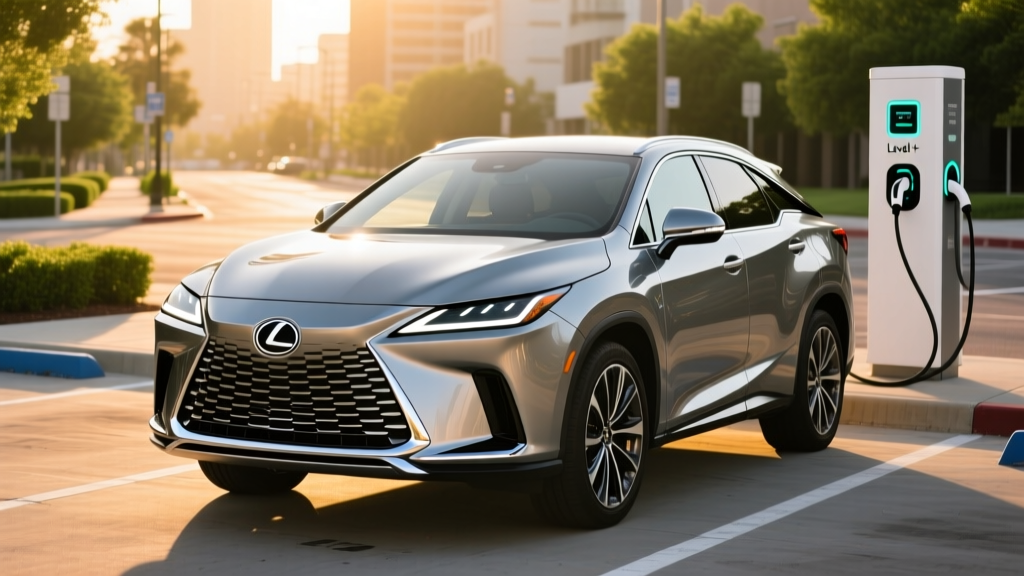
If you want Lexus luxury and SUV practicality but aren't ready to commit to a full battery-electric vehicle, the 2026 Lexus RX 450h+ plug-in hybrid occupies a compelling middle ground. It pairs a turbocharged four-cylinder with a sizable battery pack for short all-electric commutes, then seamlessly reverts to an efficient conventional hybrid for longer road trips. Below, we break down every number that matters — from real-world MPG to charging speed, tax credit eligibility, and long-term battery reliability.
2026 Lexus RX 450h+ Quick Spec Sheet
| Spec | Value |
|---|---|
| Powertrain | 2.5L 4-cyl + 3 electric motors (AWD) |
| Combined Horsepower | 304 HP |
| Battery (Usable) | 18.1 kWh lithium-ion |
| EPA Electric-Only Range | 37 miles |
| Total Combined Range | ~440 miles |
| EPA MPG (Charge-Sustaining) | 35 combined / 37 city / 34 highway |
| MPGe (Electric + Gas) | 83 MPGe |
| Level 2 Charging (Full) | ~2.5 hours at 6.6 kW |
| DC Fast Charging | Not available |
| 0–60 mph | 6.2 seconds |
| Base MSRP (Premium trim) | ~$52,050 |
| Battery Warranty | 10 years / 150,000 miles |
HEV vs PHEV: Where the RX 450h+ Fits
Conventional Hybrid (HEV) — The standard RX 350h uses a small battery recharged entirely by regenerative braking and the gas engine. You never plug it in. It delivers consistent fuel economy but no meaningful electric-only driving.
Plug-In Hybrid (PHEV) — The RX 450h+ carries a much larger 18.1 kWh battery that you plug in overnight. That battery delivers 37 miles of pure electric driving before the gas engine seamlessly engages. Think of it as an EV for your commute and a hybrid for your road trip.
The distinction matters for your wallet and your daily routine. If you can charge at home and your commute falls within 37 miles round-trip, you may burn almost no gasoline on weekdays. If you forget to plug in or lack home charging access, the RX 450h+ still functions as a 35-MPG hybrid — you just lose the electric-range advantage.
Real-World MPG: What Owners Actually See
| Driving Scenario | Expected MPG |
|---|---|
| EPA City (charge-sustaining) | 37 MPG |
| EPA Highway (charge-sustaining) | 34 MPG |
| EPA Combined | 35 MPG |
| Real-world city (mixed driving) | 33–38 MPG |
| Real-world highway (75 mph) | 30–33 MPG |
| Cold weather (below 32°F) | 28–32 MPG |
Hybrids tend to outperform their EPA ratings in stop-and-go city driving where regenerative braking is most active. On sustained highway runs above 70 mph, expect a slight dip below the EPA sticker — typical for any PHEV once the battery is depleted. Cold weather saps both battery efficiency and engine efficiency; plan for roughly a 10–15% MPG reduction in freezing conditions, plus reduced electric-only range (closer to 28–30 miles).
Electric-Only Range and Charging Details
The RX 450h+ delivers an EPA-rated 37 miles on battery power alone at speeds up to about 85 mph. That covers the average American one-way commute (roughly 16 miles, per Census data) with margin to spare for errands.
Charging is straightforward but limited to Level 2:
- Level 1 (120V household outlet): ~12–14 hours from empty to full — viable only as a trickle top-up.
- Level 2 (240V, 6.6 kW onboard charger): ~2.5 hours from empty to full. A home Level 2 wallbox replenishes the battery overnight with time to spare.
- DC Fast Charging: Not supported. The RX 450h+ lacks a CCS or NACS DC port, so public fast chargers are off the table.
The absence of DC fast charging is the PHEV's most notable limitation for apartment dwellers or anyone without reliable home or workplace Level 2 access. Without regular plug-in charging, you're carrying 600+ pounds of battery you're not fully utilizing.
Powertrain and Performance
Under the hood sits a 2.5-liter inline-four paired with three electric motors — one on the front axle integrated into the transaxle, and two powering the rear axle for standard electronic AWD. Combined output is 304 horsepower, and the 0–60 mph sprint takes 6.2 seconds. That's brisk for a two-row luxury SUV and noticeably quicker than the conventional RX 350h (250 HP, ~7.4 seconds to 60).
The transition between electric and hybrid modes is among the smoothest in the segment. Toyota/Lexus has decades of hybrid powertrain refinement, and it shows: no clunky handoffs, no drone from the CVT under moderate acceleration. Floor it, and the four-cylinder does get vocal — a common trait of Atkinson-cycle engines mated to eCVTs — but around-town driving is whisper-quiet in EV mode.
Pricing, Trims, and Tax Credit Eligibility
| Trim | Approx. MSRP |
|---|---|
| Premium | $52,050 |
| Premium+ | $56,200 |
| Luxury | $61,050 |
Federal Tax Credit (§30D) — 2026 Rules: The RX 450h+ is a PHEV with a battery capacity exceeding 7 kWh, which meets the baseline §30D requirement. However, full $7,500 credit eligibility depends on battery-component and critical-mineral sourcing requirements that shift annually under the Inflation Reduction Act. Lexus/Toyota's supply chain has historically struggled with North American sourcing mandates.
Key buyer requirements per the IRS:
- MSRP must not exceed $80,000 for SUVs (all RX 450h+ trims qualify)
- Buyer AGI: ≤$150,000 single / ≤$300,000 joint filers
- Battery sourcing thresholds (verify current-year compliance on fueleconomy.gov)
- Credit can now be transferred to the dealer as a point-of-sale rebate
Always confirm eligibility with your tax professional before purchase. Credit amounts can be $0, $3,750, or $7,500 depending on sourcing compliance in the model year.
Battery Longevity, Warranty, and Replacement Cost
Hybrid Battery Warranty: Lexus covers the RX 450h+ traction battery for 10 years or 150,000 miles (whichever comes first) — one of the longest hybrid battery warranties in the luxury segment. If the battery drops below a defined capacity threshold (typically ~70% of original), Lexus will repair or replace it under warranty.
Toyota and Lexus hybrid batteries have an exceptional longevity track record. Real-world data from older RX 400h and RX 450h (non-plus) models shows many original packs exceeding 200,000 miles with manageable degradation. The larger PHEV battery in the 450h+ operates with a conservative buffer — Lexus doesn't allow full 0–100% utilization, which reduces stress on the cells and extends cycle life.
If you do need an out-of-warranty replacement down the road, expect a cost in the $8,000–$12,000 range (parts and labor) based on current Lexus PHEV battery pricing. That's a meaningful sum, but given the 10-year warranty and proven reliability of Toyota/Lexus hybrid systems, most original owners will never face it.
Who Should Buy the RX 450h+ (and Who Shouldn't)
Choose the RX 450h+ if:
- You can charge at home (Level 2) nightly
- Your weekday driving is under 37 miles round-trip
- You want EV-like daily driving with no range anxiety on road trips
- You value Lexus reliability and resale value
- You're not ready for full EV charging infrastructure dependence
Look elsewhere if:
- You lack home or workplace charging (PHEV advantage is wasted)
- Your commute exceeds 40 miles one-way (consider a full EV like the Ioniq 5 or Model Y)
- You want DC fast charging for road-trip top-ups
- You prioritize maximum cargo space (the PHEV battery slightly reduces under-floor storage vs. the RX 350h)
Frequently Asked Questions
How many MPG does the 2026 Lexus RX 450h+ get?
Once the battery is depleted, the RX 450h+ operates as a conventional hybrid rated at 35 MPG combined (37 city / 34 highway) by the EPA. In real-world city driving, owners often see 33–38 MPG thanks to regenerative braking. Highway cruising at 75+ mph typically yields 30–33 MPG.
How far can the RX 450h+ go on electric power alone?
The EPA rates it at 37 miles of all-electric range. In cold weather or at sustained highway speeds, expect that to drop to roughly 28–32 miles. For typical suburban commuting in moderate temperatures, hitting the full 37 miles is realistic.
Hybrid vs PHEV vs EV — which is right for me?
A conventional hybrid (HEV) like the RX 350h is ideal if you can't charge at home and want maximum simplicity. A PHEV like the RX 450h+ is the sweet spot if you have home charging and a short commute but still take road trips. A full EV makes sense if you have reliable charging access, drive under 300 miles between stops, and want the lowest per-mile operating cost. The PHEV bridges the gap — but only if you actually plug it in.
Is the Lexus RX 450h+ reliable long-term?
Lexus consistently ranks at or near the top of J.D. Power and Consumer Reports reliability surveys. The hybrid powertrain is proven across millions of Toyota/Lexus vehicles. The 10-year/150,000-mile battery warranty provides strong protection. Out-of-warranty battery replacement runs $8,000–$12,000, but most packs outlast that threshold by a wide margin.
Does the RX 450h+ qualify for a federal tax credit?
It may, but it depends on current-year battery sourcing rules under IRS §30D. The vehicle's MSRP is well under the $80,000 SUV cap, and most buyers will fall under the income limits. However, Toyota/Lexus battery component and critical mineral sourcing compliance varies by model year. Check the latest status on fueleconomy.gov and consult a tax professional before relying on the credit in your purchase decision.