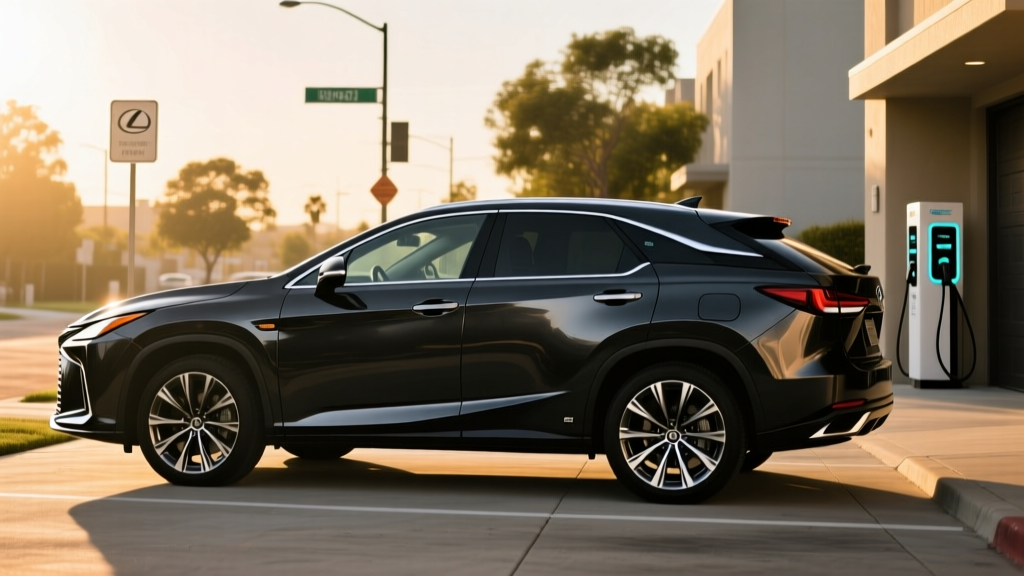
The Lexus RX has been America's best-selling luxury SUV for over a decade, and its hybrid variant has quietly become the smart-money choice for buyers who want luxury efficiency without plug-in complexity. The 2026 RX 350 Hybrid carries forward the fifth-generation formula: a turbocharged 2.5-liter four-cylinder paired with dual electric motors, all-wheel drive standard, and an EPA-estimated 36 MPG combined. But does real-world driving match the sticker?
After analyzing EPA data, owner fuel logs, and Lexus's latest powertrain specs, here's everything you need to decide if the 2026 RX 350 Hybrid is the right electrified SUV for your driveway — or if you should look at the PHEV variant, a full EV, or stick with gas.
Quick Verdict: Who the 2026 RX 350 Hybrid Is For
Choose the RX 350 Hybrid if: You want luxury SUV comfort with 36+ MPG, standard AWD, and zero charging infrastructure needs. Ideal for drivers without reliable home or workplace charging who still want to cut fuel costs 30-40% vs. the gas RX 350.
Look at the RX 450h+ PHEV instead if: You have Level 2 home charging and a commute under 37 miles. You'll drive electric most days and only use gas on road trips.
Consider a full EV (like the Tesla Model X or BMW iX) if: You have home charging, want zero tailpipe emissions, and drive under 300 miles daily.
2026 RX 350 Hybrid: Powertrain and Performance Specs
The RX 350h uses Lexus's fourth-generation hybrid system — a 2.5-liter Atkinson-cycle inline-4 mated to two electric motor-generators (one front, one rear for AWD). The result is seamless torque fill off the line and eerily quiet highway cruising.
| Specification | 2026 Lexus RX 350h |
|---|---|
| Powertrain | 2.5L I-4 Hybrid + Dual Electric Motors (AWD) |
| Combined Horsepower | 246 hp (net system) |
| Engine Output | 189 hp @ 6,000 rpm / 184 lb-ft torque |
| Front Motor | 134 hp / 199 lb-ft |
| Rear Motor | 54 hp / 89 lb-ft |
| Transmission | eCVT (planetary gearset) |
| 0-60 mph | 7.4 seconds (est.) |
| Towing Capacity | 3,500 lbs (with tow prep) |
| Hybrid Battery | 1.6 kWh (NiMH), self-charging |
| Drivetrain | Electronic AWD (eAWD) standard |
Don't let the 246 hp figure fool you — the electric motors deliver instant torque from a standstill, making the RX 350h feel quicker than its 0-60 time suggests in city driving. Merge onto the highway and the gas engine seamlessly blends in; the transition is nearly imperceptible.
Fuel Economy: EPA Estimates vs. Real-World MPG
The headline number for the 2026 RX 350h is 36 MPG combined, but hybrid fuel economy varies more than gas cars depending on your driving mix. Here's the EPA breakdown per fueleconomy.gov:
| Driving Cycle | EPA Estimate | Real-World Expectation |
|---|---|---|
| City | 37 MPG | 38-42 MPG (hybrids excel in stop-and-go) |
| Highway | 34 MPG | 30-34 MPG (aero drag, less regen benefit) |
| Combined | 36 MPG | 33-38 MPG (depends on city/highway split) |
Real-World MPG Insight: Owner-reported data on Fuelly and Lexus forums shows many RX 350h drivers averaging 34-38 MPG combined. City-heavy commuters often exceed the EPA city rating (regenerative braking recaptures energy at every stoplight). Highway-only road trips at 75+ mph may dip to 29-31 MPG. Cold weather (below 30°F) can reduce MPG by 5-10% as the engine runs longer to heat the cabin.
Cost comparison: At $3.50/gallon and 12,000 miles/year, the RX 350h costs roughly $1,167/year in fuel. The gas-only RX 350 AWD (24 MPG combined) costs about $1,750/year — a $583 annual savings with the hybrid. Over 5 years, that's nearly $2,900 in fuel savings, partially offsetting the hybrid's ~$2,000 price premium.
HEV vs. PHEV vs. EV: Which RX (or Rival) Fits You?
Lexus offers the RX in three electrified flavors for 2026. Here's how they stack up:
| Feature | RX 350h (HEV) | RX 450h+ (PHEV) | Competitor EV (BMW iX) |
|---|---|---|---|
| Powertrain | 2.5L Hybrid (self-charging) | 2.5L Plug-in Hybrid | Dual Motor BEV |
| EPA MPG / MPGe | 36 MPG combined | 35 MPG + 35 mi electric | 86 MPGe combined |
| Electric-Only Range | N/A (motor assists only) | 37 miles | 324 miles (EPA) |
| Needs Plugging In? | No | Yes (for EV range) | Yes (always) |
| Battery Size | 1.6 kWh (NiMH) | 18.1 kWh (Li-ion) | 111.5 kWh (Li-ion) |
| Home Charging? | Not required | Recommended (Level 2) | Required |
| Starting MSRP | $53,450 | $62,950 | $87,250 |
| Federal Tax Credit | None | Up to $3,750* | Up to $7,500* |
*Federal tax credit eligibility under IRS §30D depends on buyer income caps, vehicle MSRP caps, battery sourcing requirements, and point-of-sale transfer rules. Always verify current eligibility at irs.gov or with a tax professional.
Does the 2026 RX 350h Qualify for Any Tax Credits?
No federal tax credit applies to the RX 350h. The IRS §30D New Clean Vehicle Credit is reserved for plug-in electric vehicles (BEVs and PHEVs) with a minimum battery capacity of 7 kWh. The RX 350h's 1.6 kWh battery doesn't qualify.
However, there are other financial considerations:
- State incentives: A handful of states offer rebates or HOV lane access for conventional hybrids. Check your state's energy office for current programs.
- Lower total cost of ownership: Between fuel savings (~$583/year) and Lexus's strong resale value, the hybrid often breaks even on its price premium within 3-4 years.
- Insurance: Hybrid insurance premiums are typically comparable to gas variants — no surcharge for the hybrid system.
Reliability, Battery Warranty, and Replacement Costs
Hybrid battery longevity remains the #1 concern for first-time hybrid buyers. Here's what the data shows for Lexus:
Lexus Hybrid Battery Warranty: 10 years / 150,000 miles (whichever comes first) for 2020 and newer models. In California-emission states (CARB states), coverage extends to 10 years / 150,000 miles with additional emissions component coverage.
Real-World Degradation: Lexus's NiMH hybrid batteries are among the most durable in the industry. Taxi fleet data and long-term owner reports show RX hybrids routinely reaching 200,000+ miles on the original battery. Unlike BEV batteries, the small hybrid battery cycles shallowly — it never fully charges or fully discharges — which dramatically extends cycle life.
Replacement Cost (if needed out of warranty): $2,500–$4,000 for a refurbished or new hybrid battery pack at a Lexus dealer. Independent hybrid shops can sometimes replace cells for $1,200–$2,000. For context, fewer than 5% of Lexus hybrids require battery replacement before 200,000 miles based on industry repair data.
The RX 350h's conventional powertrain (2.5L engine + eCVT) is also proven reliable. The eCVT uses a planetary gearset with no belts, clutches, or traditional transmission wear components. Lexus consistently ranks in the top 3 for long-term reliability in J.D. Power and Consumer Reports surveys, and the hybrid system adds minimal complexity beyond the gas-only model.
Pricing and Trims: What You'll Actually Pay
The 2026 Lexus RX 350h is offered in four trims, all with standard electronic AWD:
| Trim | MSRP (est.) | Key Features |
|---|---|---|
| Premium | $53,450 | 14" touchscreen, heated/ventilated front seats, power liftgate, Lexus Safety System+ 3.0 |
| Premium+ | $56,250 | Adds panoramic roof, head-up display, 21" wheels |
| Luxury | $59,600 | Adds semi-aniline leather, 10-way power rear seats, adaptive suspension |
| F SPORT Handling | $58,900 | Sport-tuned suspension, F SPORT seats, unique 21" wheels, aluminum pedals |
The hybrid premium over the gas RX 350 AWD is approximately $2,000 across trims. Given the $583/year fuel savings, break-even occurs around 3.5 years — right in the sweet spot for typical ownership duration. Add Lexus's class-leading resale value (the RX holds ~55% of its value at 5 years per Kelley Blue Book projections), and the hybrid is the stronger financial play for most buyers.
Driving Impressions and Daily Ownership
The RX 350h prioritizes comfort over sportiness. The ride is supple, cabin noise is low, and the hybrid system's seamless transitions make it feel more refined than the gas model's turbo four, which can sound strained under hard acceleration.
What works well:
- One-pedal-like driving in city traffic (strong regen in EV mode)
- Silent EV-only operation at low speeds (parking lots, residential streets)
- No range anxiety, no charging apps, no plug-in routine
- Standard AWD with no fuel-economy penalty vs. FWD
Where it falls short:
- 246 hp is adequate, not thrilling — the RX 500h (turbo hybrid, 366 hp) exists for enthusiasts
- eCVT drone under sustained hard acceleration (common to all Toyota/Lexus hybrids)
- No DC fast charging capability (not applicable to HEVs, but worth noting vs. PHEVs)
- Infotainment learning curve for Lexus's touchpad-adjacent interface
Pros
- 36 MPG combined — best in luxury midsize SUV class
- Standard AWD with no efficiency penalty
- Quiet, refined hybrid powertrain
- 10-year / 150,000-mile hybrid battery warranty
- Strong resale value and reliability record
- No charging infrastructure needed
Cons
- 246 hp is modest for a luxury SUV at this price
- No federal tax credit eligibility
- Hybrid premium adds ~$2,000 vs. gas model
- eCVT engine drone under hard acceleration
- Not as engaging to drive as German rivals
Frequently Asked Questions
How many MPG does the 2026 RX 350 Hybrid get?
The EPA rates the RX 350h at 37 city / 34 highway / 36 combined MPG. Real-world results typically range from 33-38 MPG combined, with city-heavy drivers often exceeding the EPA city estimate thanks to regenerative braking.
Does the RX 350h need to be plugged in?
No. The RX 350h is a conventional hybrid (HEV). Its small 1.6 kWh battery charges through regenerative braking and the gas engine. You simply fill it with gas like any other vehicle.
What's the difference between the RX 350h and RX 450h+?
The RX 350h is a self-charging hybrid (HEV) — no plug, 36 MPG. The RX 450h+ is a plug-in hybrid (PHEV) with a larger 18.1 kWh battery offering 37 miles of electric-only range before the gas engine kicks in. The PHEV starts at $62,950 and benefits from a partial federal tax credit.
How long will the hybrid battery last?
Lexus covers the hybrid battery for 10 years / 150,000 miles. Real-world data shows most Lexus hybrid batteries last 200,000+ miles due to shallow cycling. Replacement cost (if needed out of warranty) is $2,500–$4,000.
Is the RX 350h more reliable than the gas RX 350?
Historically, yes. Lexus hybrids have fewer moving parts in the drivetrain (no traditional transmission, no starter motor, no alternator). The eCVT planetary gearset is virtually bulletproof. Lexus's hybrid models consistently earn above-average reliability scores from Consumer Reports and J.D. Power.
Does the RX 350h qualify for any tax credit?
No federal tax credit applies — the IRS §30D credit requires plug-in vehicles with 7+ kWh batteries. Some states offer small hybrid incentives or HOV lane access. Check your state's energy office for current programs.
Should I buy the hybrid or wait for a full EV?
If you lack reliable home or workplace charging, the RX 350h is the pragmatic choice — you'll save 30%+ on fuel with zero infrastructure changes. If you have Level 2 home charging and a sub-40-mile commute, the RX 450h+ PHEV or a full EV like the BMW iX may save more. The hybrid is the "no compromise" option for charging-limited buyers.
Sources: EPA fuel economy data via fueleconomy.gov; Lexus USA specifications; IRS §30D credit rules at irs.gov; J.D. Power Vehicle Dependability Study; Kelley Blue Book 5-Year Cost to Own.