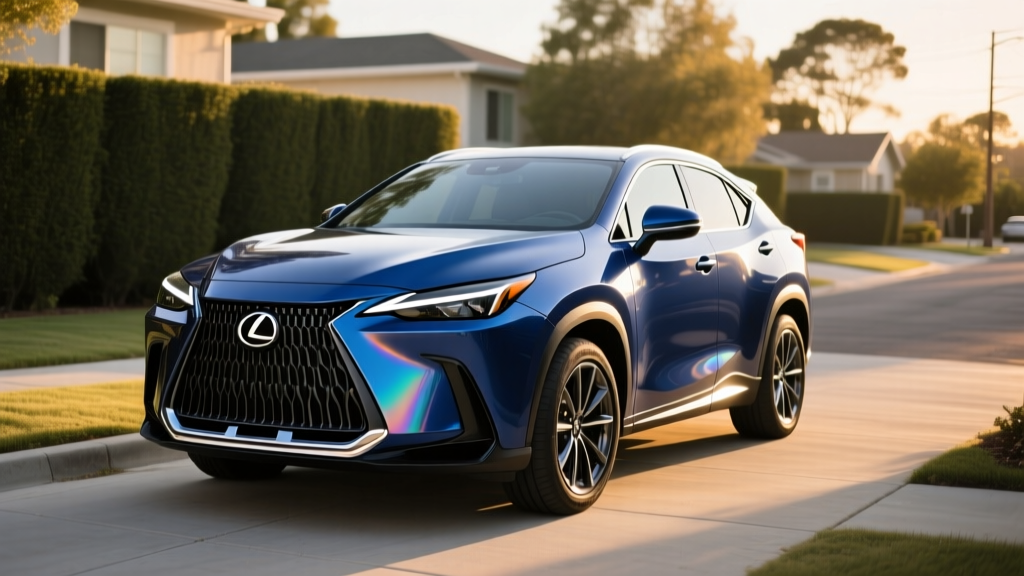
The Lexus NX has long been a luxury compact SUV benchmark for refinement and reliability, but the plug-in hybrid variant — badged the NX 450h+ — is where Toyota's premium brand makes its most compelling efficiency argument. For the 2026 model year, the Lexus NX PHEV pairs a 2.5-liter four-cylinder engine with a high-output plug-in hybrid system to deliver 37 miles of electric-only driving, 304 combined horsepower, and an EPA-estimated 36 MPG combined once the battery depletes. It's a vehicle engineered for buyers who want electric commuting without committing to a full battery-electric vehicle.
This guide breaks down everything that matters: real-world MPG versus the EPA sticker, charging logistics, battery longevity, federal tax credit eligibility under current IRS §30D rules, and whether the NX 450h+ makes more sense for your driveway than the conventional NX 350h hybrid or a full EV like the Tesla Model Y or BMW iX.
Lexus NX Hybrid Lineup: HEV vs PHEV Explained
Before diving into the plug-in, it helps to understand how Lexus positions its two electrified NX variants. The conventional hybrid — the NX 350h — uses Toyota's proven series-parallel hybrid system with a small battery that charges through regenerative braking and the engine. You never plug it in. The NX 450h+ PHEV adds a substantially larger battery pack, a more powerful electric drive system, and a charge port for grid charging.
HEV vs PHEV: What's the Difference?
| Feature | NX 350h (HEV) | NX 450h+ (PHEV) |
|---|---|---|
| Plug-in charging | No — self-charging | Yes — Level 1 & Level 2 |
| Battery size | ~1.6 kWh (small buffer) | 18.1 kWh (gross) |
| Electric-only range | ~1 mile at low speed | 37 miles (EPA) |
| Combined HP | 244 hp | 304 hp |
| EPA combined MPG | 39 MPG | 36 MPG (charge-sustaining) |
| EPA MPGe (electric) | N/A | 84 MPGe |
The PHEV trades a small amount of charge-sustaining MPG for 37 miles of zero-emission electric commuting and significantly more total power.
EPA MPG, MPGe, and Electric-Only Range
According to fueleconomy.gov, the 2026 Lexus NX 450h+ achieves:
| Metric | City | Highway | Combined |
|---|---|---|---|
| MPG (charge-sustaining, gas engine) | 38 | 34 | 36 |
| MPGe (charge-depleting, electric mode) | — | — | 84 |
| Electric-only range | 37 miles (EPA est.) | ||
Real-World Range vs. EPA Sticker
The EPA's 37-mile electric-only estimate assumes moderate temperatures, mixed driving, and a full charge. In real-world conditions:
- Warm-weather city commuting (65–80°F): Expect 34–38 miles electric. Regenerative braking in stop-and-go traffic helps stretch range.
- Highway driving (70+ mph): Electric range drops to roughly 28–32 miles due to higher aerodynamic drag and less regen opportunity.
- Cold weather (below 32°F): Plan for 22–28 miles. Battery chemistry loses efficiency in the cold, and cabin heating draws additional energy. The NX 450h+ does not include a dedicated heat pump for the cabin, which means resistive heating pulls from the traction battery.
Once the battery depletes, the gasoline engine engages seamlessly. Total combined range (electric + gas tank) exceeds 500 miles, eliminating any range anxiety on longer trips.
Real-World MPG: What Owners Report
Hybrids and PHEVs often exceed their EPA city estimates in real-world driving because regenerative braking recaptures energy that gas cars waste as heat. The NX 450h+ in charge-sustaining mode (after the battery is depleted) delivers consistent 34–40 MPG in mixed driving, with city-heavy routes pushing toward the higher end. If you charge nightly and your commute falls within the 37-mile electric envelope, your actual gasoline consumption could be negligible — some owners report visiting a gas station once every two months.
Powertrain and Performance Specs
| Specification | 2026 Lexus NX 450h+ AWD |
|---|---|
| Engine | 2.5L inline-4 Atkinson-cycle |
| Combined system horsepower | 304 hp |
| Front electric motor | Permanent magnet synchronous |
| Rear electric motor (eAWD) | Independent rear motor, 54 hp |
| 0–60 mph | 6.0 seconds |
| Drivetrain | Electronic AWD (eAWD) |
| Towing capacity | 2,000 lbs |
| Battery (gross / usable) | 18.1 kWh / ~14.5 kWh usable |
| Battery chemistry | Lithium-ion (NMC) |
| Cargo volume (rear seats up / down) | 22.7 / 46.9 cu ft |
| Curb weight | ~4,425 lbs |
The 304-hp combined output makes the NX 450h+ the quickest NX variant — quicker than the turbocharged NX 350 gas model. The eAWD system uses a dedicated rear electric motor rather than a mechanical driveshaft, providing instant torque to the rear wheels when traction demands it. It's not a performance SUV, but the powertrain delivers confident highway merging and smooth, silent electric acceleration from a stoplight.
Charging: How, How Long, and at What Cost
The NX 450h+ charges via a J1772 connector (the standard for non-Tesla plug-in vehicles in North America). Here's what you need to know about charging speeds and logistics:
| Charging Level | Power (kW) | 0–100% Time | Availability |
|---|---|---|---|
| Level 1 (120V household outlet) | ~1.4 kW | ~12 hours | Any standard outlet |
| Level 2 (240V home or public) | 3.3 kW (onboard charger limit) | ~4.5 hours | Home wallbox, workplace, public L2 |
| DC Fast Charge | Not supported — no DC fast charging capability | ||
A critical detail: the NX 450h+ has a 3.3 kW onboard charger, which is the bottleneck for Level 2 charging. Even if you plug into a 7.2 kW or 11.5 kW public Level 2 station, the vehicle will only accept 3.3 kW. This means a full charge takes roughly 4.5 hours regardless of the station's rated output.
For most PHEV owners, this isn't a dealbreaker. The 18.1 kWh battery is small enough that overnight Level 2 charging — or even Level 1 from a standard outlet — will fully replenish the battery by morning. The absence of DC fast charging means the NX 450h+ isn't designed for repeated mid-trip electric top-ups on road trips, but the gasoline engine handles long-distance driving without compromise.
Cost to Charge
At the U.S. average residential electricity rate of approximately $0.17/kWh (EIA, 2025 data), a full charge of the NX 450h+ costs roughly $2.50–$3.00 — enough for 37 miles of electric driving. That works out to approximately $0.07–$0.08 per mile on electricity, compared to roughly $0.14–$0.16 per mile on gasoline at $3.50/gallon and 36 MPG. The savings compound if you have access to workplace Level 2 charging or time-of-use electricity rates that drop below $0.10/kWh overnight.
Pricing, Trims, and Federal Tax Credit Eligibility
The 2026 Lexus NX 450h+ is offered in two trims:
| Trim | MSRP (incl. destination) |
|---|---|
| NX 450h+ Premium | ~$61,490 |
| NX 450h+ F SPORT Handling | ~$64,190 |
Federal Tax Credit: Does the NX 450h+ Qualify?
Under the IRS §30D Clean Vehicle Credit, the NX 450h+ is a plug-in hybrid and technically falls under the credit framework. However, eligibility is not guaranteed and depends on several factors that change periodically:
IRS §30D Tax Credit Checklist (2026 Rules)
- MSRP cap: SUVs must have an MSRP at or below $80,000. Both NX 450h+ trims clear this threshold. ✅
- Buyer income cap: Modified AGI must not exceed $150,000 (single), $225,000 (head of household), or $300,000 (married filing jointly).
- Battery component sourcing: A percentage of battery components must be manufactured or assembled in North America. This requirement tightens annually. Check the IRS qualified vehicles list for current-year NX 450h+ status.
- Critical minerals: A percentage of critical minerals must be sourced from the U.S. or free-trade-agreement countries. This threshold also escalates yearly.
- Point-of-sale transfer: If eligible, the credit can be transferred to the dealer at purchase, reducing the purchase price directly rather than waiting for a tax refund.
⚠️ Battery sourcing requirements have disqualified several PHEVs in prior years. Always verify the NX 450h+ on the IRS eligible vehicle list before purchase, and consult a tax professional for your specific situation.
Battery Warranty, Reliability, and Replacement Cost
Hybrid and PHEV battery longevity remains one of the top concerns for buyers transitioning from conventional vehicles. Lexus backs the NX 450h+ with industry-leading hybrid battery coverage:
Lexus Hybrid Battery Warranty
- Hybrid battery: 10 years / 150,000 miles (whichever comes first)
- Hybrid system components: 8 years / 100,000 miles
- Basic vehicle warranty: 4 years / 50,000 miles
- Powertrain warranty: 6 years / 70,000 miles
The 10-year/150,000-mile battery warranty applies in all 50 states and is among the longest in the luxury compact SUV segment.
Reliability Track Record
Toyota and Lexus have the deepest hybrid production experience of any automaker, with over 25 years of hybrid system manufacturing since the original Prius in 1997. The NX 450h+ shares its hybrid powertrain architecture with the Toyota RAV4 Prime, which has demonstrated strong reliability in fleet and consumer data. Lexus consistently ranks at or near the top in J.D. Power Vehicle Dependability Studies and Consumer Reports reliability surveys.
For NMC lithium-ion batteries in PHEV applications, degradation is typically modest because the battery management system (BMS) maintains a substantial buffer — the NX 450h+ uses approximately 14.5 kWh of its 18.1 kWh gross capacity, leaving roughly 20% as buffer to protect long-term health. Expect 8–12% capacity loss over 10 years under normal use, which would reduce electric-only range from 37 miles to approximately 33 miles — still highly usable.
Battery Replacement Cost
If the hybrid battery fails outside of warranty coverage, a replacement for the NX 450h+ is estimated at $8,000–$12,000 including parts and labor at a Lexus dealership. Independent hybrid specialists may offer refurbished packs for $5,000–$7,000. However, given the 10-year/150,000-mile warranty and Toyota/Lexus's track record of hybrid batteries lasting 15+ years, out-of-pocket replacement during typical ownership is uncommon.
Who Should Buy the Lexus NX PHEV?
Decision Framework
Choose the NX 450h+ PHEV if:
- Your daily commute is under 35 miles round-trip and you can charge at home or work
- You want electric commuting but frequently take road trips beyond EV charging infrastructure
- You value Lexus reliability, dealership support, and resale value
- You want more power (304 hp) than the conventional NX 350h offers
- You're not ready to commit to a full EV but want to reduce fuel consumption significantly
Choose the NX 350h (conventional HEV) if:
- You cannot install a home charger (apartment, street parking, no garage)
- You want the lowest purchase price and don't need plug-in electric range
- Your driving is mostly highway, where PHEV electric-range advantages diminish
Choose a full EV (e.g., Tesla Model Y, BMW iX, Genesis GV60) if:
- You have reliable home Level 2 charging
- You want zero tailpipe emissions and minimal maintenance (no oil changes, no engine)
- You want access to DC fast charging for road trips
- You're eligible for the full $7,500 federal tax credit on a qualifying EV
Pros
- 37 miles electric-only covers most commutes
- 304 hp with smooth, quiet electric acceleration
- 500+ mile total range eliminates range anxiety
- 10-year/150,000-mile hybrid battery warranty
- Excellent build quality and Lexus reliability
- eAWD standard, confident in rain and light snow
Cons
- 3.3 kW onboard charger limits Level 2 speed
- No DC fast charging capability
- $61,490+ starting price is steep for the segment
- Tax credit eligibility uncertain due to sourcing rules
- No heat pump — cold-weather electric range drops noticeably
- Infotainment learning curve vs. prior Lexus systems
Frequently Asked Questions
How many MPG does the Lexus NX PHEV get?
The 2026 Lexus NX 450h+ achieves an EPA-estimated 38 city / 34 highway / 36 combined MPG in charge-sustaining mode (after the battery is depleted). In electric mode, it achieves 84 MPGe combined. Real-world city driving often yields 38–40 MPG thanks to regenerative braking, while sustained highway driving at 75+ mph may return 32–34 MPG.
How far can the Lexus NX 450h+ go on electric only?
The EPA rates the NX 450h+ at 37 miles of electric-only range. In real-world conditions, expect 34–38 miles in warm city driving, 28–32 miles on the highway, and 22–28 miles in freezing temperatures. Total combined range (electric + gasoline) exceeds 500 miles.
Hybrid vs PHEV vs EV — which is right for me?
A conventional hybrid (HEV) like the NX 350h is best if you can't charge at home — it requires no plug and delivers consistent MPG improvement. A PHEV like the NX 450h+ is ideal if you can charge nightly and your commute fits within the electric range, giving you EV-like daily driving with a gas engine for longer trips. A full EV (BEV) makes sense if you have home charging, want zero emissions, minimal maintenance, and are comfortable planning road-trip charging stops. The PHEV is the bridge option — it removes range anxiety while still reducing daily fuel consumption to near zero.
Is the Lexus NX PHEV reliable, and what does battery replacement cost?
Lexus and Toyota have the longest hybrid production history in the industry, and the NX 450h+ benefits from that engineering maturity. The hybrid battery is covered by a 10-year/150,000-mile warranty. Out-of-warranty replacement is estimated at $8,000–$12,000 at a dealership, though Toyota/Lexus hybrid batteries routinely last 15+ years with gradual capacity loss rather than sudden failure. The RAV4 Prime, which shares this powertrain, has shown strong reliability in long-term fleet data.
Does the 2026 Lexus NX 450h+ qualify for a federal tax credit?
The NX 450h+ may qualify for up to $7,500 under the IRS §30D Clean Vehicle Credit, but eligibility depends on battery component sourcing, critical minerals requirements, buyer income limits, and the $80,000 SUV MSRP cap. Both NX 450h+ trims fall below the MSRP cap. However, sourcing requirements tighten annually and have disqualified some PHEVs in prior years. Check the IRS qualified clean vehicles list before purchasing, and consult a tax professional to confirm your personal eligibility. If eligible, the credit can be transferred to the dealer at the point of sale.
Can I charge the NX 450h+ at a Tesla Supercharger?
No. The NX 450h+ uses a J1772 connector for Level 1 and Level 2 AC charging and does not support DC fast charging of any kind — including Tesla's NACS, CCS, or CHAdeMO connectors. You can charge at any J1772-compatible Level 2 station (ChargePoint, EVgo L2, Blink, workplace chargers) or a standard 120V household outlet.
How long does it take to charge the NX 450h+ at home?
On a standard 120V outlet (Level 1, ~1.4 kW), a full charge takes approximately 12 hours. On a 240V Level 2 home charger, the 3.3 kW onboard charger limits intake to about 4.5 hours for a full 0–100% charge. Most owners plug in overnight and wake up to a full battery every morning, making charging time largely irrelevant for daily use.