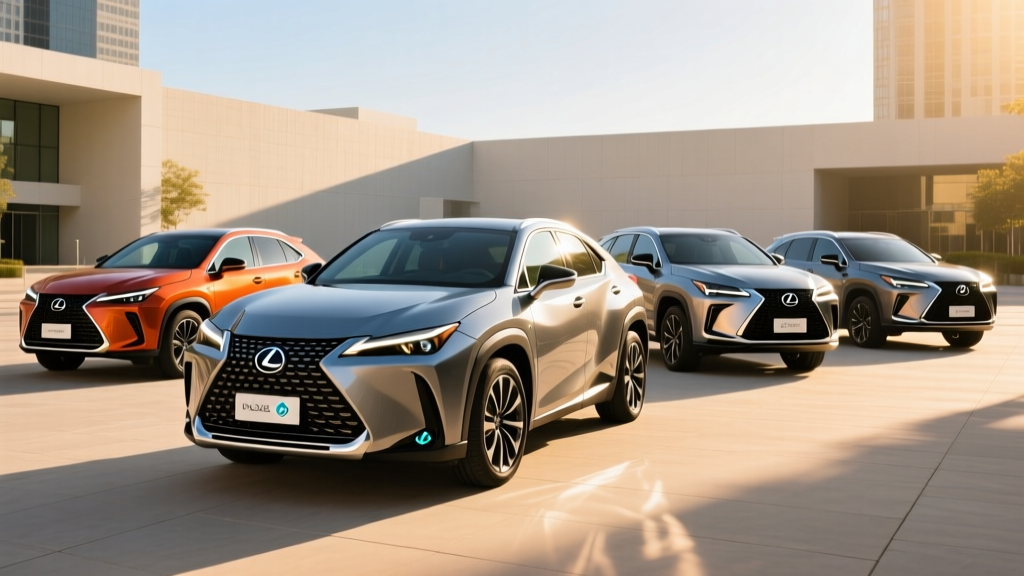
Lexus has gone all-in on hybrid powertrains for 2026. Every core SUV in the lineup now offers either a conventional hybrid (HEV) or a plug-in hybrid (PHEV) variant — and in some cases, both. For buyers who want Toyota-group reliability with premium refinement but aren't ready to commit to a full battery-electric vehicle, the 2026 Lexus hybrid range is the most comprehensive in the luxury segment.
This guide breaks down every 2026 Lexus hybrid and PHEV model — the compact UX 350h, the mid-size NX 350h and NX 450h+, the popular RX 350h and RX 450h+, and the three-row TX 500h — with exact EPA fuel economy, electric-only range, powertrain specs, pricing, and real-world ownership considerations.
HEV vs PHEV: Which Lexus Hybrid Type Fits You?
Before diving into specific models, it's essential to understand the two hybrid architectures Lexus uses. Conflating them is the single most common mistake hybrid shoppers make.
| Feature | Conventional Hybrid (HEV) | Plug-In Hybrid (PHEV) |
|---|---|---|
| Charging Required? | No — self-charges via engine & regen | Yes — plug in to access full electric range |
| Battery Size | ~1.0–2.0 kWh (small buffer) | ~18.1 kWh (NX 450h+) |
| Electric-Only Driving | Brief, low-speed EV mode (<1 mi) | 30–37 mi EPA electric-only |
| Fuel Economy | High MPG combined (35–43 MPG) | High MPGe on electric + good MPG on gas |
| Federal Tax Credit | Not eligible for §30D credit | May qualify (sourcing & income rules apply) |
| Complexity | Lower — no charger needed | Higher — benefits most with home charging |
| Best For | Apartment dwellers, high-mileage commuters | Homeowners with Level 2 charging, short commutes |
The rule of thumb: if you can charge at home and your daily round-trip commute is under 35 miles, a Lexus PHEV lets you drive on electricity most days while retaining gas-engine range for road trips. If you lack reliable charging access or drive long distances daily, the HEV models deliver outstanding efficiency with zero behavior change.
2026 Lexus UX 350h: The Entry-Level Hybrid
The UX 350h remains the most affordable Lexus hybrid and one of the most fuel-efficient luxury crossovers on the market. Built on the TNGA-C platform shared with the Toyota Corolla Cross, it pairs a 2.0-liter four-cylinder engine with two electric motors for standard all-wheel drive.
| Spec | UX 350h |
|---|---|
| Powertrain | 2.0L I4 + 2 electric motors (AWD) |
| Combined Horsepower | 181 hp |
| EPA City / Highway / Combined | 43 / 41 / 42 MPG |
| Fuel Tank | 10.6 gal |
| Total Range | ~445 mi |
| 0–60 mph | ~7.0 sec |
| Starting MSRP | $39,340 |
| Tax Credit Eligibility | Not eligible (HEV) |
Real-world fuel economy for the UX 350h tends to match or slightly exceed the EPA combined figure in city-heavy driving, where regenerative braking recovers the most energy. On sustained highway trips at 75+ mph, expect closer to 37–39 MPG — still excellent for a luxury AWD crossover. Over a 12,000-mile year at $3.50/gallon, the UX 350h uses roughly $1,000 in fuel compared to $1,680 for a comparable 25 MPG gas vehicle.
2026 Lexus NX 350h and NX 450h+: Mid-Size Versatility
The NX lineup offers both HEV and PHEV options, giving buyers maximum flexibility. The NX 350h is the volume seller; the NX 450h+ is the plug-in variant for buyers with home charging.
NX 350h (Conventional Hybrid)
| Spec | NX 350h |
|---|---|
| Powertrain | 2.5L I4 + 2 electric motors (AWD) |
| Combined Horsepower | 244 hp |
| EPA City / Highway / Combined | 41 / 37 / 39 MPG |
| Total Range | ~560 mi |
| 0–60 mph | ~6.8 sec |
| Starting MSRP | $44,190 |
| Tax Credit Eligibility | Not eligible (HEV) |
NX 450h+ (Plug-In Hybrid)
| Spec | NX 450h+ |
|---|---|
| Powertrain | 2.5L I4 + 2 electric motors (AWD) |
| Combined Horsepower | 304 hp |
| Battery | 18.1 kWh lithium-ion |
| EPA Electric-Only Range | 37 mi |
| EPA Combined (gas, after EV range) | 36 MPG |
| Combined MPGe (electric + gas) | 84 MPGe |
| Total Range (EV + gas) | ~490 mi |
| Level 2 Charge Time (0–100%) | ~3.0 hours at 6.6 kW |
| DC Fast Charging | Not available |
| 0–60 mph | ~6.0 sec |
| Starting MSRP | $60,490 |
| Tax Credit Eligibility | See §30D section below |
The NX 450h+ is the efficiency champion if your routine involves plugging in nightly. A 37-mile electric range covers most daily commutes without the engine ever starting. Once the battery depletes, it operates as a conventional hybrid at 36 MPG combined — no range anxiety, no behavior change required for longer trips. The trade-off is a roughly $16,300 price premium over the NX 350h, which takes years of fuel savings to recoup unless your electricity is cheap and your commute is short.
Important charging note: the NX 450h+ uses a J1772 connector for Level 2 AC charging at 6.6 kW. It does not support DC fast charging — a common limitation among PHEVs due to their smaller battery packs. For daily use, a home Level 2 charger fully replenishes the battery overnight in about three hours.
2026 Lexus RX 350h and RX 450h+: The Bestseller, Electrified
The RX is Lexus's highest-volume model, and the hybrid variants account for a growing share of sales. Both the RX 350h and RX 450h+ use the TNGA-K platform with a 2.5-liter four-cylinder hybrid system.
| Spec | RX 350h | RX 450h+ |
|---|---|---|
| Type | HEV | PHEV |
| Combined Horsepower | 250 hp | 304 hp |
| Battery | ~1.6 kWh NiMH | 18.1 kWh lithium-ion |
| EPA City / Hwy / Combined | 37 / 34 / 36 MPG | 35 MPG (gas) / 83 MPGe |
| Electric-Only Range | N/A | 37 mi EPA |
| Level 2 Charge Time | N/A | ~3.0 hours at 6.6 kW |
| DC Fast Charging | N/A | Not available |
| 0–60 mph | ~7.2 sec | ~6.2 sec |
| Starting MSRP | $52,310 | $65,450 |
In real-world testing, the RX 350h consistently delivers 34–38 MPG in mixed driving, with city-heavy routes pushing toward the upper end thanks to aggressive regenerative braking. Highway-only driving at 70+ mph settles around 32–34 MPG. The RX 450h+, when charged daily, can operate for weeks without visiting a gas station if commutes stay within its 37-mile electric envelope.
For a detailed EPA breakdown, see the official fueleconomy.gov database.
2026 Lexus TX 500h: Three-Row Hybrid Power
The TX is Lexus's dedicated three-row SUV, and the TX 500h hybrid uses a more powerful turbocharged hybrid system to handle the extra mass.
| Spec | TX 500h |
|---|---|
| Powertrain | 2.4L turbo I4 + electric motors (AWD) |
| Combined Horsepower | 371 hp / 406 lb-ft torque |
| EPA City / Highway / Combined | 27 / 28 / 27 MPG |
| 0–60 mph | ~5.7 sec |
| Towing Capacity | 5,000 lbs |
| Starting MSRP | $66,210 |
| Tax Credit Eligibility | Not eligible (HEV) |
Twenty-seven MPG combined in a 5,000-pound, three-row luxury SUV is genuinely impressive. A gas-only competitor like the BMW X5 xDrive40i returns roughly 24 MPG combined, while the TX 500h also offers more torque and standard AWD. Real-world fuel economy in suburban driving often reaches 28–29 MPG; sustained highway towing will drop it to the low 20s.
Full 2026 Lexus Hybrid MPG Comparison
| Model | Type | City MPG | Highway MPG | Combined MPG/MPGe | EV Range | Starting MSRP |
|---|---|---|---|---|---|---|
| UX 350h | HEV | 43 | 41 | 42 MPG | — | $39,340 |
| NX 350h | HEV | 41 | 37 | 39 MPG | — | $44,190 |
| NX 450h+ | PHEV | — | — | 84 MPGe / 36 MPG gas | 37 mi | $60,490 |
| RX 350h | HEV | 37 | 34 | 36 MPG | — | $52,310 |
| RX 450h+ | PHEV | — | — | 83 MPGe / 35 MPG gas | 37 mi | $65,450 |
| TX 500h | HEV | 27 | 28 | 27 MPG | — | $66,210 |
Battery Warranty, Reliability, and Replacement Costs
Lexus Hybrid Battery Warranty: All 2026 Lexus hybrid and PHEV models carry a 10-year / 150,000-mile hybrid battery warranty (whichever comes first), covering defects and capacity loss below a specified threshold. This applies to both the traction battery in HEVs and the larger lithium-ion pack in PHEVs. The standard new-vehicle warranty is 4 years / 50,000 miles, with a 6-year / 70,000-mile powertrain warranty.
Lexus hybrid reliability is among the strongest in the industry, largely because the Toyota Hybrid System (THS) architecture has been in continuous production since 1997. The planetary gear-set power-split device has no traditional transmission clutches or belts to wear out. Independent reliability data from Consumer Reports and J.D. Power consistently ranks Lexus at or near the top for long-term dependability.
Battery replacement cost: If a hybrid battery fails outside warranty, replacement costs vary significantly by model:
- HEV models (UX, NX, RX 350h, TX 500h): $3,000–$5,500 for the battery pack, plus ~$500–$1,000 labor
- PHEV models (NX 450h+, RX 450h+): $8,000–$12,000 for the larger 18.1 kWh lithium-ion pack
However, real-world failure rates for Lexus hybrid batteries are low. Many Toyota/Lexus hybrid packs from the 2004–2010 era have exceeded 200,000 miles without replacement. The 10-year/150,000-mile warranty provides substantial coverage for the vast majority of ownership timelines.
Federal Tax Credit Eligibility for 2026 Lexus PHEVs
Only the plug-in hybrid models — the NX 450h+ and RX 450h+ — are potentially eligible for the federal §30D Clean Vehicle Credit. Conventional hybrids (UX 350h, NX 350h, RX 350h, TX 500h) do not qualify for any federal purchase incentive.
- Credit amount: Up to $7,500, split into $3,750 for critical-minerals sourcing and $3,750 for battery-component sourcing (per IRS §30D rules)
- Buyer income caps: $150,000 single / $225,000 head of household / $300,000 joint filers (modified AGI)
- MSRP caps: $80,000 for SUVs (both NX 450h+ and RX 450h+ qualify as SUVs)
- Battery sourcing: Critical minerals and battery components must meet escalating domestic/free-trade-partner thresholds that tighten annually through 2030
- Point-of-sale transfer: Eligible buyers can transfer the credit to the dealer for an upfront price reduction at purchase
- Assembly requirement: Vehicle must undergo final assembly in North America — Lexus NX and RX PHEVs are assembled in Japan, which may disqualify them from the credit depending on current-year rules
Critical caveat: Lexus PHEVs are manufactured in Japan. Under §30D's North American final-assembly requirement, the NX 450h+ and RX 450h+ may not qualify for the federal credit. Always verify a specific VIN on the fueleconomy.gov tax credit tool before purchasing. Tax rules are subject to change — consult a tax professional for your specific situation.
Hybrid vs PHEV vs Full EV: Which Is Right for You?
Choose a Lexus HEV (UX 350h, NX 350h, RX 350h, TX 500h) if:
- You live in an apartment or lack reliable home charging access
- You drive 40+ miles daily and don't want to manage charging
- You want maximum simplicity — no plugs, no apps, no charging networks
- Budget is a priority (HEVs are $15,000–$20,000 less than PHEV variants)
Choose a Lexus PHEV (NX 450h+, RX 450h+) if:
- You have Level 2 home charging (or can install it)
- Your daily commute is under 35 miles round-trip
- You want EV-like daily driving with gas-engine flexibility for road trips
- You value the 304 hp performance boost the PHEV powertrain provides
Choose a full EV (e.g., Lexus RZ 450e) if:
- You have reliable home and/or workplace charging
- You want zero tailpipe emissions and minimal maintenance (no oil changes, no engine)
- Your daily driving is under 220 miles and you're comfortable planning DC fast-charge stops for road trips
- You want to maximize fuel-cost savings (electricity at ~$0.13/kWh ≈ $1.20/gallon equivalent)
Pros and Cons of the 2026 Lexus Hybrid Lineup
Pros
- Class-leading reliability track record with 10-yr/150,000-mi battery warranty
- UX 350h achieves 42 MPG combined — among the most efficient luxury vehicles sold
- PHEV models offer 37 mi electric range without sacrificing gas flexibility
- No range anxiety in any configuration — HEVs never need plugging in
- Strong resale value; Lexus hybrids depreciate slower than most luxury competitors
- Standard AWD on all hybrid variants
Cons
- PHEV models (NX 450h+, RX 450h+) carry a steep $16,000+ premium over HEV equivalents
- No DC fast charging on PHEV models — Level 2 only
- TX 500h returns only 27 MPG combined (impressive for its size, but still the thirstiest Lexus hybrid)
- PHEVs assembled in Japan may not qualify for the $7,500 federal tax credit
- Infotainment system, while improved, still trails BMW iDrive and Mercedes MBUX in responsiveness
- HEV models lack the instant-torque acceleration feel of full EVs
Frequently Asked Questions
How many MPG does the 2026 Lexus UX 350h get?
The UX 350h achieves an EPA-estimated 43 city / 41 highway / 42 combined MPG. Real-world city driving often matches or slightly exceeds 42 MPG thanks to frequent regenerative braking. Highway-only driving at sustained high speeds may return 37–39 MPG.
How far can the Lexus NX 450h+ go on electric only?
The NX 450h+ has an EPA-rated 37 miles of electric-only range. In mild weather at city speeds, some drivers report 38–40 miles before the engine engages. In cold weather (below 32°F) or at highway speeds, expect 28–33 miles of usable electric range due to battery efficiency loss and cabin heating demands.
Is the 2026 Lexus RX 350h reliable?
Lexus consistently ranks at or near the top of J.D. Power and Consumer Reports reliability surveys. The hybrid powertrain in the RX 350h uses Toyota's proven power-split architecture with no conventional transmission, reducing mechanical wear points. The hybrid battery carries a 10-year/150,000-mile warranty.
What does it cost to replace a Lexus hybrid battery?
For conventional hybrid models (UX, NX, RX 350h, TX 500h), battery replacement runs $3,000–$5,500 plus labor. For PHEV models (NX 450h+, RX 450h+), the larger 18.1 kWh pack costs $8,000–$12,000. However, Lexus hybrid batteries rarely fail within the 10-year/150,000-mile warranty period based on historical data.
Does any 2026 Lexus hybrid qualify for a tax credit?
Only PHEV models (NX 450h+, RX 450h+) are potentially eligible for the federal §30D credit of up to $7,500. However, because these vehicles are assembled in Japan, they may not meet the North American final-assembly requirement. Always verify eligibility by VIN at fueleconomy.gov. Conventional Lexus hybrids do not qualify for any federal purchase credit.
Do Lexus hybrids need to be plugged in?
No — conventional Lexus hybrids (HEV) charge their own batteries through the gasoline engine and regenerative braking. You never plug them in. Only the PHEV models (NX 450h+, RX 450h+) benefit from being plugged in to access their full electric-only range. If you never plug in a PHEV, it still functions as a conventional hybrid — you just miss out on the electric driving benefits.
How does the TX 500h compare to a gas-only three-row SUV?
The TX 500h delivers 27 MPG combined with 371 hp and 5,000-lb towing capacity. A comparable gas-only three-row luxury SUV typically returns 20–23 MPG combined. Over 15,000 miles per year at $3.50/gallon, the TX 500h saves approximately $700–$900 annually in fuel costs versus a 22 MPG competitor.