Quick Verdict: A Practical Hybrid for Daily Drivers
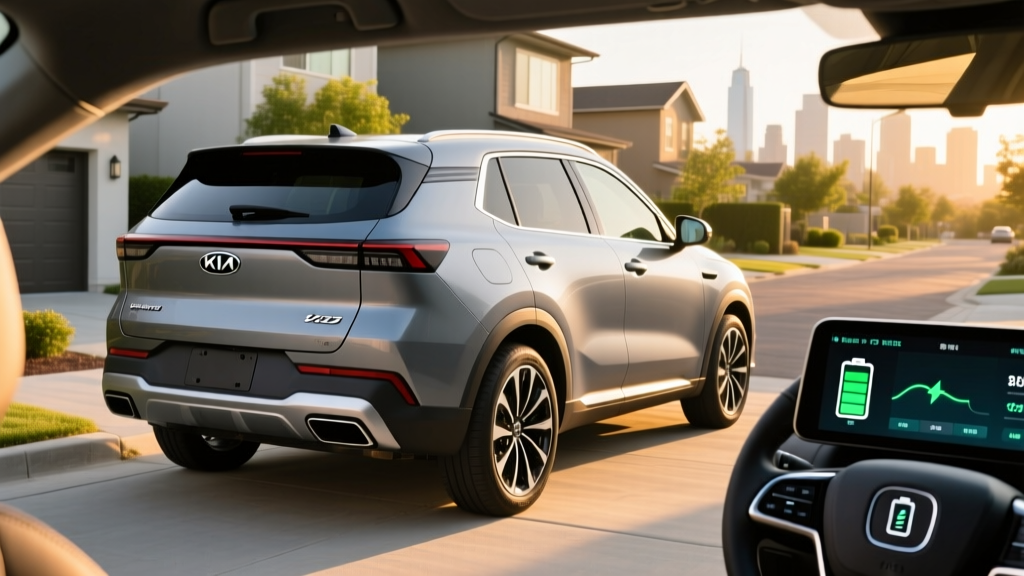
The 2026 Kia Sportage Hybrid SUV lands in the sweet spot for buyers who want electrified efficiency without plugging in. With an EPA-estimated 43 MPG combined (42 city / 44 highway) for front-wheel-drive trims and standard all-wheel drive on most configurations, it delivers compact-SUV practicality with midsize-sedan fuel economy. The available PHEV variant pushes further with 34 miles of electric-only range. For drivers who can't install a home charger or who regularly take long road trips, the Sportage Hybrid eliminates range anxiety entirely while still cutting fuel costs significantly versus a gas-only competitor.
HEV vs. PHEV: Which Sportage Hybrid Is Right for You?
Conventional Hybrid (HEV): The standard Sportage Hybrid pairs a 1.6-liter turbocharged four-cylinder with an electric motor and a small battery (roughly 1.5 kWh). You never plug it in — regenerative braking and the engine keep the battery charged. It operates seamlessly, delivering 226 combined horsepower and up to 43 MPG combined. This is the right pick if you lack reliable access to a charging outlet and want maximum simplicity.
Plug-In Hybrid (PHEV): The Sportage PHEV uses the same 1.6L turbo engine but pairs it with a larger 13.8 kWh battery pack and a more powerful electric motor, producing 261 combined horsepower. It delivers an EPA-estimated 34 miles of electric-only range — enough for most daily commutes without using a drop of gasoline. Once the battery depletes, it functions as a conventional hybrid with an EPA rating of 35 MPG combined. The trade-off: a higher starting price and the need for regular plug-in access to capture the full benefit.
Fuel Economy: EPA Ratings and Real-World MPG
| Powertrain | Drivetrain | EPA City | EPA Highway | EPA Combined | Real-World Expectation |
|---|---|---|---|---|---|
| HEV (Hybrid) | FWD | 42 MPG | 44 MPG | 43 MPG | 40–46 MPG (city-biased driving favors hybrids) |
| HEV (Hybrid) | AWD | 38 MPG | 38 MPG | 38 MPG | 35–40 MPG |
| PHEV (Plug-In) | AWD | 36 MPG* | 35 MPG* | 35 MPG* / 84 MPGe† | 33–38 MPG (hybrid mode); 30–34 mi EV range |
*Hybrid mode after battery depletion. †MPGe measures efficiency during electric-only operation. Source: fueleconomy.gov.
Hybrids typically outperform their EPA highway ratings in city driving because regenerative braking recovers energy at every stop. In real-world testing, drivers who do predominantly urban commuting often see 44–47 MPG from the FWD HEV. Highway-heavy driving at 75+ MPH drops efficiency to roughly 37–39 MPG for AWD models. Cold weather (below 30°F) reduces fuel economy by approximately 5–10% due to increased engine warm-up time and cabin heating demands — a smaller penalty than the 20–30% range loss a full EV experiences in the same conditions.
Powertrain Specs: What's Under the Hood
| Specification | Sportage HEV | Sportage PHEV |
|---|---|---|
| Engine | 1.6L Turbo I-4 | 1.6L Turbo I-4 |
| Electric Motor | 44 kW (59 hp) | 66 kW (88 hp) |
| Combined Output | 226 hp / 258 lb-ft | 261 hp / 258 lb-ft |
| Transmission | 6-speed automatic | 6-speed automatic |
| Battery Capacity | ~1.5 kWh (self-charging) | 13.8 kWh (lithium-ion) |
| EV-Only Range | N/A | 34 miles (EPA) |
| Total Range | ~520 miles | ~430 miles (EV + gas combined) |
| 0–60 MPH | ~7.4 sec | ~6.7 sec |
| Towing Capacity | 2,000 lbs | 2,000 lbs |
The PHEV's 261-hp output gives it noticeably stronger acceleration, particularly in EV mode where instant electric torque makes city driving feel brisk. Both models use a conventional 6-speed automatic rather than a CVT, which means more natural-feeling acceleration without the "rubber band" effect some hybrids exhibit.
PHEV Charging: Times, Connectors, and Daily Practicality
The Sportage PHEV's 13.8 kWh battery can be replenished in two ways:
- Level 1 (120V household outlet): Approximately 11–12 hours from empty to full. Plugging in overnight at a standard outlet is sufficient for most daily commutes if you have garage or driveway access.
- Level 2 (240V home charger or public station): Approximately 3.5 hours from empty to full using a 7.2 kW onboard charger. This is the recommended setup for PHEV owners who want flexibility for midday top-ups.
No DC fast charging: Like most PHEVs, the Sportage PHEV does not support DC fast charging. The battery is too small to benefit from 50+ kW charge rates, and the added hardware would increase cost and weight. For a 34-mile EV range, Level 2 charging is entirely adequate.
The PHEV uses a standard J1772 connector for Level 1 and Level 2 charging, compatible with virtually every public charging network (ChargePoint, EVgo, Electrify America Level 2 stations) and all home charging equipment.
Pricing, Trims, and Tax Credit Eligibility
| Trim | Powertrain | Drivetrain | MSRP (2026) |
|---|---|---|---|
| LX | HEV | FWD | $30,090 |
| EX | HEV | AWD | $33,590 |
| SX-Prestige | HEV | AWD | $37,490 |
| X-Line | PHEV | AWD | $40,590 |
| X-Line Prestige | PHEV | AWD | $44,190 |
Destination charge (~$1,390) additional. Pricing per Kia's official site; confirm with your dealer for current incentives.
Federal Tax Credit: PHEV Eligibility
The Sportage PHEV may qualify for up to $3,750 under the IRS §30D Clean Vehicle Credit, depending on battery component and critical-mineral sourcing requirements that change annually. The conventional HEV does not qualify for the federal EV tax credit (it is reserved for plug-in vehicles with battery capacity ≥7 kWh).
Key §30D rules for 2026:
- Buyer income caps apply: $150,000 single / $300,000 joint MAGI
- MSRP cap: $80,000 for SUVs (both PHEV trims clear this easily)
- Battery sourcing and critical-mineral requirements must be met — the credit may be $3,750 or $7,500 depending on compliance
- Point-of-sale transfer is available, letting you apply the credit as a down payment reduction at the dealer
Consult IRS.gov §30D guidance and a tax professional to confirm your eligibility before purchasing.
Battery Warranty, Reliability, and Replacement Cost
Kia backs both the HEV and PHEV hybrid battery packs with a 10-year / 100,000-mile warranty (15 years / 150,000 miles in California-emission states including CA, CT, ME, MD, MA, NJ, NY, OR, RI, VT, and WA). This covers defects and capacity loss below a defined threshold (typically 70% state-of-health).
Reliability outlook: Kia's 1.6L turbo hybrid powertrain has been in production since the 2023 model year across the Sportage, Tucson, and Sorento lineups. Hybrid systems from Korean automakers have demonstrated strong durability in fleet data, with most battery packs lasting well beyond 150,000 miles before significant degradation. Unlike full EVs, the hybrid battery is relatively small, which limits thermal stress during operation.
Battery replacement cost: If the hybrid battery fails outside warranty, expect a replacement cost of approximately $2,000–$3,500 for the HEV pack and $5,000–$7,500 for the PHEV pack (parts + labor). These figures are estimates based on current Kia hybrid service pricing; actual costs vary by dealer and region. Given the 10-year warranty and typical ownership cycles, most original owners will never face this expense.
Sportage Hybrid vs. Full EV vs. Gas: Which Fits Your Life?
Choose the Sportage HEV (conventional hybrid) if:
- You lack reliable access to a charging outlet (apartment, street parking)
- You frequently drive 400+ miles between fill-ups and don't want to plan charging stops
- You want 40+ MPG with zero behavior change from your current gas car
- Your budget is under $38,000
Choose the Sportage PHEV if:
- You can charge at home (Level 1 or Level 2) and your daily commute is under 35 miles round-trip
- You want EV-like silence and zero gas use on weekdays, but need gas-engine range for weekend road trips
- You value the 261-hp powertrain upgrade and qualify for the §30D tax credit
Choose a full BEV (like the Kia EV6 or Hyundai Ioniq 5) if:
- You have reliable home Level 2 charging
- Your daily driving is under 250 miles and you're comfortable with DC fast charging on road trips
- You want to eliminate all gasoline costs and maintenance (no oil changes, no spark plugs)
- You qualify for the full $7,500 federal tax credit, narrowing the price gap
Pros and Cons
✅ Pros
- Class-leading 43 MPG combined (FWD HEV)
- Spacious interior with 39.6 cu ft cargo volume behind rear seats
- 10-year / 100,000-mile hybrid battery warranty
- PHEV offers 34 miles EV range for gas-free commuting
- Standard safety suite (forward collision avoidance, lane keeping, blind-spot monitoring)
- AWD available across most trims
❌ Cons
- AWD drops HEV fuel economy to 38 MPG combined
- PHEV carries a ~$7,000 premium over equivalent HEV trim
- No DC fast charging on PHEV (limits public-charging convenience)
- Turbo engine requires premium fuel for maximum performance (regular is acceptable with slight power reduction)
- Federal tax credit for PHEV may be only $3,750 depending on sourcing compliance
Frequently Asked Questions
How many MPG does the 2026 Kia Sportage Hybrid get?
The FWD Sportage HEV is EPA-rated at 42 city / 44 highway / 43 combined MPG. The AWD HEV drops to 38 MPG combined. The PHEV achieves 84 MPGe in electric mode and 35 MPG combined once the battery is depleted.
How far can the Sportage PHEV go on electric only?
The EPA rates the Sportage PHEV at 34 miles of electric-only range. In real-world conditions with mild temperatures and moderate speeds, expect 30–34 miles. Cold weather (below freezing) and aggressive acceleration can reduce this to 25–28 miles.
Is the Sportage Hybrid reliable, and what does a battery replacement cost?
Kia's hybrid system has proven reliable since its 2023 introduction, and the 10-year/100,000-mile battery warranty provides strong protection. Out-of-warranty battery replacement runs $2,000–$3,500 for the HEV and $5,000–$7,500 for the PHEV, though most owners will never need this service.
Does the 2026 Sportage Hybrid qualify for a tax credit?
The conventional HEV does not qualify for the federal §30D credit (it's not a plug-in vehicle). The PHEV may qualify for up to $3,750–$7,500 depending on battery sourcing compliance, your income, and the vehicle MSRP — all of which must be verified against current IRS rules. Some states offer additional hybrid or PHEV rebates; check your state's energy office for details.
Do I need to plug in the Sportage HEV?
No. The conventional hybrid (HEV) charges its own battery through regenerative braking and the gasoline engine. You simply fill up at a gas station as you would with any other car. Only the PHEV variant benefits from being plugged in.
Hybrid vs. PHEV vs. EV — which should I buy?
If you can charge at home and commute under 35 miles daily, the PHEV gives you the best of both worlds: electric weekdays, gas-engine freedom on weekends. If you can't charge at home, the HEV delivers excellent MPG with zero lifestyle change. If you have home charging, drive under 250 miles daily, and want to eliminate gasoline entirely, a full BEV like the Kia EV6 offers lower running costs and qualifies for a larger federal tax credit.