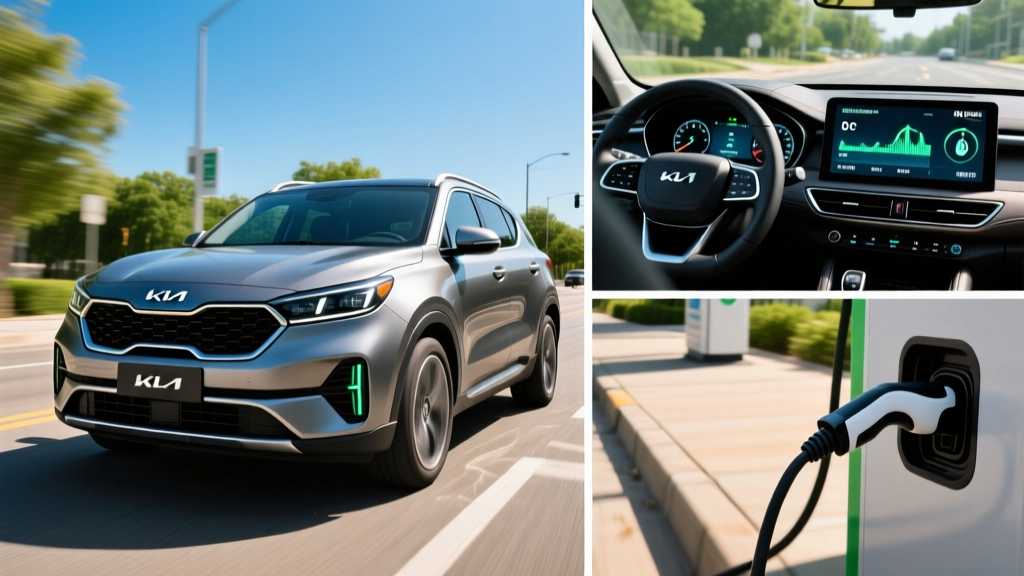
Quick Verdict: The Sportage Hybrid Balances Punch and Efficiency
The 2026 Kia Sportage Hybrid occupies a pragmatic middle ground in the compact crossover segment. It delivers the instant torque response that electric motors provide without the range anxiety or charging infrastructure dependence of a full battery-electric vehicle. With a combined output of 227 horsepower from its turbocharged engine and electric motor pairing, the Sportage HEV posts a 0-60 mph time of approximately 7.1 seconds — quick enough for confident highway merging, though not class-leading. The plug-in hybrid (PHEV) variant shaves that to roughly 6.7 seconds thanks to a more powerful electric motor and 13.7 kWh battery.
This guide breaks down every critical number — from EPA MPG to battery warranty terms — so you can decide whether the Sportage Hybrid, the Sportage PHEV, or a full EV better fits your driving pattern.
HEV vs PHEV: Which Sportage Hybrid Is Right for You?
Kia offers the Sportage in two distinct electrified flavors for 2026, and confusing them is the single most common mistake buyers make at the dealership. Here is the fundamental difference:
| Feature | Sportage Hybrid (HEV) | Sportage Plug-In Hybrid (PHEV) |
|---|---|---|
| Plug-in charging required? | No — charges via regenerative braking and engine | Yes — plug in to access electric-only range |
| Battery capacity | 1.49 kWh (small buffer) | 13.7 kWh (usable ~11.5 kWh) |
| Electric-only range | N/A (motor assists only at low speeds) | EPA-estimated 34 miles |
| Combined horsepower | 227 hp | 261 hp |
| 0-60 mph | ~7.1 seconds | ~6.7 seconds |
| Starting MSRP | $32,090 (LX AWD) | $40,590 (X-Line) |
| Federal tax credit (§30D) | Not eligible | Up to $7,500 (subject to sourcing/income rules) |
The bottom line: If you cannot charge at home or at work, the conventional HEV is the correct choice — it requires zero behavior change and still delivers excellent fuel economy. If you have Level 2 charging access and most of your daily driving falls under 34 miles, the PHEV can operate as an EV for the vast majority of your commutes while retaining a gas engine for longer trips.
Fuel Economy: EPA MPG and Real-World Results
Fuel economy is where the Sportage Hybrid justifies its existence. Here are the official EPA estimates from fueleconomy.gov for the 2026 model year:
| Powertrain | City MPG | Highway MPG | Combined MPG |
|---|---|---|---|
| Sportage Hybrid AWD | 38 | 38 | 38 |
| Sportage Hybrid FWD | 42 | 44 | 43 |
| Sportage PHEV AWD (gas mode) | 35 | 34 | 35 |
| Sportage PHEV AWD (MPGe, EV+gas) | 84 MPGe combined | ||
Real-World MPG vs. EPA Sticker
Hybrids typically exceed their EPA city estimates in real-world stop-and-go traffic because regenerative braking recovers energy that a gas-only vehicle wastes as heat. In mixed suburban driving with frequent stops, owners regularly report 40-44 MPG in the FWD HEV — slightly above the EPA city rating.
Highway driving tells a different story. At sustained 75+ mph speeds, the electric motor contributes less and the 1.6-liter turbocharged engine does most of the work. Expect highway fuel economy to dip to 33-35 MPG for the AWD HEV in real-world conditions — a few MPG below the EPA highway figure. Cold weather (below 40°F) further reduces efficiency by 8-12% because the engine runs more frequently to generate cabin heat.
For PHEV owners who charge regularly and keep most trips under 34 miles, gasoline consumption drops dramatically. It is realistic to use only 5-8 gallons per month if your commute is short and you charge nightly.
2026 Kia Sportage Hybrid 0-60 and Powertrain Specs
The search for the 2026 Kia Sportage Hybrid 0-60 time usually comes from buyers comparing it against turbocharged gas crossovers. Here is how the powertrain breaks down:
| Specification | HEV | PHEV |
|---|---|---|
| Engine | 1.6L Turbo GDI 4-cyl | 1.6L Turbo GDI 4-cyl |
| Engine output | 178 hp / 195 lb-ft | 178 hp / 195 lb-ft |
| Electric motor output | 47 kW (62 hp) / 195 lb-ft | 72 kW (97 hp) / 224 lb-ft |
| Combined system output | 227 hp / 258 lb-ft | 261 hp / 258 lb-ft |
| Transmission | 6-speed automatic | 6-speed automatic |
| 0-60 mph | ~7.1 sec | ~6.7 sec |
| Drivetrain | FWD or AWD | AWD standard |
| Towing capacity | 2,000 lbs | 2,000 lbs |
| Cargo volume (rear seats up) | 39.6 cu ft | 34.5 cu ft (battery intrusion) |
The 7.1-second 0-60 time in the HEV puts it on par with the Honda CR-V Hybrid and slightly behind the Toyota RAV4 Hybrid (~7.4 sec). The PHEV's 6.7-second run gives it a meaningful advantage in passing situations and on-ramp acceleration. Both variants benefit from the electric motor's instant torque delivery at low RPM, which makes the Sportage feel quicker off the line than the 0-60 number alone suggests.
PHEV Electric-Only Range and Charging
The Sportage PHEV carries a 13.7 kWh battery (approximately 11.5 kWh usable) that delivers an EPA-estimated 34 miles of electric-only range. That covers the average American commute round-trip, which the Bureau of Transportation Statistics pegs at roughly 30 miles.
Charging the PHEV
| Charging Method | Power | 0-100% Time | Notes |
|---|---|---|---|
| Level 1 (120V household outlet) | ~1.4 kW | ~10 hours | Adequate for overnight top-up |
| Level 2 (240V home charger) | 7.2 kW | ~2 hours | Recommended for daily use |
| DC Fast Charge | Not supported | N/A | No DC fast-charge port |
Critical note: The Sportage PHEV does not support DC fast charging. This is standard for most PHEVs in this class — the battery is too small to benefit meaningfully from high-power DC charging, and the added hardware would increase cost and weight. All charging will happen at home or at Level 2 public stations.
For home Level 2 charging, a 240V outlet (NEMA 14-50 or hardwired wall connector) delivers a full charge in about two hours. Many PHEV owners simply plug into a standard 120V outlet overnight, which recovers roughly 12-15 miles of range in 10 hours — sufficient if your daily electric-only driving is modest.
Pricing, Trims, and Tax Credit Eligibility
Here is the 2026 Kia Sportage Hybrid pricing structure by trim level:
| Trim | Powertrain | MSRP |
|---|---|---|
| LX (FWD) | HEV | $30,090 |
| LX (AWD) | HEV | $32,090 |
| EX (AWD) | HEV | $34,590 |
| SX-Prestige (AWD) | HEV | $38,090 |
| X-Line (AWD) | PHEV | $40,590 |
| X-Line Prestige (AWD) | PHEV | $44,090 |
Federal Tax Credit for the PHEV
The conventional Sportage HEV does not qualify for the federal §30D clean vehicle tax credit — that credit applies only to plug-in vehicles with sufficient battery capacity. The Sportage PHEV, however, may qualify for up to $7,500 under current IRS rules, subject to these requirements:
- MSRP cap: The vehicle must have an MSRP at or below $80,000 for SUVs (the Sportage PHEV clears this easily).
- Buyer income cap: Modified adjusted gross income must not exceed $150,000 (single), $225,000 (head of household), or $300,000 (joint filing).
- Battery sourcing: A percentage of critical minerals and battery components must be sourced from the U.S. or free-trade-agreement countries. These thresholds increase annually and can reduce the credit to $3,750 or eliminate it entirely depending on the specific battery supply chain for the model year.
- Point-of-sale transfer: As of 2024, buyers can transfer the credit to the dealer at purchase, reducing the out-of-pocket price immediately rather than waiting for a tax refund.
Because battery sourcing requirements tighten each year, verify current §30D eligibility on the IRS website or with a tax professional before purchasing. Do not assume the full $7,500 credit applies — the actual amount depends on Kia's supply chain compliance for the specific build month of your vehicle.
Battery Warranty, Reliability, and Replacement Cost
Battery longevity is the top concern for first-time hybrid buyers. Here is what Kia provides:
| Coverage | HEV | PHEV |
|---|---|---|
| Hybrid battery warranty | 10 years / 100,000 miles | 10 years / 100,000 miles |
| Hybrid system components | 10 years / 100,000 miles | 10 years / 100,000 miles |
| Limited vehicle warranty | 5 years / 60,000 miles | 5 years / 60,000 miles |
| Powertrain warranty | 10 years / 100,000 miles | 10 years / 100,000 miles |
Kia's 10-year/100,000-mile hybrid battery warranty is among the best in the industry, matching Hyundai and exceeding Toyota's 10-year/150,000-mile coverage in duration but not mileage. The warranty guarantees that the battery will retain sufficient capacity to function as designed — typically defined as not dropping below 70% of original capacity.
Real-World Battery Longevity
Modern hybrid batteries rarely fail within the warranty period. The HEV's 1.49 kWh battery undergoes shallow charge-discharge cycles (it never fully charges or fully depletes), which dramatically extends cell life. Consumer Reports data and owner forums show that Kia and Hyundai hybrid batteries routinely exceed 150,000 miles with minimal degradation.
If replacement is needed out of warranty, expect a cost of $2,500-$4,000 for the HEV battery pack and $5,000-$8,000 for the larger PHEV battery, including labor. Refurbished packs are increasingly available at 30-50% lower cost. These figures are comparable to what Toyota and Honda charge for equivalent replacements.
Who Should Choose the Sportage Hybrid vs. a Full EV or Gas Car?
Choose the Sportage HEV if:
- You cannot install a home charger (apartment, street parking, landlord restrictions)
- You want zero change to your fueling habits — just fill up at gas stations
- You drive more than 200 miles per week in mixed city/highway conditions
- You want the lowest upfront cost in the Sportage lineup
Choose the Sportage PHEV if:
- You can install a Level 2 charger at home or have reliable workplace charging
- Your daily round-trip commute is 34 miles or less
- You want EV-like daily driving but need gas-engine flexibility for road trips
- You qualify for the §30D federal tax credit, which can offset the ~$8,500 PHEV premium
Choose a full EV (like the Kia EV6 or Hyundai Ioniq 5) if:
- You have reliable home charging and access to DC fast-charging corridors for road trips
- You want zero tailpipe emissions and minimal maintenance (no oil changes, no spark plugs)
- Your household has a second gas vehicle for longer trips, or you rarely exceed 250 miles in a day
Stick with the gas-only Sportage if:
- Your budget is strictly under $29,000 and you drive fewer than 10,000 miles per year (the fuel savings of a hybrid take longer to recoup at low mileage)
Pros and Cons
Pros
- Excellent real-world city MPG — frequently exceeds EPA estimates in stop-and-go traffic
- 10-year/100,000-mile hybrid battery and powertrain warranty
- PHEV qualifies for up to $7,500 federal tax credit (with sourcing/income caveats)
- Strong 0-60 acceleration for the hybrid class (7.1 sec HEV, 6.7 sec PHEV)
- Spacious cabin with up to 39.6 cu ft of cargo volume (HEV)
- No charging infrastructure required for HEV
Cons
- PHEV loses 5.1 cu ft of cargo space due to battery placement
- No DC fast charging on PHEV — limits public charging utility on road trips
- Highway MPG falls short of EPA estimates at sustained high speeds
- PHEV carries a significant price premium over the HEV (~$8,500 before credits)
- Cold-weather efficiency penalty of 8-12% on both HEV and PHEV
- FWD not available on PHEV (AWD only, reducing efficiency slightly)
Frequently Asked Questions
How many MPG does the 2026 Kia Sportage Hybrid get?
The AWD Sportage Hybrid is EPA-rated at 38 MPG combined (38 city / 38 highway). The FWD variant achieves 43 MPG combined (42 city / 44 highway). Real-world city driving often exceeds EPA estimates due to regenerative braking, while sustained highway speeds above 75 mph typically yield 33-35 MPG for the AWD model.
How far can the Sportage PHEV go on electric only?
The 2026 Sportage PHEV has an EPA-estimated 34 miles of electric-only range from its 13.7 kWh battery. This covers most daily commutes. Once the battery is depleted, the vehicle operates as a conventional hybrid with an EPA rating of 35 MPG combined.
Does the 2026 Kia Sportage Hybrid qualify for a tax credit?
The conventional HEV does not qualify for any federal tax credit. The PHEV may qualify for up to $7,500 under IRS §30D rules, but eligibility depends on your income, the vehicle's battery component sourcing, and current-year thresholds. Verify on irs.gov before purchasing.
Is the Sportage Hybrid reliable and what does battery replacement cost?
Kia's hybrid system has proven reliable, backed by a 10-year/100,000-mile hybrid battery warranty. Out-of-warranty replacement costs approximately $2,500-$4,000 for the HEV battery and $5,000-$8,000 for the PHEV battery. Most hybrid batteries exceed 150,000 miles before requiring service.
What is the 2026 Kia Sportage Hybrid 0-60 time?
The Sportage HEV reaches 0-60 mph in approximately 7.1 seconds with its 227-hp combined output. The PHEV variant, with 261 hp from its larger electric motor, achieves 0-60 in about 6.7 seconds. Both figures are competitive within the compact hybrid crossover segment.
Do I need to plug in the Sportage Hybrid?
No. The conventional Sportage HEV charges its small battery entirely through regenerative braking and the gasoline engine — you never plug it in. Only the PHEV variant requires plugging in to access its 34 miles of electric-only range. If you forget to charge the PHEV, it simply operates as a regular hybrid.