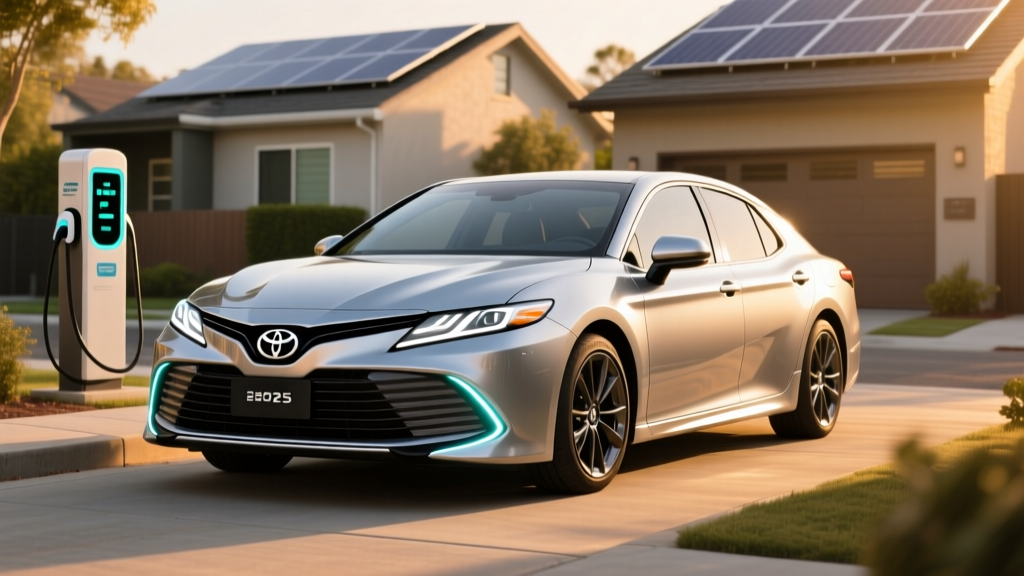
The ninth-generation Toyota Camry arrived for the 2025 model year with a significant powertrain shift: every Camry is now a hybrid. Toyota dropped the conventional gas-only four-cylinder entirely, betting that its fifth-generation hybrid system delivers the efficiency buyers want without the range compromises or charging dependencies of a full battery-electric vehicle. For shoppers searching 2025 Camry Hybrid miles per gallon data, the headline number is impressive — up to 51 MPG combined on front-wheel-drive trims — but real-world results, trim-level variation, and the ownership math deserve a closer look.
This guide covers the 2025 Camry Hybrid's EPA fuel economy across every trim, how real-world driving affects those numbers, the powertrain behind the efficiency, battery longevity and warranty, and how it stacks up against plug-in hybrids and full EVs for different buyer profiles.
2025 Camry Hybrid MPG: EPA Ratings by Trim
The 2025 Camry Hybrid uses Toyota's latest hybrid synergy drive, pairing a 2.5-liter four-cylinder engine with electric motors. Front-wheel-drive (FWD) models use a single front motor, while all-wheel-drive (AWD) trims add a second rear motor. That drivetrain difference creates a meaningful MPG split across the lineup.
| Trim | Drivetrain | City MPG | Highway MPG | Combined MPG |
|---|---|---|---|---|
| LE | FWD | 53 | 50 | 51 |
| LE | AWD | 51 | 49 | 50 |
| SE | FWD | 48 | 47 | 47 |
| SE | AWD | 46 | 46 | 46 |
| XLE | FWD | 48 | 47 | 47 |
| XLE | AWD | 46 | 46 | 46 |
| XSE | FWD | 48 | 47 | 47 |
| XSE | AWD | 46 | 46 | 46 |
The LE trim's 51 MPG combined figure is the segment benchmark, but it comes with a trade-off: the LE rides on 16-inch wheels with low-rolling-resistance tires and is the lightest trim in the lineup. Moving to the SE, XLE, or XSE adds weight, larger wheels (18- or 19-inch), and stickier tires — all of which cost you 4-5 MPG combined. The AWD system's rear motor adds roughly 70 pounds and parasitic drag, dropping efficiency by another 1 MPG across the board.
Real-World MPG: What Owners Actually See
Toyota hybrids have a well-documented tendency to exceed their EPA city ratings in stop-and-go driving. The hybrid system recovers energy through regenerative braking, and the more you brake, the more the battery recharges. In warm-weather urban commuting at speeds under 45 mph, many Camry Hybrid owners report 55-58 MPG on the LE trim — above the 53 MPG city sticker.
- EPA Combined: 51 MPG
- City (warm weather, moderate traffic): 53-58 MPG
- Highway (70-75 mph, flat terrain): 44-48 MPG
- Highway (cold weather, 30°F or below): 40-44 MPG
- Mixed driving (annual average): 48-52 MPG
Highway driving is where the Camry Hybrid loses ground versus its EPA rating. At sustained speeds above 70 mph, the gasoline engine runs continuously — the electric motor can't assist meaningfully at cruise. Cold weather further reduces efficiency because the engine must run longer to generate cabin heat and warm the catalytic converter. Expect a 10-15% combined MPG drop in northern winters.
For context, the EPA's annual fuel cost estimate for the Camry Hybrid LE (FWD) is approximately $1,050 based on 15,000 miles driven, 55% city / 45% highway, and $3.50/gallon regular unleaded. That's roughly $600-$800 less per year than a comparable midsize sedan with a conventional turbocharged gas engine rated around 30 MPG combined.
HEV vs PHEV vs EV: Is the Camry Hybrid the Right Choice?
The 2025 Camry is a conventional hybrid (HEV) — it does not plug in, has no electric-only driving range, and charges its small battery entirely through regenerative braking and the gasoline engine. This is fundamentally different from a plug-in hybrid (PHEV) like the Toyota RAV4 Prime or a full battery-electric vehicle (BEV) like the Tesla Model 3.
| Attribute | HEV (Camry Hybrid) | PHEV (e.g., Hyundai Sonata PHEV) | BEV (e.g., Tesla Model 3) |
|---|---|---|---|
| Plugs in? | No | Yes (Level 1 or Level 2) | Yes (Level 2 + DC fast) |
| Electric-only range | None (motor assists engine) | 25-45 miles typical | 250-360 miles (EPA) |
| Total range | ~580 miles (13.2 gal tank) | ~500+ miles (electric + gas) | 250-360 miles |
| Home charging needed? | No | Recommended for full benefit | Required |
| Federal tax credit (§30D) | Not eligible | Up to $7,500 if eligible | Up to $7,500 if eligible |
| Maintenance | Oil changes, standard hybrid service | Oil changes + EV systems | Minimal (no oil, fewer fluids) |
| Best for | No home charging, high mileage, simplicity | Short commute + home charging + road trips | Home charging access, lower fuel cost, no gas |
- Choose the Camry Hybrid (HEV) if: You don't have reliable home or workplace charging access, you drive 15,000+ miles per year, you want zero lifestyle changes versus a gas car, and you prioritize a low purchase price ($29,495 starting MSRP).
- Choose a PHEV if: You have Level 2 charging at home, your daily commute is under 35 miles round-trip (covering most days on electric), and you still want gas-engine range for road trips without planning charging stops.
- Choose a full EV if: You have home charging, want to eliminate gasoline entirely, can absorb higher upfront cost (partially offset by the §30D tax credit), and your typical road trips are under 300 miles or you're willing to plan DC fast-charging stops.
2025 Camry Hybrid Powertrain and Performance Specs
The 2025 Camry uses Toyota's fifth-generation hybrid system, which is lighter and more compact than the fourth-gen unit in the outgoing Camry. The 2.5-liter Dynamic Force four-cylinder engine produces 184 horsepower on its own, while the front electric motor contributes 134 hp. Combined system output is 225 horsepower on FWD models and 232 horsepower on AWD models (the rear motor adds 40 hp).
| Engine | 2.5L DOHC 16-valve 4-cylinder (A25A-FXS) |
| Engine horsepower | 184 hp @ 5,700 rpm |
| Front motor output | 134 hp / 155 lb-ft torque |
| Rear motor (AWD only) | 40 hp / 89 lb-ft torque |
| Combined system output | 225 hp (FWD) / 232 hp (AWD) |
| Transmission | Electronically controlled CVT (eCVT) |
| 0-60 mph (est.) | ~7.2 sec (FWD) / ~7.0 sec (AWD) |
| Hybrid battery | Lithium-ion, ~1.0 kWh (bipolar, under rear seat) |
| Fuel tank | 13.2 gallons (regular unleaded) |
| Curb weight | 3,490 - 3,595 lbs (varies by trim) |
The lithium-ion hybrid battery in the 2025 Camry uses Toyota's bipolar electrode design, which Toyota says delivers roughly 1.5x the output of the previous nickel-metal-hydride pack in a smaller, lighter package. At approximately 1.0 kWh of total capacity, this battery is not designed for electric-only driving — it exists to buffer regenerative energy and assist the gas engine during acceleration. You will never see a "pure EV" mode that moves the car more than a few hundred feet at low speed.
Performance-wise, 225 hp in a 3,500-pound sedan delivers adequate but not exciting acceleration. The eCVT keeps the engine in its optimal power band, and the electric motor's instant torque fills in the low-end response that CVTs typically lack. It's a smooth, refined powertrain that prioritizes efficiency over sportiness, though the SE and XSE trims add firmer suspension tuning for sharper handling.
Pricing, Trims, and Tax Credit Eligibility
The 2025 Camry Hybrid starts at $29,495 (LE FWD, including destination charge) and tops out around $36,000 for a fully equipped XSE AWD. That pricing represents a modest increase over the outgoing generation, but Toyota has bundled more standard equipment — including Toyota Safety Sense 3.0, a 7-inch (or optional 12.3-inch) touchscreen, wireless Apple CarPlay and Android Auto, and LED headlights across all trims.
| Trim | FWD MSRP | AWD MSRP |
|---|---|---|
| LE | $29,495 | $30,895 |
| SE | $31,195 | $32,595 |
| XLE | $33,495 | $34,895 |
| XSE | $34,695 | $36,095 |
Federal Tax Credit: Does the Camry Hybrid Qualify?
No. The 2025 Toyota Camry Hybrid is a conventional HEV and does not qualify for the IRS §30D Clean Vehicle Credit. Under current IRS rules, only plug-in electric vehicles (PHEVs and BEVs) with a battery capacity of at least 7 kWh are eligible for the federal tax credit, which can provide up to $7,500 for qualifying new vehicles. The Camry Hybrid's ~1.0 kWh battery falls well below that threshold.
The Camry Hybrid also does not qualify for the §25E Used Clean Vehicle Credit (up to $4,000 for used PHEVs/BEVs). Some states or local utilities may offer small rebates for hybrid purchases, but these vary widely by jurisdiction. Check your state energy office or utility provider for current programs.
- ❌ Battery capacity under 7 kWh (Camry: ~1.0 kWh)
- ❌ Not a plug-in vehicle (no external charging capability)
- ❌ HEVs are excluded from §30D by statute
- ✅ The credit applies to PHEVs (e.g., RAV4 Prime, Prius Prime) and BEVs only
- ✅ Some states offer separate hybrid incentives — check afdc.energy.gov
Hybrid Battery Warranty, Lifespan, and Replacement Cost
Hybrid battery longevity remains the single biggest concern for first-time hybrid buyers. Toyota's track record here is strong: the Prius, Camry Hybrid, and RAV4 Hybrid have accumulated decades of real-world data showing hybrid batteries routinely lasting 150,000-200,000+ miles before needing replacement.
- Hybrid battery warranty: 10 years / 150,000 miles (whichever comes first)
- Hybrid system components: 8 years / 100,000 miles
- Powertrain warranty: 5 years / 60,000 miles
- Basic warranty: 3 years / 36,000 miles
- Warranty coverage threshold: Toyota covers the hybrid battery if capacity drops below a defined performance threshold (not a specific percentage — determined by dealer diagnostic scan)
The 10-year / 150,000-mile hybrid battery warranty applies in all 50 states, an improvement from earlier model years when California Air Resources Board (CARB) states received 10/150 and other states received 8/100. Toyota unified the coverage starting with the 2020 model year.
If the battery does need replacement out of warranty, a new OEM hybrid battery for the Camry Hybrid typically costs $2,500-$4,000 installed at a Toyota dealer. Independent hybrid shops and refurbished battery options can reduce that to $1,500-$2,500. Given that the battery is a relatively small ~1.0 kWh lithium-ion pack (not the 60-100 kWh packs in full EVs), replacement costs are a fraction of what a BEV battery swap would require.
Toyota's hybrid batteries benefit from conservative charge management — the system never fully charges or fully depletes the pack, keeping the state of charge (SoC) in a roughly 40-80% window. This buffer dramatically reduces degradation and is a key reason these batteries outlast early expectations.
Reliability and Long-Term Ownership
The 2025 Camry Hybrid inherits a strong reliability reputation from the Camry nameplate, which has consistently scored above average in IIHS safety testing and J.D. Power dependability studies. The fifth-generation hybrid system is an evolution of proven technology, not a first-year redesign risk.
Maintenance costs are modest. The Camry Hybrid requires standard oil changes (typically every 10,000 miles with synthetic oil), brake fluid checks, and cabin air filter replacements. One often-overlooked advantage: hybrid regenerative braking significantly reduces brake pad wear. Many Camry Hybrid owners report original brake pads lasting 80,000-100,000 miles because the electric motor handles most deceleration below ~40 mph.
There is no timing belt to replace (the A25A-FXS engine uses a timing chain), and the eCVT transmission has no traditional clutch packs or bands to wear out — it's a planetary gearset with far fewer failure points than a conventional automatic.
Pros, Cons, and Final Verdict
- Best-in-class 51 MPG combined (LE FWD) — real-world city driving often exceeds EPA
- No plug-in charging required — zero lifestyle adjustment from a gas car
- Low starting price ($29,495) for a midsize hybrid sedan
- 10-year / 150,000-mile hybrid battery warranty across all 50 states
- Standard Toyota Safety Sense 3.0 (AEB, lane-keeping, adaptive cruise, blind-spot)
- AWD available on every trim for $1,400
- Proven reliability and strong resale value
- No federal tax credit eligibility (HEV exclusion)
- SE/XLE/XSE trims drop to 46-47 MPG combined — a noticeable gap from the LE
- Highway MPG falls short of EPA sticker, especially in cold weather
- 225 hp is adequate but not engaging — this is an efficiency-first sedan
- Infotainment is functional but not class-leading in responsiveness
- No plug-in hybrid variant offered (Toyota reserves PHEV for Prius Prime and RAV4 Prime)
The 2025 Camry Hybrid occupies a specific and compelling niche: it's the highest-MPG midsize sedan you can buy that requires absolutely no charging infrastructure, no range planning, and no tax-credit paperwork. If your priority is minimizing fuel cost and ownership hassle while retaining the flexibility to drive anywhere without stopping to charge, the Camry Hybrid LE at 51 MPG combined is difficult to beat.
However, if you have home Level 2 charging and a short commute, a PHEV like the Prius Prime (44 miles electric-only, then 52 MPG combined on gas) could eliminate most of your gasoline use entirely — and qualify for up to $3,750 in federal tax credits under current §30D rules. The math depends on your driving pattern, charging access, and how long you plan to keep the vehicle.
Frequently Asked Questions
How many MPG does the 2025 Camry Hybrid actually get?
The EPA rates the Camry Hybrid LE (FWD) at 53 city / 50 highway / 51 combined. In real-world driving, city MPG often exceeds the EPA estimate (55-58 MPG is common in warm weather), while highway driving at 70+ mph typically returns 44-48 MPG. Sportier trims (SE, XLE, XSE) are rated 46-47 combined due to larger wheels and added weight.
Does the Camry Hybrid need to be plugged in?
No. The 2025 Camry Hybrid is a conventional HEV, not a plug-in hybrid. The battery charges itself through regenerative braking and the gasoline engine. There is no charging port, no electric-only driving mode, and no need for any home or public charging infrastructure.
How far can the Camry Hybrid drive on a full tank?
With a 13.2-gallon fuel tank and 51 MPG combined, the Camry Hybrid LE can travel approximately 670 miles between fill-ups under EPA-rated conditions. Real-world mixed driving (48-52 MPG) yields roughly 630-680 miles of range. Highway-heavy driving at 75 mph will reduce that to around 580-620 miles.
Is the Camry Hybrid battery expensive to replace?
A new OEM hybrid battery replacement costs approximately $2,500-$4,000 installed at a Toyota dealer. Refurbished or aftermarket options can reduce the cost to $1,500-$2,500. However, Toyota's 10-year / 150,000-mile warranty covers most battery failures during normal ownership, and real-world data shows these batteries commonly lasting 150,000-200,000+ miles.
Does the 2025 Camry Hybrid qualify for any tax credit?
The Camry Hybrid does not qualify for the federal §30D Clean Vehicle Credit because it is a conventional HEV with a battery under 7 kWh. Only plug-in vehicles (PHEVs and BEVs) are eligible. Some state or utility rebates may apply — check afdc.energy.gov for programs in your area.
Should I buy the Camry Hybrid or a full EV like the Tesla Model 3?
If you have home Level 2 charging, drive under 300 miles per day, and want to eliminate gasoline entirely, a full EV offers lower per-mile fuel costs (electricity at ~$0.12-$0.16/kWh vs. gas at ~$3.50/gallon) and less maintenance. If you lack charging access, take frequent long road trips, or want the lowest purchase price with zero lifestyle adjustment, the Camry Hybrid is the more practical choice. A PHEV like the Prius Prime splits the difference — electric commuting with gas-engine backup.
Is the AWD system worth the 1 MPG penalty?
If you regularly drive in rain, snow, or on unpaved roads, the electronic AWD system (which engages the rear motor automatically when front wheels slip) provides meaningful traction benefits for a negligible efficiency loss. The $1,400 AWD upcharge also includes the rear motor's 40 additional horsepower. For dry-climate drivers who rarely encounter low-traction conditions, FWD is the more cost-efficient choice.