2026 Jeep Compass Hybrid 4xe: The Compact SUV PHEV for Trail-Rated Commuters
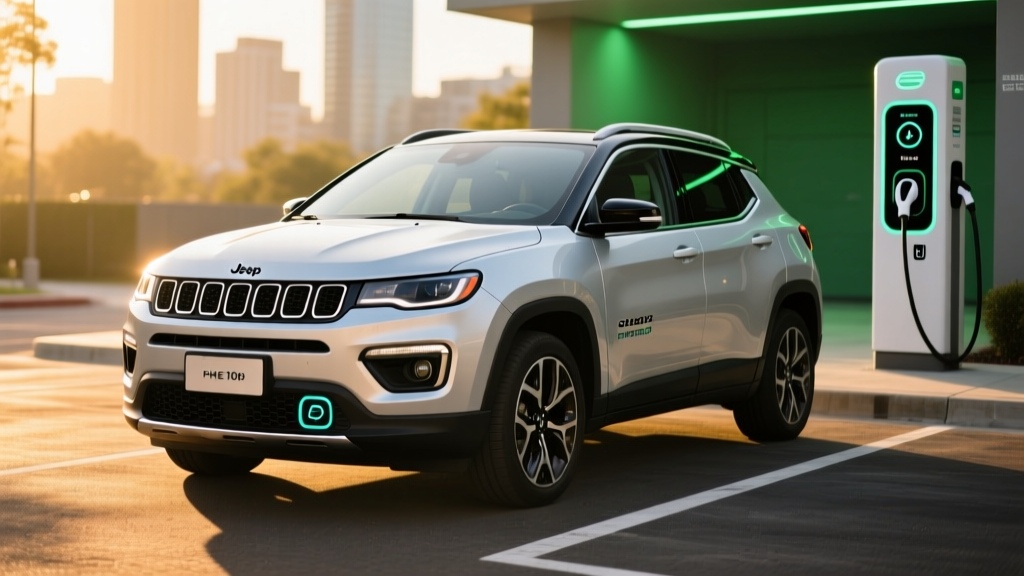
Jeep's entry into the electrified compact-SUV segment returns for 2026 with the Compass 4xe — a plug-in hybrid that pairs a turbocharged gasoline engine with a rear-axle electric motor to deliver all-wheel drive, electric-only commuting, and genuine off-road capability. Unlike a conventional hybrid (HEV) that never plugs in, the Compass 4xe is a full PHEV: you charge it from a wall outlet or public station to unlock its zero-emission electric range, and a gas engine takes over for longer trips.
For 2026, Jeep has refined the powertrain calibration and bumped battery capacity slightly, yielding modest gains in electric range and efficiency. The Compass 4xe competes directly against the Toyota RAV4 Prime, Ford Escape PHEV, and Mitsubishi Outlander PHEV. Here's every number that matters before you head to the dealer.
HEV vs. PHEV: What the Compass 4xe Actually Is
Conventional Hybrid (HEV)
- Small battery (~1–2 kWh) recharged by regenerative braking and the engine
- Never plugs in — you simply fuel up with gasoline
- Electric motor assists the engine; cannot drive on electricity alone for meaningful distances
- Typical MPG improvement: 20–35% over a gas-only equivalent
- Example: Toyota RAV4 Hybrid
Plug-In Hybrid (PHEV) — Compass 4xe
- Larger battery (~15.5 kWh usable) that charges via a plug (Level 1 or Level 2)
- Delivers a usable electric-only range before the gas engine starts
- Operates as a regular hybrid once the battery is depleted
- Can qualify for federal tax credits (subject to §30D sourcing and income rules)
- Example: Jeep Compass 4xe, Toyota RAV4 Prime
The distinction matters for your wallet and your daily routine. If you can charge at home and your commute falls within the electric-only range, a PHEV like the Compass 4xe can run predominantly on electricity Monday through Friday while retaining gas-engine range for weekend road trips — effectively giving you EV-like daily costs with zero range anxiety.
Fuel Economy, Electric Range, and Total Driving Range
| Metric | Value |
|---|---|
| EPA Combined MPGe (electric + gas) | 87 MPGe |
| EPA Combined MPG (gas-only, battery depleted) | 29 MPG |
| City MPG (gas-only) | 30 MPG |
| Highway MPG (gas-only) | 27 MPG |
| Electric-Only Range (EPA) | 32 miles |
| Total Combined Range (electric + gas) | ~430 miles |
| Fuel Tank Capacity | 11.2 gallons |
Real-World MPG vs. EPA Sticker
The EPA rates the Compass 4xe at 29 MPG combined once the battery is depleted. In real-world mixed driving, expect 27–31 MPG depending on terrain, temperature, and driving style. City driving often exceeds the EPA figure because regenerative braking recaptures energy in stop-and-go traffic. Highway cruising at 75+ mph will push consumption toward 25–26 MPG. In cold weather (below 30°F), the gas engine engages sooner to provide cabin heat, reducing electric-only range to roughly 22–26 miles.
For context, the non-hybrid 2026 Jeep Compass with the 2.0L turbo achieves 25 MPG combined — making the 4xe's 29 MPG (gas-only) a meaningful 16% improvement even when you never plug in.
Powertrain Specs: Horsepower, Engine, and Motors
| Specification | Detail |
|---|---|
| Engine | 1.3L turbocharged inline-4 |
| Engine Output | 177 HP / 210 lb-ft torque |
| Rear Electric Motor | 60 HP (45 kW) |
| Combined System Output | 240 HP |
| Transmission | 6-speed automatic (front axle) |
| Drivetrain | eAWD (electric rear axle, no mechanical driveshaft) |
| 0–60 MPH | ~6.6 seconds |
| Max Tow Capacity | 2,000 lbs |
The eAWD system is a defining feature: the rear axle is driven solely by the electric motor, with no mechanical connection to the front engine. This means the Compass 4xe can operate in front-wheel drive (gas engine), rear-wheel drive (electric motor), or all-wheel drive (both) depending on conditions. Jeep's Selec-Terrain system carries over with Auto, Snow, Sand/Mud, and Sport modes. The Trailhawk 4xe trim adds a Rock mode and increased ground clearance for genuine off-road capability rare in the PHEV segment.
Battery, Charging Speed, and Charging Time
| Specification | Detail |
|---|---|
| Battery Chemistry | NMC (nickel-manganese-cobalt) lithium-ion |
| Total Battery Capacity | 15.5 kWh |
| Usable Battery Capacity | ~12.0 kWh |
| Level 1 Charging (120V household) | ~8 hours (0–100%) |
| Level 2 Charging (240V, 7.4 kW onboard charger) | ~2 hours (0–100%) |
| DC Fast Charging | Not supported |
| Charge Port | J1772 (Level 1/Level 2) |
The Compass 4xe does not support DC fast charging — a limitation common to most PHEVs in this price class. With a relatively small 15.5 kWh battery, the 7.4 kW onboard Level 2 charger replenishes the pack in roughly two hours, which is practical for overnight home charging or a midday top-up at a workplace Level 2 station.
Home charging setup: A standard 120V outlet (Level 1) will fully charge the battery overnight in about 8 hours. For faster replenishment, a 240V Level 2 home charger (NEMA 14-50 or hardwired) cuts that to ~2 hours. Installation costs for a Level 2 circuit typically range from $500–$1,800 depending on panel proximity and local electrical codes — consult a licensed electrician for a site-specific quote.
Pricing, Trims, and Tax Credit Eligibility
| Trim | MSRP (est.) |
|---|---|
| Willys 4xe | $36,495 |
| Latitude 4xe | $38,095 |
| Trailhawk 4xe | $41,595 |
| Limited 4xe | $42,595 |
All prices include the $1,595 destination charge. The Compass 4xe falls well under the IRS §30D MSRP cap of $80,000 for SUVs, so price alone doesn't disqualify it from federal incentives.
Federal Tax Credit Eligibility (§30D) — 2026 Rules
- Maximum credit: Up to $3,750 (dependent on critical-mineral and battery-component sourcing compliance)
- MSRP cap: Vehicle MSRP must be ≤ $80,000 (Compass 4xe qualifies)
- Buyer income cap: AGI ≤ $150,000 (single) / $300,000 (joint) / $225,000 (head of household)
- Battery sourcing: Critical minerals and battery components must meet phased-in domestic/free-trade sourcing requirements — verify on IRS.gov before purchase
- Point-of-sale transfer: Eligible buyers can transfer the credit to the dealer for an upfront price reduction at purchase
- Assembly: Final assembly must occur in North America (Compass 4xe is assembled in Toluca, Mexico — verify current-year eligibility)
Note: The Compass 4xe's Mexico assembly may affect §30D eligibility. Always confirm on the IRS clean vehicle credit page and with your tax professional before relying on the credit in your purchase decision.
Battery Warranty, Reliability, and Replacement Cost
2026 Jeep Compass 4xe — Hybrid Battery Warranty
Coverage: 10 years / 100,000 miles (whichever comes first)
Capacity retention threshold: Warranty covers the battery if it falls below 70% of original capacity during the coverage period
Powertrain warranty: 5 years / 60,000 miles (engine, transmission, electric motor)
Bumper-to-bumper: 3 years / 36,000 miles
Jeep's 10-year/100,000-mile hybrid battery warranty is competitive and aligns with the industry standard set by Hyundai/Kia and Toyota. The 70% capacity threshold means Jeep will repair or replace the battery if it degrades to the point where your electric-only range drops below roughly 22 miles from the original 32.
Reliability outlook: The 1.3L turbo-four and eAWD system carry over from prior model years with incremental software refinements for 2026. The previous-generation Compass 4xe drew mixed reliability scores from owners, with some reporting software-related drivetrain faults. Jeep has issued multiple TSBs (technical service bulletins) addressing these issues, and the 2026 model benefits from those fixes. Still, it's worth noting that the IIHS and NHTSA safety ratings should be checked once 2026 crash-test results are published.
Battery replacement cost: If the battery fails out of warranty, a full PHEV battery replacement for the Compass 4xe is estimated at $6,000–$9,000 including parts and labor, based on current Stellantis parts pricing. Individual module replacement (if only a subset of cells degrade) can reduce that cost. NMC batteries in PHEVs typically retain 85–90% capacity after 8–10 years of normal use, making out-of-warranty failure uncommon but not impossible.
Who Should Buy the Compass 4xe — and Who Shouldn't
Choose the 2026 Jeep Compass 4xe If:
- Your daily commute is under 30 miles and you can charge at home — you'll drive on electricity most weekdays
- You want AWD and light off-road capability (especially in the Trailhawk trim) without going full EV
- You take regular road trips where charging infrastructure is sparse or unreliable
- You want a compact SUV with a sub-$40K starting price and potential tax incentives
- You need a vehicle that can tow (2,000 lbs) — most electric compact SUVs in this class cannot
Look Elsewhere If:
- Your commute exceeds 35 miles one-way — the 32-mile electric range won't cover your full trip, and you'll burn gas daily
- You want a full electric vehicle with 250+ miles of range and DC fast charging for road trips
- Prioritizing maximum fuel economy above all — the Toyota RAV4 Prime delivers 42 miles electric and 38 MPG gas-only
- You need third-row seating — the Compass is a two-row compact SUV
- Reliability track record is your top concern — Toyota and Honda hybrids have longer proven histories
Pros
- Genuine off-road capability in Trailhawk trim (rare for PHEVs)
- 240 HP combined — quick for the segment (6.6s 0–60)
- 32-mile electric range covers most daily commutes
- 10-year/100,000-mile battery warranty
- Under $80K MSRP cap for potential federal tax credit
Cons
- No DC fast charging capability
- Gas-only MPG (29 combined) trails the RAV4 Prime (38 combined)
- Mexico assembly may affect §30D tax credit eligibility
- Cargo space reduced vs. gas Compass due to battery placement
- Mixed historical reliability scores for the Compass platform
Compass 4xe vs. Key PHEV Competitors
| Spec | Jeep Compass 4xe | Toyota RAV4 Prime | Ford Escape PHEV |
|---|---|---|---|
| Electric Range (EPA) | 32 mi | 42 mi | 37 mi |
| Gas-Only MPG (combined) | 29 MPG | 38 MPG | 40 MPG |
| Combined HP | 240 HP | 302 HP | 210 HP |
| AWD | Yes (eAWD) | Yes (eAWD) | No (FWD only) |
| DC Fast Charge | No | No | No |
| Starting MSRP | ~$36,495 | ~$44,500 | ~$39,500 |
| Off-Road Capability | High (Trailhawk) | Moderate | Low |
The Compass 4xe undercuts both competitors on price and stands alone in off-road capability. The RAV4 Prime dominates on electric range and gas-only MPG but costs significantly more and faces long waitlists at many dealers. The Escape PHEV offers the best fuel economy but is front-wheel-drive only, which may be a dealbreaker for snow-belt buyers.
Frequently Asked Questions
How many MPG does the 2026 Jeep Compass Hybrid get?
The Compass 4xe is rated by the EPA at 29 MPG combined (30 city / 27 highway) when operating on gasoline after the battery is depleted. In real-world driving, expect 27–31 MPG depending on conditions. When factoring in electric-only driving, the combined rating is 87 MPGe.
How far can the Compass 4xe go on electric only?
The EPA rates the 2026 Compass 4xe at 32 miles of electric-only range. Real-world results vary: expect 28–34 miles in mild weather with moderate speeds, and 22–26 miles in cold weather (below 30°F) when the battery is less efficient and cabin heating draws additional power.
Does the Compass 4xe qualify for a federal tax credit?
Potentially — the Compass 4xe meets the MSRP cap (under $80,000) and buyer income thresholds may apply. However, its final assembly in Toluca, Mexico may affect eligibility under §30D's North American assembly requirement, and battery-sourcing rules determine whether the full $3,750 or $7,500 credit applies. Always verify current eligibility on IRS.gov and consult a tax professional before purchasing.
Is the Compass 4xe hybrid reliable, and what does battery replacement cost?
The Compass 4xe's powertrain has seen incremental improvements for 2026, addressing software-related complaints from earlier model years. The hybrid battery is covered by a 10-year/100,000-mile warranty (70% capacity threshold). Out-of-warranty replacement is estimated at $6,000–$9,000, though NMC PHEV batteries rarely require full replacement within their first decade.
Hybrid vs. PHEV vs. EV — which should I choose?
A conventional hybrid (HEV) is best if you can't charge at home and want better MPG with no behavior change. A PHEV like the Compass 4xe is ideal if you can charge at home, commute under 30 miles, and want the option of gas-engine range for road trips. A full EV (BEV) makes sense if you have reliable home charging, your daily driving is under 200 miles, and you want to eliminate gasoline entirely. For more on this decision, see our EPA fuel-economy comparison tool.
Can the Compass 4xe charge at a public DC fast charger?
No. The Compass 4xe does not have a DC fast-charge port. It charges via J1772 at Level 1 (120V, ~8 hours) or Level 2 (240V, ~2 hours). This is standard for most PHEVs — the battery is small enough that Level 2 charging is adequate.
Does the battery eat into cargo space?
Yes, slightly. The high-voltage battery is mounted under the rear cargo floor, raising the load floor by approximately 2 inches. Cargo volume drops from 27.2 cu ft (gas Compass) to roughly 24.5 cu ft behind the rear seats in the 4xe. Folding the rear seats still provides usable space, but the raised floor is noticeable when loading heavy items.
Sources: IRS Clean Vehicle Credits, fueleconomy.gov (EPA), Jeep/Stellantis official specifications. All specs reflect 2026 model-year data available at time of publication. Pricing and tax-credit rules are subject to change.