Quick Verdict: The Tucson Hybrid Balances Efficiency and Practicality
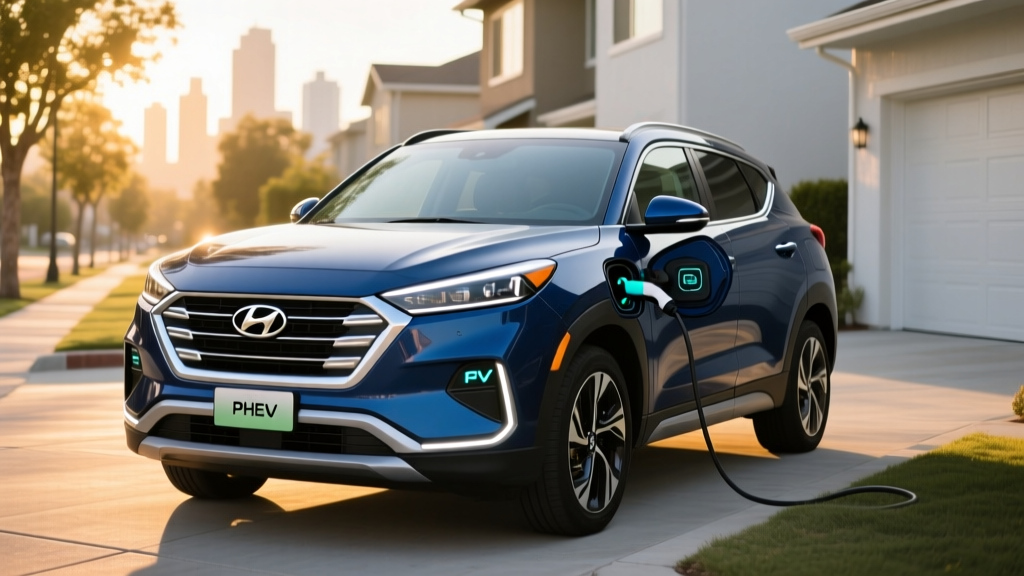
The 2026 Hyundai Tucson Hybrid occupies a compelling middle ground for SUV shoppers who want meaningful fuel savings without committing to a plug. Available in two distinct flavors — a conventional hybrid (HEV) that never needs charging and a plug-in hybrid (PHEV) offering 33 miles of electric-only range — the Tucson lineup covers a wide spectrum of buyers. The HEV targets drivers who want set-it-and-forget-it efficiency, while the PHEV rewards those with home charging access and short commutes. Both share a 1.6-liter turbocharged four-cylinder paired with electric motors, all-wheel drive as standard, and a starting price that undercuts many rivals.
HEV vs. PHEV — What's the Difference?
| Feature | Tucson Hybrid (HEV) | Tucson Plug-In Hybrid (PHEV) |
|---|---|---|
| Needs to plug in? | No — charges via regenerative braking and engine | Yes — plug in for electric-only driving |
| Electric-only range | N/A | 33 miles (EPA) |
| Battery size | 1.49 kWh | 13.8 kWh |
| Combined horsepower | 232 hp | 268 hp |
| EPA combined MPG / MPGe | 38 MPG combined | 80 MPGe combined (electric+gas); 35 MPG gas-only |
| Level 2 charge time (0–100%) | N/A | ~2 hours at 7.2 kW |
| DC fast charging | N/A | No |
| Federal tax credit (§30D) | Not eligible | Up to $7,500 (eligibility varies) |
Fuel Economy: EPA MPG and Real-World Numbers
For the conventional Tucson Hybrid (HEV), the EPA rates fuel economy at 38 MPG combined, breaking down to approximately 37 MPG city and 38 MPG highway, depending on trim. These figures apply across the Blue, SEL Convenience, and Limited trims, though the base Blue trim historically edges slightly higher in city driving due to lower weight and less equipment.
| Model | City MPG | Highway MPG | Combined MPG |
|---|---|---|---|
| 2026 Tucson Hybrid Blue (HEV) | 38 | 38 | 38 |
| 2026 Tucson Hybrid SEL/Limited (HEV) | 37 | 37 | 37 |
| 2026 Tucson PHEV (gas-only mode) | 34 | 35 | 35 |
| 2026 Tucson PHEV (combined MPGe) | 80 MPGe | ||
Real-World MPG: What to Actually Expect
Hybrids thrive in stop-and-go traffic where regenerative braking recovers energy that a gas car would waste as heat. In real-world city driving, Tucson Hybrid owners frequently report 39–42 MPG, exceeding the EPA city estimate. Highway driving is a different story: sustained 75+ MPH speeds reduce the hybrid system's advantage, and expect 34–36 MPG on long interstate trips. Cold weather (below 35°F) can knock 2–4 MPG off combined figures as the engine runs more frequently to heat the cabin and warm up the catalytic converter.
For the PHEV, real-world electric-only range varies. The 33-mile EPA estimate assumes moderate temperatures and gentle acceleration. In winter conditions or with aggressive driving, expect 26–29 miles before the gas engine engages. Once the battery depletes, the PHEV operates as a conventional hybrid at roughly 33–35 MPG.
Powertrain and Performance Specs
Both Tucson electrified variants use Hyundai's Smartstream 1.6-liter turbocharged GDI four-cylinder engine paired with an electric motor and a 6-speed automatic transmission. All-wheel drive is standard across all trims — a notable advantage over competitors that charge extra for AWD.
| Specification | Tucson HEV | Tucson PHEV |
|---|---|---|
| Engine | 1.6L Turbo GDI I4 | 1.6L Turbo GDI I4 |
| Electric motor output | 47.7 kW (64 hp) | 66.9 kW (90 hp) |
| Combined system horsepower | 232 hp | 268 hp |
| Combined system torque | 271 lb-ft | 271 lb-ft |
| Transmission | 6-speed automatic | 6-speed automatic |
| Drivetrain | AWD (standard) | AWD (standard) |
| 0–60 mph (est.) | ~7.4 seconds | ~6.6 seconds |
| Towing capacity | 2,000 lbs | 2,000 lbs |
| Battery capacity | 1.49 kWh | 13.8 kWh |
| Battery chemistry | Lithium-ion polymer | Lithium-ion polymer |
The PHEV's larger electric motor gives it a meaningful acceleration advantage — the 0–60 mph time drops by nearly a full second. That extra torque is immediately noticeable during highway merging and passing maneuvers. Neither variant uses a continuously variable transmission (CVT), which means the driving experience feels more natural and less rubber-bandy than some Toyota and Honda hybrid competitors.
PHEV Electric-Only Range and Charging Details
The Tucson PHEV's 13.8 kWh battery delivers an EPA-rated 33 miles of electric-only range. For commuters with a round-trip distance under 30 miles, this means the gas engine may not start at all during the work week — effectively making it an EV for daily use with a gas-powered safety net for road trips.
Charging the Tucson PHEV
- Level 1 (120V household outlet): ~7 hours from empty to full. Viable if you can plug in overnight.
- Level 2 (240V, 7.2 kW onboard charger): ~2 hours from empty to full. A dedicated home Level 2 station is ideal.
- DC fast charging: Not available. The Tucson PHEV does not support DC fast charging — this is typical for PHEVs in this class.
- Charger connector: Standard J1772 (compatible with all public Level 2 stations).
The 2-hour Level 2 charge time is competitive with the Toyota RAV4 Prime (~2.5 hours) but slower than dedicated EVs. Since the battery is relatively small, most PHEV owners will find that overnight Level 1 charging on a standard 120V outlet is sufficient — a significant advantage for renters or homeowners who don't want to invest in a 240V installation.
Pricing, Trims, and Tax Credit Eligibility
The 2026 Tucson Hybrid (HEV) starts at approximately $34,250 MSRP for the Blue trim, rising to around $40,000 for the fully equipped Limited. The Tucson PHEV commands a premium, starting near $40,250 MSRP for the SEL trim and reaching approximately $46,500 for the Limited.
Federal Tax Credit: Who Qualifies?
Under the current IRS §30D rules, the Tucson PHEV may qualify for up to $7,500 in federal tax credits, but eligibility depends on several factors that change frequently:
- MSRP cap: SUVs must have an MSRP at or below $80,000 (all Tucson PHEV trims qualify).
- Buyer income cap: Modified adjusted gross income must not exceed $150,000 (single), $225,000 (head of household), or $300,000 (joint filers).
- Battery sourcing: Critical minerals and battery components must meet phased-in domestic-content requirements that tighten annually. Hyundai has been working to localize battery supply, but verify current-year eligibility at fueleconomy.gov before purchasing.
- Point-of-sale transfer: Eligible buyers can transfer the credit to the dealer at purchase, reducing the upfront price rather than waiting for a tax refund.
The conventional Tucson Hybrid (HEV) does not qualify for the §30D federal tax credit. That credit applies only to plug-in vehicles with a battery capacity of at least 7 kWh. Some states offer separate incentives for conventional hybrids — check your state's energy office for current programs.
Note: Tax credit rules are subject to legislative change. Consult a tax professional and verify on irs.gov before making a purchase decision based on credit eligibility.
Reliability, Battery Warranty, and Replacement Cost
Hyundai backs both Tucson hybrid models with one of the most comprehensive warranty packages in the industry. The hybrid battery and hybrid system components are covered under Hyundai's dedicated hybrid/electric component warranty.
Warranty Coverage at a Glance
| Hybrid battery | 10 years / 100,000 miles (original owner); 10 years / 100,000 miles in CARB states |
| Hybrid system components | 10 years / 100,000 miles |
| New vehicle limited warranty | 5 years / 60,000 miles |
| Powertrain warranty | 10 years / 100,000 miles |
| Capacity retention guarantee | Hyundai replaces the battery if capacity falls below 70% during the warranty period |
Hybrid battery replacement cost, should it be needed outside of warranty, typically ranges from $2,500 to $4,500 for the HEV's smaller battery and $5,000 to $8,000 for the PHEV's larger pack, including labor. However, real-world data from Hyundai's hybrid lineup (now spanning over a decade with the Sonata and Ioniq hybrids) shows that hybrid battery failures before 150,000 miles are uncommon. The lithium-ion polymer cells used in the Tucson are managed by a robust thermal system that avoids the extreme charge states that accelerate degradation.
For reliability ratings, the Tucson Hybrid has performed well in owner surveys. Check current data at NHTSA for any active recalls or technical service bulletins.
Hybrid vs. PHEV vs. Full EV: Which Tucson Fits You?
Hyundai sells the Tucson in three powertrain variants — conventional hybrid, plug-in hybrid, and a full battery-electric version in some markets. Here's a practical decision framework:
Choose the Tucson Hybrid (HEV) if:
- You don't have access to home or workplace charging
- You want lower fuel costs with zero behavior change
- Your budget is under $40,000 and you don't qualify for tax credits
- You drive a mix of city and highway with no predictable short commute
Choose the Tucson PHEV if:
- You can charge at home (even a 120V outlet works)
- Your daily round-trip commute is under 30 miles
- You qualify for the federal tax credit (reducing effective price significantly)
- You want EV-like daily driving but need gas flexibility for road trips
Choose a full EV (e.g., Tucson EV or Ioniq 5) if:
- You have reliable home Level 2 charging
- Your daily driving is under 250 miles
- You want to eliminate gas entirely and minimize maintenance
- You're eligible for the full $7,500 federal credit
The PHEV is the most financially compelling option for buyers who qualify for the federal credit. A $40,250 MSRP reduced by $7,500 at point-of-sale brings the effective price to $32,750 — essentially matching the conventional hybrid's sticker while adding electric-only commuting capability and more power.
Pros and Cons
Pros
- Standard AWD across all trims — no upcharge
- HEV exceeds EPA city MPG in real-world stop-and-go driving
- PHEV qualifies for up to $7,500 federal tax credit (verify eligibility)
- 10-year / 100,000-mile hybrid battery warranty
- 6-speed automatic (no CVT drone)
- Spacious cargo area: 38.7 cu ft behind rear seats (HEV)
- Competitive pricing vs. RAV4 Hybrid and CR-V Hybrid
Cons
- Highway MPG drops below EPA estimate at sustained 75+ MPH
- PHEV does not support DC fast charging
- Conventional hybrid does not qualify for federal tax credit
- Infotainment learning curve with Hyundai's latest UI
- Towing limited to 2,000 lbs (below some gas-only competitors)
- PHEV cargo space slightly reduced due to larger battery placement
Frequently Asked Questions
How many MPG does the 2026 Hyundai Tucson Hybrid get?
The Tucson Hybrid (HEV) is EPA-rated at 38 MPG combined (37–38 city / 37–38 highway depending on trim). Real-world city driving often yields 39–42 MPG, while sustained highway driving above 75 MPH typically returns 34–36 MPG.
How far can the Tucson PHEV go on electric only?
The EPA rates the Tucson PHEV at 33 miles of electric-only range. In real-world conditions — especially cold weather or aggressive acceleration — expect 26–29 miles before the gas engine engages. Total combined range (electric + full gas tank) exceeds 400 miles.
Does the Tucson Hybrid need to be plugged in?
No. The conventional Tucson Hybrid (HEV) charges its small 1.49 kWh battery through regenerative braking and the gas engine. You never plug it in. Only the Tucson Plug-In Hybrid (PHEV) requires plugging in to access its electric-only range — though it will still drive as a conventional hybrid if you never charge it.
Does the 2026 Tucson Hybrid qualify for a tax credit?
The conventional hybrid (HEV) does not qualify for the federal §30D tax credit. The Tucson PHEV may qualify for up to $7,500, subject to buyer income limits, battery-sourcing requirements, and MSRP caps. Always verify current eligibility at fueleconomy.gov and consult a tax professional.
Is the Tucson Hybrid reliable? What does battery replacement cost?
Hyundai's hybrid powertrain has demonstrated strong reliability over more than a decade across its model lineup. The hybrid battery is warranted for 10 years / 100,000 miles with a 70% capacity retention threshold. Out-of-warranty replacement costs range from $2,500–$4,500 (HEV) or $5,000–$8,000 (PHEV), though premature failures are uncommon based on historical data.
How does the Tucson Hybrid compare to the RAV4 Hybrid and CR-V Hybrid?
The Tucson Hybrid's 38 MPG combined is competitive with the Toyota RAV4 Hybrid (~40 MPG combined) and Honda CR-V Hybrid (~40 MPG combined). The Tucson offers standard AWD at a lower starting price than both, plus a longer hybrid battery warranty (10 years vs. Toyota's 10 years/150,000 miles in CARB states and Honda's 8 years/100,000 miles). The RAV4 Prime PHEV offers more electric range (42 miles) but starts significantly higher. Check the latest EPA data at fueleconomy.gov for side-by-side comparisons.
Can the Tucson PHEV DC fast charge?
No. Like most plug-in hybrids in this class, the Tucson PHEV only supports Level 1 (120V) and Level 2 (240V) AC charging. The 13.8 kWh battery charges fully in about 2 hours on Level 2, which is sufficient for overnight or workplace top-ups.