The midsize hybrid sedan segment has no shortage of options, but the 2026 Hyundai Sonata Limited Hybrid carves out a specific niche: premium trim-level features paired with a proven parallel-hybrid powertrain that sips fuel without requiring you to plug in. If you've been cross-shopping the Toyota Camry Hybrid, Honda Accord Hybrid, and Kia K5 Hybrid, this deep-dive on the Sonata's top-trim hybrid is designed to give you the exact numbers you need to decide.
Before we get into the specs, a critical distinction: the Sonata Hybrid is a conventional hybrid electric vehicle (HEV). It recharges its small battery through regenerative braking and the gasoline engine. You never plug it in. This is fundamentally different from a plug-in hybrid (PHEV) like the discontinued Hyundai Ioniq PHEV or the Toyota Prius Prime, which offers 30–40+ miles of electric-only driving before the gas engine kicks in. We'll compare these architectures in detail below.
Powertrain and Performance Specs
The 2026 Sonata Limited Hybrid pairs a 2.0-liter inline-4 gasoline engine with a permanent-magnet synchronous electric motor integrated into a 6-speed automatic transmission. Hyundai's hybrid system uses a transmission-mounted electric motor (TMED) rather than the e-CVT planetary gearset found in Toyota's hybrid synergy drive, which gives the Sonata a more traditional shift feel that some drivers prefer over the rubber-band sensation of a CVT.
| Specification | Value |
|---|---|
| Gasoline Engine | 2.0L GDI inline-4 |
| Engine Output | 150 hp / 139 lb-ft torque |
| Electric Motor Output | 39 kW (52 hp) / 151 lb-ft torque |
| Combined Net System Output | 192 hp / 271 lb-ft torque |
| Transmission | 6-speed automatic with TMED |
| Drivetrain | Front-wheel drive |
| Hybrid Battery (traction) | ~1.76 kWh lithium-ion polymer |
| 0–60 mph (est.) | ~7.7 seconds |
The 192 combined horsepower figure is competitive with the Camry Hybrid's 225 hp (which benefits from a standard AWD rear motor) and the Accord Hybrid's 204 hp. The Sonata's advantage isn't straight-line speed — it's the seamlessness of its hybrid system transitions and the natural feel of its conventional automatic transmission.
Fuel Economy: EPA Ratings vs. Real-World MPG
Fuel efficiency is the primary reason buyers choose the Sonata Hybrid over the turbocharged gas-only Sonata. Here is the EPA-rated fuel economy breakdown for the Limited trim:
| Driving Cycle | EPA Rating |
|---|---|
| City | 44 MPG |
| Highway | 51 MPG |
| Combined | 47 MPG |
The Limited trim achieves slightly lower numbers than the base Blue or SEL Hybrid trims (rated up to 50/54/52 MPG city/highway/combined on the Blue trim) due to larger 18-inch alloy wheels, additional sound insulation, and the weight of premium features like the panoramic sunroof and ventilated seats.
HEV vs. PHEV vs. Full EV: Which Architecture Fits You?
The Sonata Hybrid is an HEV — no plug, no electric-only range to speak of (the system uses the battery in short bursts for assist and low-speed creep, not sustained electric driving). If you're wondering whether a PHEV or full battery-electric vehicle (BEV) might serve you better, here's a decision framework:
| Factor | HEV (Sonata Hybrid) | PHEV (e.g., Prius Prime) | BEV (e.g., Tesla Model 3) |
|---|---|---|---|
| Plug-in Required? | No | Yes (for EV range benefit) | Yes (mandatory) |
| Electric-Only Range | ~0 miles (motor assist only) | 30–44 miles typical | 250–360 miles typical |
| Home Charging Needed? | No | Recommended (120V or 240V) | Yes (240V Level 2 ideal) |
| Fuel Cost (per mile, avg.) | ~$0.08–$0.10 | ~$0.04–$0.08 (varies) | ~$0.03–$0.06 |
| Federal Tax Credit (§30D) | Not eligible | Up to $7,500 (if eligible) | Up to $7,500 (if eligible) |
| Maintenance Complexity | Low (engine + small battery) | Moderate (two full systems) | Low (no engine) |
| Best For | No home charging; long highway commutes | Short commute + home charging; weekend road trips | Home charging access; mostly under 250 mi/day |
Choose the Sonata Hybrid if: You don't have access to home or workplace charging, you drive a high percentage of highway miles, or you simply want the lowest-complexity path to excellent fuel economy. The HEV architecture means zero behavior change from your current gas car — you just fill up less often.
Look at a PHEV instead if: You have a garage or driveway with a standard 120V outlet, your daily commute is under 40 miles round-trip, and you want to drive mostly on electricity during the week while keeping gas flexibility for road trips. The federal tax credit can make a PHEV competitive on price despite a higher sticker.
Consider a full BEV if: You can install a Level 2 home charger, your daily driving is predictable and under 250 miles, and you want to eliminate gasoline entirely. Operating costs are lowest with a BEV, but you accept the trade-off of longer refueling times on road trips.
Pricing, Trims, and Tax Credit Eligibility
The 2026 Hyundai Sonata Hybrid is offered in three trims. Pricing below includes destination charge:
| Trim | MSRP (incl. destination) |
|---|---|
| Blue | ~$31,250 |
| SEL | ~$34,100 |
| Limited | ~$38,350 |
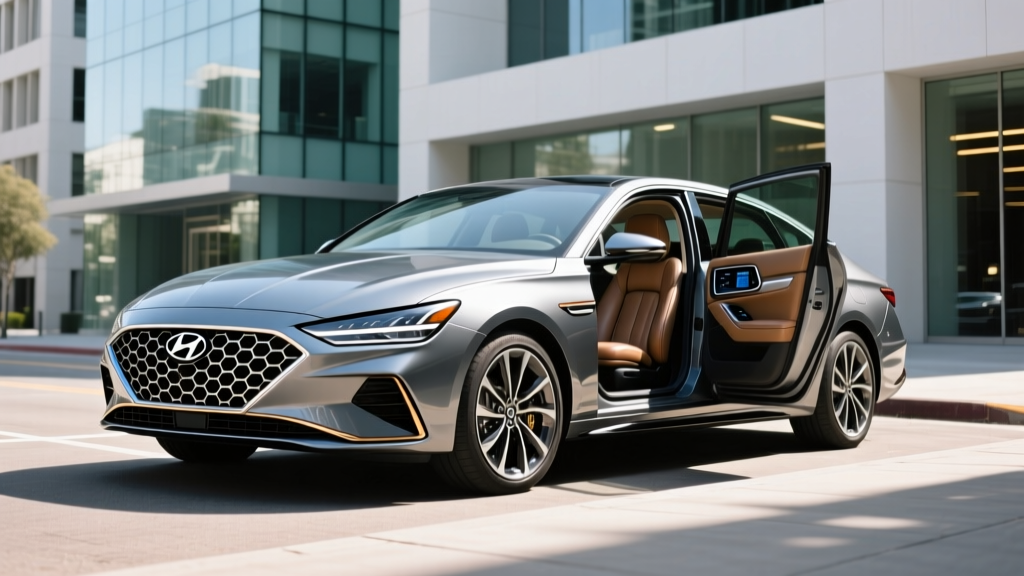
The Limited trim commands a premium of roughly $7,000 over the Blue, but it adds: Nappa leather seating surfaces, a panoramic curved display (dual 12.3-inch screens), Hyundai Digital Key 2, a Bose 12-speaker audio system, ventilated front seats, heated rear seats, a head-up display, Highway Driving Assist 2 (HDA2), and Remote Smart Parking Assist.
Limited Trim Features and Interior Technology
The Limited is Hyundai's flagship Sonata Hybrid trim, and the interior reflects it. The panoramic curved display houses both the digital instrument cluster and the infotainment touchscreen in a single glass panel. Wireless Apple CarPlay and Android Auto are standard across all trims, but the Limited adds built-in navigation with real-time traffic and over-the-air map updates.
Hyundai's Bluelink connected services include remote start with climate control preconditioning, vehicle diagnostics, and stolen-vehicle notification. The Limited also features a digital key system that allows you to use a compatible smartphone or NFC card as the vehicle key — useful for families sharing one car.
On the driver-assistance front, the Limited trim includes Hyundai SmartSense with: Forward Collision-Avoidance Assist with pedestrian, cyclist, and junction-turning detection; Blind-Spot Collision-Avoidance Assist; Rear Cross-Traffic Collision-Avoidance Assist; Lane Keeping Assist; and Highway Driving Assist 2 (HDA2), which provides adaptive cruise control with stop-and-go and lane-centering on divided highways.
Battery Warranty, Reliability, and Long-Term Costs
Hybrid battery longevity is consistently the top concern among first-time hybrid buyers. Here's what Hyundai provides:
| Component | Coverage |
|---|---|
| Hybrid Battery (traction) | 10 years / 100,000 miles |
| Hybrid System Components (motor, inverter, etc.) | 10 years / 100,000 miles |
| New Vehicle Limited Warranty | 5 years / 60,000 miles |
| Powertrain Warranty (engine, transmission) | 10 years / 100,000 miles |
| Roadside Assistance | 5 years / unlimited miles |
Regarding overall reliability: Hyundai's hybrid powertrain has been in continuous production since 2011, and the TMED architecture is now in its third generation. The 2.0L naturally aspirated engine is understressed compared to the 1.6L turbo in the gas Sonata, which should translate to strong long-term durability. J.D. Power and Consumer Reports have generally rated recent Sonata Hybrid model years as average to above-average in predicted reliability.
Driving Impressions and Ownership Practicalities
The Sonata Limited Hybrid drives like a well-isolated midsize sedan that happens to get exceptional fuel economy — which is exactly what its target buyer wants. The transition between electric-motor assist and gasoline-engine power is nearly imperceptible in normal driving. The 6-speed automatic shifts crisply, and there's none of the droning RPM flare you experience with e-CVT-equipped competitors under hard acceleration.
Ride quality on the Limited's 18-inch wheels is firm but compliant. Road noise is well-suppressed thanks to active noise control and additional acoustic insulation in the Limited trim. The regenerative braking system offers multiple levels of regen (adjustable via steering-wheel paddles), though the Sonata Hybrid does not offer true one-pedal driving — it will creep at low speeds like a conventional automatic, which most hybrid buyers actually prefer for its familiarity.
Cargo space is 16.0 cubic feet in the trunk, competitive with the Camry Hybrid (15.1 cu ft) and Accord Hybrid (16.7 cu ft). The hybrid battery is packaged under the rear seats, so trunk space is not compromised compared to the gas-only Sonata.
Pros and Cons at a Glance
Pros
- 47 MPG combined EPA — 51 MPG highway is class-leading for a premium trim
- No plugging in required; zero behavior change from a gas car
- 10-year/100,000-mile hybrid battery and powertrain warranty
- 6-speed automatic avoids CVT drone; natural driving feel
- Limited trim loaded with premium tech: HUD, Bose audio, HDA2
- Strong rear-seat space and trunk volume (16.0 cu ft)
Cons
- No federal tax credit eligibility (HEV, not PHEV/BEV)
- 192 hp is adequate but not quick — ~7.7s 0–60 trails some rivals
- Limited trim at ~$38,350 pushes into entry-luxury pricing territory
- AWD not available (Camry Hybrid offers standard AWD)
- Real-world highway MPG drops to ~44–47 at sustained 75+ mph speeds
- No plug-in hybrid variant currently offered in the Sonata lineup
Frequently Asked Questions
How many MPG does the 2026 Hyundai Sonata Limited Hybrid get?
The EPA rates the Limited trim at 44 MPG city, 51 MPG highway, and 47 MPG combined. In real-world mixed driving, owners commonly see 48–52 MPG in city and suburban conditions. Highway-only driving at high speeds reduces this to roughly 44–47 MPG. Lower trims (Blue, SEL) achieve up to 50/54/52 MPG due to lighter weight and smaller wheels.
Does the Sonata Hybrid need to be plugged in?
No. The Sonata Hybrid is a conventional HEV. Its small traction battery (~1.76 kWh) recharges automatically through regenerative braking and the gasoline engine. You refuel it exactly like a gas car — at a gas station. There is no plug, no charging port, and no electric-only driving range.
Is there a plug-in hybrid (PHEV) version of the Sonata?
As of the 2026 model year, Hyundai does not offer a plug-in hybrid variant of the Sonata in the U.S. market. The previous-generation Sonata PHEV was discontinued after the 2019 model year. If you want a Hyundai PHEV, the Tucson PHEV and Santa Fe PHEV are the current options in the Hyundai lineup, both of which are SUVs.
Does the 2026 Sonata Hybrid qualify for any tax credit?
The conventional Sonata Hybrid does not qualify for the federal IRS §30D Clean Vehicle Credit, which is limited to plug-in vehicles (PHEVs and BEVs) meeting battery-component and critical-mineral sourcing requirements. Some states offer separate rebates or HOV-lane access for conventional hybrids, but these vary by jurisdiction. Consult your state energy office or a tax professional for current local incentives.
How long will the hybrid battery last and what does replacement cost?
Hyundai covers the hybrid traction battery for 10 years or 100,000 miles, whichever comes first. In practice, Hyundai's hybrid batteries have demonstrated strong longevity, with many owners exceeding 150,000 miles on original packs. If replacement is ever needed out of warranty, expect to pay approximately $2,000–$3,500 including labor — far less than a full EV battery replacement, which can run $10,000–$20,000+.
How does the Sonata Hybrid compare to the Camry and Accord hybrids?
The Sonata Limited Hybrid's 47 MPG combined trails the Camry Hybrid's ~52 MPG combined slightly, but the Camry's advantage comes partly from its standard AWD rear motor and available lighter trims. The Accord Hybrid rates ~48 MPG combined with 204 hp. The Sonata differentiates with its conventional automatic transmission (no CVT), a 10-year/100,000-mile warranty (vs. Toyota's 8-year/100,000-mile hybrid battery warranty), and a premium Limited trim that undercuts comparably equipped rivals on price.
Sources: EPA fuel economy data from fueleconomy.gov; Hyundai specifications from Hyundai News; IRS §30D tax credit rules from IRS.gov.