The 2022 Honda Accord Hybrid Touring sits at the top of Honda's hybrid sedan lineup, pairing a 2.0-liter Atkinson-cycle engine with a two-motor hybrid system for a combined 212 horsepower. For buyers researching this specific trim, the core question is whether its EPA-rated 48 MPG combined holds up in daily driving — and how it stacks against plug-in hybrids and full EVs in 2026's market. This guide covers exact fuel economy data, real-world efficiency, battery longevity, ownership costs, and who should still consider this model on the used market.
HEV vs PHEV: What the Accord Hybrid Actually Is
The 2022 Accord Hybrid is a conventional hybrid electric vehicle (HEV), not a plug-in hybrid (PHEV). This distinction matters because it determines how you fuel the car, what range you get, and whether you qualify for federal incentives.
| Feature | HEV (Accord Hybrid) | PHEV (e.g., Toyota Prius Prime) | BEV (e.g., Tesla Model 3) |
|---|---|---|---|
| Plug-in charging required? | No — gas only | Yes (optional but recommended) | Yes — mandatory |
| Electric-only range | ~1-2 mi at low speed | 25-44 mi typical | 250-350+ mi |
| Total range | ~580 mi | ~550-600 mi combined | 250-350+ mi |
| Battery size | 1.3 kWh (nominal) | 13.6-18.1 kWh | 50-82 kWh |
| Federal tax credit (§30D) | Not eligible | Up to $7,500 if eligible | Up to $7,500 if eligible |
| Fueling | Gas station only | Gas + Level 1/2 charging | Level 1/2/DC charging |
The Accord Hybrid recovers energy through regenerative braking and engine-driven generation, storing it in a small lithium-ion battery that assists acceleration and enables brief electric-only operation at low speeds. You never plug it in. You simply fill up at any gas station and drive.
Fuel Economy: EPA Ratings vs Real-World MPG
The EPA rates the 2022 Honda Accord Hybrid Touring at 48 MPG combined (48 city / 47 highway). This is among the highest ratings in the midsize sedan segment and a key reason this model remains in demand on the used market.
| Driving Condition | EPA Rating | Real-World Expectation |
|---|---|---|
| City | 48 MPG | 47-52 MPG (hybrids often exceed EPA in stop-and-go) |
| Highway (65-70 mph) | 47 MPG | 42-46 MPG (sustained high speed reduces hybrid advantage) |
| Combined | 48 MPG | 44-49 MPG depending on commute mix |
| Cold weather (below 32°F) | — | 38-43 MPG (engine runs more for cabin heat) |
Conventional hybrids like the Accord tend to exceed their EPA city rating in real-world stop-and-go driving because regenerative braking recaptures more energy with frequent stops. Highway driving is the opposite: at sustained 70+ mph speeds, the engine does most of the work and the hybrid system provides less benefit, dropping efficiency by 4-6 MPG below the sticker.
In cold weather, expect a 10-15% reduction. The engine must run more frequently to generate cabin heat (the Accord Hybrid lacks a heat pump, which is more common in EVs and some PHEVs). Owners in northern climates commonly report 38-43 MPG in winter months.
For authoritative EPA data, see the 2022 Honda Accord Hybrid on fueleconomy.gov.
Powertrain Specs: Horsepower, Engine, and Hybrid System
| Specification | 2022 Accord Hybrid Touring |
|---|---|
| Combined system horsepower | 212 hp |
| Engine | 2.0L 4-cyl Atkinson-cycle (143 hp, 129 lb-ft) |
| Propulsion motor | AC synchronous (181 hp, 232 lb-ft) |
| Generator motor | AC synchronous (used for charging/start) |
| Transmission | e-CVT (no traditional gears — motor-driven) |
| Hybrid battery | 1.3 kWh lithium-ion (nominal) |
| 0-60 mph | ~6.7 seconds (est.) |
| Drivetrain | Front-wheel drive |
| Fuel tank | 12.8 gallons |
| Total range (est.) | ~580 miles |
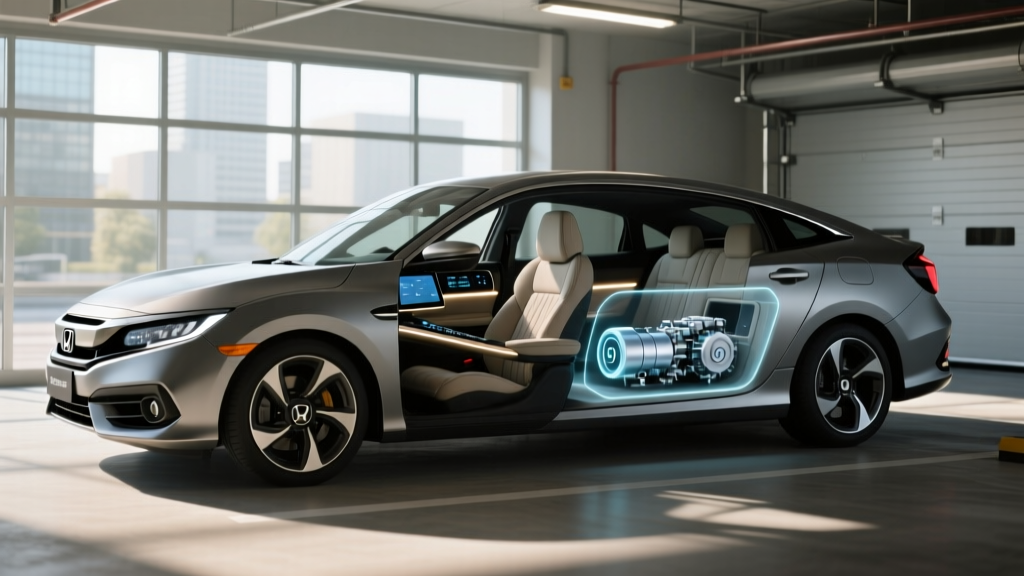
Honda's two-motor hybrid system operates differently than Toyota's planetary-gear setup. At low speeds, the propulsion motor drives the wheels directly while the engine acts as a generator. At highway speeds, a lockup clutch connects the engine directly to the wheels for efficiency. The result is smooth, electric-like acceleration around town and efficient cruising on the interstate.
The Touring trim adds features that slightly increase weight (leather seats, 10-speaker audio, wireless charging, navigation) compared to lower trims, but the impact on fuel economy is negligible — all Accord Hybrid trims share the same 48 MPG combined EPA rating.
Battery Warranty, Lifespan, and Replacement Cost
Hybrid battery longevity is the top concern for used hybrid buyers. Here's what Honda covers and what to expect:
| Coverage | Terms |
|---|---|
| Hybrid battery warranty | 8 years / 100,000 miles (10 yr / 150,000 mi in CARB states) |
| Hybrid system components | 8 years / 100,000 miles |
| Powertrain warranty | 5 years / 60,000 miles |
| Basic warranty | 3 years / 36,000 miles |
For a 2022 model, the original hybrid battery warranty extends to at least 2030 or 100,000 miles (whichever comes first). In California Air Resources Board (CARB) states — including CA, NY, MA, NJ, CT, and others — the warranty extends to 10 years / 150,000 miles, covering the battery through 2032.
Real-world degradation: Honda's lithium-ion hybrid battery is small (1.3 kWh) and operates in a narrow state-of-charge window (roughly 40-60%), which minimizes stress. Most Honda hybrid batteries from the 2017-2022 generation show minimal capacity loss at 100,000 miles. Unlike EV batteries, hybrid batteries don't need to hold large amounts of energy — even a 20% capacity loss would be barely noticeable in daily driving because the system compensates by running the engine slightly more.
Replacement cost: If the hybrid battery fails out of warranty, a new OEM replacement from Honda runs approximately $3,000-$4,000 (parts and labor). Third-party refurbished units are available for $1,500-$2,500. This is significantly less than EV battery replacement ($8,000-$20,000+) because the battery is far smaller.
Pricing, Tax Credits, and Ownership Economics
The 2022 Honda Accord Hybrid Touring carried an original MSRP of $37,295 (including destination). On the used market in 2026, expect to pay approximately $24,000-$29,000 depending on mileage and condition.
Federal tax credit: The Accord Hybrid does not qualify for the federal §30D clean vehicle credit. That credit applies only to plug-in electric vehicles (PHEVs and BEVs) with sufficient battery capacity. Conventional HEVs are excluded. Some states offer minor incentives for hybrids, but these vary by jurisdiction — check your state's energy or DMV website for current programs.
For current §30D rules and eligible vehicles, refer to the IRS clean vehicle credit page.
Estimated 5-Year Ownership Cost (15,000 mi/year)
| Category | Accord Hybrid Touring | Accord 1.5T (gas) | Notes |
|---|---|---|---|
| Fuel (75,000 mi) | ~$4,700 | ~$6,600 | At $3.50/gal; 48 vs 33 MPG combined |
| Insurance (avg.) | ~$8,500 | ~$7,800 | Hybrid premiums slightly higher |
| Maintenance | ~$2,200 | ~$2,500 | Regen braking saves pad wear |
| Depreciation (est.) | ~$9,000 | ~$8,500 | Hybrids hold value well in 2026 |
| Total (5-year est.) | ~$24,400 | ~$25,400 | Hybrid saves ~$1,000 over 5 years |
The fuel savings are meaningful but not dramatic — roughly $1,900 over five years at $3.50/gallon. The Accord Hybrid's advantage is lower total cost without requiring any change in fueling behavior. If gas prices rise above $4.50/gallon, the savings widen considerably.
Accord Hybrid vs PHEV vs EV: Which Fits You?
Choose the Accord Hybrid (HEV) if:
- You cannot charge at home (apartment, street parking, no garage)
- You regularly drive 400+ miles in a day and don't want to plan charging stops
- You want maximum simplicity — gas and go, no apps, no charging cables
- Your daily commute is under 50 miles but you take frequent long road trips
Choose a PHEV (e.g., Toyota Prius Prime, Hyundai Tucson PHEV) if:
- You can install a Level 2 charger at home and have a commute under 40 miles
- You want electric-only daily driving but gas flexibility for road trips
- You qualify for the §30D federal tax credit (income and sourcing rules apply)
Choose a full EV (e.g., Tesla Model 3, Hyundai Ioniq 6) if:
- You have reliable home charging and your daily driving is under 250 miles
- You want the lowest per-mile fuel cost ($0.04-$0.06/mi on home electricity vs $0.10-$0.14/mi for the Accord Hybrid)
- You want minimal maintenance (no oil changes, fewer brake jobs, no transmission fluid)
The Accord Hybrid's strongest position in 2026 is for buyers who want excellent fuel economy with zero lifestyle changes. No charging infrastructure needed, no range planning, no cold-weather range loss beyond what any gas car experiences. It simply gets 48 MPG and goes 580 miles on a tank.
Pros and Cons
Pros
- 48 MPG combined EPA — among the best in any midsize sedan
- No plug-in charging required; works with existing gas infrastructure
- 580-mile total range eliminates range anxiety entirely
- Smooth, electric-like low-speed acceleration from two-motor system
- Touring trim includes Honda Sensing suite, leather, premium audio
- Strong resale value; hybrid demand remains high in 2026
- Hybrid battery warranty extends to 2030+ on 2022 models
Cons
- No federal tax credit eligibility (HEV excluded from §30D)
- Highway MPG drops to 42-46 in real-world sustained-speed driving
- Cold-weather fuel economy drops 10-15% (no heat pump)
- CVT-like driving feel lacks engagement compared to geared transmissions
- FWD only — no AWD option (available on Toyota Camry Hybrid)
- Touring trim MSRP was $37,295 — premium over base Hybrid (~$28,000)
- Discontinued after 2022 model year (replaced by 2023+ Accord Hybrid redesign)
Frequently Asked Questions
How many MPG does the 2022 Honda Accord Hybrid Touring get?
The EPA rates it at 48 MPG city, 47 MPG highway, and 48 MPG combined. In real-world driving, owners typically see 44-49 MPG combined, with city driving often exceeding 48 MPG and highway cruising dropping to 42-46 MPG. Cold weather reduces efficiency to approximately 38-43 MPG.
Is the 2022 Accord Hybrid a plug-in hybrid?
No. The Accord Hybrid is a conventional HEV (hybrid electric vehicle). You never plug it in. It charges its small 1.3 kWh battery through regenerative braking and the gasoline engine. Honda did not offer a plug-in Accord in the US market for this generation.
Does the Accord Hybrid qualify for any tax credit?
No. The federal §30D clean vehicle credit applies only to plug-in vehicles (PHEVs and BEVs). Conventional hybrids like the Accord Hybrid are not eligible. Some states may offer minor incentives — check your state's energy office for details.
How long will the hybrid battery last, and what does replacement cost?
Honda's hybrid battery is warranted for 8 years/100,000 miles (10 years/150,000 miles in CARB states). For a 2022 model, this means coverage through at least 2030. Real-world data from Honda's hybrid fleet suggests these batteries last well beyond 150,000 miles with minimal degradation. If replacement is needed out of warranty, expect $3,000-$4,000 for an OEM unit or $1,500-$2,500 for a refurbished battery.
Is the 2022 Accord Hybrid reliable?
Yes. Honda's two-motor hybrid system has been in production since 2014 (Accord Hybrid) and 2017 (redesigned system). The powertrain has fewer wear components than a conventional automatic transmission — no torque converter, no traditional gear sets. The NHTSA gave the 2022 Accord strong safety ratings, and the IIHS named it a Top Safety Pick+.
How does it compare to the Toyota Camry Hybrid?
The 2022 Camry Hybrid is rated at 52 MPG combined (LE trim) or 46 MPG (XLE/XSE), giving it a slight efficiency edge in lower trims. The Camry Hybrid offers AWD as an option, which the Accord does not. However, the Accord Hybrid Touring offers a more spacious rear seat (40.8" vs 38.0" legroom) and a larger trunk (16.7 vs 15.1 cu ft). Both are excellent choices; the decision often comes down to AWD needs and interior space preference.
Should I buy a used 2022 Accord Hybrid in 2026?
If you want a reliable, efficient midsize sedan with no charging requirements, the 2022 Accord Hybrid Touring is a strong used-market pick. With original hybrid battery warranty still active through 2030, you're protected on the most expensive component. At $24,000-$29,000 used, it offers premium features and 48 MPG at a significant discount from its original $37,295 MSRP. The main consideration is that Honda redesigned the Accord for 2023 with updated styling and tech — if those matter to you, the newer generation is worth comparing.