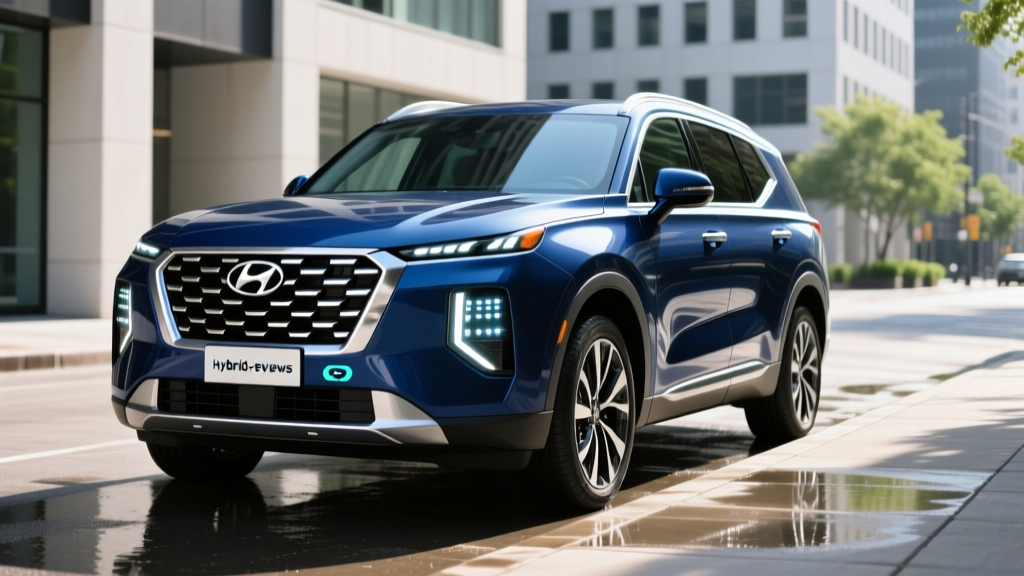
The 2026 Hyundai Palisade Hybrid arrives as the second model year of Hyundai's fourth-generation three-row SUV, and it carries a specific mission: deliver the cargo and passenger space of a full-size SUV without the fuel bill of a traditional V6. For families weighing a large SUV purchase, the Palisade Hybrid sits at a crossroads between conventional gas models, plug-in hybrids, and full EVs — and understanding exactly what it offers (and what it doesn't) is critical before signing a lease or purchase agreement.
This guide breaks down the 2026 Palisade Hybrid's powertrain, real-world and EPA fuel economy, pricing across trims, battery warranty coverage, and how it stacks up against the PHEV and full-EV alternatives.
2026 Palisade Hybrid Powertrain and Performance Specs
The 2026 Palisade Hybrid pairs a 1.6-liter turbocharged four-cylinder engine with an electric motor integrated into the transmission housing. This is Hyundai's proven Smartstream hybrid architecture, shared in concept with the Tucson Hybrid and Santa Fe Hybrid but tuned for the Palisade's larger mass and towing demands.
| Specification | Value |
|---|---|
| Engine | 1.6L turbocharged 4-cylinder |
| Electric Motor | 44.2 kW (59 hp) permanent-magnet synchronous |
| Combined System Output | ~258 hp / 258 lb-ft torque (est.) |
| Transmission | 6-speed automatic (hybrid-optimized) |
| Drivetrain | FWD standard; HTRAC AWD available |
| Hybrid Battery | ~1.49 kWh lithium-ion (self-charging HEV) |
| Towing Capacity | Up to 5,000 lbs (AWD, properly equipped) |
| 0–60 mph | ~7.8 seconds (est.) |
| Seating | 7 or 8 passengers |
| Cargo (behind 3rd row) | ~18.0 cu ft |
The combined output of approximately 258 horsepower is a meaningful upgrade over the prior-generation Palisade V6's 291 hp in peak terms, but the hybrid's electric motor fills in low-rpm torque, making acceleration from a stoplight feel more responsive than the numbers suggest. The 6-speed automatic avoids the drone associated with CVTs in some competing hybrids, a deliberate choice by Hyundai for a vehicle in this price class.
HEV vs PHEV: Which Palisade Are We Talking About?
Before going further, it's essential to distinguish between the two hybrid flavors Hyundai offers in its SUV lineup — because the Palisade Hybrid is a conventional hybrid (HEV), not a plug-in hybrid (PHEV). This distinction matters for your daily routine, your wallet, and your tax situation.
| Feature | Conventional Hybrid (HEV) | Plug-In Hybrid (PHEV) |
|---|---|---|
| Plugs in to charge? | No — charges via regenerative braking and engine | Yes — has a larger battery you charge externally |
| Electric-only range | Very short (under 1 mile at low speeds) | Typically 25–45 miles on battery alone |
| Battery size | ~1–2 kWh | ~13–25 kWh |
| Federal tax credit (§30D) | Not eligible | Up to $7,500 (if requirements met) |
| Best for | Drivers who can't charge at home; want better MPG without lifestyle change | Drivers with home charging and short commutes who want EV-like daily driving |
As of the 2026 model year, Hyundai does not offer a Palisade PHEV in the United States. If plug-in capability is a must-have in a three-row Hyundai SUV, the closest option is the Hyundai Santa Fe PHEV, though it sacrifices third-row space and cargo volume. The Palisade Hybrid is strictly an HEV — it never needs to be plugged in and operates like a conventional gas car that simply sips less fuel.
Fuel Economy: EPA Ratings and Real-World MPG
The headline number for any hybrid buyer is fuel economy. Here's what the EPA rates the 2026 Palisade Hybrid at, based on the most current fueleconomy.gov data:
| Drivetrain | City MPG | Highway MPG | Combined MPG |
|---|---|---|---|
| FWD | 30 | 28 | 29 |
| HTRAC AWD | 28 | 26 | 27 |
Compared to the non-hybrid 2026 Palisade with its turbocharged 2.5-liter four-cylinder (rated at approximately 22 mpg combined for AWD), the hybrid delivers a 20–25% improvement in overall fuel consumption. Over 15,000 miles per year at $3.50/gallon, that's roughly $550–$700 in annual fuel savings.
Pricing, Trims, and Tax Credit Eligibility
The 2026 Palisade Hybrid is available across multiple trim levels. Pricing below reflects MSRP (destination charges may add approximately $1,395):
| Trim | Drivetrain | MSRP (est.) |
|---|---|---|
| SEL Premium | FWD | $44,350 |
| SEL Premium | HTRAC AWD | $46,350 |
| Limited | HTRAC AWD | $51,200 |
| Calligraphy | HTRAC AWD | $54,800 |
Federal Tax Credit Status
Because the Palisade Hybrid is a conventional HEV (not a plug-in hybrid), it does not qualify for the federal §30D new clean vehicle tax credit. That credit, currently up to $7,500, is reserved for battery electric vehicles (BEVs) and plug-in hybrids (PHEVs) that meet battery sourcing, MSRP cap, and buyer income requirements as outlined on irs.gov.
Some states may offer their own incentives for hybrid vehicles — for example, certain states provide rebates or reduced registration fees for any electrified vehicle. Check your state's energy office or department of environmental quality for current programs, as these vary widely by jurisdiction and change annually.
- Vehicle must be a BEV or PHEV (not a conventional HEV) — Palisade Hybrid does not qualify
- MSRP cap: $80,000 for SUVs/vans/pickups; $55,000 for sedans
- Buyer income cap: $150K single / $300K joint (modified AGI)
- Battery must meet critical-mineral and component sourcing thresholds
- Credit can be transferred to the dealer at point of sale for an upfront price reduction
If the tax credit is a priority, consider the Hyundai Ioniq 5 (BEV) or Santa Fe PHEV instead.
Battery Warranty, Longevity, and Replacement Cost
The hybrid battery is the single biggest concern for used-hybrid buyers and a top question for new-hybrid shoppers. Here's what Hyundai provides:
- Hybrid battery: 10 years / 100,000 miles (whichever comes first)
- Hybrid system components (motor, inverter, controller): 10 years / 100,000 miles
- Powertrain warranty: 10 years / 100,000 miles
- Basic bumper-to-bumper: 5 years / 60,000 miles
Hyundai's 10-year hybrid battery warranty is among the best in the industry and matches or exceeds Toyota's coverage. In states that follow California Air Resources Board (CARB) emissions standards, hybrid-related emissions components may carry extended coverage up to 15 years / 150,000 miles.
How Long Will the Battery Actually Last?
The Palisade Hybrid's ~1.49 kWh battery is small by EV standards, but that's actually an advantage for longevity. Small hybrid batteries experience shallow charge/discharge cycles — typically cycling between 40% and 80% state of charge — which dramatically reduces wear. Real-world data from Hyundai's Tucson and Sonata hybrids (which share similar battery chemistry and management systems) shows minimal degradation over 100,000+ miles.
If the battery does fail outside warranty, replacement cost for a Hyundai hybrid battery pack in this size class typically ranges from $2,000 to $3,500 including labor at a dealership. Independent hybrid specialists can sometimes source refurbished packs for $1,200–$2,000. This is a fraction of the cost of a full EV battery replacement ($8,000–$20,000+), which is one reason hybrids carry lower long-term risk for battery-anxious buyers.
Who Should Choose the Palisade Hybrid vs a PHEV or Full EV?
The Palisade Hybrid is not the right choice for everyone. Here's a practical decision framework:
- You cannot install a Level 2 home charger (apartment living, no garage, HOA restrictions)
- You regularly take road trips exceeding 300+ miles and don't want to plan around charging stops
- You need three rows and 5,000-lb towing but want better fuel economy than a gas-only SUV
- You prefer zero change to your refueling habits — just fill up at any gas station
- You have home Level 2 charging and a commute under 30 miles round-trip
- You want EV-like daily driving with a gas backup for longer trips
- The federal §30D tax credit (up to $7,500) would meaningfully lower your purchase cost
- You can accept slightly less cargo space and a smaller third row
- You have reliable home charging and access to DC fast charging on road trips
- You want the lowest per-mile energy cost (electricity vs. gasoline)
- You want to maximize federal and state incentives
- You're willing to plan charging stops on long trips (30–40 min every 250–300 miles)
Pros and Cons of the 2026 Palisade Hybrid
Pros
- 29 mpg combined (FWD) is excellent for a 4,500+ lb three-row SUV
- No plug-in charging required — zero lifestyle change from a gas car
- 10-year / 100,000-mile hybrid battery warranty
- Strong low-end torque from electric motor improves city drivability
- 5,000-lb towing capacity retained (AWD)
- Hyundai's comprehensive warranty coverage across the board
Cons
- No federal tax credit — HEVs are excluded from §30D
- No PHEV variant available — can't drive on electric-only for commutes
- AWD fuel economy drops to 27 mpg combined
- Hybrid premium over gas model adds $2,000–$3,000 to purchase price
- Highway mpg is lower than city mpg (typical of hybrids but counterintuitive)
- Smaller hybrid battery means no meaningful electric-only range
Frequently Asked Questions
How many MPG does the 2026 Palisade Hybrid get?
The EPA rates the FWD Palisade Hybrid at 30 city / 28 highway / 29 combined mpg. The HTRAC AWD model is rated at 28 city / 26 highway / 27 combined. In real-world suburban driving, many owners report matching or slightly exceeding the city figure thanks to regenerative braking, while sustained highway speeds above 70 mph tend to pull numbers below the highway rating.
Does the Palisade Hybrid need to be plugged in?
No. The Palisade Hybrid is a conventional (self-charging) hybrid. The small battery recharges through regenerative braking and the gasoline engine. You simply fill up at a gas station as you would with any other vehicle. There is no plug, no charging cable, and no home charger required.
How far can the Palisade Hybrid drive on electric only?
Effectively zero miles at any meaningful speed. The ~1.49 kWh battery provides brief electric-only assist at very low speeds (parking lots, creeping in traffic) but is not designed for sustained electric-only driving. If electric-only commute range is a priority, you need a PHEV or a full EV.
Is the 2026 Palisade Hybrid reliable?
Hyundai's hybrid powertrain has a strong track record across the Tucson, Sonata, and Santa Fe lineups. The hybrid system adds complexity (electric motor, inverter, battery) but removes other wear items — regenerative braking extends brake pad life significantly, and the engine operates under less stress. The 10-year/100,000-mile hybrid battery warranty provides long-term peace of mind. Independent reliability data from sources like IIHS and owner surveys show Hyundai hybrids performing well in the 3–5 year ownership window.
What does a Palisade Hybrid battery replacement cost?
Out of warranty, a replacement hybrid battery pack for a Hyundai SUV in this class typically costs $2,000–$3,500 at a dealership (parts and labor). Refurbished or aftermarket packs may be available for $1,200–$2,000 through independent hybrid specialists. Given the 10-year/100,000-mile warranty and the shallow-cycle nature of small HEV batteries, most owners will never face this expense.
Does the Palisade Hybrid qualify for any tax credit?
Not the federal §30D credit — that is limited to plug-in hybrids and battery electric vehicles. Some states offer their own hybrid incentives (rebates, HOV lane access, reduced registration fees), but these vary by jurisdiction. Check your state's official energy or environmental agency website for current programs. Consult a tax professional for personalized advice.
How does the Palisade Hybrid compare to the Toyota Grand Highlander Hybrid?
The Toyota Grand Highlander Hybrid is the Palisade Hybrid's most direct competitor. The Grand Highlander Hybrid achieves up to 36 mpg combined (FWD) with Toyota's fourth-generation hybrid system, which is notably higher than the Palisade's 29 mpg. However, the Palisade typically offers a lower starting price, more aggressive styling, and Hyundai's longer 10-year powertrain warranty vs. Toyota's 10-year hybrid battery but 5-year powertrain coverage. The choice often comes down to whether fuel economy (Toyota) or value and warranty (Hyundai) ranks higher on your list.
Bottom Line: Is the 2026 Palisade Hybrid Worth the Premium?
The hybrid premium over the gas-only Palisade is roughly $2,000–$3,000 depending on trim. At a savings of approximately $600 per year in fuel costs (15,000 miles driven, $3.50/gallon, 22 mpg gas vs. 29 mpg hybrid), the payback period is about 3.5 to 5 years. If you plan to keep the vehicle for the full warranty period (10 years), the hybrid pays for itself and then some — while delivering smoother low-speed acceleration and reduced brake wear as bonus benefits.
For families who need three rows, can't charge at home, and want to reduce fuel costs without changing their driving habits, the 2026 Palisade Hybrid is one of the most practical options on the market. It won't give you electric-only commuting or a federal tax credit, but it will cut your fuel bill by 20–25% and ask nothing of you in return except the occasional trip to the gas station.