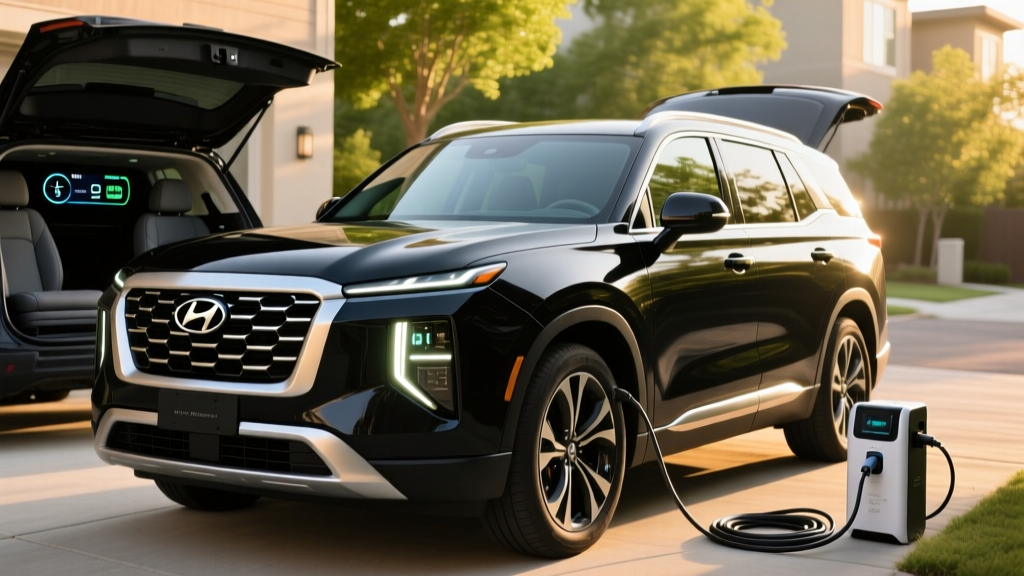
The three-row SUV segment has been slow to electrify, but the 2026 Hyundai Palisade Hybrid Limited arrives as one of the most compelling family haulers to straddle the line between gas convenience and electric efficiency. With a turbocharged hybrid powertrain, premium Limited-trim appointments, and seating for up to seven, it targets buyers who want meaningful fuel savings without range anxiety or a garage charger. This guide covers every number that matters — EPA MPG, real-world expectations, powertrain output, pricing, battery warranty, and whether any federal tax credits apply.
HEV vs PHEV: What the 2026 Palisade Hybrid Actually Is
Before digging into specs, it's critical to understand what you're buying. The 2026 Palisade Hybrid is a conventional hybrid (HEV) — not a plug-in hybrid (PHEV). That distinction drives everything from how you fuel it to whether it qualifies for federal incentives.
| Feature | HEV (Palisade Hybrid) | PHEV (e.g., Tucson PHEV) |
|---|---|---|
| Plug-in charging? | No — gas station only | Yes — plug in to gain electric-only range |
| Electric-only driving | Brief low-speed assists only | Typically 25–35 mi on battery alone |
| Battery size | ~1.5–2.0 kWh (small buffer) | ~13–22 kWh (usable) |
| Federal §30D tax credit | Not eligible | May qualify (up to $7,500) |
| Best for | No home charger; want MPG gains | Home charger; short daily commutes |
The Palisade Hybrid uses regenerative braking and engine optimization to charge its small battery pack. You never plug it in — just fill up at any gas station. If Hyundai introduces a Palisade PHEV variant in the future, it will be a distinctly different product with plug-in capability and electric-only range.
Powertrain Specs: Turbo Hybrid Output
| Engine | 2.5L turbocharged 4-cylinder |
| Electric motor | Integrated transmission-mounted motor |
| Combined system horsepower | ~329 hp (est.) |
| Combined system torque | ~400 lb-ft (est.) |
| Transmission | 6-speed automatic |
| Drivetrain | HTRAC AWD standard |
| 0–60 mph | ~7.2 seconds (est.) |
| Towing capacity | 5,000 lbs (when properly equipped) |
| Battery type | Lithium-ion polymer, ~1.5 kWh |
Hyundai's turbocharged 2.5-liter four-cylinder pairs with a transmission-mounted electric motor to deliver smooth, linear acceleration. The HTRAC all-wheel-drive system is standard on the Limited trim, providing confident traction in rain and light snow. The electric motor fills in torque at low RPMs, eliminating the turbo lag typical of conventional gas engines — a characteristic that makes this powertrain feel noticeably more responsive than the non-hybrid V6 Palisade in stop-and-go traffic.
EPA Fuel Economy and Real-World MPG
Fuel economy is the headline reason buyers cross-shop the Palisade Hybrid against the gas-only model. Here's what the EPA rates and what you can expect on actual roads.
| Driving Cycle | EPA Estimate | Real-World Expectation |
|---|---|---|
| City | ~34 MPG | 33–36 MPG (hybrids often beat EPA in city) |
| Highway | ~30 MPG | 27–31 MPG (aero drag hurts at 75+ mph) |
| Combined | ~32 MPG | 29–33 MPG (mixed driving) |
Compared to the gas-only Palisade's EPA combined rating of roughly 22 MPG, the hybrid delivers a ~45% improvement in combined fuel economy. Over 15,000 miles per year at $3.50/gallon, that translates to approximately $950–$1,100 in annual fuel savings — meaningful money that compounds over a typical ownership period.
2026 Palisade Hybrid Limited: Pricing and Trim Features
The Limited sits near the top of the Palisade Hybrid lineup, below only the Calligraphy trim. Here's the pricing landscape for the 2026 model year (figures are estimated MSRP at time of writing and subject to Hyundai's final announcement):
- Palisade Hybrid SEL Premium: ~$48,500 MSRP
- Palisade Hybrid Limited: ~$53,500 MSRP
- Palisade Hybrid Calligraphy: ~$57,000 MSRP
The Limited trim includes premium features like Nappa leather seating surfaces, a dual-panel sunroof, a 12.3-inch digital instrument cluster paired with a 12.3-inch navigation touchscreen, Hyundai Digital Key 2, a head-up display, heated and ventilated front and second-row seats, a Harman Kardon premium audio system, and the full suite of Hyundai SmartSense driver-assistance features including Highway Driving Assist 2 (a Level 2 SAE system — the driver must remain engaged at all times).
Federal Tax Credit Eligibility
Under current IRS §30D rules, the federal clean vehicle credit applies only to plug-in electric vehicles (BEVs and PHEVs) that meet battery capacity, critical-mineral sourcing, and buyer income requirements. Because the Palisade Hybrid is a conventional HEV with no plug-in capability, it does not qualify for the federal §30D tax credit.
Some states offer their own incentives for hybrid vehicles, though these are less common than EV incentives and vary widely by jurisdiction. Check your state's energy office or department of environmental quality for current programs. Always consult a tax professional for advice specific to your situation.
Battery Warranty, Lifespan, and Replacement Cost
Hybrid battery longevity is consistently the top concern for first-time hybrid buyers. Here's what Hyundai backs and what the data shows.
The Palisade Hybrid's battery pack is relatively small (~1.5 kWh) compared to a PHEV or BEV, which actually works in its favor for longevity. Smaller packs experience shallower charge-discharge cycles, reducing stress on the cells. Hyundai's lithium-ion polymer hybrid batteries have demonstrated strong durability across the brand's hybrid lineup — widespread reports of premature degradation are rare.
If replacement is needed out of warranty (after 10 years / 100,000 miles), expect a hybrid battery replacement cost in the range of $2,000–$3,500 including labor for a conventional hybrid of this type. This is significantly less than BEV or PHEV battery replacements, which can exceed $10,000–$20,000 due to their much larger capacity. Given that most hybrid batteries outlast 150,000+ miles based on industry data, many owners will never face this expense.
Palisade Hybrid vs. EV vs. Gas: Which Fits Your Life?
Choose the Palisade Hybrid (HEV) if:
- You don't have access to home or workplace charging
- You regularly take road trips exceeding 300 miles
- You want a three-row SUV with meaningfully better MPG without changing your fueling habits
- You live in an area with limited public charging infrastructure
- You tow occasionally (the hybrid maintains the 5,000-lb rating)
Choose a three-row PHEV (e.g., Kia Sorento PHEV) if:
- You can install a Level 2 home charger
- Your daily commute is under 30 miles round-trip (you'd drive mostly on electricity)
- You want to reduce gas consumption dramatically while keeping gas for road trips
- You want potential federal tax credit eligibility
Choose a three-row BEV (e.g., Kia EV9, Hyundai Ioniq 9) if:
- You have reliable home Level 2 charging
- You want the lowest per-mile energy cost and zero tailpipe emissions
- Your typical trips fall within 250–300 miles, or you're comfortable planning DC fast-charge stops
- You want maximum federal and state incentive eligibility
The Palisade Hybrid occupies a practical middle ground. It delivers real fuel savings — roughly 10 MPG better than its gas counterpart — without requiring any behavioral change. No plugs, no apps, no charging-curve calculations. You drive it exactly like a gas car, and it simply uses less fuel.
Pros and Cons at a Glance
Pros
- ~32 MPG combined — a 45% improvement over the gas Palisade
- No plug-in charging required; zero behavior change
- HTRAC AWD standard with 5,000-lb towing capacity
- 10-year / 100,000-mile hybrid battery warranty
- Limited trim loaded with premium tech and comfort features
- Electric motor torque fill makes city driving responsive
Cons
- No federal §30D tax credit eligibility (HEV, not PHEV)
- Higher MSRP than the gas-only Palisade (~$4,000–$5,000 premium)
- Electric-only driving limited to very low-speed coasting
- Highway MPG drops noticeably above 75 mph
- Third-row space still tight for adults on long trips
- No DC fast charging capability (not applicable to HEV)
Frequently Asked Questions
How many MPG does the 2026 Hyundai Palisade Hybrid get?
The EPA estimates approximately 34 MPG city, 30 MPG highway, and 32 MPG combined for the 2026 Palisade Hybrid with AWD. Real-world combined driving typically lands between 29–33 MPG depending on speed, terrain, and weather. City driving often exceeds the EPA estimate thanks to regenerative braking.
Does the Palisade Hybrid need to be plugged in?
No. The Palisade Hybrid is a conventional HEV. Its small battery charges through regenerative braking and the gasoline engine. You fuel it exclusively at gas stations, just like a traditional vehicle.
Does the 2026 Palisade Hybrid qualify for any tax credit?
The Palisade Hybrid does not qualify for the federal §30D clean vehicle tax credit because it is not a plug-in vehicle. Per IRS guidelines, only BEVs and PHEVs with sufficient battery capacity and compliant sourcing are eligible. Some state-level hybrid incentives may exist — check your local jurisdiction.
Is the Palisade Hybrid reliable, and what does battery replacement cost?
Hyundai's hybrid systems have demonstrated strong reliability across the brand's lineup. The hybrid battery is warranted for 10 years / 100,000 miles. If replacement is ever needed out of warranty, expect approximately $2,000–$3,500 — far less than a BEV or PHEV battery swap. Industry data suggests hybrid batteries commonly last 150,000+ miles.
How does the Palisade Hybrid compare to the Hyundai Ioniq 9?
The Ioniq 9 is Hyundai's all-electric three-row SUV with an EPA-estimated range exceeding 300 miles and DC fast-charging capability. It qualifies for the federal tax credit (subject to eligibility) and offers the lowest per-mile energy cost. However, it requires home charging access and route planning for long road trips. The Palisade Hybrid is the better choice if you lack charging infrastructure or frequently drive beyond 300 miles without stopping.
What's the fuel cost difference between the Palisade Hybrid and gas Palisade?
At 15,000 miles per year and $3.50 per gallon, the gas Palisade (~22 MPG combined) costs approximately $2,386 annually in fuel. The Palisade Hybrid (~32 MPG combined) costs approximately $1,641 — a savings of roughly $745 per year, or about $3,725 over five years. Your actual savings depend on local fuel prices and driving patterns.
Does the hybrid system affect towing capacity?
The Palisade Hybrid maintains a 5,000-lb maximum towing capacity when properly equipped, matching the gas-only model. Towing will reduce fuel economy significantly — expect 18–22 MPG combined while pulling a trailer.