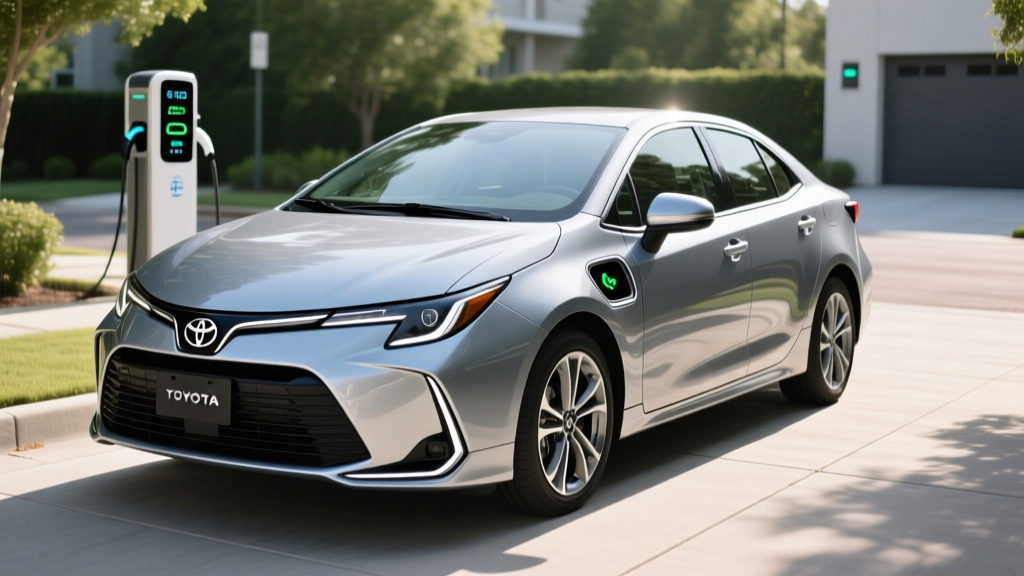
The Toyota Corolla Hybrid has quietly become one of the most efficient vehicles you can buy without plugging in. For 2026, Toyota carries forward the fifth-generation hybrid system that debuted with the current generation, pairing a 1.8-liter four-cylinder with dual electric motors and a compact lithium-ion battery pack. The result is a sedan that routinely exceeds 50 MPG in real-world city driving while starting under $25,000.
This is a conventional hybrid (HEV), not a plug-in. You never need to charge it — the system recovers energy through regenerative braking and the gasoline engine. If you're looking for electric-only driving, you'll want to consider a PHEV or full BEV instead (more on that below).
2026 Corolla Hybrid Fuel Economy: EPA Ratings vs. Real World
The EPA rates the 2026 Corolla Hybrid as follows, depending on trim and drivetrain:
| Trim / Drivetrain | City MPG | Highway MPG | Combined MPG |
|---|---|---|---|
| LE (FWD) | 53 | 46 | 50 |
| LE (AWD-e) | 51 | 44 | 48 |
| SE (FWD) | 50 | 43 | 47 |
| XSE (FWD) | 50 | 43 | 47 |
These are among the highest EPA ratings of any non-plug-in vehicle sold in the United States, trailing only the Hyundai Ioniq Hybrid and rivaling the Prius. According to fueleconomy.gov, the FWD LE trim's 50 MPG combined saves an estimated $3,750 in fuel costs over five years compared to the average new vehicle.
Powertrain and Performance Specs
The 2026 Corolla Hybrid uses Toyota's fifth-generation hybrid synergy drive. Here's the full breakdown:
| Engine | 1.8L DOHC 4-cylinder (Atkinson cycle) |
| Engine Power | 96 hp @ 5,200 rpm |
| Front Motor Power | 94 hp (70 kW) |
| AWD-e Rear Motor (if equipped) | 40 hp (30 kW) |
| Net Combined Horsepower | 138 hp |
| Hybrid Battery | ~0.9 kWh lithium-ion (sealed, not plug-in) |
| Transmission | Electronically controlled CVT (eCVT) |
| 0–60 MPH | ~9.1 seconds (FWD) |
| Drivetrain Options | FWD or AWD-e (electronic on-demand) |
| Fuel Tank Capacity | 11.4 gallons |
| Total Driving Range | ~570 miles (FWD LE at 50 MPG combined) |
The 138 combined horsepower is modest — this is not a performance car. The 0–60 time of roughly 9.1 seconds is adequate for merging and passing but won't win any stoplight races. Where the Corolla Hybrid excels is low-speed responsiveness: the electric motor provides instant torque from a stop, making it feel quicker in city traffic than the 0–60 number suggests.
The AWD-e system is worth noting. Unlike mechanical all-wheel drive, the rear axle is powered by a separate 40 hp electric motor that engages only when slip is detected or during hard acceleration from low speeds. It adds roughly 100 lbs and costs you 2 MPG combined, but provides meaningful traction in rain and light snow without the efficiency penalty of a traditional AWD system.
Corolla Hybrid vs. Plug-In Hybrid vs. Full EV: Which Fits You?
The Corolla Hybrid is an HEV (hybrid electric vehicle). It cannot plug in and has no electric-only range to speak of — the small battery assists the gas engine but cannot drive the car on electricity alone for more than a mile or two at very low speeds. Here's how it compares to the alternatives:
| Factor | HEV (Corolla Hybrid) | PHEV (Prius Prime) | BEV (Tesla Model 3 / Chevy Equinox EV) |
|---|---|---|---|
| Plug-in Required? | No | Recommended (not required) | Yes |
| Electric-Only Range | ~0 miles | 39–44 miles | 250–363 miles |
| Home Charging Needed? | No | Optional but ideal | Yes (Level 2 strongly recommended) |
| Best For | Apartment dwellers, no charging access | Short commutes + home charging | Daily drivers with home/work charging |
| Fuel Cost (per mile) | ~$0.08 | ~$0.04 (electric) / $0.08 (gas) | ~$0.04 (electric) |
| Federal Tax Credit | Not eligible | Up to $3,750 (§30D) | Up to $7,500 (§30D) |
| Starting MSRP | ~$24,225 | ~$33,445 | ~$34,990+ |
Choose the Corolla Hybrid if you don't have access to home or workplace charging, want the lowest purchase price, and prioritize proven reliability over cutting-edge tech. It's the simplest path to 50 MPG with zero lifestyle change.
Choose a PHEV (like the Prius Prime) if you have a garage or driveway where you can install a Level 2 charger, your daily commute is under 40 miles round-trip, and you want to drive mostly on electricity while keeping a gas engine for road trips.
Choose a full BEV if you have reliable charging access, want the lowest per-mile fuel cost, and are ready to plan longer road trips around DC fast-charging stops.
Pricing, Trims, and Tax Credit Eligibility
The 2026 Corolla Hybrid is available in three trims. Pricing below includes destination charge:
| Trim | MSRP (FWD) | MSRP (AWD-e) | Key Features |
|---|---|---|---|
| LE | $24,225 | $25,625 | Toyota Safety Sense 3.0, 8" touchscreen, wireless CarPlay/Android Auto, LED headlights |
| SE | $26,725 | $28,125 | Sport-tuned suspension, 16" alloy wheels, paddle shifters, Smart Key |
| XSE | $28,925 | — | SofTex seats, 10.5" touchscreen, JBL audio (9 speakers), heated front seats, wireless charging |
Without a federal credit, the Corolla Hybrid's value proposition rests on its low purchase price and exceptional fuel economy. At $24,225 for the LE, it undercuts the gas-only Corolla LE by only about $1,000, yet saves roughly $750/year in fuel. The hybrid premium pays for itself in roughly 16 months for a driver covering 12,000 miles annually.
Hybrid Battery Warranty, Lifespan, and Replacement Cost
Hybrid battery longevity is the number-one concern for buyers considering a used or high-mileage Corolla Hybrid. Here's what you need to know:
| Hybrid Battery Warranty | 10 years / 150,000 miles (whichever comes first) |
| Hybrid System Components | 8 years / 100,000 miles |
| Powertrain Warranty | 5 years / 60,000 miles |
| Basic Bumper-to-Bumper | 3 years / 36,000 miles |
Toyota's 10-year/150,000-mile hybrid battery warranty is among the best in the industry. The battery pack itself is a compact lithium-ion unit — far smaller than an EV battery — and Toyota's hybrid system is engineered to keep it within an optimal state-of-charge window (roughly 40–80%), which dramatically reduces degradation.
Real-world lifespan data: Corolla Hybrids have been on sale since the 2020 model year in the US, and the broader Toyota hybrid platform (shared with the Prius) has over two decades of field data. Failure before 150,000 miles is uncommon. When replacement is needed out of warranty, a new OEM hybrid battery for the Corolla Hybrid costs approximately $2,000–$3,000 installed at a Toyota dealer. Independent hybrid specialists often offer refurbished packs for $1,200–$1,800.
For context, that's a fraction of EV battery replacement costs ($8,000–$20,000+), and the Corolla Hybrid's small battery is far less likely to need replacement within the typical ownership period.
Reliability, Safety, and Ownership Costs
The Corolla nameplate carries a reputation for bulletproof reliability, and the hybrid variant is no exception. The fifth-generation Toyota Hybrid System (THS) has been in production since 2022 and benefits from decades of iterative refinement. There are no belts to replace, no traditional starter motor, and the eCVT has no clutch packs or bands to wear out — it's a planetary gearset with far fewer failure points than a conventional automatic transmission.
Safety: Every 2026 Corolla Hybrid comes standard with Toyota Safety Sense 3.0, which includes:
- Pre-Collision System with Pedestrian Detection
- Lane Departure Alert with Steering Assist
- Dynamic Radar Cruise Control (full-speed)
- Lane Tracing Assist
- Automatic High Beams
- Road Sign Assist
The Corolla sedan has historically earned top marks from the IIHS and NHTSA. Toyota Safety Sense is a Level 1/Level 2 driver-assistance suite — it supports the driver but does not replace active supervision. You must keep your hands on the wheel and eyes on the road at all times.
Insurance and maintenance: The Corolla Hybrid typically costs $1,200–$1,600/year to insure (varies significantly by driver profile and state). Maintenance is minimal: oil changes every 10,000 miles, cabin air filter every 15,000–20,000 miles, and brake pads that often last 80,000+ miles thanks to regenerative braking handling most deceleration.
Pros
- 50+ MPG combined — among the most efficient non-plug-in vehicles sold
- Under $25,000 starting price — lowest-cost path to 50 MPG
- No plug-in charging required — works for apartment dwellers
- 10-year/150,000-mile hybrid battery warranty
- AWD-e available for rain and snow traction
- Toyota Safety Sense 3.0 standard on every trim
- Regenerative braking extends brake pad life significantly
Cons
- Modest 138 hp — slow acceleration (9.1 sec 0–60)
- No federal tax credit eligibility
- Small 11.4-gallon fuel tank limits range to ~570 miles
- Rear seat space is tight for taller passengers
- Base LE interior is functional but plain
- AWD-e costs 2 MPG and $1,400 extra
Who Should Buy the 2026 Corolla Hybrid?
The 2026 Corolla Hybrid is the right choice if your priority is maximum fuel efficiency with minimum lifestyle disruption. It's ideal for:
- Commuters without home charging: If you park on the street or in a garage without an outlet, a plug-in vehicle isn't practical. The Corolla Hybrid delivers 50 MPG with zero infrastructure change.
- Budget-conscious buyers: At $24,225, it's one of the cheapest new vehicles that achieves 50 MPG, and the total cost of ownership over five years is exceptionally low.
- Rideshare and delivery drivers: High city MPG directly translates to higher take-home earnings. The Corolla Hybrid's city-biased efficiency (53 MPG city) is ideal for stop-and-go routes.
- First-time hybrid buyers: The Corolla Hybrid is the lowest-risk entry point into hybrid ownership — proven tech, long warranty, and Toyota dealer support nationwide.
It's not the right choice if you want electric-only driving, need rapid acceleration, or require substantial cargo or passenger space (consider the Prius or a hybrid SUV like the RAV4 Hybrid instead).
Frequently Asked Questions
How many MPG does the 2026 Corolla Hybrid get?
The EPA rates the FWD Corolla Hybrid LE at 53 city / 46 highway / 50 combined MPG. The AWD-e version drops to 51/44/48. Sport-tuned SE and XSE trims are rated at 50/43/47. In real-world city driving, many owners report 52–56 MPG, exceeding the EPA estimate thanks to frequent regenerative braking opportunities.
Does the Corolla Hybrid need to be plugged in?
No. The Corolla Hybrid is a conventional hybrid (HEV). It charges its small battery pack through regenerative braking and the gasoline engine. You simply fill it with gas like any other car. There is no plug, no charging cable, and no electric-only driving range.
Is the Corolla Hybrid eligible for a federal tax credit?
No. The federal §30D clean vehicle credit requires a plug-in vehicle with at least 7 kWh of battery capacity. The Corolla Hybrid's battery is under 1 kWh, so it does not qualify. Some states and utilities offer small rebates for conventional hybrids — check your local programs for details.
How long will the hybrid battery last?
Toyota warranties the hybrid battery for 10 years or 150,000 miles. Based on two decades of Toyota hybrid data (Prius, Camry Hybrid, RAV4 Hybrid), most hybrid batteries last well beyond 150,000 miles with normal use. The system keeps the battery in a conservative state-of-charge window to minimize degradation.
How much does it cost to replace the Corolla Hybrid battery?
If replacement is needed out of warranty, expect to pay $2,000–$3,000 for a new OEM battery installed at a Toyota dealer. Refurbished or aftermarket packs from independent hybrid specialists typically cost $1,200–$1,800 installed. This is far less than EV battery replacement costs.
Corolla Hybrid vs. Prius: which is better?
The 2026 Prius (redesigned for 2023) is rated at up to 57 MPG combined and offers 196 hp — more power and more efficiency than the Corolla Hybrid, but starting around $28,345. The Corolla Hybrid is roughly $4,000 cheaper at the base trim. If budget is your top priority, the Corolla Hybrid wins. If you want more power and a few extra MPG, the Prius is the stronger overall package.
Is the AWD-e system worth it?
The AWD-e adds $1,400 and costs 2 MPG combined (48 vs. 50). It provides an electrically driven rear axle that engages during low-traction situations — useful in rain, slush, and light snow. If you live in a region with mild winters or frequently drive on wet roads, it's a reasonable upgrade. In dry, warm climates, the FWD model is the better value.
Sources: fueleconomy.gov (EPA ratings), Toyota Motor Corporation (manufacturer specifications), IRS §30D Clean Vehicle Credit (tax credit eligibility). All specifications reflect 2026 model year data available at time of publication. Verify pricing and eligibility with your local dealer and tax professional.