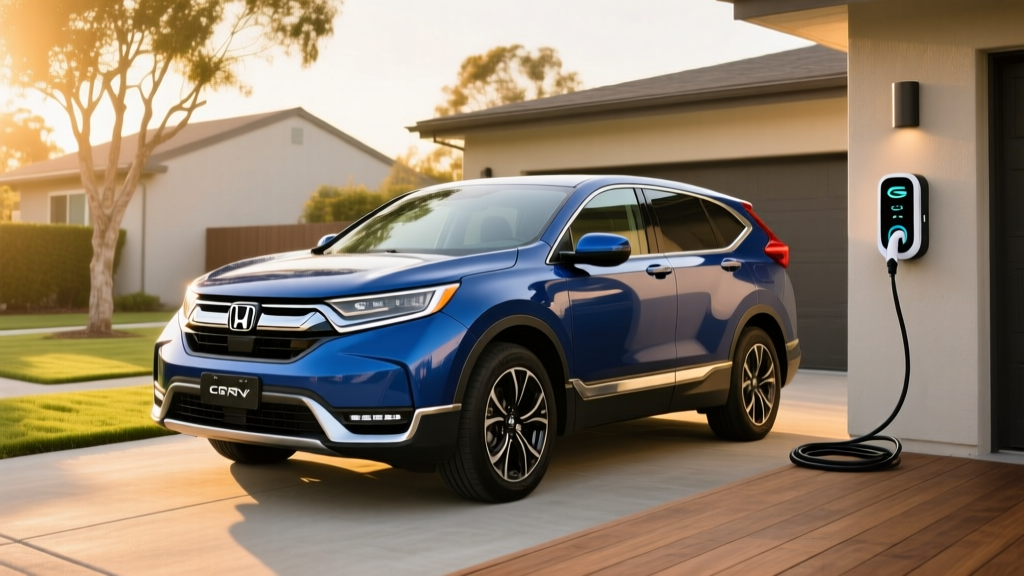
The Honda CR-V has been America's best-selling compact SUV for years, and its hybrid variant now accounts for a significant share of those sales. For 2026, the CR-V Hybrid continues with the proven two-motor powertrain introduced in the current generation, offering a compelling middle ground between a conventional gas SUV and a full battery-electric vehicle. If you're researching the 2026 CR-V Hybrid, you want hard numbers on fuel economy, real-world efficiency, pricing, and long-term battery reliability — not marketing slogans. This guide delivers exactly that.
2026 CR-V Hybrid Powertrain and Performance
The 2026 Honda CR-V Hybrid uses Honda's fourth-generation two-motor hybrid system, pairing a 2.0-liter Atkinson-cycle inline-four engine with two electric motors. The setup produces a combined system output of 204 horsepower and 247 lb-ft of torque, routed to the front wheels on standard trims or all four wheels via Honda's Real Time AWD system on available trims.
Unlike some competitors that use a traditional stepped automatic transmission, the CR-V Hybrid employs an e-CVT (electronic continuously variable transmission) that manages the interplay between the gas engine and electric motors seamlessly. The engine itself produces 146 hp, but the electric motors fill in the low-end torque gap, giving the CR-V Hybrid surprisingly confident acceleration from a stop. Honda lists 0-60 mph in approximately 7.6 seconds — not sporty, but perfectly adequate for highway merging and daily driving.
| Engine | 2.0L Atkinson-cycle I-4 |
|---|---|
| Combined System Output | 204 hp / 247 lb-ft torque |
| Transmission | e-CVT (two-motor hybrid system) |
| Drivetrain | FWD (Sport) or AWD (Sport Touring, Sport-L) |
| 0-60 mph | ~7.6 seconds |
| Towing Capacity | 1,000 lbs |
One note for buyers who tow: the CR-V Hybrid's 1,000-pound towing capacity is modest. If you regularly haul a small trailer or jet skis, the conventional 1.5L turbo CR-V (rated at 1,500 lbs) is the better choice. The hybrid's advantage is fuel efficiency, not hauling.
EPA Fuel Economy and Real-World MPG
Fuel economy is the headline reason buyers choose the CR-V Hybrid over its gas-only sibling. The EPA rates the 2026 CR-V Hybrid as follows:
| Drivetrain | City | Highway | Combined |
|---|---|---|---|
| FWD (Sport trim) | 43 MPG | 36 MPG | 40 MPG |
| AWD (Sport, Sport-L, Sport Touring) | 40 MPG | 34 MPG | 37 MPG |
Source: fueleconomy.gov
Real-World MPG: What to Actually Expect
The EPA numbers tell part of the story, but real-world results depend heavily on your driving mix. Based on owner-reported data and independent testing:
- City-dominant driving: The hybrid system excels here. Expect 38-44 MPG in stop-and-go traffic, where regenerative braking and electric-motor propulsion do the heavy lifting. Some owners consistently exceed the EPA city rating.
- Highway-dominant driving: At sustained 70-80 mph speeds, the gas engine runs more often. Expect 32-35 MPG on long highway trips, slightly below the EPA highway figure. This is typical for all hybrids — they're optimized for urban efficiency.
- Cold weather: In sub-freezing temperatures, expect a 3-5 MPG reduction as the engine runs more frequently to generate cabin heat and maintain battery temperature. This is less severe than the range loss EVs experience in cold weather but still measurable.
- Combined mixed driving (realistic): Most owners report 35-39 MPG in mixed AWD use, which aligns closely with the EPA combined rating.
At 15,000 miles/year and $3.40/gallon regular unleaded, the AWD Hybrid (37 MPG combined) costs approximately $1,378/year in fuel. The gas AWD CR-V (28 MPG combined) costs approximately $1,821/year. That's a savings of roughly $443 per year or $2,215 over five years with the hybrid.
2026 CR-V Hybrid Trims and Pricing
Honda offers the CR-V Hybrid exclusively in the sport-oriented trims for 2026. The hybrid powertrain is not available on the base LX or mid-tier EX — you must step up to a Sport badged trim to get it.
| Sport FWD | $36,395 |
|---|---|
| Sport AWD | $37,895 |
| Sport-L AWD | $40,895 |
| Sport Touring AWD | $43,895 |
All prices include destination charge. The Sport FWD at $36,395 represents the entry point into the CR-V Hybrid lineup and delivers the best fuel economy (40 MPG combined). The Sport Touring AWD at $43,895 adds leather seats, a Bose 12-speaker audio system, wireless Apple CarPlay and Android Auto, a heated steering wheel, and Honda's full Honda Sensing suite with low-speed braking control.
Federal and State Tax Credit Eligibility
The 2026 Honda CR-V Hybrid is a conventional hybrid (HEV), not a plug-in hybrid. Under current IRS §30D rules, the federal clean vehicle credit of up to $7,500 applies only to plug-in electric vehicles (BEVs and PHEVs) with qualifying battery sourcing, MSRP caps, and buyer income limits. The CR-V Hybrid does not qualify for the federal EV tax credit.
However, some states and utilities offer rebates or incentives for hybrid vehicles. Check your state's energy office or utility provider for local programs. The IRS clean vehicle credit page details current federal eligibility rules for electrified vehicles.
Hybrid vs. Plug-In Hybrid vs. Full EV: Which Fits You?
The CR-V lineup in 2026 includes the conventional Hybrid and the gas-only 1.5T turbo model. Honda does not currently offer a CR-V plug-in hybrid (PHEV) in the U.S. market — that role was previously filled by the Clarity PHEV, which was discontinued. If you're cross-shopping, here's how the options break down:
| Factor | CR-V Hybrid (HEV) | PHEV (e.g., Toyota RAV4 Prime) | Full EV (e.g., Tesla Model Y) |
|---|---|---|---|
| Plug-in charging needed? | No — self-charging | Yes — for electric range | Yes — exclusively |
| Electric-only range | None (EV assist only) | 35-42 miles typical | 280-330 miles (EPA) |
| Home charging install | Not required | Level 2 recommended | Level 2 essential |
| Federal tax credit | Not eligible | Up to $7,500 (if eligible) | Up to $7,500 (if eligible) |
| Best for | No home charging access; want simplicity | Short commute + home charging | Home charging + lower running costs |
| Maintenance complexity | Low — proven system | Moderate — two systems | Lowest — no engine |
Choose the CR-V Hybrid if: You don't have access to home or workplace charging, you want better fuel economy without changing your refueling habits, and you prefer the lowest-complexity path to efficiency. The hybrid requires zero behavioral change — you fill up at gas stations exactly as before, just less often.
Consider a PHEV instead if: You have home charging and a commute under 40 miles. A PHEV like the RAV4 Prime can handle most daily driving on electricity alone, with the gas engine available for longer trips. The trade-off is higher upfront cost and the need for a Level 2 home charger to maximize value.
Consider a full EV if: You have reliable home Level 2 charging, want the lowest per-mile fuel cost, and your typical trips fall within 250-300 miles (or you're comfortable planning DC fast-charging stops for road trips).
Reliability, Battery Warranty, and Long-Term Costs
Hybrid battery longevity is the number-one concern for first-time hybrid buyers. Here's what the data shows:
Honda covers the hybrid battery with an 8-year/100,000-mile warranty (10 years/150,000 miles in CARB states including California, New York, Massachusetts, and others that follow California emissions standards). This covers defects and capacity loss below a defined threshold.
How Long Do Honda Hybrid Batteries Actually Last?
Honda's hybrid battery packs use nickel-metal hydride (NiMH) chemistry in the current CR-V Hybrid — a mature, well-proven technology. Real-world data from previous-generation CR-V Hybrids and Honda Accord Hybrids suggests these batteries routinely last 150,000-200,000 miles before significant degradation occurs. The lithium-ion battery in Honda's newer systems is expected to perform similarly or better.
Replacement cost, should it be needed out of warranty, typically ranges from $2,000 to $4,000 including labor at a Honda dealership. Third-party hybrid battery specialists can sometimes perform replacements for $1,500-$2,500. However, the vast majority of CR-V Hybrid owners will never need a battery replacement during typical ownership.
The broader powertrain — the 2.0L engine, e-CVT, and electric motors — carries Honda's standard 5-year/60,000-mile powertrain warranty. Honda's reputation for reliability is strong, and the hybrid system adds minimal mechanical complexity compared to the gas model. The e-CVT has no traditional gears or clutch packs to wear out; it's fundamentally simpler than a conventional automatic transmission.
Maintenance Costs Compared to Gas CR-V
The CR-V Hybrid requires the same routine maintenance as the gas model — oil changes, tire rotations, brake fluid, cabin air filters — with one advantage: regenerative braking significantly reduces brake pad wear. Many hybrid owners report original brake pads lasting 80,000-100,000 miles, compared to 40,000-60,000 miles on the gas model. This partially offsets the hybrid's higher purchase price over time.
Driving Impressions and Daily Practicality
The CR-V Hybrid drives like a slightly more refined version of the standard CR-V. The electric motors provide instant torque from a stop, eliminating the turbo lag you feel in the 1.5T gas model. Acceleration is linear and predictable. The e-CVT manages engine RPM well under hard acceleration — there's some drone under full throttle, but it's less intrusive than earlier Honda hybrid systems.
Ride quality is comfortable and composed, with well-damped suspension tuning that handles broken pavement without fuss. Road noise is present but acceptable for the class. The Sport Touring trim adds acoustic glass that reduces highway noise noticeably.
Interior space is identical to the gas CR-V: 36.3 cubic feet of cargo volume behind the rear seats and 76.5 cubic feet with the rear seats folded. The hybrid battery pack is mounted under the cargo floor, so there's no loss of cargo space or passenger room compared to the gas model. This is a significant advantage — some competitor hybrids sacrifice cargo volume for battery packaging.
Safety and Driver Assistance
Every 2026 CR-V Hybrid comes standard with Honda Sensing, which includes:
- Adaptive Cruise Control (ACC) with Low-Speed Follow
- Collision Mitigation Braking System (CMBS)
- Lane Keeping Assist System (LKAS)
- Road Departure Mitigation (RDM)
- Traffic Sign Recognition
- Blind Spot Information (BSI) with Rear Cross Traffic Monitor (Sport-L and Sport Touring)
Important clarity: Honda Sensing is a SAE Level 2 driver-assistance system. It can manage steering and speed on highways, but the driver must remain fully attentive, keep hands on the wheel, and be prepared to take over at any moment. This is not autonomous driving. Honda's system is competent and well-calibrated for highway cruising, but it does not match the hands-free capability of Ford's BlueCruise or GM's Super Cruise on compatible roads.
The CR-V earned top safety ratings from both the IIHS (Top Safety Pick) and NHTSA (5-Star Overall), making it one of the safest vehicles in the compact SUV segment.
Pros, Cons, and Final Verdict
- Strong real-world MPG — 35-39 MPG mixed in AWD models
- No plug-in charging required — zero lifestyle change
- Proven hybrid reliability with 8-yr/100k-mi battery warranty
- No cargo space compromise vs. gas CR-V
- Standard AWD availability across hybrid trims
- Top safety ratings (IIHS Top Safety Pick, NHTSA 5-Star)
- No federal tax credit eligibility (HEV, not PHEV/BEV)
- Modest 1,000-lb towing capacity
- Sport trim pricing starts at $36,395 — premium over gas LX
- No plug-in hybrid CR-V option in the U.S. market
- Highway MPG drops to low 30s at sustained 75+ mph speeds
- e-CVT drone under hard acceleration
Bottom line: The 2026 CR-V Hybrid is the right choice for compact SUV buyers who want meaningfully better fuel economy without adopting plug-in charging or committing to a full EV. It's especially well-suited to urban and suburban drivers who rack up city miles, where the hybrid system delivers its greatest efficiency advantage. If you have home charging and a short commute, a PHEV may save more on fuel — but the CR-V Hybrid's simplicity, proven reliability, and zero-compromise packaging make it one of the most sensible hybrid SUVs on the market.
Frequently Asked Questions
How many MPG does the 2026 CR-V Hybrid get?
The EPA rates the FWD CR-V Hybrid at 43 city / 36 highway / 40 combined MPG. AWD models are rated at 40 city / 34 highway / 37 combined. Real-world mixed driving typically yields 35-39 MPG in AWD trims, with city-heavy commutes often exceeding the EPA city rating.
Does the 2026 CR-V Hybrid need to be plugged in?
No. The CR-V Hybrid is a conventional hybrid (HEV), not a plug-in hybrid. It charges its battery through regenerative braking and the gas engine. You never plug it in — you simply refuel at a gas station as you would with any other car.
Is there a plug-in hybrid (PHEV) version of the CR-V?
Honda does not offer a CR-V PHEV in the United States for 2026. If you want a compact SUV PHEV, the Toyota RAV4 Prime (42 miles electric-only, EPA) and the Hyundai Tucson PHEV (33 miles electric-only) are the closest competitors.
Does the CR-V Hybrid qualify for the $7,500 federal tax credit?
No. The federal §30D clean vehicle credit applies only to plug-in electric vehicles (BEVs and PHEVs) that meet battery sourcing, MSRP, and buyer income requirements. The CR-V Hybrid, as a conventional HEV, is not eligible. Check your state and utility for possible local hybrid incentives.
How long will the CR-V Hybrid battery last?
Honda covers the hybrid battery for 8 years/100,000 miles (10 years/150,000 miles in CARB states). Real-world data from Honda's hybrid vehicles shows batteries routinely lasting 150,000-200,000 miles. Out-of-warranty replacement costs range from $2,000-$4,000, though most owners never need one.
Is the CR-V Hybrid slower than the gas CR-V?
No — the hybrid is actually slightly quicker in everyday driving. The 204 hp combined output and instant electric motor torque give it stronger low-speed acceleration than the 190 hp turbo gas model, even though the 0-60 times are similar (~7.6 seconds hybrid vs. ~7.8 seconds gas 1.5T AWD).
What's the best CR-V Hybrid trim to buy?
The Sport AWD at $37,895 offers the best value — you get AWD, the full Honda Sensing suite, a 7-inch touchscreen, and the hybrid fuel economy advantage for a reasonable premium over the gas EX. The Sport Touring at $43,895 is worth it if you want leather, premium audio, and the most refined cabin experience, but the fuel economy is identical across all hybrid trims.