Quick Verdict: The Off-Road-Leaning Hybrid That Actually Saves Gas
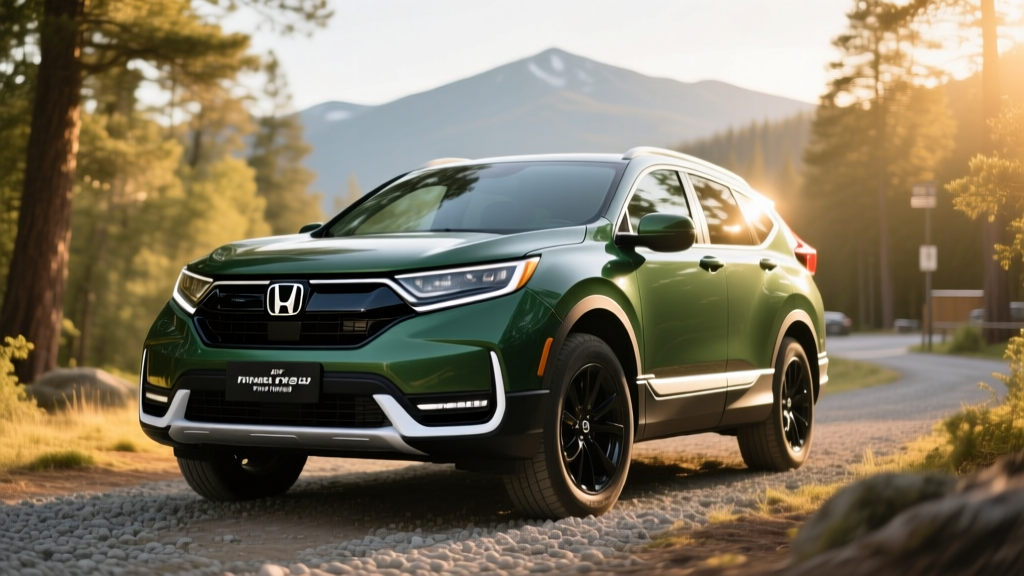
The 2026 Honda CR-V TrailSport Hybrid occupies a specific niche: buyers who want the rugged styling and all-weather confidence of Honda's TrailSport badge without sacrificing fuel efficiency. Underneath the orange stitching and all-terrain tires sits Honda's proven fourth-generation two-motor hybrid system, delivering an EPA-estimated 37 MPG combined while routing power through a torque-vectoring all-wheel-drive system.
This is a conventional hybrid (HEV), not a plug-in. You never plug it in — the 1.1 kWh lithium-ion battery recharges through regenerative braking and the gasoline engine. That distinction matters for buyers cross-shopping the CR-V Hybrid against plug-in competitors like the Toyota RAV4 Prime or the Hyundai Tucson PHEV.
| Specification | 2026 CR-V TrailSport Hybrid |
|---|---|
| Powertrain | 2.0L Atkinson-cycle 4-cyl + 2 electric motors |
| Combined Horsepower | 204 hp |
| Combined Torque | 247 lb-ft (electric motor peak) |
| Drivetrain | AWD (rear motor-driven) |
| Battery Capacity | 1.1 kWh (lithium-ion) |
| EPA MPG (City / Hwy / Combined) | 40 / 34 / 37 |
| Fuel Tank | 14.0 gallons |
| Total Range | ~518 miles |
| 0–60 mph | ~7.8 seconds (est.) |
| Towing Capacity | 1,000 lbs |
| Cargo Volume (rear seats up / down) | 36.3 / 76.5 cu ft |
| Ground Clearance | 8.3 inches |
| Base MSRP | $40,850 (incl. destination) |
Fuel Economy: EPA Numbers vs. Real-World MPG
The EPA rates the 2026 CR-V TrailSport Hybrid at 40 MPG city, 34 MPG highway, and 37 MPG combined per fueleconomy.gov. These figures apply to the TrailSport Hybrid trim specifically, which uses all-terrain tires that carry a slight highway rolling-resistance penalty versus the Sport Touring Hybrid's all-season rubber.
| Driving Scenario | Expected MPG |
|---|---|
| EPA City (sticker) | 40 |
| EPA Highway (sticker) | 34 |
| EPA Combined (sticker) | 37 |
| Real-World City (mixed suburban) | 38–43 |
| Real-World Highway (70–75 mph) | 30–33 |
| Real-World Combined (owner avg.) | 34–38 |
| Cold Weather (below 32°F, short trips) | 28–34 |
Hybrids like the CR-V tend to exceed their EPA city rating in moderate-temperature stop-and-go driving because regenerative braking recovers energy that a gas car wastes as heat. Highway driving is the opposite story: aerodynamic drag dominates at speed, and the hybrid system has less opportunity to recapture energy. Expect 30–33 MPG on sustained interstate runs at 70–75 mph.
The TrailSport's all-terrain tires and 8.3 inches of ground clearance introduce modest aerodynamic and rolling-resistance penalties compared to the Sport Touring Hybrid, which achieves 43/36/40 MPG. If maximum efficiency is your priority over trail aesthetics, the Sport Touring Hybrid is the more frugal choice.
HEV vs. PHEV: Understanding What the TrailSport Hybrid Is (and Isn't)
The CR-V TrailSport Hybrid is a conventional hybrid electric vehicle (HEV). This is a critical distinction from plug-in hybrids (PHEVs) and battery electric vehicles (BEVs):
| Feature | CR-V TrailSport Hybrid (HEV) | Typical PHEV (e.g., RAV4 Prime) | Battery EV (e.g., Ioniq 5) |
|---|---|---|---|
| Plug-in Charging Required? | No | Yes (optional but recommended) | Yes (mandatory) |
| Electric-Only Range | None (EV assist only) | 35–42 miles | 250–320+ miles |
| Battery Size | 1.1 kWh | 14–18 kWh | 58–84 kWh |
| Gasoline Engine? | Yes | Yes | No |
| Total Range | ~518 miles | ~550–600 miles | 250–320 miles |
| Home Charger Needed? | No | Recommended (Level 2) | Essential (Level 2) |
| Federal Tax Credit (§30D) | No | Up to $7,500 (if eligible) | Up to $7,500 (if eligible) |
The TrailSport Hybrid's 1.1 kWh battery is far too small to propel the vehicle on electricity alone for meaningful distances. Instead, the electric motors assist the 2.0L engine during acceleration, enable engine-off coasting at low speeds, and enable silent EV-mode creeping in parking lots for brief stretches (typically under 1 mile at very low speeds). The engine starts and stops seamlessly as the system demands.
Who should choose this HEV over a PHEV or EV? Buyers who lack access to home or workplace charging, who regularly drive more than 300 miles between fill-ups, who tow occasionally, or who simply don't want to think about plugging in. The HEV trades the PHEV's electric-only commuting capability for total fueling flexibility — you just fill up at any gas station.
Powertrain Deep Dive: How Honda's Two-Motor Hybrid System Works
Honda's hybrid system in the 2026 CR-V uses a series-parallel architecture with two electric motors and no conventional transmission. Here's how power flows:
- At low speeds and light loads: The gasoline engine generates electricity (acting as a generator), and the drive motor propels the wheels — essentially series-hybrid operation.
- During hard acceleration: Both the engine (via the generator motor) and the battery supply power to the drive motor simultaneously for maximum output.
- At steady highway cruising: A lock-up clutch connects the engine directly to the front wheels for efficient mechanical drive, bypassing the electrical conversion.
- During deceleration: The drive motor acts as a generator, converting kinetic energy back into battery charge (regenerative braking).
The rear axle receives power from a separate electric motor, enabling the AWD system to send up to 50% of available torque rearward when traction demands it. This is not a mechanical driveshaft system — it's fully electric torque distribution, which responds faster than a traditional viscous-coupling AWD setup.
The 204 combined horsepower and 247 lb-ft of electric motor torque give the TrailSport Hybrid adequate passing power. The 0–60 mph sprint takes approximately 7.8 seconds — not quick by performance standards, but competitive within the hybrid compact SUV segment and noticeably more responsive than the non-hybrid CR-V's 1.5L turbo at low speeds.
TrailSport-Specific Off-Road and Capability Features
The TrailSport badge adds more than cosmetic upgrades. For 2026, Honda equips this trim with:
- All-terrain tires (235/60R18) on unique 18-inch alloy wheels — these provide better traction on loose surfaces but reduce highway MPG by roughly 2–3 MPG versus the Sport Touring's all-season tires.
- Retuned AWD torque distribution with a dedicated "Trail" drive mode that biases torque rearward and adjusts throttle mapping for low-grip surfaces.
- Increased ground clearance at 8.3 inches (vs. 8.2 on other AWD hybrids — marginal, but combined with the tires, it helps on rutted trails).
- Underbody skid plates protecting the engine and fuel tank on rough terrain.
- Hill Descent Control for controlled low-speed descents on steep, loose grades.
Let's be realistic about capability: this is a soft-roader, not a body-on-frame truck. The TrailSport Hybrid handles fire roads, snow-covered passes, sandy beach access, and muddy campgrounds with confidence. It does not handle rock crawling, deep sand, or extreme articulation. The 1,000-pound towing capacity also limits utility — if you need to tow a 3,000-pound camper, look at the non-hybrid CR-V (1,500 lbs) or a larger SUV entirely.
Pricing, Trims, and Tax Credit Eligibility
The 2026 CR-V TrailSport Hybrid starts at $40,850 including Honda's $1,350 destination charge. This positions it roughly $2,500 above the Sport Hybrid and $4,000 above the EX-L Hybrid, reflecting the off-road hardware, exclusive interior materials, and standard Honda Sensing suite.
Pros
- 37 MPG combined in an AWD SUV with genuine light off-road capability
- Proven, reliable hybrid system with no plug-in complexity
- Spacious cargo area (36.3 cu ft behind rear seats)
- Standard Honda Sensing ADAS suite
- No home charging infrastructure required
- Strong resale value trajectory for Honda hybrids
Cons
- No federal §30D tax credit eligibility (HEVs don't qualify)
- 1,000-lb towing capacity is low for the segment
- All-terrain tires reduce highway MPG vs. Sport Touring Hybrid
- No plug-in / electric-only commuting option
- TrailSport premium over Sport Hybrid is steep for the hardware added
- 1.1 kWh battery too small for sustained EV-mode driving
Does the CR-V TrailSport Hybrid Qualify for a Federal Tax Credit?
No. The federal §30D Clean Vehicle Credit applies only to plug-in electric vehicles — battery EVs and plug-in hybrids with sufficient battery capacity. Conventional hybrids like the CR-V TrailSport Hybrid do not qualify for the federal credit regardless of buyer income or vehicle price. Per IRS guidelines, the vehicle must have a battery capacity of at least 7 kWh and be capable of plug-in recharging to be eligible. The TrailSport Hybrid's 1.1 kWh battery and lack of a charge port disqualify it entirely.
Some states offer modest rebates or HOV-lane access for conventional hybrids, but these vary widely and change frequently. Check your state's energy office or DMV for current programs.
Reliability, Battery Warranty, and Long-Term Ownership Costs
Honda's hybrid system is among the most proven in the industry. The two-motor architecture has been in production since the 2014 Accord Hybrid, with continuous refinement across three generations. There is no conventional automatic transmission to fail — the e-CVT is a fixed-ratio gearset with no belts, clutches, or bands to wear out.
Honda Hybrid Battery Warranty
- Coverage: 8 years / 100,000 miles (10 years / 150,000 miles in CARB states: CA, CT, ME, MA, NJ, NY, OR, RI, VT, WA, CO, MD, NM, MN, NV)
- What's covered: Hybrid battery pack, power control unit, drive motor, and related hybrid-system components
- Capacity threshold: Honda warrants against defects and abnormal degradation; specific SoH percentage thresholds are evaluated case-by-case at the dealer
- Replacement cost (out of warranty): Approximately $3,000–$4,500 for the battery pack, plus $500–$1,000 labor — significantly less than a BEV battery replacement
The 1.1 kWh battery pack in the CR-V Hybrid is small, which works in its favor for longevity. Shallow charge/discharge cycles (the system typically operates between 20% and 80% state of charge) minimize stress on the cells. Real-world data from Honda hybrid owners shows minimal degradation over 100,000+ miles — most owners never experience a hybrid battery failure within the warranty period, and many original batteries in 2014–2017 Accord Hybrids are still in service.
For total cost of ownership, the TrailSport Hybrid's advantage is fuel savings without the upfront premium of a PHEV or BEV. At 37 MPG combined and $3.50/gallon fuel, annual fuel cost for 12,000 miles is roughly $1,135. A comparable gas-only compact SUV at 28 MPG combined would cost about $1,500 — a $365/year savings that compounds over ownership. Insurance rates for the CR-V Hybrid tend to track closely with non-hybrid trims, with no significant surcharge.
Who Should Buy the 2026 CR-V TrailSport Hybrid — And Who Shouldn't
Choose the CR-V TrailSport Hybrid If:
- You want AWD capability for snow, dirt roads, or camping without sacrificing fuel economy
- You don't have access to home or workplace EV charging
- You regularly drive 300+ miles between fill-ups and don't want range or charging logistics
- You value Honda's reliability record and strong resale value
- You prefer the TrailSport aesthetic and light off-road hardware
Look Elsewhere If:
- You want electric-only commuting (consider the RAV4 Prime or Tucson PHEV)
- You need a federal tax credit to make the math work (look at eligible PHEVs or BEVs)
- You tow more than 1,000 lbs regularly
- Maximum fuel economy matters more than off-road styling (choose the Sport Touring Hybrid at 40 MPG combined)
- You want zero tailpipe emissions (only a BEV delivers that)
Frequently Asked Questions
How many MPG does the 2026 Honda CR-V TrailSport Hybrid get?
The EPA rates it at 40 MPG city, 34 MPG highway, and 37 MPG combined. In real-world mixed driving, most owners report 34–38 MPG combined, with city driving often exceeding the EPA estimate and highway driving falling 2–4 MPG below it.
Is the CR-V TrailSport Hybrid a plug-in?
No. It is a conventional hybrid (HEV). You never plug it in. The battery recharges through regenerative braking and the gasoline engine. If you want plug-in capability, the CR-V lineup does not currently offer a PHEV variant in the U.S. — you'd need to look at competitors like the Toyota RAV4 Prime or Hyundai Tucson PHEV.
How far can it drive on electric power alone?
Effectively zero miles in any practical sense. The 1.1 kWh battery can power EV-mode creeping at parking-lot speeds for very short distances (under a mile), but the engine starts automatically under any meaningful acceleration or above roughly 25 mph. This is not an electric-commuting vehicle.
Is the hybrid battery reliable, and what does replacement cost?
Honda's hybrid battery systems have an excellent reliability record spanning over a decade of production. The battery is warranted for 8 years/100,000 miles (10/150,000 in CARB states). Out-of-warranty replacement costs approximately $3,000–$4,500 for the pack plus labor — far less than a full EV battery. Most hybrid batteries last well beyond the warranty period.
Does the 2026 CR-V TrailSport Hybrid qualify for any tax credit?
It does not qualify for the federal §30D Clean Vehicle Credit, which requires plug-in capability and a minimum 7 kWh battery. Some states may offer small rebates for conventional hybrids, but these vary by jurisdiction. Consult your state's energy office or a tax professional for current local incentives.
How does the TrailSport Hybrid compare to the Sport Touring Hybrid?
The Sport Touring Hybrid achieves 43/36/40 MPG (EPA) thanks to all-season tires and slightly lower ride height, and it starts around $38,500. The TrailSport Hybrid trades 3 combined MPG for all-terrain tires, skid plates, Hill Descent Control, Trail drive mode, and the TrailSport appearance package at a $2,350 premium. Choose based on whether the off-road capability and styling justify the cost and efficiency trade-off.
Can the CR-V TrailSport Hybrid tow?
Yes, but with a 1,000-pound maximum towing capacity — suitable for a small utility trailer, bike rack, or lightweight popup camper. This is lower than the non-hybrid CR-V's 1,500-pound rating and significantly less than competitors like the Ford Escape Hybrid (1,500 lbs) or Toyota RAV4 Hybrid (1,750 lbs). If towing is a priority, the TrailSport Hybrid is not the best choice.
Sources: EPA fuel economy data via fueleconomy.gov; Honda Motor Co. official specifications; IRS Clean Vehicle Credit guidelines at irs.gov.