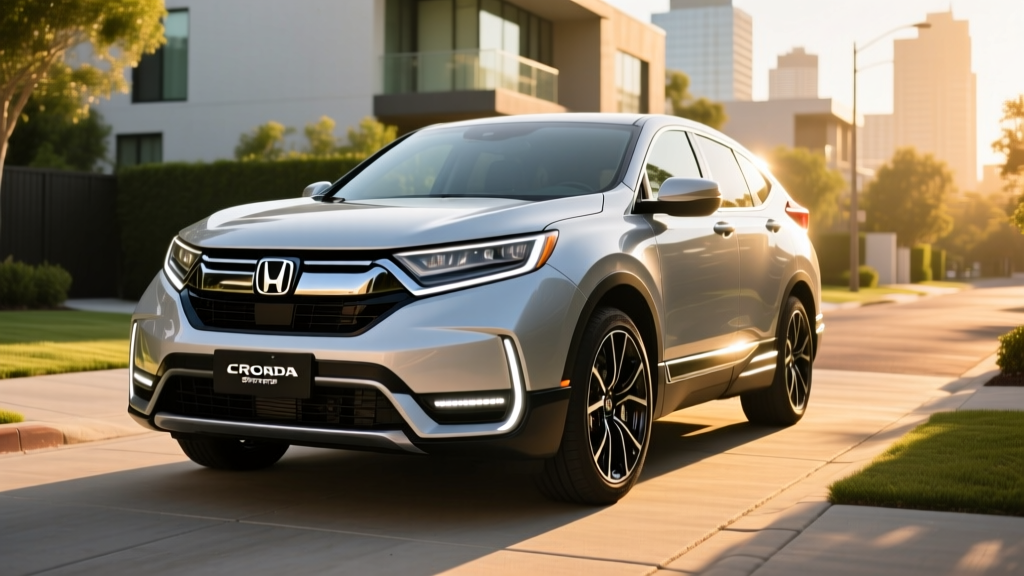
The compact SUV segment doesn't lack options, but few balance efficiency, practicality, and price the way the 2026 Honda CR-V Sport Hybrid does. As a conventional hybrid (HEV) — not a plug-in — it requires zero changes to your fueling routine. You just fill up with gas and go, while a two-motor hybrid system quietly slashes fuel consumption, especially in stop-and-go city driving where hybrids shine brightest.
This review breaks down the CR-V Sport Hybrid's EPA-rated fuel economy, real-world MPG observations, powertrain specs, ownership costs, and how it stacks up against plug-in hybrids and full battery-electric vehicles. If you're cross-shopping electrified compact SUVs, the data below will help you decide whether this is the right fit.
HEV vs PHEV vs EV: Where the CR-V Sport Hybrid Fits
Before diving into specs, it's worth clarifying exactly what the 2026 CR-V Sport Hybrid is — and what it isn't. Honda offers the CR-V with a conventional hybrid powertrain across multiple trims (Sport, Sport-L, and Sport Touring). This is a self-charging hybrid (HEV), meaning its small battery recharges through regenerative braking and the gasoline engine. There is no plug, no electric-only driving mode of meaningful distance, and no home charger required.
Quick Reference: HEV vs PHEV vs BEV
| Feature | HEV (CR-V Sport Hybrid) | PHEV (e.g., Toyota RAV4 Prime) | BEV (e.g., Tesla Model Y) |
|---|---|---|---|
| Plug-in charging? | No | Yes (Level 1/2) | Yes (Level 1/2/DC) |
| Electric-only range | <1 mile at low speed | 35–42 miles typical | 260–330+ miles |
| Gas engine? | Yes (primary) | Yes (backup) | No |
| Fuel cost per mile | ~$0.10–$0.12 | ~$0.04–$0.10 (varies) | ~$0.03–$0.06 |
| Federal tax credit (§30D) | No | Up to $7,500* | Up to $7,500* |
| Home charger needed? | No | Recommended | Essential |
*§30D credit eligibility depends on MSRP caps, buyer income limits, battery sourcing, and point-of-sale transfer rules. See IRS.gov for current-year requirements.
The CR-V Sport Hybrid targets buyers who want meaningful fuel savings without altering their daily habits. If you can't install a home charger, live in an apartment, or regularly take long road trips through areas with sparse charging infrastructure, an HEV eliminates the infrastructure dependency entirely.
Fuel Economy: EPA Ratings and Real-World MPG
Fuel economy is the headline number for any hybrid buyer. The 2026 Honda CR-V Sport Hybrid carries EPA ratings that place it among the most efficient compact SUVs available — particularly in city driving, where the electric motor handles low-speed propulsion and the engine operates only in its most efficient range.
| Drivetrain | City MPG | Highway MPG | Combined MPG |
|---|---|---|---|
| FWD (Sport Hybrid) | 43 | 36 | 40 |
| AWD (Sport Hybrid) | 40 | 34 | 37 |
Source: fueleconomy.gov (EPA estimates).
Real-World MPG: What to Actually Expect
Honda's two-motor hybrid system is optimized for urban efficiency. In real-world mixed driving, owners and testers consistently report that the CR-V Hybrid meets or slightly exceeds its EPA combined rating in city-heavy commutes — often hitting 41–44 MPG on routes dominated by stoplights and low-speed traffic. This is a common hybrid trait: regenerative braking recovers energy that a gas car would waste as heat.
Highway driving tells a different story. At sustained 70–80 mph speeds, the engine is doing most of the work, and aerodynamic drag reduces the hybrid advantage. Expect 33–36 MPG on the highway with AWD, and slightly better with FWD. Cold weather (below 35°F) will knock 2–4 MPG off any of these figures as the engine runs more frequently to provide cabin heat and maintain battery temperature.
Real-World Range Per Tank
With a 14.0-gallon fuel tank and the AWD Sport Hybrid's 37 MPG combined rating, you're looking at approximately 518 miles of total range per fill-up. FWD models can stretch past 560 miles. That's fewer fuel stops and genuine peace of mind on long trips — no charging planning required.
Powertrain and Performance Specs
The 2026 CR-V Sport Hybrid uses Honda's fourth-generation two-motor hybrid system, which pairs a 2.0-liter Atkinson-cycle four-cylinder engine with two electric motors and a lithium-ion battery pack. The system operates primarily in EV Drive (electric motor only) at low speeds, Hybrid Drive (engine generates electricity for the motor) at moderate loads, and Engine Drive (direct mechanical connection) at steady highway cruising.
| Specification | 2026 CR-V Sport Hybrid |
|---|---|
| Combined System Horsepower | 204 hp |
| Combined System Torque | 247 lb-ft |
| Gas Engine | 2.0L Atkinson-cycle I-4 (146 hp) |
| Drive Motors | Dual electric (propulsion + generation) |
| Hybrid Battery | ~1.1 kWh lithium-ion (not plug-in) |
| Transmission | e-CVT (direct-drive, no traditional gears) |
| 0–60 mph | ~7.8 seconds |
| Drivetrain | FWD standard, AWD available |
| Towing Capacity | 1,000 lbs |
| Cargo Volume (rear seats up) | 36.3 cu ft |
| Cargo Volume (rear seats folded) | 76.5 cu ft |
The 247 lb-ft of electric torque is available from a standstill, which gives the CR-V Sport Hybrid a responsive, punchy feel around town that belies its 204-hp rating. Merging onto highways and passing slower traffic is confident. The e-CVT is smooth and avoids the rubber-band revving associated with older Toyota hybrid systems, though it lacks the stepped gear simulation some drivers prefer.
AWD models add a rear-mounted electric motor that provides torque to the rear wheels when traction is needed — this is an on-demand system, not a mechanical driveshaft connection, which keeps weight and drivetrain losses low.
Pricing, Trims, and Tax Credit Eligibility
The 2026 CR-V Sport Hybrid is available in three trims, all sharing the same powertrain. Pricing positions it competitively against the Toyota RAV4 Hybrid and Hyundai Tucson Hybrid.
| Trim | Drivetrain | MSRP (est.) |
|---|---|---|
| Sport Hybrid | FWD | $36,350 |
| Sport Hybrid | AWD | $37,850 |
| Sport-L Hybrid | AWD | $39,850 |
| Sport Touring Hybrid | AWD | $42,350 |
Prices include destination charge. Actual dealer pricing may vary. Verify current MSRP on Honda's official site.
Does the CR-V Sport Hybrid Qualify for a Federal Tax Credit?
No. The federal §30D Clean Vehicle Credit applies only to plug-in electric vehicles (PHEVs and BEVs) with sufficient battery capacity and compliant battery sourcing. Because the CR-V Sport Hybrid is a conventional HEV with a small, non-plug-in battery, it does not qualify for the $7,500 federal tax credit — nor does it qualify for the up-to-$4,000 used clean vehicle credit under §25E.
Some states offer their own incentives for hybrids, but these are increasingly rare as state programs shift focus to plug-in vehicles. Check your state's energy or DMV website for current hybrid incentives, as these vary by jurisdiction and change frequently.
Battery Warranty, Reliability, and Replacement Costs
Hybrid battery longevity remains one of the most common concerns among first-time hybrid buyers. The good news: Honda's track record with hybrid batteries is strong, and the warranty provides substantial protection.
Honda Hybrid Battery Warranty
- Coverage: 8 years / 100,000 miles (10 years / 150,000 miles in CARB states including CA, NY, MA, and others)
- What's covered: Hybrid battery pack, hybrid control module, and related powertrain components
- Capacity threshold: Honda replaces or repairs if the battery fails to hold sufficient charge to operate the hybrid system — unlike EV warranties, there's no published percentage-degradation threshold for HEVs
Real-World Battery Lifespan
Honda's lithium-ion hybrid battery packs are designed for shallow cycling — they never fully charge or fully discharge, which dramatically reduces wear compared to a full EV battery. Based on long-term data from Honda hybrid owners (including the Accord Hybrid and previous CR-V Hybrid generations), most hybrid batteries last well beyond 150,000 miles with minimal capacity loss. Failures before 100,000 miles are uncommon and would be covered under warranty.
Battery Replacement Cost
If you do need a replacement outside warranty, a new OEM Honda CR-V hybrid battery currently costs between $2,000 and $3,500 installed at a dealership. Independent hybrid specialists and refurbished battery options can reduce this to $1,200–$2,000. Given the battery's small ~1.1 kWh size (compared to 60–100 kWh in an EV), replacement costs are a fraction of what a full EV battery swap would require.
For overall reliability, the CR-V has historically earned strong marks. The IIHS typically rates the CR-V as a Top Safety Pick when equipped with Honda Sensing, and NHTSA ratings have consistently been at or near five stars overall.
Who Should Buy the CR-V Sport Hybrid — and Who Shouldn't
Choose the 2026 CR-V Sport Hybrid If:
- You want 37–40 MPG combined without plugging in or changing your routine
- You live in an apartment or lack access to home/workplace charging
- Your commute is city-heavy, where hybrids deliver peak efficiency gains
- You regularly drive 400+ miles on road trips and don't want to plan charging stops
- You want a proven, low-risk hybrid system with strong resale value
- Your budget is under $43,000 for a well-equipped AWD hybrid SUV
Consider a PHEV or Full EV Instead If:
- You have home charging and a short commute — a PHEV like the RAV4 Prime or CR-V's own plug-in variant (where available) lets you drive 30–40 miles on electricity alone, cutting fuel use to near zero on weekdays
- You want to qualify for the $7,500 federal tax credit — only plug-in vehicles are eligible under current §30D rules
- You want zero tailpipe emissions on daily drives — a BEV like the Hyundai Ioniq 5 or Tesla Model Y eliminates gas entirely
- You want one-pedal driving and instant 300+ hp — BEVs deliver performance that hybrids in this price range can't match
Driving Impressions and Daily Usability
The 2026 CR-V Sport Hybrid drives like a well-sorted compact SUV that happens to be efficient — not like an efficiency project that compromises on comfort. Ride quality is composed over rough pavement, cabin noise is well-managed (a traditional Honda weak point that's been addressed in this generation), and the Honda Sensing suite of driver-assist features — adaptive cruise, lane-keeping, blind-spot monitoring — is standard across all hybrid trims.
The Sport trim's styling adds blacked-out exterior accents and 18-inch wheels that give it a more aggressive stance than the base LX, though the 18-inch rubber does contribute slightly to road noise compared to the 17-inch wheels on lower trims. Interior materials in the Sport are a step above the base model, with a leather-wrapped steering wheel and cloth/leatherette seats. The Sport-L adds leather-trimmed seats and a power liftgate; the Sport Touring tops the range with navigation, a premium audio system, and heated rear seats.
One practical note: the hybrid battery is packaged under the cargo floor, which preserves the full 36.3 cu ft of cargo space behind the rear seats. There is no frunk (front trunk), and the spare tire is replaced by a tire repair kit on hybrid trims — something to factor in if you frequently travel in remote areas.
Ownership Costs: 5-Year Projection
One of the strongest arguments for the CR-V Sport Hybrid is its low running cost relative to the gas-only CR-V. Here's a simplified five-year comparison assuming 15,000 miles per year and $3.50/gallon regular fuel:
| Cost Factor (5 Years / 75,000 mi) | CR-V Gas (AWD, 28 MPG comb.) | CR-V Sport Hybrid (AWD, 37 MPG comb.) |
|---|---|---|
| Fuel Cost | $9,375 | $7,095 |
| Fuel Savings vs. Gas | — | $2,280 |
| Estimated Maintenance | $3,200 | $3,000 |
| Insurance (avg.) | $7,500 | $7,800 |
| MSRP Premium (Hybrid vs. Gas AWD) | — | ~$3,500 |
| Net 5-Year Cost Difference | Baseline | ~$1,780 more, before resale |
The hybrid's MSRP premium over a comparably equipped gas CR-V AWD is typically recouped in fuel savings within 4–5 years for average drivers. For high-mileage commuters (20,000+ miles/year), the payback period drops to roughly 3 years. Hybrids also tend to hold resale value better than their gas counterparts, which further narrows the total cost gap.
Frequently Asked Questions
How many MPG does the 2026 Honda CR-V Sport Hybrid get?
The FWD Sport Hybrid is EPA-rated at 43 city / 36 highway / 40 combined MPG. The AWD version drops to 40 city / 34 highway / 37 combined. In real-world city-heavy driving, many owners report exceeding the EPA combined figure by 1–4 MPG, while sustained highway driving at 75+ mph yields slightly below the highway rating.
Does the CR-V Sport Hybrid need to be plugged in?
No. This is a conventional hybrid (HEV), not a plug-in hybrid (PHEV). The battery charges through regenerative braking and the gasoline engine. There is no charging port, and you cannot plug it in. You fuel it exactly like a regular gas car.
How far can the CR-V Sport Hybrid drive on electric power alone?
Less than one mile, and only at very low speeds (under 25 mph in light-load conditions). The hybrid system uses electric propulsion to assist the engine and enable brief engine-off coasting, but it is not designed for meaningful electric-only driving. If you want 30+ miles of electric range, you need a PHEV or a full EV.
Is the CR-V Sport Hybrid reliable, and what does battery replacement cost?
Honda's hybrid system has a strong reliability record. The hybrid battery is warrantied for 8 years/100,000 miles (10 years/150,000 miles in CARB states). Most Honda hybrid batteries last well beyond 150,000 miles. Out-of-warranty replacement costs $2,000–$3,500 at a dealer, or $1,200–$2,000 through independent specialists.
Does the 2026 CR-V Sport Hybrid qualify for any tax credit?
No. The federal §30D Clean Vehicle Credit is only available for plug-in vehicles (PHEVs and BEVs) that meet battery sourcing, MSRP, and buyer income requirements. The CR-V Sport Hybrid, as a non-plug-in HEV, does not qualify for federal EV tax credits. Check your state's energy office for any local hybrid incentives, though these are increasingly uncommon.
Should I get the CR-V Hybrid or a full EV like the Ioniq 5?
It depends on your charging access and driving patterns. If you can charge at home and your daily commute is under 250 miles, a BEV offers lower per-mile fuel costs, stronger acceleration, zero tailpipe emissions, and eligibility for the $7,500 federal credit. If you lack reliable charging access, frequently drive long distances, or want the lowest upfront cost with zero infrastructure dependency, the CR-V Sport Hybrid is the more practical choice.
What's the difference between the CR-V Sport, Sport-L, and Sport Touring Hybrid?
All three share the identical 204-hp hybrid powertrain and battery. The Sport is the entry point with cloth/leatherette seats and 18-inch wheels. The Sport-L adds leather seats, a power liftgate, and wireless phone charging. The Sport Touring adds built-in navigation, a Bose premium audio system, heated rear seats, and rain-sensing wipers. The powertrain, fuel economy, and cargo space are the same across all three.
Pros
- 40 MPG combined (FWD) — among the best in the compact SUV class
- No plug-in required — zero infrastructure dependency
- 247 lb-ft of electric torque for confident city acceleration
- Full 36.3 cu ft cargo space preserved (battery under floor)
- Honda Sensing safety suite standard on all trims
- Strong hybrid battery warranty (8–10 years)
- 518+ mile range per tank (AWD)
Cons
- No federal tax credit eligibility (HEV, not PHEV/BEV)
- Highway MPG drops to 34 (AWD) — hybrid advantage shrinks at speed
- No spare tire — tire repair kit only
- 1,000-lb towing limit (lower than some turbo-gas competitors)
- AWD adds $1,500 and costs 3 MPG combined
- No wireless Apple CarPlay/Android Auto on base Sport trim