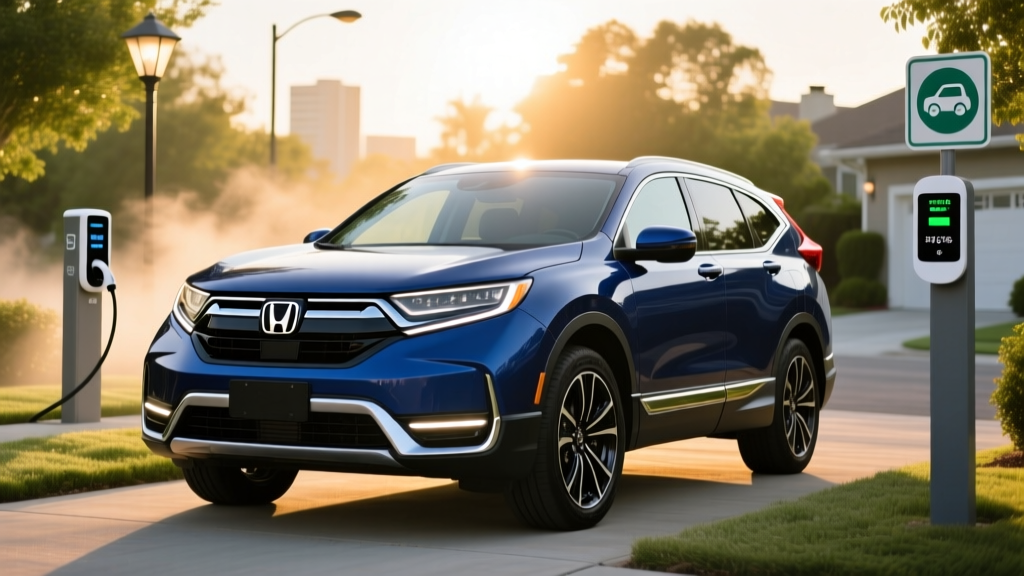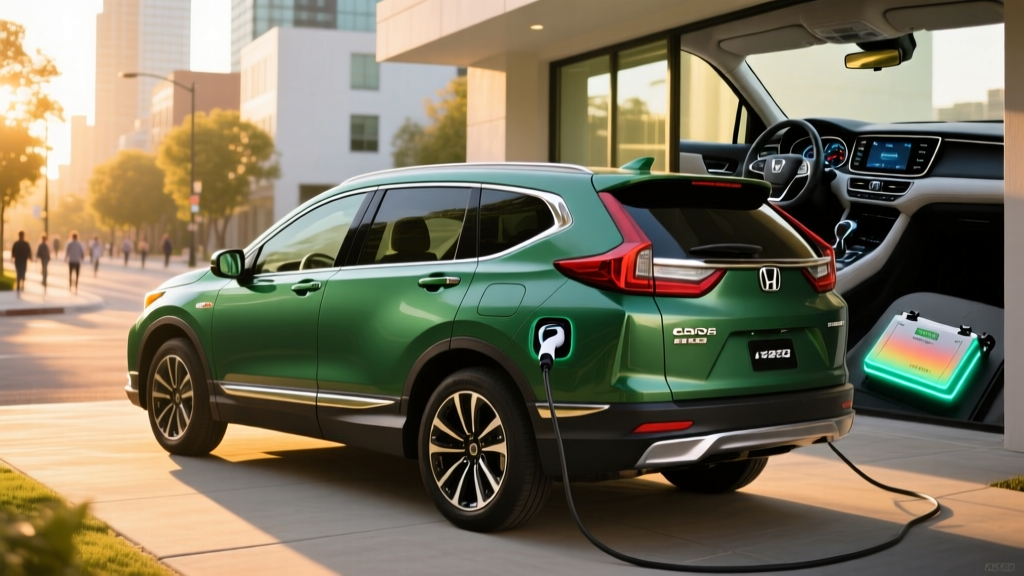
The 2026 Honda CR-V Hybrid Touring sits at the top of Honda's mainstream hybrid SUV lineup, pairing the brand's fourth-generation two-motor hybrid system with the most feature-rich trim available. For buyers weighing a conventional hybrid against a plug-in hybrid or full EV, the CR-V Hybrid represents a no-compromise middle ground: no charging infrastructure required, meaningful fuel savings over the gas-only CR-V, and the cargo space and ground clearance that compact SUV buyers expect.
This guide breaks down the Touring trim's real-world fuel economy, powertrain specs, battery longevity, ownership costs, and whether it's the right electrified choice for your driving pattern — all with exact numbers, not marketing fluff.
HEV vs. PHEV: What the CR-V Hybrid Actually Is
Before diving into specs, it's critical to distinguish what the 2026 CR-V Hybrid is — and isn't.
| Feature | CR-V Hybrid (HEV) | Typical PHEV (e.g., Toyota RAV4 Prime) | Full EV (e.g., Tesla Model Y) |
|---|---|---|---|
| Plugs in? | No | Yes | Yes |
| Electric-only range | ~1 mile at low speed | 35–42 miles | 280–330 miles |
| Battery size | ~1.06 kWh (buffer) | ~18.1 kWh usable | 60–82 kWh usable |
| Home charging needed? | No | Recommended (Level 2) | Required |
| Gas engine? | Yes — primary power | Yes — backup after EV range | No |
| Federal tax credit (§30D) | Not eligible | Up to $7,500 (if eligible) | Up to $7,500 (if eligible) |
The CR-V Hybrid is a conventional hybrid (HEV). It captures energy through regenerative braking and the gasoline engine to charge its small battery pack. You never plug it in. The electric motors assist the engine during acceleration and can propel the vehicle at low speeds for very short distances, but the gasoline engine remains the primary energy source. This is fundamentally different from a plug-in hybrid (PHEV) like the Toyota RAV4 Prime or a full battery electric vehicle (BEV) like the Hyundai Ioniq 5.
If you need electric-only commuting range or want to access the federal §30D clean vehicle tax credit, you'll need a PHEV or BEV. The CR-V Hybrid's value proposition is simpler: drop-in fuel savings with zero lifestyle change.
Fuel Economy: EPA Ratings and Real-World MPG
The 2026 CR-V Hybrid Touring comes standard with all-wheel drive (AWD), which slightly affects efficiency compared to the FWD hybrid trims Honda has offered in prior years. Here's the EPA breakdown:
| Driving Cycle | EPA Rating (AWD) | Real-World Expectation |
|---|---|---|
| City | 43 MPG | 42–46 MPG (hybrids often beat EPA in city) |
| Highway | 36 MPG | 33–36 MPG (aerodynamic drag limits hybrid advantage) |
| Combined | 40 MPG | 37–42 MPG depending on driving mix |
Source: EPA Fuel Economy
Why real-world often exceeds EPA in city driving: The EPA city cycle includes moderate stops and accelerations. In real stop-and-go traffic, the CR-V Hybrid's regenerative braking recaptures more energy, and the engine shuts off more frequently at idle. Owners who drive predominantly urban routes regularly report 44–46 MPG on forums and fuel-tracking apps. Highway driving is where hybrids lose their advantage — above 65 mph, the gasoline engine does nearly all the work, and the CR-V's boxy SUV profile creates aerodynamic drag that limits efficiency to the low-to-mid 30s.
Cold-weather impact: Expect a 5–10% efficiency reduction in sustained sub-freezing temperatures. The engine runs more often to generate cabin heat (unlike a BEV with a heat pump, the hybrid uses waste engine heat), and the battery's charge/discharge efficiency drops in the cold. Winter combined MPG typically lands around 35–38.
Powertrain: Engine, Motors, and 204 Combined Horsepower
| Specification | 2026 CR-V Hybrid Touring AWD |
|---|---|
| Engine | 2.0L Atkinson-cycle inline-4 |
| Engine output | 145 hp @ 6,100 rpm / 134 lb-ft torque |
| Front electric motor | 181 hp / 247 lb-ft |
| Rear electric motor (AWD) | ~48 hp (torque-vectoring rear axle) |
| Combined system output | 204 hp / 247 lb-ft |
| Transmission | e-CVT (direct-drive, no fixed gears) |
| 0–60 mph | ~7.6 seconds (est.) |
| Drivetrain | AWD standard (electronic rear-axle torque vectoring) |
| Battery | ~1.06 kWh lithium-ion (buffer-type, not large storage) |
| Towing capacity | 1,000 lbs |
Honda's two-motor hybrid system operates in three modes: EV Drive (battery powers the front motor for low-speed maneuvering), Hybrid Drive (engine generates electricity that powers the front motor, with surplus charging the battery), and Engine Drive (a lock-up clutch connects the engine directly to the front wheels at highway cruising speeds for maximum efficiency). The rear motor provides AWD traction on demand and enables subtle torque vectoring in corners.
The combined 204 hp is adequate for merging and passing but won't feel sporty. The e-CVT eliminates shift shock and keeps the powertrain in its optimal efficiency band, though some drivers notice a droning quality under hard acceleration — a characteristic of all CVT-based hybrid systems. The instant torque from the electric motor (247 lb-ft available from near zero RPM) makes the CR-V Hybrid feel punchy around town despite its modest peak horsepower figure.
2026 CR-V Hybrid Touring Pricing and Tax Credit Eligibility
The Touring is the top-of-the-line CR-V Hybrid trim. Here's the pricing landscape for the 2026 model year:
| CR-V Hybrid Trim | MSRP (approx.) | Key Additions Over Base Hybrid |
|---|---|---|
| Sport Hybrid (base hybrid trim) | ~$35,350 | Hybrid powertrain, Sport styling |
| Sport-L Hybrid | ~$37,700 | Leather seats, power liftgate |
| Sport Touring Hybrid | ~$40,850 | Navigation, Bose audio, wireless CarPlay/Android Auto, heated rear seats, hands-free liftgate |
Federal tax credit: The CR-V Hybrid does not qualify for the IRS §30D New Clean Vehicle Credit. That credit is reserved for plug-in electric vehicles (PHEVs and BEVs) meeting battery sourcing, MSRP caps, and buyer income requirements. Conventional hybrids are excluded from §30D.
State incentives: Some states offer rebates or HOV lane access for hybrids, though these have largely shifted toward PHEVs and BEVs. Check your state's energy office or AFDC incentive database for current programs.
Total cost of ownership context: At 40 MPG combined and $3.50/gallon gasoline, the CR-V Hybrid Touring costs roughly $1,313/year in fuel for 15,000 miles of driving. A comparable gas-only CR-V AWD at 28 MPG combined would cost about $1,875/year — a savings of approximately $562/year or $2,810 over five years with the hybrid.
Battery Longevity, Warranty, and Replacement Costs
Honda Hybrid Battery Warranty:
- Coverage: 8 years / 100,000 miles (10 years / 150,000 miles in CARB states including CA, NY, MA, and others)
- What's covered: Defects and capacity loss below functional threshold
- Replacement cost (out of warranty): $2,000–$4,000 for the hybrid battery pack (significantly less than a BEV battery)
The CR-V Hybrid's battery pack is small (~1.06 kWh) and operates within a narrow state-of-charge window — typically between 40% and 80%. This "buffer" operating strategy dramatically reduces stress on the cells compared to a BEV that regularly cycles from 10% to 90%. As a result, hybrid battery degradation is minimal in practice.
Real-world reliability data: Honda's hybrid systems in the CR-V and Accord have demonstrated strong longevity. Third-generation hybrid systems in 2017–2022 CR-Vs and Accords have accumulated high-mileage examples well past 150,000 miles without battery replacement. The smaller battery size also means that if replacement is ever needed, the cost is a fraction of what a BEV owner would face ($2,000–$4,000 vs. $10,000–$20,000+).
The hybrid powertrain beyond the battery — the e-CVT, electric motors, and power control unit — has proven robust. Honda's overall powertrain warranty covers 5 years / 60,000 miles, with the hybrid-specific components covered under the longer 8/100k (or 10/150k) hybrid battery warranty.
Touring Trim: What You Get for the Premium
The Sport Touring Hybrid commands roughly $5,500 over the base Sport Hybrid. Here's what justifies that premium:
- Infotainment: 9-inch touchscreen with wireless Apple CarPlay and Android Auto, built-in navigation, Bose 12-speaker premium audio
- Comfort: Heated front and rear seats, heated steering wheel, dual-zone automatic climate control, leather-trimmed interior
- Convenience: Hands-free power tailgate, wireless phone charger, low-speed braking control, front and rear parking sensors
- Safety (Honda Sensing suite): Adaptive cruise control with low-speed follow, lane-keeping assist, road departure mitigation, collision mitigation braking, traffic sign recognition, blind-spot monitoring with rear cross-traffic alert
- Exterior: 19-inch alloy wheels, LED headlights with auto high-beam, rain-sensing wipers, panoramic moonroof (where equipped)
ADAS note: Honda Sensing is a Level 2 driver-assistance system per SAE classification. It provides steering and speed assistance simultaneously, but the driver must remain fully engaged — hands on the wheel, eyes on the road. It is not autonomous driving. Honda does not currently offer a hands-free highway driving system comparable to GM's Super Cruise or Ford's BlueCruise in the CR-V lineup.
Hybrid vs. PHEV vs. EV: Which Fits Your Situation?
Choose the CR-V Hybrid (HEV) if:
- You can't charge at home (apartment, street parking, no garage)
- You want fuel savings with zero behavior change — no plugging in, no range planning
- Your budget tops out around $40,000–$42,000 for a fully loaded compact SUV
- You frequently take long road trips and don't want to plan around charging stops
- You live in an area with sparse public charging infrastructure
Choose a PHEV (like the Toyota RAV4 Prime or Hyundai Tucson PHEV) if:
- You can install a Level 2 home charger and have a commute under 35 miles
- You want electric-only daily driving but gas flexibility for road trips
- You qualify for the §30D tax credit (income and sourcing requirements apply — consult a tax professional)
- You're willing to pay a $5,000–$8,000 premium over the hybrid equivalent
Choose a full EV (like the Tesla Model Y or Hyundai Ioniq 5) if:
- You have reliable home Level 2 charging
- Your daily driving is under 250 miles and you're willing to plan road-trip charging
- You want the lowest per-mile energy cost (~$0.04–$0.06/mile on home electricity vs. ~$0.09/mile for the hybrid on gas)
- You want to eliminate oil changes and reduce maintenance (EVs have fewer moving parts)
Pros, Cons, and the Bottom Line
Pros
- 40 MPG combined with no plug-in requirement — true drop-in efficiency
- Excellent city MPG (43 EPA, often 44+ real-world)
- AWD standard on all hybrid trims — no FWD compromise
- Touring trim loaded with premium features at ~$41K
- Proven hybrid reliability with 8yr/100K battery warranty (10yr/150K in CARB states)
- Strong resale value — CR-V consistently ranks among top-retained compact SUVs
- 76.5 cu ft cargo volume with rear seats folded
Cons
- No federal tax credit — HEVs are excluded from §30D
- Highway MPG drops to 36 — less advantage on long interstate trips
- e-CVT drone under hard acceleration (common to all hybrid CVTs)
- 1,000-lb towing capacity — lower than some turbo-gas competitors
- No plug-in hybrid CR-V variant available in the US market
- Touring trim pushes $41K — approaching luxury compact SUV territory
- No hands-free driving assist (Honda Sensing requires hands on wheel)
Frequently Asked Questions
How many MPG does the 2026 Honda CR-V Hybrid Touring get?
The EPA rates the 2026 CR-V Hybrid AWD at 43 city / 36 highway / 40 combined MPG. Real-world results frequently exceed the city rating (44–46 MPG in stop-and-go traffic) while highway driving typically matches or slightly underperforms the EPA estimate (33–36 MPG at 70+ mph). Cold weather reduces combined efficiency by roughly 5–10%.
Does the CR-V Hybrid need to be plugged in?
No. The CR-V Hybrid is a conventional hybrid (HEV), not a plug-in hybrid (PHEV). It charges its small battery through regenerative braking and the gasoline engine. You fuel it like any other car — at the gas pump. Honda does not currently sell a plug-in CR-V variant in the United States.
Is the CR-V Hybrid reliable, and what does a battery replacement cost?
Honda's hybrid system has demonstrated strong real-world reliability, with many examples exceeding 150,000 miles without battery issues. The hybrid battery is warrantied for 8 years/100,000 miles (10 years/150,000 miles in CARB states). If replacement is ever needed out of warranty, expect $2,000–$4,000 — far less than a full EV battery replacement.
Does the 2026 CR-V Hybrid qualify for any tax credit?
No. The federal §30D New Clean Vehicle Credit applies only to plug-in electric vehicles (PHEVs and BEVs) that meet battery sourcing, MSRP, and buyer income requirements. Conventional hybrids like the CR-V Hybrid are not eligible. Some states may offer minor incentives — check your state energy office for current programs.
How does the CR-V Hybrid compare to the gas-only CR-V?
The gas-only 2026 CR-V AWD is rated at approximately 27 city / 32 highway / 29 combined MPG. The hybrid's 40 MPG combined represents a ~38% improvement in fuel economy. At 15,000 miles/year and $3.50/gallon, that translates to roughly $562 in annual fuel savings. The hybrid also delivers more low-end torque (247 lb-ft from the electric motor vs. 179 lb-ft from the 1.5L turbo gas engine), making it feel more responsive in city driving.
What's the difference between the Sport, Sport-L, and Sport Touring Hybrid trims?
All three share the same 204 hp hybrid AWD powertrain and 40 MPG combined rating. The Sport is the base hybrid trim (~$35,350). The Sport-L adds leather seats and a power liftgate (~$37,700). The Sport Touring adds navigation, Bose 12-speaker audio, wireless phone connectivity, heated rear seats, hands-free tailgate, and additional driver-assist features (~$40,850).