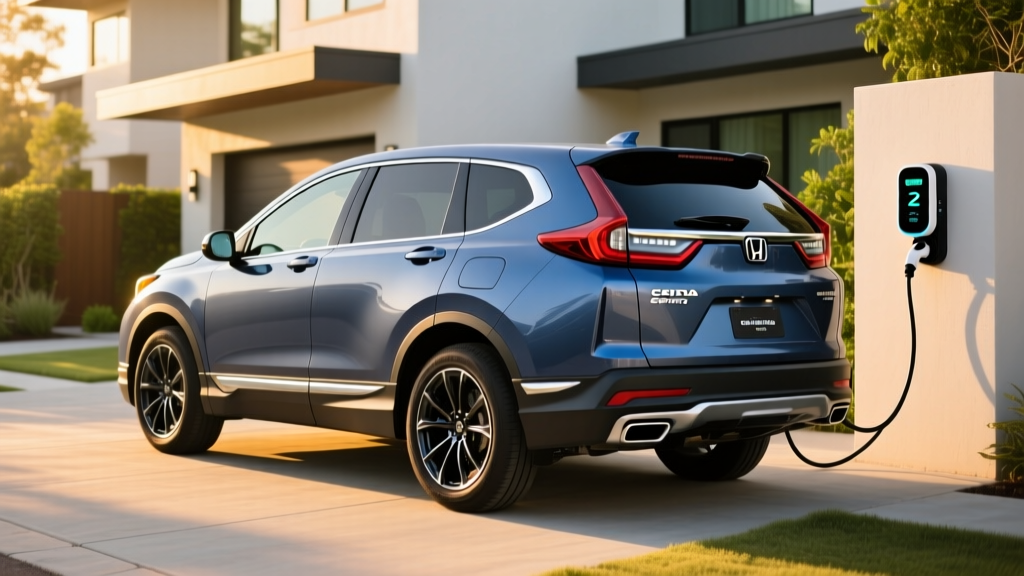
The 2026 Honda CR-V Hybrid Sport-L occupies a compelling middle ground in the compact SUV segment. It pairs Honda's proven two-motor hybrid system with a near-luxury interior, delivering strong city fuel economy without the plug-in complexity or range anxiety of a full EV. For buyers who want meaningful fuel savings, don't have reliable home charging access, or simply want a set-it-and-forget-it electrified SUV, the Sport-L trim is one of the most complete packages Honda offers.
But how does the CR-V Hybrid Sport-L stack up in real-world driving? What's the actual fuel economy beyond the EPA sticker? And is the hybrid battery something to worry about long-term? This guide breaks down every number that matters — from MPG to MSRP to battery warranty — so you can decide whether this is the right electrified SUV for your garage.
2026 Honda CR-V Hybrid Sport-L: Key Specs at a Glance
| Specification | Value |
|---|---|
| Powertrain | 2.0L 4-cylinder + two-motor hybrid system |
| Combined Horsepower | 204 hp |
| Combined Torque | 247 lb-ft (electric motor) |
| Transmission | e-CVT (direct-drive) |
| Drivetrain | AWD standard (Sport-L) |
| EPA Fuel Economy (City/Hwy/Combined) | 40 / 34 / 37 MPG |
| Fuel Tank Capacity | 15.3 gallons |
| Total Driving Range | ~566 miles (EPA est.) |
| 0-60 mph | ~7.6 seconds (est.) |
| Cargo Volume (behind rear seats) | 36.3 cu ft |
| Cargo Volume (rear seats folded) | 76.5 cu ft |
| Towing Capacity | 1,000 lbs |
| MSRP (Sport-L AWD) | $39,995 |
| Hybrid Battery Warranty | 8 years / 100,000 miles |
HEV vs. PHEV vs. EV: Where Does the CR-V Hybrid Fit?
Before diving into the numbers, it's critical to understand what the CR-V Hybrid is — and what it isn't. Honda currently sells the CR-V Hybrid as a conventional hybrid (HEV), not a plug-in hybrid (PHEV). In the U.S. market, Honda discontinued the Clarity PHEV and does not currently offer a CR-V plug-in variant stateside, though a CR-V e:PHEV exists in select international markets.
Conventional Hybrid (HEV): The CR-V Hybrid charges its small battery (~1.06 kWh) entirely through regenerative braking and the gasoline engine. You never plug it in. It cannot drive on electric power alone for meaningful distances. Fuel savings come from the electric motor assisting the engine, especially at low speeds and in stop-and-go traffic.
Plug-In Hybrid (PHEV): A PHEV has a larger battery (typically 12-20 kWh), can be plugged in to charge, and offers 20-40+ miles of electric-only driving before the gas engine kicks in. Examples include the Toyota RAV4 Prime (42 miles EV range) and Hyundai Tucson PHEV (33 miles EV range). PHEVs qualify for partial federal tax credits if battery sourcing and MSRP requirements are met.
Battery Electric Vehicle (BEV): No gasoline engine at all. Full electric range (250-400+ miles). Requires home or public charging access. Examples: Tesla Model Y, Hyundai Ioniq 5, Ford Mustang Mach-E.
The CR-V Hybrid Sport-L is best understood as a vehicle that feels like a refined gas SUV but sips fuel like a much smaller car — particularly in city driving, where the electric motor does the heavy lifting.
Fuel Economy: EPA Ratings and Real-World MPG
The EPA rates the 2026 CR-V Hybrid AWD at 40 MPG city / 34 MPG highway / 37 MPG combined. The FWD variant (not available on Sport-L, which is AWD-only) bumps those numbers slightly to 43/36/40 MPG.
| Configuration | City MPG | Highway MPG | Combined MPG |
|---|---|---|---|
| FWD (Sport Touring Hybrid, lower trims) | 43 | 36 | 40 |
| AWD (Sport-L, Sport Touring Hybrid) | 40 | 34 | 37 |
Source: U.S. EPA / fueleconomy.gov
Real-World MPG: What Owners Actually See
Honda's two-motor hybrid system is one of the best in the segment at exceeding its EPA city rating. The electric motor handles most low-speed propulsion, and the 2.0L Atkinson-cycle engine only engages directly at higher speeds or under heavy acceleration. In mixed city/suburban driving, owners and reviewers consistently report 38-43 MPG combined, with city-heavy commutes sometimes pushing above 42 MPG.
However, highway-dominant driving tells a different story. At sustained 75-80 mph speeds, the gasoline engine is doing most of the work, and the hybrid system's advantage shrinks. Expect 32-35 MPG on long highway trips, which is still competitive with rivals but below the EPA combined sticker.
Cold weather also impacts hybrid fuel economy. In freezing temperatures (below 32°F), the engine runs more frequently to generate cabin heat and maintain battery temperature, typically reducing combined MPG by 3-5 MPG (roughly a 10-15% drop). This is less severe than the range loss EVs experience in winter (often 20-30%), but it's a measurable effect worth planning for.
EPA combined range: ~566 miles (15.3 gal × 37 MPG).
Real-world mixed driving: 540-600 miles depending on conditions.
Highway-dominant road trip: ~490-530 miles per tank.
Cold-weather city driving: ~500-540 miles per tank.
Powertrain and Driving Performance
The CR-V Hybrid uses Honda's fourth-generation two-motor hybrid system. Here's how it works in practice:
- At low speeds (0-25 mph): The vehicle runs primarily on the electric drive motor, drawing from the lithium-ion battery. The engine may run as a generator to recharge the battery but doesn't drive the wheels.
- At moderate speeds (25-55 mph): The system seamlessly blends electric and engine power. The engine often acts as a generator, sending electricity to the drive motor rather than directly turning the wheels.
- At highway speeds (55+ mph): A lock-up clutch engages, connecting the engine directly to the wheels for optimal efficiency at steady-state cruising.
- Under hard acceleration: Both the engine and electric motor contribute, delivering the full 204 hp and 247 lb-ft of torque.
The result is a driving experience that feels surprisingly responsive around town. The 247 lb-ft of electric motor torque is available nearly instantly, giving the CR-V Hybrid a punchy, confident feel from stoplights that belies its 204 hp rating. The e-CVT is smooth and avoids the "rubber band" droning associated with older CVT designs — Honda's system uses fixed gear ratios for the engine direct-drive mode rather than a traditional belt-and-pulley CVT.
The 0-60 mph time of approximately 7.6 seconds is adequate for daily driving and highway merging. It's not sporty — the Hybrid is tuned for comfort and efficiency — but it's quicker than the base 1.5L turbo gas CR-V (approximately 8.3 seconds to 60 mph).
Sport-L Trim: What You Get for $39,995
The Sport-L sits as a mid-to-upper trim in the CR-V Hybrid lineup, positioned between the Sport and the range-topping Sport Touring Hybrid. For the $39,995 MSRP (including destination), the Sport-L adds several premium features over the Sport trim:
- Leather-trimmed seats (Sport uses cloth/leatherette)
- Wireless Apple CarPlay and Android Auto (9-inch touchscreen)
- Wireless phone charger
- Power tailgate with walk-away close
- Heated front seats and heated steering wheel
- Honda Sensing suite (adaptive cruise control, lane-keeping assist, collision mitigation braking, road departure mitigation)
- 19-inch Berlina Black alloy wheels
- Blind-spot information system with cross-traffic monitor
- Dual-zone automatic climate control
What the Sport-L does not include (reserved for the $43,995 Sport Touring Hybrid): Bose premium audio, heated rear seats, ventilated front seats, hands-free power tailgate, built-in navigation, and a Wi-Fi hotspot.
Tax Credits and Incentives: What Qualifies?
Here's where the HEV vs. PHEV distinction becomes financially important.
The 2026 Honda CR-V Hybrid is a conventional hybrid (HEV) and does not qualify for the IRS §30D Clean Vehicle Credit. That credit — up to $7,500 — applies only to plug-in electric vehicles (BEVs and PHEVs) that meet battery sourcing, critical mineral, MSRP cap, and buyer income requirements. Since the CR-V Hybrid cannot be plugged in and has no meaningful electric-only range, it falls outside the credit's scope entirely.
Some states and localities offer smaller incentives for conventional hybrids, though these are increasingly rare as incentive programs shift toward plug-in vehicles. A handful of states offer reduced registration fees, HOV lane access, or modest rebates for any electrified vehicle. Check your state's energy office or the Alternative Fuels Data Center for current local programs.
Battery Warranty, Reliability, and Replacement Cost
Hybrid battery longevity remains a top concern for buyers switching from a conventional gas vehicle. Here's what the data shows for Honda's system:
Honda covers the CR-V Hybrid's lithium-ion battery pack for 8 years or 100,000 miles (whichever comes first) in most states. In California Air Resources Board (CARB) states — which include CA, CT, ME, MA, NJ, NY, OR, RI, VT, and WA — the hybrid battery is covered for 10 years or 150,000 miles under emissions-related warranty provisions.
The warranty covers battery capacity loss below a specified threshold (typically ~70% of original capacity) and any defects in the hybrid system components, including the power control unit and electric motors.
Long-Term Reliability
Honda's hybrid system has a strong track record. The two-motor design, first introduced in the Accord Hybrid and refined across multiple generations, has fewer wear-prone components than some competing systems. There is no traditional transmission to fail (the e-CVT uses a direct-drive clutch mechanism), and the battery is relatively small (~1.06 kWh), meaning it undergoes shallower charge-discharge cycles that reduce degradation stress.
Based on data from earlier Honda hybrid models (Accord Hybrid, Insight, previous-gen CR-V Hybrid), hybrid battery replacements are uncommon before 150,000-200,000 miles. When replacement is needed outside of warranty, a new OEM hybrid battery for the CR-V typically costs between $2,000 and $4,000 including labor. Third-party refurbished batteries are available for approximately $1,200-$2,500.
The CR-V as a platform scores well in reliability surveys. Honda's hybrid components have not been a significant source of complaints, and the NHTSA and IIHS have historically rated the CR-V highly for crash safety (check current-year ratings when available).
CR-V Hybrid Sport-L vs. the Competition
The compact hybrid SUV segment is fiercely competitive. Here's how the CR-V Hybrid Sport-L compares to its key rivals:
| Vehicle | Combined MPG (AWD) | Horsepower | Cargo (cu ft) | MSRP (Comparable Trim) |
|---|---|---|---|---|
| Honda CR-V Hybrid Sport-L AWD | 37 | 204 hp | 36.3 | $39,995 |
| Toyota RAV4 Hybrid XLE Premium AWD | 39 | 219 hp | 37.6 | $38,445 |
| Hyundai Tucson Hybrid Limited AWD | 37 | 226 hp | 38.7 | $40,650 |
| Ford Escape Hybrid Premium AWD | 39 | 210 hp | 34.4 | $39,500 |
The RAV4 Hybrid edges ahead on fuel economy and offers slightly more cargo space. The Tucson Hybrid leads in horsepower. But the CR-V Hybrid Sport-L stands out for interior refinement, ride quality, and the maturity of Honda's hybrid system — it's arguably the most polished driving experience in this group, even if it doesn't win any single spec-sheet category.
Who Should Buy the CR-V Hybrid Sport-L — And Who Shouldn't
- You want meaningful fuel savings (37-40 MPG) without changing your habits or installing a charger
- Your driving is city-heavy or mixed suburban, where the hybrid system excels
- You value a refined, quiet cabin and Honda's safety tech suite
- You need AWD for snow or rain but don't want the fuel penalty of a traditional AWD SUV
- You plan to keep the vehicle 8-12 years and want proven hybrid reliability
- You want electric-only driving or plug-in capability (consider a RAV4 Prime or Tucson PHEV)
- You want to qualify for the $7,500 federal EV tax credit (requires a BEV or PHEV)
- Your driving is almost entirely highway — the hybrid advantage is smaller at sustained high speeds
- You need towing capacity above 1,000 lbs (the hybrid system limits towing vs. the gas turbo CR-V at 1,500 lbs)
- You want maximum cargo volume — the hybrid battery slightly reduces under-floor storage
No home charging + want fuel savings → CR-V Hybrid (HEV) is ideal. No plug, no behavior change.
Have home charging + want electric commuting → Consider a PHEV like the RAV4 Prime or a BEV like the Ioniq 5 if your daily commute is under 40 miles.
Want the $7,500 tax credit → You need a qualifying BEV or PHEV. The CR-V Hybrid doesn't qualify. Check IRS.gov for current eligible vehicles.
Drive mostly highway, 40+ miles daily → The hybrid still saves fuel, but the gap vs. an efficient gas SUV narrows. A diesel or efficient turbo may be competitive.
Frequently Asked Questions
How many MPG does the 2026 Honda CR-V Hybrid Sport-L get?
The EPA rates the CR-V Hybrid Sport-L (AWD) at 40 MPG city, 34 MPG highway, and 37 MPG combined. In real-world mixed driving, most owners report 38-43 MPG combined, with city-heavy driving often exceeding the EPA estimate and highway-dominant trips falling slightly below.
Does the CR-V Hybrid need to be plugged in?
No. The CR-V Hybrid is a conventional hybrid (HEV). Its battery charges entirely through regenerative braking and the gasoline engine. You fuel it like any other gas vehicle — there is no plug, no charging cable, and no electric-only driving range to manage.
Does the 2026 CR-V Hybrid qualify for any tax credit?
The CR-V Hybrid does not qualify for the federal §30D Clean Vehicle Credit, which is limited to plug-in vehicles (BEVs and PHEVs). Some states may offer small incentives for hybrids, but these vary by jurisdiction and are becoming less common. Check your state's energy office for current programs.
Is the Honda CR-V Hybrid reliable? What about battery replacement?
Honda's two-motor hybrid system has demonstrated strong long-term reliability. The hybrid battery is warrantied for 8 years/100,000 miles (10 years/150,000 miles in CARB states). Based on historical data from Honda hybrids, battery failure before 150,000 miles is uncommon. Out-of-warranty replacement costs approximately $2,000-$4,000 for an OEM battery.
Is the CR-V Hybrid Sport-L better than the gas CR-V?
For most buyers, yes. The Hybrid delivers significantly better fuel economy (37 MPG combined vs. 28 MPG combined for the 1.5T AWD gas model), more low-end torque (247 lb-ft vs. 179 lb-ft), and a smoother driving experience. The trade-off is a higher starting price (~$4,000 premium over comparable gas trims) and slightly reduced towing capacity (1,000 lbs vs. 1,500 lbs). If you drive more than 10,000 miles per year, the fuel savings typically offset the price premium within 4-6 years.
How does the CR-V Hybrid compare to the Toyota RAV4 Prime?
The RAV4 Prime is a plug-in hybrid (PHEV) with 42 miles of electric-only range, 302 hp, and eligibility for a partial federal tax credit. It costs significantly more ($44,000+ MSRP) and has limited availability. The CR-V Hybrid Sport-L is a conventional hybrid — lower cost, no plug, no electric-only range, but simpler ownership and strong real-world fuel economy. If you can charge at home and want electric commuting, the RAV4 Prime is the more capable (but pricier) choice. If you want a no-fuss hybrid, the CR-V Hybrid Sport-L is the more practical pick.