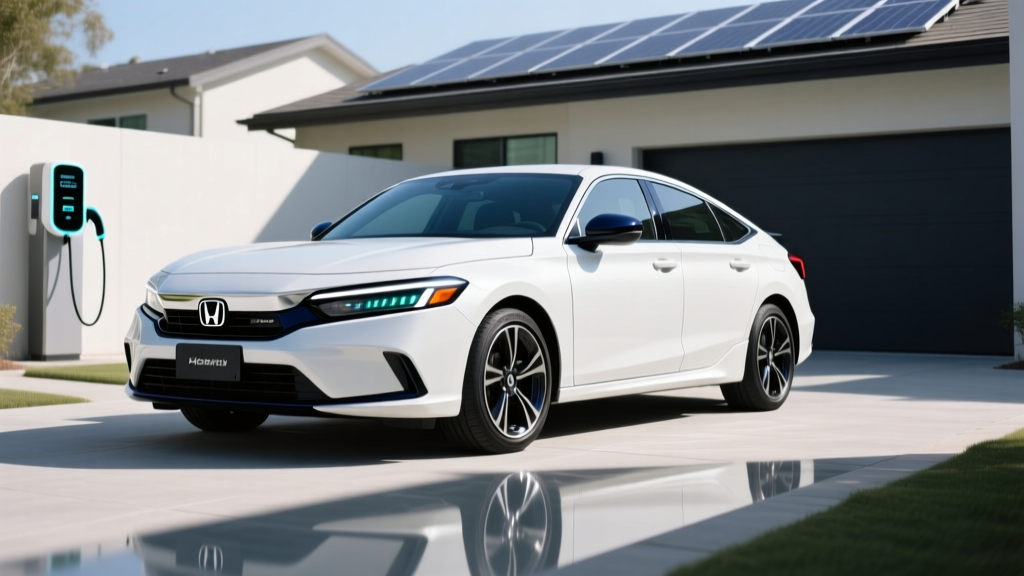
The Honda Civic has been a compact-car benchmark for decades, but the reintroduction of the Civic Hybrid has turned it into a serious efficiency contender. For buyers searching for a 13 Honda Civic Hybrid—whether that's shorthand for the 13th-generation Civic platform or the next evolution of Honda's hybrid compact—the current-generation Civic Hybrid (introduced for the 2025 model year and carried into 2026) is the model to evaluate. It pairs Honda's fourth-generation two-motor hybrid system with a 2.0-liter Atkinson-cycle engine, delivering 200 combined horsepower and an EPA-estimated 49 MPG combined in the sedan.
This isn't a plug-in hybrid. There's no charging port, no electric-only driving mode, and no federal EV tax credit. It's a conventional hybrid (HEV) that refuels at any gas station and squeezes every last mile out of each gallon. Below, we break down everything you need to know—real-world MPG, powertrain specs, pricing, battery warranty, and how it stacks up against PHEVs and full EVs.
HEV vs. PHEV: What the Civic Hybrid Actually Is
Before diving into specs, it's critical to understand what the Civic Hybrid is—and isn't. Honda offers the Civic Hybrid exclusively as a conventional hybrid (HEV). There is no plug-in hybrid (PHEV) variant in the current Civic lineup.
| Feature | HEV (Civic Hybrid) | PHEV (e.g., Toyota Prius Prime) | BEV (e.g., Hyundai Ioniq 6) |
|---|---|---|---|
| Plug-in charging | No | Yes | Yes |
| Electric-only range | ~1 mile (low-speed) | 25–44 miles | 250–360+ miles |
| Refueling | Gas station only | Gas + plug-in | Plug-in only |
| Federal tax credit (§30D) | Not eligible | Up to $7,500 (if eligible) | Up to $7,500 (if eligible) |
| Home charger needed | No | Recommended | Essential |
The Civic Hybrid's small lithium-ion battery (approximately 1.0 kWh usable) is recharged entirely through regenerative braking and the gasoline engine. You never plug it in. This makes it ideal for drivers who lack access to home or workplace charging but still want dramatically better fuel economy than a gas-only car.
Fuel Economy: EPA Ratings and Real-World MPG
The headline number for the 2026 Honda Civic Hybrid sedan is 49 MPG combined per the EPA. Here's the full breakdown by driving cycle:
| Body Style | City MPG | Highway MPG | Combined MPG |
|---|---|---|---|
| Sedan (Sport Hybrid / Sport Touring Hybrid) | 50 | 47 | 49 |
Source: fueleconomy.gov
In mixed driving that includes city stop-and-go, suburban commuting, and highway cruising, owners and independent testers consistently report 47–53 MPG combined in the Civic Hybrid sedan. Hybrids tend to exceed their EPA city rating because regenerative braking recovers energy in stop-and-go traffic. Highway-only driving at 75+ MPH may drop efficiency to the low-to-mid 40s. In cold weather (below 30°F), expect a 5–10% reduction as the engine runs more frequently to provide cabin heat and warm up the powertrain.
With a 12.4-gallon fuel tank, the Civic Hybrid sedan delivers a real-world total range of approximately 580–650 miles between fill-ups—enough for most drivers to go two weeks or more between gas station visits.
Powertrain: 200 HP From Honda's Two-Motor System
The Civic Hybrid uses Honda's fourth-generation e:HEV two-motor hybrid system. Unlike Toyota's planetary-gear power-split design, Honda's system primarily drives the wheels with the electric motor, with the gasoline engine acting mostly as a generator—except at steady highway speeds, where a lockup clutch connects the engine directly to the wheels for efficiency.
| Specification | Value |
|---|---|
| Engine | 2.0L DOHC 4-cyl (Atkinson cycle) |
| Engine HP / Torque | 143 HP / 134 lb-ft |
| Drive Motor HP / Torque | 181 HP / 232 lb-ft |
| Combined System Output | 200 HP / 232 lb-ft |
| Transmission | e-CVT (direct drive w/ lockup clutch) |
| Drivetrain | Front-wheel drive |
| 0–60 MPH (est.) | ~7.1 seconds |
| Battery Type | Lithium-ion (~1.0 kWh usable) |
The result is a compact sedan that feels genuinely quick off the line—electric motor torque is instantaneous—and cruises quietly on the highway. The 200 HP combined output is a meaningful step up from the 158 HP in the non-hybrid 2.0L Civic and even the 180 HP 1.5L turbo. It's one of the most powerful offerings in the compact hybrid segment.
Pricing, Trims, and Tax Credit Eligibility
The 2026 Honda Civic Hybrid is available in two trims for the sedan:
- Sport Hybrid: Starting at approximately $29,845 (including destination)
- Sport Touring Hybrid: Starting at approximately $32,845 (including destination)
The Sport Touring Hybrid adds features like a Bose premium audio system, wireless phone charging, heated rear seats, a larger 9-inch touchscreen with wireless Apple CarPlay/Android Auto, and Honda's full Honda Sensing suite of driver-assist features (standard on both trims).
The Honda Civic Hybrid is a conventional hybrid (HEV), not a plug-in electric vehicle. Under IRS §30D Clean Vehicle Credit rules, only plug-in electric vehicles (PHEVs and BEVs) with sufficient battery capacity qualify for the federal tax credit of up to $7,500. The Civic Hybrid does not qualify for any federal purchase incentive.
Some states may offer modest rebates or HOV-lane access for hybrids—check your state's energy or DMV website for current programs.
Battery Warranty, Reliability, and Replacement Cost
Hybrid battery longevity is consistently the top concern among first-time hybrid buyers. Here's what Honda provides:
- Hybrid battery (high-voltage): 8 years / 100,000 miles (10 years / 150,000 miles in CARB states including CA, NY, MA, and others)
- Hybrid system components: 8 years / 100,000 miles
- Powertrain warranty: 5 years / 60,000 miles
- New vehicle limited warranty: 3 years / 36,000 miles
Honda's hybrid systems have proven highly durable. The two-motor architecture is mechanically simpler than traditional automatic transmissions—there are no belts, torque converters, or multi-speed gearsets to fail. Real-world data from earlier Honda hybrids (Insight, Accord Hybrid) shows battery packs routinely lasting 150,000–200,000+ miles before significant degradation.
If a replacement is needed out of warranty, a refurbished Civic Hybrid battery pack typically costs $2,000–$3,500 installed, while a new OEM pack may run $3,500–$5,000. For context, this is far less than EV battery replacement costs ($8,000–$20,000+) because the Civic Hybrid's pack is small (~1 kWh vs. 60–100 kWh in a BEV).
Honda has earned strong reliability marks from both IIHS (Top Safety Pick ratings) and Consumer Reports, where the Civic line generally scores average to above-average in predicted reliability.
Who Should Choose the Civic Hybrid vs. a PHEV or EV?
Choose the Civic Hybrid (HEV) if:
- You don't have access to home or workplace charging
- You want maximum MPG without changing your refueling habits
- Your budget is under $33,000 and you want a well-equipped compact sedan
- You drive 12,000–15,000 miles/year and want to cut fuel costs by ~40% vs. a gas-only Civic
- You want a proven, low-maintenance powertrain with a long warranty
Choose a PHEV (e.g., Toyota Prius Prime) if:
- You can charge at home (Level 1 or 2) and your commute is under 40 miles round-trip
- You want electric-only daily driving with gas-engine backup for road trips
- You may qualify for the $7,500 federal tax credit, offsetting the higher purchase price
Choose a full EV (e.g., Hyundai Ioniq 6, Tesla Model 3) if:
- You have reliable home Level 2 charging
- Your daily driving is under 250 miles and you road-trip infrequently
- You want to eliminate gas entirely and minimize moving-part maintenance
- You qualify for federal/state EV incentives that bring the effective price close to a hybrid
The Civic Hybrid occupies a clear niche: it's the efficiency upgrade for drivers who aren't ready—or able—to plug in. At ~49 MPG combined, it uses roughly 245 gallons per year at 12,000 miles, compared to ~375 gallons for a gas-only Civic (32 MPG combined). At $3.50/gallon, that's approximately $455 in annual fuel savings, or $2,275 over five years—not including potential maintenance savings from reduced engine wear (the engine runs less often and the regenerative braking system extends brake-pad life).
Pros and Cons at a Glance
- 49 MPG combined EPA; real-world often exceeds 50 MPG in city driving
- 200 HP makes it the quickest Civic this side of the Si/Type R
- No plug-in required—zero lifestyle change from a gas car
- 600+ mile total range per tank
- Honda Sensing ADAS standard on all trims
- Strong resale value and proven hybrid reliability
- No federal tax credit (HEV, not PHEV/BEV)
- Available only in Sport and Sport Touring trims (no base LX Hybrid)
- Highway MPG (47) lags behind city (50)—typical for hybrids
- Sedan only; no Civic Hybrid hatchback currently offered
- Engine drone under hard acceleration (e-CVT characteristic)
Frequently Asked Questions
How many MPG does the Honda Civic Hybrid get?
The 2026 Honda Civic Hybrid sedan is EPA-rated at 50 city / 47 highway / 49 combined MPG. In real-world driving, owners frequently report 47–53 MPG combined, with city-heavy routes often yielding numbers above the EPA estimate thanks to regenerative braking.
Does the Civic Hybrid need to be plugged in?
No. The Civic Hybrid is a conventional hybrid (HEV), not a plug-in hybrid (PHEV). Its small lithium-ion battery recharges through regenerative braking and the gasoline engine. You refuel at any gas station, exactly like a traditional car.
Does the Honda Civic Hybrid qualify for any tax credit?
No federal tax credit applies. The IRS §30D Clean Vehicle Credit is available only to plug-in vehicles (PHEVs and BEVs) that meet battery sourcing, MSRP, and buyer income requirements. Some states may offer small hybrid incentives—check your state energy office for details.
How long will the Civic Hybrid battery last?
Honda warranties the hybrid battery for 8 years/100,000 miles (10 years/150,000 miles in CARB states). Based on historical data from Honda's hybrid fleet, the battery pack commonly lasts 150,000–200,000+ miles. Replacement costs range from $2,000 (refurbished) to $5,000 (new OEM) if needed out of warranty.
Is the Civic Hybrid faster than the gas Civic?
Yes. The Civic Hybrid produces 200 combined horsepower and 232 lb-ft of torque (from the electric motor), compared to 158 HP in the base 2.0L gas Civic. The hybrid's estimated 0–60 MPH time of ~7.1 seconds beats the gas model's ~7.7 seconds, and the instant electric torque makes it feel even quicker in everyday driving.
Hybrid vs. PHEV vs. EV — which should I buy?
If you can't charge at home, the Civic Hybrid (HEV) is the clear winner—it requires zero infrastructure change. If you can charge at home and commute under 40 miles daily, a PHEV like the Prius Prime lets you drive mostly on electricity while keeping gas-engine range for road trips. If you have Level 2 home charging and want zero tailpipe emissions, a full EV like the Ioniq 6 or Model 3 offers the lowest operating cost—but at a higher purchase price and with road-trip planning required for charging stops.