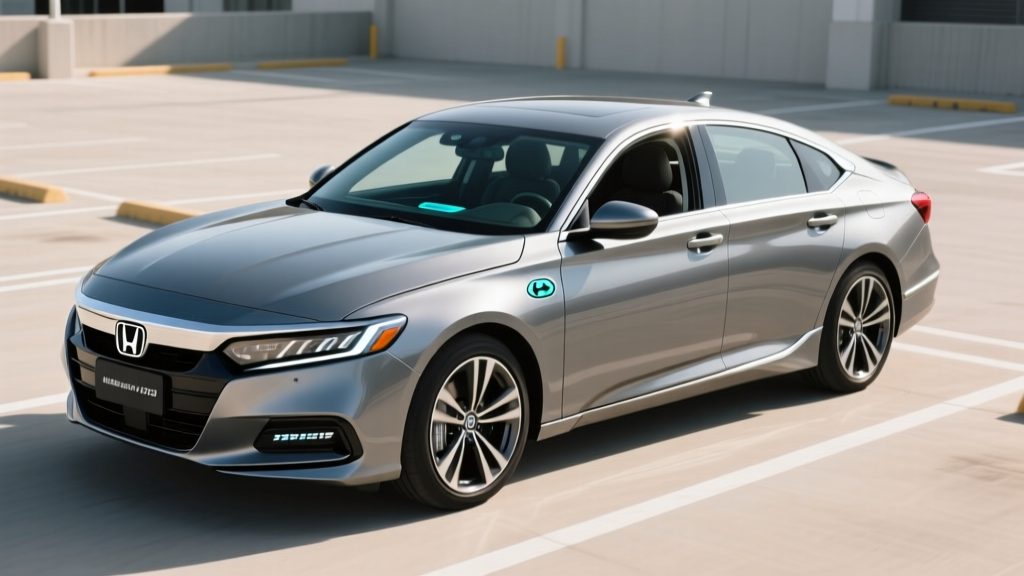
The midsize sedan segment has thinned out, but the Honda Accord remains a benchmark — and its hybrid powertrain is the version most buyers should consider. The new 2026 Honda Accord Hybrid carries forward the two-motor system Honda has refined over multiple generations, delivering EPA ratings near 50 MPG combined while avoiding the complexity, weight, and price premium of a plug-in hybrid or full electric vehicle. This guide breaks down exactly what the 2026 Accord Hybrid offers in efficiency, performance, ownership cost, and how it stacks up against PHEV and BEV alternatives.
HEV vs PHEV vs EV: Where the Accord Hybrid Fits
Before diving into specs, it's worth clarifying what the Accord Hybrid is — and isn't. Honda offers the Accord exclusively as a conventional hybrid (HEV). There is no plug-in hybrid (PHEV) Accord, and Honda has not announced plans for one. That distinction matters because HEVs and PHEVs operate fundamentally differently.
Conventional Hybrid (HEV) vs Plug-In Hybrid (PHEV)
- HEV (Accord Hybrid): No plug. A small battery (~1 kWh) is recharged entirely by regenerative braking and the gasoline engine. You never plug it in — just fuel up like a regular car. The electric motor assists the engine and enables brief low-speed EV driving, but the gas engine does most of the work.
- PHEV (e.g., Toyota Prius Prime, Hyundai Tucson PHEV): Has a larger battery (typically 12–20 kWh) that can be plugged in to charge. Offers 25–45 miles of electric-only driving before the gas engine kicks in, functioning as a conventional hybrid afterward.
- BEV (e.g., Tesla Model 3, Hyundai Ioniq 6): Fully electric. No gas engine. Relies entirely on grid charging, with ranges from 250–400+ miles.
The Accord Hybrid is designed for drivers who want dramatically better fuel economy than a gas car without changing their fueling habits. No home charger needed, no range planning, no charging-station hunting on road trips.
Fuel Economy: EPA Ratings and Real-World MPG
The 2026 Honda Accord Hybrid is rated by the EPA at 51 MPG city / 44 MPG highway / 48 MPG combined for the Sport and EX-L trims (18-inch wheels). The Sport-L and Touring trims, equipped with 19-inch wheels, drop slightly to 46 MPG city / 41 MPG highway / 44 MPG combined, per fueleconomy.gov.
| Trim | City MPG | Highway MPG | Combined MPG |
|---|---|---|---|
| Sport / EX-L (18" wheels) | 51 | 44 | 48 |
| Sport-L / Touring (19" wheels) | 46 | 41 | 44 |
Real-World MPG: What to Actually Expect
Honda's two-motor hybrid system excels in stop-and-go city driving, where the electric motor handles low-speed propulsion and the engine acts primarily as a generator. In real-world mixed driving, owners of the current-generation Accord Hybrid consistently report 45–52 MPG combined, with city-heavy commutes sometimes pushing above the EPA city figure. This is a common trait of series-parallel hybrids — the EPA city test cycle can't fully capture how efficiently these systems operate at low speeds with frequent regen braking.
On sustained highway trips at 70–80 mph, expect closer to 39–43 MPG in the 18-inch wheel trims. The engine engages directly with the wheels via a lockup clutch at highway speeds, which is efficient but less advantaged than the city cycle. Cold weather (below 35°F) will knock 3–5 MPG off any hybrid due to reduced battery efficiency, longer engine warm-up, and increased accessory loads — plan for 40–44 MPG combined in winter conditions in northern climates.
Powertrain: Two-Motor Hybrid System
The 2026 Accord Hybrid uses Honda's fourth-generation two-motor hybrid system, pairing a 2.0-liter Atkinson-cycle four-cylinder engine with two electric motors — one functioning as a drive motor and the other as a generator/starter.
| Specification | Detail |
|---|---|
| Engine | 2.0L Atkinson-cycle inline-4 |
| Combined System Horsepower | 204 hp |
| Combined System Torque | 247 lb-ft (motor torque) |
| Transmission | e-CVT (single-speed direct drive + engine lockup clutch) |
| Drivetrain | Front-wheel drive |
| 0–60 mph | ~6.5 seconds (est.) |
| Hybrid Battery | ~1.06 kWh lithium-ion |
| Fuel Tank | 12.8 gallons |
| Total Driving Range | ~614 miles (48 MPG × 12.8 gal) |
The electric motor delivers 247 lb-ft of torque from near-zero RPM, giving the Accord Hybrid strong initial acceleration that feels more responsive than its 204 hp figure suggests. The engine only directly drives the wheels at highway cruising speeds via a lockup clutch; at all other speeds, the drive motor handles propulsion while the engine spins the generator to produce electricity. This series-parallel architecture is one of the most efficient hybrid designs in production and is a key reason the Accord Hybrid achieves its city-dominant EPA ratings.
Pricing, Trims, and Tax Credit Eligibility
The 2026 Honda Accord Hybrid is available across four trims. Pricing starts at approximately $34,995 (including destination) for the Sport Hybrid and climbs to roughly $40,495 for the Touring Hybrid. These are Honda's MSRP figures; dealer pricing may vary.
| Trim | MSRP (approx.) | Key Features |
|---|---|---|
| Sport Hybrid | $34,995 | 18" wheels, heated front seats, Honda Sensing suite |
| EX-L Hybrid | $36,495 | Leather, wireless CarPlay/Android Auto, moonroof |
| Sport-L Hybrid | $37,195 | 19" wheels, sport styling, leather-trimmed seats |
| Touring Hybrid | $40,495 | Adaptive dampers, Bose audio, ventilated front seats, HUD |
Does the Accord Hybrid Qualify for a Federal Tax Credit?
No. The federal §30D Clean Vehicle Credit applies only to plug-in electric vehicles — battery electric vehicles (BEVs) and plug-in hybrids (PHEVs) with sufficient battery capacity. Because the Accord Hybrid is a conventional HEV that cannot be plugged in, it does not qualify for the $3,750–$7,500 federal purchase credit. The IRS rules are clear on this point (irs.gov).
Some states may offer modest incentives for hybrid vehicles, but these are far less common than EV incentives and vary widely by jurisdiction. Check your state's energy or environmental agency for current programs.
Battery Warranty, Reliability, and Replacement Cost
Hybrid battery longevity is the most common concern among first-time hybrid buyers, and it's one Honda addresses with strong warranty coverage.
Hybrid Battery Warranty
Honda covers the Accord Hybrid's lithium-ion battery pack for 8 years / 100,000 miles (whichever comes first) in most states, and 10 years / 150,000 miles in California Air Resources Board (CARB) states including CA, CO, CT, ME, MD, MA, NJ, NY, OR, RI, VT, and WA. This warranty covers battery capacity loss below a defined threshold and any defects.
How Long Do Honda Hybrid Batteries Last?
Honda's hybrid systems have an excellent track record. The current two-motor architecture uses a relatively small lithium-ion pack (~1.06 kWh) that operates within a narrow state-of-charge window — typically between 30% and 70% — which dramatically reduces stress on the cells. In practice, Honda hybrid batteries from the past decade have shown minimal measurable degradation even past 150,000 miles. Full battery failure requiring replacement is rare in the Accord Hybrid specifically.
If replacement is needed out of warranty, a new OEM hybrid battery for the Accord Hybrid typically costs $2,000–$4,000 installed, depending on the source and whether you go through a dealer or independent hybrid specialist. Third-party refurbished packs can reduce this to $1,500–$2,500. This is dramatically less expensive than a BEV traction battery replacement, which can exceed $10,000–$15,000.
Overall Reliability
Honda's hybrid powertrain has proven to be one of the most dependable in the industry. The e-CVT design has no conventional belts, clutches, or gear sets that wear — it's an elegantly simple system with two motor-generators on a planetary gearset. Honda Sensing (the standard ADAS suite including adaptive cruise control, lane-keeping assist, and automatic emergency braking) adds a layer of active safety, though it remains an SAE Level 2 system requiring full driver attention.
Driving Impressions and Daily Usability
The Accord Hybrid drives like a conventional sedan — which is precisely its appeal. The transition between electric-only and engine-assisted driving is nearly imperceptible from behind the wheel. Under gentle acceleration, the car launches on electric motor power alone; press harder and the engine fires up to generate electricity for the drive motor. At steady highway speeds above ~45 mph, the lockup clutch engages and the engine drives the wheels directly for maximum efficiency.
Ride quality is composed, with the Touring trim's adaptive dampers adding a layer of sophistication. Cabin noise is well-managed, though the engine drone under hard acceleration is noticeable — a characteristic of the e-CVT holding the engine at a fixed RPM. The trunk offers 16.7 cubic feet of cargo space, identical to the non-hybrid Accord, because the compact battery pack is packaged under the rear seats rather than intruding into the cargo area.
Accord Hybrid vs PHEV vs EV: Which Should You Choose?
Decision Framework
Choose the Accord Hybrid if:
- You want 45+ MPG without changing your fueling habits
- You don't have access to home or workplace charging
- You take frequent long road trips and don't want to plan around charging stations
- You want a proven, low-maintenance powertrain with 8–10 year battery warranty
- Your budget is $35,000–$40,000
Consider a PHEV (e.g., Toyota Prius Prime) if:
- You have home charging and a short commute (under 40 miles round-trip)
- You want to drive on electricity most days but need gas flexibility for longer trips
- You want partial federal tax credit eligibility (PHEVs with ≥7 kWh batteries may qualify)
Consider a full EV (e.g., Tesla Model 3, Hyundai Ioniq 6) if:
- You have reliable home Level 2 charging
- You want the lowest per-mile energy cost (~$0.04–$0.06/mile vs ~$0.09/mile for the Accord Hybrid at 30 MPG and $3.00/gal)
- You want the full $7,500 federal tax credit (subject to income, MSRP, and sourcing rules)
- You rarely drive more than 250 miles in a single day
Ownership Costs: Fuel Savings vs Conventional Gas Sedans
At the EPA combined rating of 48 MPG and a national average gas price of approximately $3.10/gallon, the Accord Hybrid costs roughly $645 per year to fuel for 10,000 miles of driving. A comparable gas-only midsize sedan rated at 30 MPG combined would cost approximately $1,033 per year — a savings of nearly $390 annually with the hybrid. Over a 5-year ownership period, that's roughly $1,950 in fuel savings, which more than offsets any modest price premium the hybrid commands over a non-hybrid equivalent.
Maintenance costs are comparable to a conventional Accord. The hybrid system adds no routine maintenance items — there's no hybrid-specific fluid change, and the regenerative braking system actually extends brake pad life by reducing friction brake usage. Oil changes follow the same interval as the gas model.
Pros and Cons
✓ Pros
- 48 MPG combined EPA — class-leading efficiency
- No plug-in required; zero behavior change from gas cars
- Strong electric torque for confident city acceleration
- 614+ mile total range between fill-ups
- Full trunk space (16.7 cu ft) — no battery intrusion
- 8–10 year hybrid battery warranty
- Honda Sensing ADAS standard on all trims
✗ Cons
- No federal tax credit (HEVs are ineligible under §30D)
- Engine drone under hard acceleration (e-CVT characteristic)
- FWD only — no AWD option unlike Toyota Camry Hybrid
- Highway MPG drops to 41–44 (less advantage vs gas at sustained speed)
- Touring trim pushes past $40K for a midsize sedan
- No PHEV variant available for electric-commute drivers
Frequently Asked Questions
How many MPG does the 2026 Honda Accord Hybrid get?
The EPA rates the 2026 Accord Hybrid at 51 city / 44 highway / 48 combined MPG for trims with 18-inch wheels (Sport, EX-L). Trims with 19-inch wheels (Sport-L, Touring) are rated at 46 city / 41 highway / 44 combined. Real-world city driving often matches or exceeds the EPA city figure, while sustained highway driving at 75+ mph will return closer to 39–43 MPG.
Does the Honda Accord Hybrid need to be plugged in?
No. The Accord Hybrid is a conventional hybrid (HEV), not a plug-in hybrid. Its small lithium-ion battery is charged entirely through regenerative braking and the gasoline engine. You simply fill up with gas as you would with any conventional car.
Is there a plug-in hybrid (PHEV) Honda Accord?
No. Honda does not offer a PHEV version of the Accord, and none has been announced for the 2026 model year. If you want a PHEV sedan, the Toyota Prius Prime (44 miles electric-only, EPA-estimated) is the closest competitor in this segment.
Does the Accord Hybrid qualify for any federal tax credit?
No. The IRS §30D Clean Vehicle Credit applies only to plug-in vehicles (BEVs and qualifying PHEVs). Conventional hybrids like the Accord Hybrid are not eligible. Check your state's incentive programs, as a few states offer modest hybrid rebates, but these are uncommon.
How long will the hybrid battery last and what does replacement cost?
Honda's hybrid batteries are designed to last the life of the vehicle and are covered by an 8-year/100,000-mile warranty (10 years/150,000 miles in CARB states). In practice, significant degradation is rare even past 150,000 miles. If replacement is needed out of warranty, expect $2,000–$4,000 for an OEM pack installed.
How does the Accord Hybrid compare to the Toyota Camry Hybrid?
The Camry Hybrid offers slightly higher combined MPG (up to 52 MPG) and an available AWD powertrain, which the Accord Hybrid lacks. However, the Accord Hybrid offers more rear-seat legroom, a larger trunk, and a more refined ride in higher trims. Both are excellent choices — the Camry Hybrid wins on efficiency and AWD availability; the Accord Hybrid wins on interior space and driving refinement.
Is the Accord Hybrid good for long road trips?
Yes. With a 12.8-gallon fuel tank and 48 MPG combined, the Accord Hybrid can travel over 600 miles between fill-ups. There's no charging infrastructure to worry about — you simply stop at any gas station. Highway comfort is strong, and the Honda Sensing adaptive cruise control reduces fatigue on long drives.