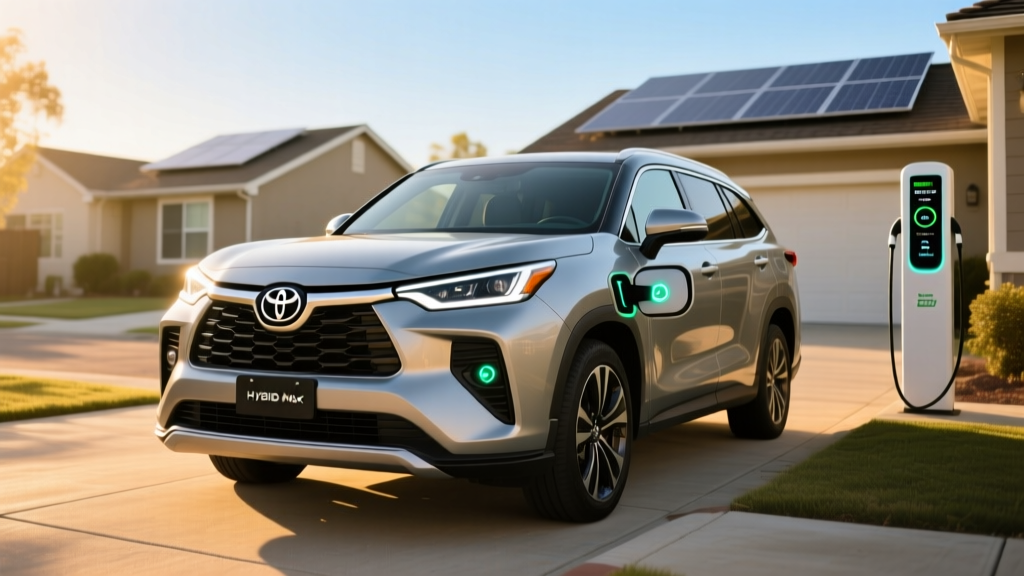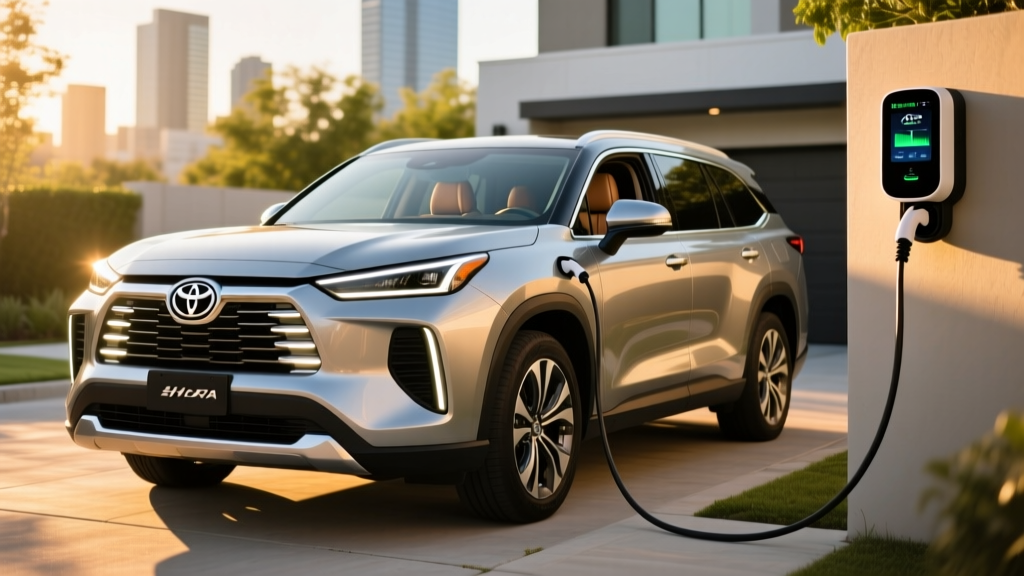
The 2026 Toyota Grand Highlander Platinum Hybrid MAX occupies a narrow but compelling lane in the three-row SUV market: it pairs a turbocharged hybrid powertrain with a premium-trim interior and standard all-wheel drive, all without requiring a plug. For large families who need three usable rows, cargo volume that rivals minivans, and fuel economy that embarrasses body-on-frame competitors, the Hybrid MAX powertrain is the performance-oriented option in the Grand Highlander lineup. But at a Platinum-trim price that pushes past $58,000, buyers need to know exactly what they're getting — and what they're not.
This review covers the 2026 Grand Highlander Hybrid MAX in Platinum trim with real-world fuel economy data, powertrain specifics, battery warranty details, tax-credit eligibility under current IRS rules, and a clear-eyed look at who should buy this hybrid versus stepping into a plug-in hybrid or full battery-electric vehicle.
Powertrain and Performance: The Hybrid MAX Difference
The Hybrid MAX is Toyota's performance hybrid architecture, distinct from the standard Grand Highlander Hybrid. Where the base hybrid pairs a 2.5-liter naturally aspirated four-cylinder with electric motors for 245 combined horsepower, the Hybrid MAX steps up to a 2.4-liter turbocharged four-cylinder teamed with a more powerful electric motor and a six-speed automatic transmission (rather than the eCVT found in the base hybrid).
| Specification | Value |
|---|---|
| Engine | 2.4L turbocharged inline-4 |
| Combined System Output | 362 hp / 400 lb-ft torque |
| Transmission | 6-speed automatic (Direct Shift) |
| Drivetrain | AWD (standard, electronic rear motor) |
| 0–60 mph (est.) | ~5.8 seconds |
| Towing Capacity | 5,000 lbs (max, properly equipped) |
| Hybrid Battery Type | Lithium-ion (sealed, self-charging) |
The 362-horsepower output puts the Hybrid MAX in a different performance bracket from most three-row crossovers. The 400 lb-ft of torque is available low in the rev range thanks to the turbo and electric motor working in concert, which makes highway merging and loaded-up mountain passes genuinely effortless. The six-speed automatic also delivers a more traditional, engaging driving feel compared to the drone-heavy eCVT in the base hybrid — a meaningful distinction for drivers who spend long hours behind the wheel.
Fuel Economy: EPA Ratings vs Real-World MPG
The Hybrid MAX trades some fuel efficiency for its performance advantage. Where the base 245-hp Grand Highlander Hybrid achieves an EPA-estimated 34–36 MPG combined depending on trim, the Hybrid MAX's turbocharged powertrain and AWD system reduce that figure meaningfully.
| Cycle | EPA Estimate | Real-World Expectation |
|---|---|---|
| City | 26 MPG | 27–29 MPG (hybrids excel in stop-and-go) |
| Highway | 27 MPG | 25–27 MPG (turbo works harder at sustained speed) |
| Combined | 27 MPG | 26–28 MPG mixed driving |
Source: fueleconomy.gov — EPA estimates for the current model year.
For context, a comparably sized gas-only three-row SUV like the Ford Explorer or Chevrolet Traverse typically returns 19–22 MPG combined. The Hybrid MAX's 27 MPG represents a roughly 25–30% improvement in fuel consumption while delivering more horsepower than either competitor's standard engine.
Pricing, Trims, and Tax Credit Eligibility
The Hybrid MAX powertrain is available exclusively in the upper trim levels of the Grand Highlander lineup. For 2026, the Platinum trim sits near the top, offering premium features like heated and ventilated second-row captain's chairs, a panoramic roof, a 12.3-inch infotainment display, Toyota's Safety Sense 3.0 suite, and a 360-degree camera system.
| Trim | Approx. MSRP | Key Features |
|---|---|---|
| Limited Hybrid MAX | ~$54,070 | Leatherette, heated/ventilated front seats, 12.3" display, power liftgate |
| Platinum Hybrid MAX | ~$58,175 | Panoramic roof, premium leather, 2nd-row captain's chairs (heated/ventilated), 360° camera, head-up display |
Prices shown are approximate base MSRP and exclude destination charges (~$1,395), dealer add-ons, and optional packages. Fully loaded with accessories, a Platinum Hybrid MAX can approach $60,000–$61,000 out the door before taxes.
Hybrid Battery Warranty and Long-Term Reliability
One of the most common questions from hybrid buyers — especially those coming from gas-only vehicles — concerns the hybrid battery: how long it lasts, what it costs to replace, and what Toyota covers under warranty.
Toyota's hybrid powertrains have accumulated an exceptionally strong reliability track record over more than two decades, beginning with the original Prius in the U.S. market. The Hybrid MAX system uses a smaller lithium-ion battery pack (roughly 1–2 kWh of usable capacity) compared to a PHEV or BEV — and because it never undergoes deep discharge cycles (the system maintains a state-of-charge buffer between roughly 40% and 80%), degradation is minimal in practice.
Based on long-term data from Toyota's hybrid fleet (including the Highlander Hybrid, RAV4 Hybrid, and Camry Hybrid), hybrid battery replacement is uncommon before 150,000–200,000 miles. When replacement is necessary outside of warranty, a Toyota hybrid battery pack typically costs between $3,000 and $5,000 including labor, depending on the service center. Refurbished battery options can reduce this cost to approximately $1,500–$2,500.
The Hybrid MAX's six-speed automatic transmission is also a conventional planetary-gear unit — more familiar to mechanics than the eCVT power-split device in the base hybrid, and historically robust in Toyota's turbocharged applications.
HEV vs PHEV vs Full EV: Which Three-Row SUV Fits Your Life?
The Grand Highlander Hybrid MAX competes in a three-row SUV segment where buyers have three electrification paths. Here's how to think about which one fits:
| Factor | Conventional Hybrid (HEV) | Plug-In Hybrid (PHEV) | Battery Electric (BEV) |
|---|---|---|---|
| Plug-in charging needed? | No — self-charging | Yes — for electric-only range | Yes — exclusively |
| Electric-only driving | Minimal (low-speed assist only) | 20–40+ miles typical | 250–400+ miles |
| Fuel cost per mile | ~$0.12–0.14/mi (gas only) | ~$0.04–0.06/mi (electric) + gas | ~$0.03–0.05/mi (electric only) |
| Federal tax credit | Not eligible | Up to $7,500 (if eligible) | Up to $7,500 (if eligible) |
| Road trip flexibility | Unlimited — gas stations everywhere | Unlimited — gas engine takes over | Requires DC fast-charging route planning |
| Home charging install | Not needed | Recommended (Level 2, ~$500–$2,000) | Essential (Level 2, ~$500–$2,000+) |
| Three-row options | Grand Highlander, Highlander, Kia Sorento HEV | Kia Sorento PHEV, Pacifica PHEV (minivan) | Kia EV9, Tesla Model X, Rivian R1S |
- You need three usable rows and maximum cargo volume without a minivan
- You cannot install a home charger (apartment, street parking, or HOA restrictions)
- You take frequent long road trips and don't want to plan around charging stops
- You want strong acceleration (362 hp) with better fuel economy than a gas-only rival
- You tow up to 5,000 lbs and need AWD traction
- You have home charging access and a mostly-electric daily commute under 30 miles
- Minimizing fuel cost per mile is a top priority
- You want to qualify for the federal §30D tax credit (up to $7,500)
- You want zero tailpipe emissions during daily driving (PHEV in EV mode or BEV)
Interior, Cargo, and Daily Livability
The "Grand" in Grand Highlander refers to a wheelbase stretch that delivers genuinely usable third-row seating for adults on shorter trips — a meaningful advantage over the standard Highlander, whose third row is best reserved for children. In the Platinum trim, second-row captain's chairs with heating and ventilation improve long-trip comfort and create a walk-through to the third row.
Cargo volume behind the third row is approximately 20.6 cubic feet — enough for several carry-on bags or a week of groceries for a large family. Fold the third row and you gain roughly 57.9 cubic feet; fold both rear rows for up to 97.5 cubic feet, rivaling mid-size minivan cargo capacity.
The Platinum trim includes Toyota's 12.3-inch touchscreen with wireless Apple CarPlay and Android Auto, a 11-speaker JBL audio system, a digital rearview mirror, and Toyota Safety Sense 3.0 (pre-collision with pedestrian detection, full-speed adaptive cruise, lane tracing assist, and road sign assist). Note that Toyota Safety Sense 3.0 is a Level 2 driver-assist system per SAE classification — it supports steering and speed but requires the driver to remain fully engaged at all times. It is not a self-driving system.
Pros and Cons at a Glance
- 362 hp with AWD makes it one of the quickest three-row hybrids available
- 27 MPG combined in a 4,600+ lb SUV is genuinely efficient
- Adult-usable third row and minivan-rivaling cargo space
- No plug-in charging required — works with any lifestyle
- 10-year / 150,000-mile hybrid battery warranty
- 5,000-lb towing capacity exceeds most crossover competitors
- Toyota's long-standing hybrid reliability record
- No federal tax credit eligibility (HEV exclusion under §30D)
- Platinum Hybrid MAX pushes $58K+ MSRP — steep for a Toyota
- Fuel economy drops below the base hybrid by 7–9 MPG combined
- No plug-in hybrid or full EV variant of the Grand Highlander exists
- Turbo engine requires premium fuel for maximum performance
- Third row still less spacious than a minivan (Sienna, Pacifica)
Frequently Asked Questions
How many MPG does the 2026 Grand Highlander Hybrid MAX get?
The EPA rates the Hybrid MAX AWD at 26 city / 27 highway / 27 combined MPG. In real-world mixed driving, expect 26–28 MPG, with city driving often yielding slightly better results thanks to regenerative braking. Highway-only driving at higher speeds may drop to 24–25 MPG.
Does the Grand Highlander Hybrid MAX need to be plugged in?
No. The Hybrid MAX is a conventional hybrid (HEV). The battery charges itself through regenerative braking and the gasoline engine. There is no plug, no charging cable, and no electric-only driving range to manage. You fuel it at a gas station like any other vehicle.
How far can the Hybrid MAX drive on electric power alone?
Effectively zero miles in any meaningful sense. The hybrid system uses the electric motor to assist acceleration and enable brief low-speed electric-only movement (such as in a parking lot or heavy traffic creep), but it cannot sustain highway speeds or travel meaningful distances without the gasoline engine. If electric-only commuting is a priority, you need a PHEV or BEV.
Is the hybrid battery reliable, and what does replacement cost?
Toyota's hybrid batteries have demonstrated excellent longevity, with many lasting 150,000–200,000+ miles before significant degradation. The 2026 Grand Highlander Hybrid MAX includes a 10-year / 150,000-mile hybrid battery warranty. Out-of-warranty replacement typically costs $3,000–$5,000 at a dealership, or $1,500–$2,500 with a refurbished unit from an independent hybrid specialist.
Does the Grand Highlander Hybrid MAX qualify for any tax credit?
No. The federal §30D clean vehicle credit applies only to plug-in vehicles (BEVs and PHEVs) that meet battery sourcing, MSRP cap, and buyer income requirements. As a conventional hybrid, the Grand Highlander Hybrid MAX is not eligible. Check your state's energy office for any local hybrid incentives, though these are uncommon and typically modest.
How does the Hybrid MAX compare to the base Grand Highlander Hybrid?
The base hybrid (245 hp, 2.5L four-cylinder, eCVT) achieves 34–36 MPG combined and starts around $43,000. The Hybrid MAX (362 hp, 2.4L turbo, 6-speed auto) delivers 27 MPG combined, faster acceleration (~5.8s vs ~7.8s 0–60), higher towing capacity, and a more engaging driving feel — at the cost of roughly 7–9 MPG and a significantly higher starting price. If fuel economy is the top priority, the base hybrid wins. If performance and towing matter more, the Hybrid MAX is the stronger choice.
Should I buy the Grand Highlander Hybrid MAX or a Kia EV9?
These serve different needs. The Grand Highlander Hybrid MAX offers unlimited range via gas stations, 5,000-lb towing, no charging infrastructure requirement, and a proven hybrid system — ideal for road-trip-heavy families without home charging. The Kia EV9 (a full BEV three-row SUV) delivers 270–300+ miles of EPA range, ~$0.04/mile fuel cost with home charging, potential §30D tax credit eligibility, and zero tailpipe emissions — but requires DC fast-charging planning on road trips and home Level 2 charging installation for daily convenience.