Quick Verdict: What the 2026 Sierra 1500 Hybrid Actually Is
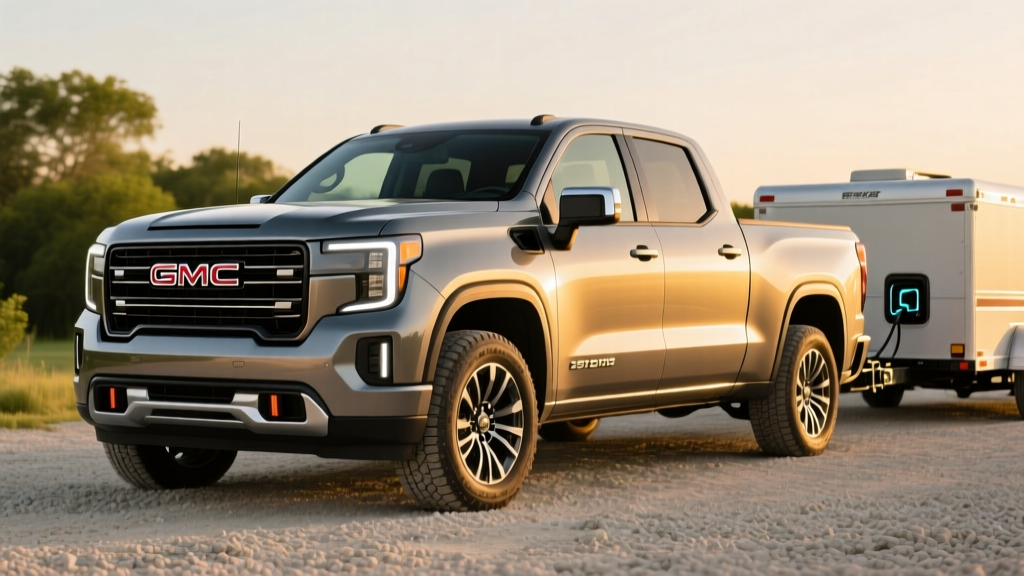
The 2026 GMC Sierra 1500 Hybrid is not a plug-in hybrid, and it is not a full electric truck like the GMC Sierra EV. Instead, GMC equips select Sierra 1500 trims with a mild-hybrid system centered around a 2.7L TurboMax inline-four engine paired with a compact electric motor/generator integrated into the drivetrain. This setup provides stop-start functionality, brief electric torque assist during acceleration, and regenerative braking — but it cannot drive on electric power alone and does not plug into a charger.
If you're searching for a Sierra that sips fuel in the city or qualifies for federal EV tax credits, this mild-hybrid system won't deliver that. But if you want a capable half-ton pickup with slightly improved fuel economy over the non-hybrid TurboMax and no change to your daily routine, it's worth understanding exactly what you're getting — and what you're not.
HEV vs. PHEV vs. Mild Hybrid — Where Does the Sierra Fit?
| Type | Plugs In? | Electric-Only Driving? | Example |
|---|---|---|---|
| Mild Hybrid (MHEV) | No | No — motor only assists the engine | 2026 GMC Sierra 1500 2.7L TurboMax Hybrid |
| Full Hybrid (HEV) | No | Briefly, at low speeds | Ford F-150 PowerBoost, Toyota Tundra i-FORCE MAX |
| Plug-in Hybrid (PHEV) | Yes | Yes — typically 20-50 miles | Jeep Wrangler 4xe, Chrysler Pacifica Hybrid |
| Battery Electric (BEV) | Yes | Yes — 200+ miles | GMC Sierra EV, Ford F-150 Lightning |
The 2026 Sierra 1500 Hybrid falls into the mildest category. It recuperates energy during braking and deceleration, stores it in a small battery, and uses it to smooth out stop-start events and provide minor torque fill. Expect fuel economy gains of roughly 1–2 MPG combined versus the non-hybrid TurboMax — not the dramatic improvements a full hybrid like the F-150 PowerBoost delivers.
Powertrain Specs: Engine, Motor, and Combined Output
The 2026 Sierra 1500 Hybrid pairs GM's TurboMax 2.7-liter turbocharged inline-four engine with an integrated motor/generator unit. Here are the key figures:
| Specification | Value |
|---|---|
| Engine | 2.7L TurboMax I4 + mild-hybrid motor/generator |
| Combined Horsepower | 310 hp @ 5,600 rpm |
| Combined Torque | 430 lb-ft @ 1,500–4,000 rpm |
| Transmission | 8-speed automatic |
| Drivetrain | RWD standard; 4WD available |
| Max Towing (properly equipped) | ~9,200 lbs (4WD Crew Cab) |
| Max Payload | ~2,240 lbs |
| Hybrid Battery | Small lithium-ion pack (~1.5 kWh), not plug-in |
| 0–60 mph (est.) | ~6.9 seconds |
The mild-hybrid system's primary contribution is low-end torque fill. The electric motor/generator kicks in during initial acceleration from a stop, helping mask the slight turbo lag inherent to a small-displacement turbo engine hauling a heavy truck. The result is smoother takeoffs and a more refined feel in stop-and-go traffic — but peak output figures remain the same as the non-hybrid TurboMax.
Fuel Economy: EPA Ratings and Real-World MPG
| Configuration | City | Highway | Combined |
|---|---|---|---|
| 2026 Sierra 1500 Hybrid 2WD | 20 MPG | 24 MPG | 22 MPG |
| 2026 Sierra 1500 Hybrid 4WD | 19 MPG | 23 MPG | 21 MPG |
| Non-Hybrid 2.7L TurboMax 2WD (baseline) | 19 MPG | 23 MPG | 20 MPG |
| Ford F-150 PowerBoost Hybrid 4WD (full HEV) | 22 MPG | 24 MPG | 23 MPG |
Source: EPA Fuel Economy (fueleconomy.gov). Verify exact figures for your trim and configuration.
How Does the Sierra 1500 Hybrid Compare to Full-Hybrid Trucks?
This is where honest expectations matter. The Sierra 1500's mild-hybrid system is fundamentally different from the full-hybrid powertrains in the Ford F-150 PowerBoost (3.5L V6 + 35 kW electric motor, 430 hp combined) or the Toyota Tundra i-FORCE MAX (3.4L twin-turbo V6 + electric motor, 437 hp combined).
Full hybrids like the PowerBoost can drive short distances on electric power alone, shut off the engine at stops without any lurch, and deliver more substantial fuel savings — typically 3–5 MPG better than a comparable non-hybrid V6 truck. The Sierra's mild hybrid cannot do any of those things independently. Its gains are incremental: smoother stop-start, minor torque assist, and a roughly 1–2 MPG combined improvement.
If maximum fuel economy in a half-ton pickup is your priority, the F-150 PowerBoost Hybrid remains the class benchmark at 23 MPG combined (4WD). If you're already committed to the GMC Sierra platform and the TurboMax engine, the mild-hybrid variant is a no-cost or low-cost upgrade that marginally improves refinement.
Pricing, Trims, and Tax Credit Eligibility
The mild-hybrid system on the 2026 Sierra 1500 is available across multiple trims. Pricing below reflects estimated MSRP for 4WD Crew Cab configurations:
| Trim | Est. MSRP (4WD Crew Cab) |
|---|---|
| SLE | ~$53,500 |
| SLT | ~$57,800 |
| AT4 | ~$64,200 |
| Denali | ~$68,500 |
Pricing is approximate and based on GM's published MSRP plus destination charge. Verify with your dealer for exact build pricing.
The 2026 GMC Sierra 1500 Hybrid does not qualify for the IRS §30D Clean Vehicle Credit (up to $7,500). That credit applies only to plug-in electric vehicles — battery-electric vehicles (BEVs) and plug-in hybrids (PHEVs) with a minimum battery capacity of 7 kWh. Since the Sierra's mild-hybrid battery is approximately 1.5 kWh and cannot be plugged in, it falls outside the program's scope. See current rules at IRS.gov.
Battery Warranty, Reliability, and Long-Term Costs
Hybrid Battery Warranty Coverage
| Hybrid/Electric Component Warranty | 8 years / 100,000 miles (whichever comes first) |
| Powertrain Warranty | 5 years / 60,000 miles |
| Bumper-to-Bumper | 3 years / 36,000 miles |
| Estimated Hybrid Battery Replacement | $1,500–$3,000 (small pack, lower cost than full HEV/PHEV batteries) |
GM's hybrid-component warranty covers the motor/generator, power electronics, and the small lithium-ion battery pack. Because the mild-hybrid battery is much smaller than a full hybrid or PHEV pack (roughly 1.5 kWh vs. 1.5–15+ kWh), replacement costs are significantly lower if failure occurs outside the warranty period.
On reliability: GM's 2.7L TurboMax engine has been in production since the 2019 model year and has accumulated a substantial track record. The mild-hybrid system adds relatively little mechanical complexity compared to a full hybrid — there's no high-voltage cabling, no large inverter, and no electric-only drivetrain mode to manage. The motor/generator unit replaces the traditional alternator and starter, so it actually eliminates two conventional wear items.
The most common concern with any hybrid system is long-term battery degradation. For a mild hybrid with a ~1.5 kWh pack that never cycles deeply (it operates between roughly 20% and 80% state of charge at all times), degradation is minimal. Most mild-hybrid batteries outlast the vehicle's useful life without significant capacity loss.
Who Should Choose the Sierra 1500 Hybrid vs. a Full EV or Gas Truck?
✓ Pros
- Smoother stop-start and low-speed refinement vs. non-hybrid TurboMax
- 430 lb-ft of torque available low in the rev range — strong for a four-cylinder truck
- No plug-in charging required — zero change to daily routine
- Full Sierra capability: towing, payload, bed configurations unchanged
- Hybrid components covered under 8-year/100,000-mile warranty
- Small battery means low replacement cost if needed
✗ Cons
- Only ~1–2 MPG improvement over non-hybrid — not a meaningful fuel cost saver
- Not eligible for any federal EV/PHEV tax credit
- Still a four-cylinder in a segment where buyers expect V6/V8 smoothness
- Full hybrids (F-150 PowerBoost, Tundra i-FORCE MAX) deliver substantially better MPG
- No electric-only driving capability — even at low speeds
- Towing fuel economy remains poor (12–15 MPG typical)
Decision Framework: Which Powertrain Fits You?
Choose the Sierra 1500 Mild Hybrid if: You're already buying a Sierra with the 2.7L TurboMax, want slightly smoother city driving, don't have access to home charging, and don't need maximum fuel savings.
Choose a full-hybrid truck (F-150 PowerBoost / Tundra i-FORCE MAX) if: Fuel economy is a top priority, you drive 15,000+ miles per year, and you want 23+ MPG combined without plugging in.
Choose a PHEV (if/when available in trucks) if: You have home Level 2 charging, commute under 40 miles round-trip, and want to drive mostly on electricity with a gas engine for longer trips.
Choose a full EV (GMC Sierra EV, F-150 Lightning) if: You have reliable home charging, your daily driving is under 250 miles, you want the lowest per-mile fuel cost (~$0.04–0.06/mile on home electricity vs. ~$0.18–0.22/mile on gas), and you qualify for the §30D tax credit.
Frequently Asked Questions
How many MPG does the 2026 GMC Sierra 1500 Hybrid get?
The EPA rates the 2026 Sierra 1500 Hybrid at 20 city / 24 highway / 22 combined MPG (2WD) and 19 city / 23 highway / 21 combined MPG (4WD). Real-world results vary: expect slightly better city MPG in stop-and-go traffic where regenerative braking recovers the most energy, and lower highway MPG at speeds above 70 MPH. Towing drops fuel economy to the 12–15 MPG range.
Does the Sierra 1500 Hybrid plug in or have electric-only range?
No. The Sierra 1500 Hybrid is a mild hybrid (MHEV). It does not have a charging port, cannot be plugged in, and cannot drive on electric power alone. The small battery recharges solely through regenerative braking and the engine. If you want electric-only driving in a GMC truck, look at the GMC Sierra EV (EPA range up to ~440 miles on the Denali Edition 1 with the Max Range battery).
Does the 2026 Sierra 1500 Hybrid qualify for any tax credit?
No. The IRS §30D Clean Vehicle Credit requires a plug-in vehicle with a battery capacity of at least 7 kWh. The Sierra 1500 Hybrid's battery is approximately 1.5 kWh and cannot be plugged in. It does not qualify for the federal credit or most state EV incentives. Check IRS.gov for current eligibility rules.
Is the mild-hybrid system reliable, and what does battery replacement cost?
Mild-hybrid systems are among the least complex electrified powertrains. GM covers hybrid-specific components under an 8-year/100,000-mile warranty. The small ~1.5 kWh lithium-ion battery operates in a narrow state-of-charge window, which minimizes degradation. If replacement is needed out of warranty, costs are estimated at $1,500–$3,000 — far less than the $5,000–$15,000+ typical for full-hybrid or PHEV battery packs.
How does the Sierra 1500 Hybrid compare to the F-150 PowerBoost?
The Ford F-150 PowerBoost is a full hybrid with a 3.5L V6 and a 35 kW electric motor producing 430 hp combined. It achieves 23 MPG combined (4WD) — roughly 2 MPG better than the Sierra mild hybrid — and can drive short distances on electric power alone at low speeds. The PowerBoost also qualifies as a more substantial fuel-saving technology. The Sierra's mild hybrid offers a smaller improvement over its non-hybrid counterpart.
Can I tow with the 2026 Sierra 1500 Hybrid?
Yes. The mild-hybrid system does not reduce towing or payload capacity. Properly equipped 4WD Crew Cab models are rated for up to approximately 9,200 lbs of towing. However, fuel economy while towing will be comparable to the non-hybrid TurboMax — expect 12–15 MPG depending on trailer weight and terrain.