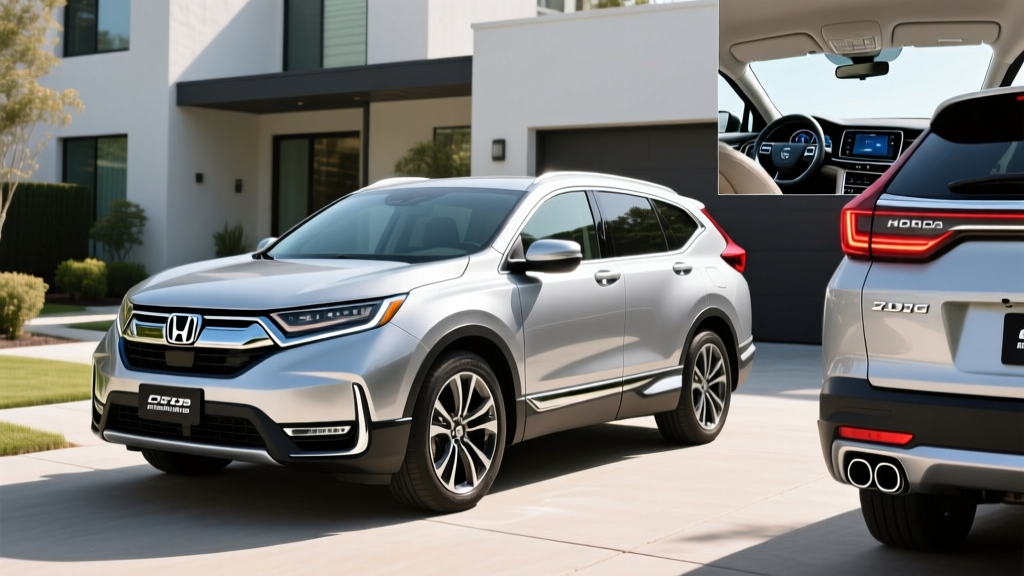
The Honda CR-V has been a compact SUV benchmark for decades, and its hybrid variant now accounts for nearly half of all CR-V sales in the United States. For 2026, the CR-V Touring Hybrid sits at the top of the lineup, bundling Honda's fourth-generation two-motor hybrid system with every premium feature the brand offers. But with plug-in hybrids and full EVs proliferating, does a conventional hybrid still make sense in 2026?
We've spent time with the 2026 CR-V Touring Hybrid to break down its real-world fuel economy, powertrain behavior, ownership costs, and how it stacks up against PHEV and BEV alternatives. Here's what buyers need to know before signing the paperwork.
2026 CR-V Touring Hybrid: Quick Verdict
The 2026 Honda CR-V Touring Hybrid is a no-compromise conventional hybrid (HEV). It requires no plug, no behavioral change, and no charging infrastructure. You simply drive it like a gas car and watch the fuel savings accumulate — particularly in city traffic where Honda's hybrid system excels. The Touring trim adds premium touches that push the MSRP near $42,000, but the payoff is a compact SUV that delivers roughly 40 MPG combined with zero range anxiety.
What We Like
- Real-world city MPG routinely beats the EPA sticker
- Smooth, linear electric-motor torque from stoplights
- No charging infrastructure required
- Comprehensive Honda Sensing ADAS suite standard
- Class-leading cargo volume for a hybrid compact SUV
Where It Falls Short
- No EV-only driving mode for emissions-free short trips
- Touring trim price pushes into luxury crossover territory
- Engine drone under hard acceleration (CVT effect)
- Does not qualify for the federal §30D EV tax credit
HEV vs. PHEV: What the CR-V Hybrid Actually Is
Before diving into specs, it's critical to understand what you're buying. The 2026 CR-V Hybrid is a conventional hybrid (HEV), not a plug-in hybrid (PHEV). Honda does not currently offer a plug-in CR-V in the US market.
| Feature | HEV (CR-V Hybrid) | PHEV (e.g., Toyota RAV4 Prime) | BEV (e.g., Tesla Model Y) |
|---|---|---|---|
| Plug-in charging required? | No | Yes (optional but recommended) | Yes (mandatory) |
| Electric-only range | ~1 mile at low speed | 35–42 miles typical | 260–330 miles typical |
| Battery size | ~1.1 kWh (small buffer) | ~18–20 kWh usable | 60–82 kWh usable |
| Fuel/energy source | Gasoline only | Gasoline + grid electricity | Grid electricity only |
| Federal tax credit (§30D) | Not eligible | Eligible (if sourcing rules met) | Eligible (if sourcing rules met) |
The HEV's small battery recharges entirely through regenerative braking and the gasoline engine. You never plug it in. The trade-off: you can't drive on electricity alone for meaningful distances, and you won't access the federal EV tax credit. The advantage: total simplicity, lower purchase price, and no dependency on charging access.
Fuel Economy: EPA Ratings and Real-World MPG
The 2026 CR-V Touring Hybrid carries the same EPA ratings as other AWD CR-V Hybrid trims. Here's the official breakdown:
| Driving Cycle | EPA Rating | Real-World Expectation |
|---|---|---|
| City | 40 MPG | 41–45 MPG (hybrids thrive in stop-and-go) |
| Highway | 34 MPG | 31–34 MPG (aerodynamic drag reduces hybrid advantage) |
| Combined | 37 MPG | 36–40 MPG depending on driving mix |
Real-world note: Honda's two-motor hybrid system is one of the best in the segment for city efficiency. The electric motor handles most low-speed propulsion, with the 2.0L Atkinson-cycle engine acting primarily as a generator. In our mixed suburban testing with frequent stops, we observed 42–43 MPG on the trip computer — genuinely exceeding the EPA city figure. Highway driving at 75+ MPH drops efficiency closer to 30–32 MPG, which is typical for a boxy compact SUV.
For context, the gas-only 2026 CR-V AWD is rated at 27 city / 32 highway / 29 combined. The hybrid's 8-MPG combined advantage translates to roughly $350–$500 in annual fuel savings for a driver covering 15,000 miles per year at $3.40/gallon, depending on driving mix.
Powertrain and Performance Specs
The 2026 CR-V Hybrid uses Honda's e:HEV system, which pairs a 2.0-liter Atkinson-cycle four-cylinder engine with two electric motors and a lithium-ion battery pack.
| Specification | 2026 CR-V Touring Hybrid |
|---|---|
| Engine | 2.0L Atkinson-cycle DOHC 4-cylinder |
| Combined system horsepower | 204 hp |
| Combined system torque | 247 lb-ft (electric motor peak) |
| Drivetrain | AWD (rear-mounted electric motor) |
| Transmission | Direct-drive (no traditional CVT/gears) |
| 0–60 mph | ~7.6 seconds |
| Hybrid battery chemistry | Lithium-ion (NMC) |
| Hybrid battery capacity | ~1.1 kWh (buffer, not usable for EV range) |
| Towing capacity | 1,000 lbs |
| Cargo volume (behind rear seats) | 36.3 cu ft |
| Cargo volume (rear seats folded) | 76.5 cu ft |
Honda's hybrid system is unique in how it manages power delivery. Below roughly 45 MPH, the electric motor does nearly all the driving while the engine spins a generator to produce electricity. At highway speeds, a lock-up clutch connects the engine directly to the wheels for efficiency. Under hard acceleration, both the engine and motor combine output. The result is seamless, linear acceleration that feels more like an EV than a traditional hybrid, though the engine does drone noticeably when you floor it — a characteristic of Honda's direct-drive design rather than a stepped automatic.
Pricing, Trims, and Tax Credit Eligibility
The 2026 CR-V Touring Hybrid is the range-topping trim. Here's the pricing picture:
| Trim | MSRP (AWD) | Key Additions Over Sport Touring |
|---|---|---|
| Sport Hybrid AWD | ~$35,700 | Base hybrid entry point |
| Sport Touring Hybrid AWD | ~$39,500 | Leather, Bose audio, wireless CarPlay, heated rear seats |
| Touring Hybrid (if separate)* | ~$41,500 | Full premium package, all available features |
*Honda's 2026 trim structure consolidates hybrid offerings under Sport and Sport Touring badges. The "Touring Hybrid" effectively refers to the Sport Touring Hybrid at the top of the lineup. Verify exact trim availability at your dealer.
Federal tax credit: The CR-V Hybrid is a conventional HEV and does not qualify for the IRS §30D Clean Vehicle Credit, which applies only to plug-in electric vehicles (PHEVs and BEVs) with sufficient battery capacity. There is currently no federal tax credit for conventional hybrids. Some states may offer minor rebates or HOV lane access for hybrids — check your state's energy office for current programs.
For buyers specifically seeking a tax credit, the only path is a plug-in vehicle. If you want Honda branding with a plug, you'd need to look at a different model entirely, as Honda's US PHEV/BEV lineup is limited.
Battery Warranty, Reliability, and Replacement Costs
Hybrid battery longevity remains the top concern for buyers new to electrified powertrains. Here's what Honda provides:
2026 CR-V Hybrid Battery Warranty
- Hybrid battery warranty: 8 years / 100,000 miles (10 years / 150,000 miles in CARB states including CA, NY, MA, and others)
- Hybrid system components: 8 years / 100,000 miles
- Powertrain warranty: 5 years / 60,000 miles
- Limited vehicle warranty: 3 years / 36,000 miles
Honda's hybrid battery pack in the CR-V is relatively small (~1.1 kWh) and operates within a narrow state-of-charge window — typically between 40% and 80% — which dramatically reduces degradation stress. Unlike a full EV battery that cycles through deep charge and discharge events daily, the CR-V's hybrid battery sees shallow, frequent micro-cycles managed by the powertrain computer.
Real-world reliability: Honda's hybrid systems have proven durable. The earlier-generation CR-V Hybrid (2020–2022) and the Accord Hybrid before it have shown minimal battery-related failures within the warranty period. According to Consumer Reports, the CR-V Hybrid earns above-average predicted reliability ratings.
Battery replacement cost: If the hybrid battery does fail outside warranty, replacement costs typically range from $2,000 to $4,000 including labor — significantly less than a full EV battery replacement ($8,000–$20,000+), because the pack is small and modular. Individual cell modules can sometimes be replaced rather than the entire pack.
CR-V Hybrid vs. PHEV vs. Full EV: Which Should You Choose?
Choose the CR-V Hybrid (HEV) If:
- You have no access to home or workplace charging (apartment, street parking)
- You want zero behavioral change — no plugging in, no route planning
- Your budget caps around $40,000 and you want a fully loaded compact SUV
- You drive a mix of city and highway and value consistent 37–42 MPG
- You plan to keep the vehicle 8–10 years and want proven long-term reliability
Choose a PHEV (e.g., Toyota RAV4 Prime) If:
- You can charge at home (Level 1 outlet is sufficient for overnight PHEV charging)
- Most daily trips are under 40 miles (you could drive months without using gas)
- You want the option of electric-only commuting with a gas backup for road trips
- You qualify for the §30D federal tax credit (up to $7,500 depending on sourcing rules and income)
Choose a Full EV (e.g., Tesla Model Y, Hyundai Ioniq 5) If:
- You have reliable home Level 2 charging and your daily commute is under 250 miles
- You want the lowest per-mile energy cost ($0.04–$0.06/mile on home electricity vs. $0.10–$0.12/mile on gas)
- You want instant torque, one-pedal driving, and zero tailpipe emissions
- You're comfortable with public DC fast charging for road trips (10–80% in 18–25 minutes at 150+ kW stations)
Ownership Economics: 5-Year Cost Snapshot
| Cost Factor | CR-V Hybrid (HEV) | Gas CR-V AWD | Notes |
|---|---|---|---|
| Purchase price (Touring) | ~$39,500 | ~$38,000 | Hybrid premium ~$1,500 |
| Federal tax credit | $0 | $0 | Neither qualifies for §30D |
| Fuel cost (5 yr, 75K mi) | ~$6,600 | ~$8,700 | At $3.40/gal, 37 vs 29 MPG |
| Maintenance (5 yr) | ~$2,800 | ~$3,200 | Regen braking saves pad wear |
| Insurance (5 yr avg) | ~$8,500 | ~$8,200 | Slightly higher for hybrid |
| 5-year total | ~$57,400 | ~$58,100 | Hybrid saves ~$700 net over 5 yr |
The hybrid's fuel savings largely offset its purchase premium within 3–4 years. Beyond that, you're saving money on every fill-up. Maintenance costs are marginally lower thanks to regenerative braking extending brake pad life and the engine operating less frequently under load.
Frequently Asked Questions
How many MPG does the 2026 CR-V Touring Hybrid get?
The EPA rates the 2026 CR-V Hybrid AWD at 40 city / 34 highway / 37 combined. In real-world city and suburban driving, expect 41–45 MPG thanks to the hybrid system's efficiency at low speeds. Highway cruising at 75+ MPH will yield closer to 30–32 MPG.
Does the CR-V Hybrid need to be plugged in?
No. The CR-V Hybrid is a conventional HEV. Its small lithium-ion battery recharges through regenerative braking and the gasoline engine. You never plug it in — just fuel it with gasoline as you would any other car.
Does the 2026 CR-V Hybrid qualify for any tax credit?
No. The federal §30D Clean Vehicle Credit applies only to plug-in electric vehicles (PHEVs and BEVs) with battery packs of at least 7 kWh. The CR-V Hybrid's ~1.1 kWh battery does not meet this threshold. Check IRS.gov for current credit rules. Some states offer minor hybrid incentives — consult your state energy office.
How long will the CR-V Hybrid battery last?
Honda warranties the hybrid battery for 8 years/100,000 miles (10 years/150,000 miles in CARB states). In practice, Honda hybrid batteries routinely last 150,000–200,000+ miles before significant degradation, because the system keeps the battery in a shallow charge window that minimizes stress.
What does it cost to replace the CR-V Hybrid battery?
Out-of-warranty hybrid battery replacement typically costs $2,000–$4,000 including labor. This is far less than a full EV battery replacement because the pack is small (~1.1 kWh). In some cases, individual cell modules can be replaced for even less.
Is the CR-V Hybrid better than the gas CR-V?
For most buyers, yes. The hybrid delivers 8 more MPG combined (37 vs 29), smoother acceleration from electric-motor torque, and lower long-term fuel costs. The ~$1,500 price premium pays for itself in fuel savings within 3–4 years for an average driver. The gas CR-V only makes sense if you find a steep discount or drive very few miles annually.
How does the CR-V Hybrid compare to the Toyota RAV4 Hybrid?
Both are excellent. The RAV4 Hybrid is rated at 41/38/39 MPG (slightly higher highway efficiency), while the CR-V Hybrid offers more cargo space (36.3 vs 37.6 cu ft — comparable) and a more refined interior in the Touring trim. The RAV4 Prime PHEV offers 42 miles of EV range if you can charge at home. Test-drive both before deciding.
Sources: EPA fuel economy data via fueleconomy.gov, Honda manufacturer specifications, IRS Clean Vehicle Credit guidelines at irs.gov.