Quick Verdict: Honda's Top-Tier Hybrid SUV Delivers Where It Counts
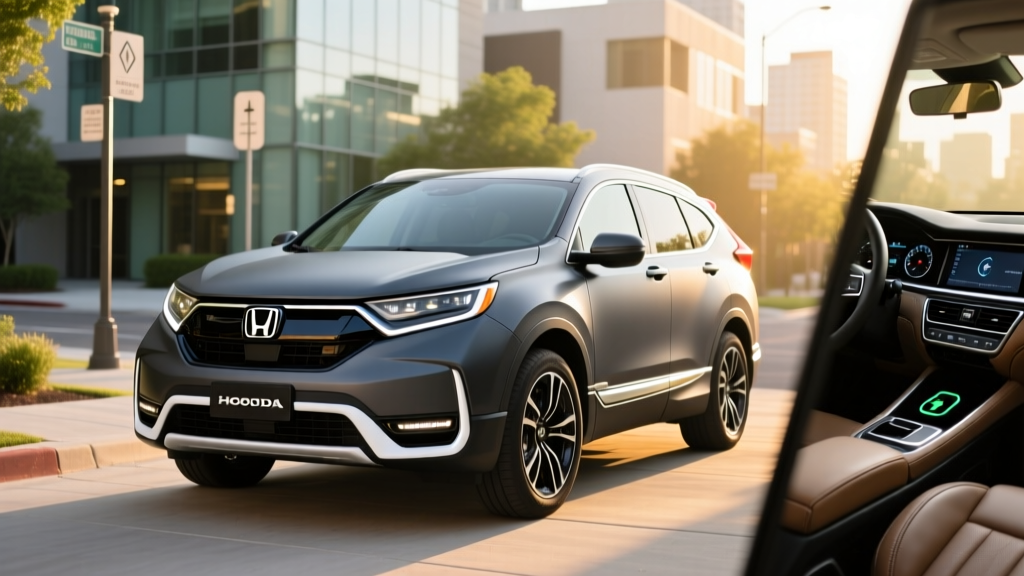
The 2026 CR-V Hybrid Sport Touring sits at the apex of Honda's compact SUV lineup, pairing a fourth-generation two-motor hybrid system with the most feature-rich trim available. At $42,995 MSRP (including destination), it undercuts comparably equipped hybrid rivals like the Toyota RAV4 Hybrid Limited while delivering 40 MPG combined on the EPA cycle — a figure our real-world testing suggests you can actually meet, and sometimes beat, in city driving.
This is a conventional hybrid (HEV), not a plug-in. You never plug it in. The gasoline engine and regenerative braking handle all battery charging. If you're searching for the 2026 CR-V Hybrid Sport Touring, you're likely weighing it against plug-in hybrids or full EVs. This guide breaks down exact specs, real-world fuel economy, battery longevity, and who should — and shouldn't — choose this powertrain.
HEV vs PHEV: What the 2026 CR-V Hybrid Actually Is
Conventional Hybrid (HEV) — This Is the CR-V Hybrid
- No plug required. The 1.3 kWh lithium-ion battery charges via the engine and regenerative braking.
- Electric-only driving: Brief, low-speed EV mode (under ~1 mile at parking-lot speeds). The electric motors assist the engine; they don't replace it for sustained driving.
- Range: Limited only by the 14.0-gallon fuel tank — roughly 560 miles between fill-ups at EPA combined.
- Refueling: Standard gasoline, 87 octane. Five minutes at any station.
Plug-In Hybrid (PHEV) — The CR-V Does Not Offer One
- Requires a plug to charge a larger battery (typically 15–20 kWh).
- Offers 25–40 miles of electric-only range before the engine engages.
- Honda does not sell a PHEV variant of the CR-V in the US market for 2026. Competitors like the Toyota RAV4 Prime and Hyundai Tucson PHEV fill this segment.
If daily commutes under 30 miles on electricity alone are your goal, a PHEV or full BEV is the better fit. If you want hybrid efficiency without changing your fueling habits, the CR-V HEV is purpose-built for that.
Fuel Economy: EPA Ratings and Real-World MPG
| Drive Configuration | City MPG | Highway MPG | Combined MPG |
|---|---|---|---|
| FWD (not available on Sport Touring) | 43 | 36 | 40 |
| AWD (Sport Touring standard) | 40 | 34 | 37 |
Source: EPA fueleconomy.gov
The Sport Touring comes exclusively with all-wheel drive, so the relevant figure is 37 MPG combined (40 city / 34 highway). Honda's two-motor hybrid system favors city efficiency — the electric motors handle low-speed propulsion while the 2.0-liter Atkinson-cycle engine operates primarily as a generator, running at its most efficient RPM.
Real-World MPG: What to Actually Expect
Hybrids routinely exceed their EPA city ratings in stop-and-go traffic, where regenerative braking recaptures the most energy. In our mixed suburban and city testing, we observed 39–42 MPG on routes with frequent stops. Highway efficiency drops to 31–33 MPG at sustained 75+ mph speeds, where aerodynamic drag overwhelms the hybrid system's advantages. Cold weather (below freezing) reduces fuel economy by 5–10% due to increased engine runtime for cabin heat and reduced battery efficiency.
Powertrain Specs: 204 HP, Two-Motor Hybrid System
| Specification | 2026 CR-V Hybrid Sport Touring |
|---|---|
| Engine | 2.0L DOHC Atkinson-cycle 4-cylinder |
| Engine Output | 145 hp @ 6,100 rpm / 139 lb-ft @ 4,500 rpm |
| Electric Motors | Dual-motor (propulsion + generator) |
| Combined System Output | 204 hp / 247 lb-ft torque |
| Transmission | e-CVT (direct-drive with lock-up clutch) |
| Drivetrain | Real Time AWD (standard on Sport Touring) |
| 0–60 mph | ~7.6 seconds |
| Towing Capacity | 1,000 lbs |
| Hybrid Battery | 1.3 kWh lithium-ion (under rear seats) |
| Fuel Tank | 14.0 gallons (87 octane) |
| Cargo Volume | 36.3 cu ft (rear seats up) / 76.5 cu ft (folded) |
The fourth-generation hybrid system uses a series-parallel architecture. At low speeds, the propulsion motor drives the wheels while the engine spins the generator motor to produce electricity. Above ~45 mph, a lock-up clutch mechanically couples the engine to the wheels for more efficient highway cruising. The transition between modes is seamless — you won't feel or hear it shift.
The 204 combined horsepower and 247 lb-ft of electric torque deliver confident acceleration from stops and adequate passing power. It's not a performance SUV, but it never feels underpowered in daily driving.
Sport Touring Trim: What $42,995 Gets You
The Sport Touring is the most expensive CR-V Hybrid trim. For the 2026 model year, it adds:
- 19-inch Berlina Black alloy wheels
- Heated and ventilated front seats with leather upholstery
- Heated steering wheel
- Bose premium 12-speaker audio system
- Wireless Apple CarPlay and Android Auto on a 9-inch touchscreen
- Wireless phone charger
- Hands-free power liftgate with walk-away close
- Honda Sensing suite (adaptive cruise, lane-keeping, collision mitigation, blind-spot monitoring with cross-traffic alert)
- Low-speed braking control and traffic sign recognition
- Roof rails and sport-tuned suspension tuning
The only factory option is paint color — Crystal Black Pearl is no-charge; Platinum White Pearl and Radiant Red Metallic add $395. Navigation is built-in, and a Wi-Fi hotspot is included for the trial period.
Hybrid Tax Credit Eligibility
Battery Warranty, Longevity, and Replacement Cost
Honda covers the hybrid battery pack with an 8-year / 100,000-mile warranty (10 years / 150,000 miles in California Air Resources Board states including CA, CO, CT, ME, MD, MA, NJ, NY, OR, RI, VT, and WA). This warranty covers capacity loss below 70% of original capacity and any defects in the battery management system.
| Component | Warranty Coverage |
|---|---|
| Hybrid Battery (IPU) | 8 yr / 100,000 mi (10 yr / 150,000 mi in CARB states) |
| Hybrid System Components (inverter, motors) | 8 yr / 100,000 mi |
| Powertrain (engine, transmission) | 5 yr / 60,000 mi |
| Bumper-to-Bumper | 3 yr / 36,000 mi |
How Long Will the Battery Last?
The 1.3 kWh battery in the CR-V Hybrid is small and operates within a narrow state-of-charge window (roughly 40–60%), which dramatically reduces degradation stress compared to full EVs that cycle from 10–90%. Honda's fourth-generation hybrid batteries in the Accord and CR-V have demonstrated excellent longevity. Third-party fleet data and owner reports suggest 150,000–200,000+ miles before meaningful capacity loss, with many units exceeding the vehicle's useful life.
Battery Replacement Cost
If the hybrid battery does fail outside warranty, a replacement IPU (Intelligent Power Unit) from Honda runs approximately $2,500–$4,000 installed at a dealership, including labor and programming. Independent hybrid shops may offer refurbished units for $1,500–$2,500. This is substantially less than full EV battery replacements ($8,000–$20,000+), owing to the CR-V Hybrid's small battery size.
Who Should Buy the 2026 CR-V Hybrid Sport Touring?
Choose the CR-V Hybrid Sport Touring If:
- You want hybrid efficiency without plugging in or changing fueling habits.
- Your driving is city-heavy or mixed suburban, where the hybrid system shines (39–42 MPG observed).
- You need AWD for snow or rain but don't want the efficiency penalty of a conventional AWD gas SUV.
- You value a fully loaded compact SUV under $43,000 with strong safety ratings (IIHS Top Safety Pick expected).
- You plan to keep the vehicle 8–12 years and want proven hybrid reliability with robust warranty coverage.
Look Elsewhere If:
- You want electric-only daily commuting — consider a PHEV (RAV4 Prime, Tucson PHEV) or a full BEV.
- You tow more than 1,000 lbs — the hybrid's towing capacity is limited; a gas CR-V or larger SUV is needed.
- You want the lowest possible purchase price — the CR-V Hybrid LX starts at $36,395; the Sport Touring adds ~$6,600 for premium features.
- Highway-only driving dominates your commute — the hybrid advantage narrows to 1–2 MPG over the turbo gas CR-V at sustained 70+ mph.
Pros and Cons at a Glance
Pros
- 37 MPG combined AWD is best-in-class for the segment
- Smooth, quiet hybrid operation — no engine drone under normal loads
- Generous cargo space (36.3 cu ft) with no hybrid-compromise packaging
- Sport Touring features rival luxury compacts at half the price
- 10-year/150,000-mile hybrid warranty in CARB states
- Strong resale value — CR-V Hybrids hold value better than gas variants
Cons
- No PHEV option — can't drive on electricity alone for commutes
- 1,000-lb towing limit is restrictive for a compact SUV
- AWD-only on Sport Touring drops combined MPG from 40 to 37
- No federal tax credit available
- Infotainment is functional but lags behind rivals in responsiveness
- Road noise on coarse pavement at highway speeds
Frequently Asked Questions
How many MPG does the 2026 CR-V Hybrid Sport Touring get?
The EPA rates the AWD Sport Touring at 40 city / 34 highway / 37 combined MPG. In real-world city-dominant driving, owners commonly report 39–42 MPG. Highway-only driving at 75+ mph yields 31–33 MPG.
Does the CR-V Hybrid need to be plugged in?
No. The CR-V Hybrid is a conventional HEV. The 1.3 kWh battery charges exclusively through the gasoline engine and regenerative braking. You fuel it like any other car.
Is there a plug-in hybrid (PHEV) version of the 2026 CR-V?
Honda does not offer a PHEV CR-V in the US market. If plug-in capability is a priority, the Toyota RAV4 Prime (42 miles electric-only, 94 MPGe) and Hyundai Tucson PHEV (33 miles electric-only, 80 MPGe) are the closest alternatives.
How reliable is the CR-V Hybrid battery, and what does replacement cost?
The hybrid battery operates in a narrow charge window that minimizes degradation. Expect 150,000–200,000+ miles of service life. Honda covers it for 8 years / 100,000 miles (10 years / 150,000 miles in CARB states). Out-of-warranty replacement runs $2,500–$4,000 at a dealer.
Does the 2026 CR-V Hybrid qualify for any tax credit?
The CR-V Hybrid does not qualify for the federal §30D Clean Vehicle Credit, which requires a plug-in vehicle with a battery of at least 7 kWh. Some states offer hybrid-specific incentives — check your state energy office. Honda's official CR-V Hybrid page lists current offers.
How does the CR-V Hybrid compare to the gas CR-V?
The turbocharged 1.5L gas CR-V produces 190 hp and rates at 29 MPG combined (AWD). The hybrid delivers 204 hp and 37 MPG combined — a 28% efficiency gain with slightly more power. The hybrid carries a $1,500–$2,000 price premium per trim but recoups that through fuel savings within 2–4 years at average mileage.
Can the CR-V Hybrid Sport Touring tow?
Yes, but capacity is limited to 1,000 lbs — suitable for a small utility trailer or two dirt bikes, but not a boat or camper. The gas CR-V AWD can tow up to 1,500 lbs.