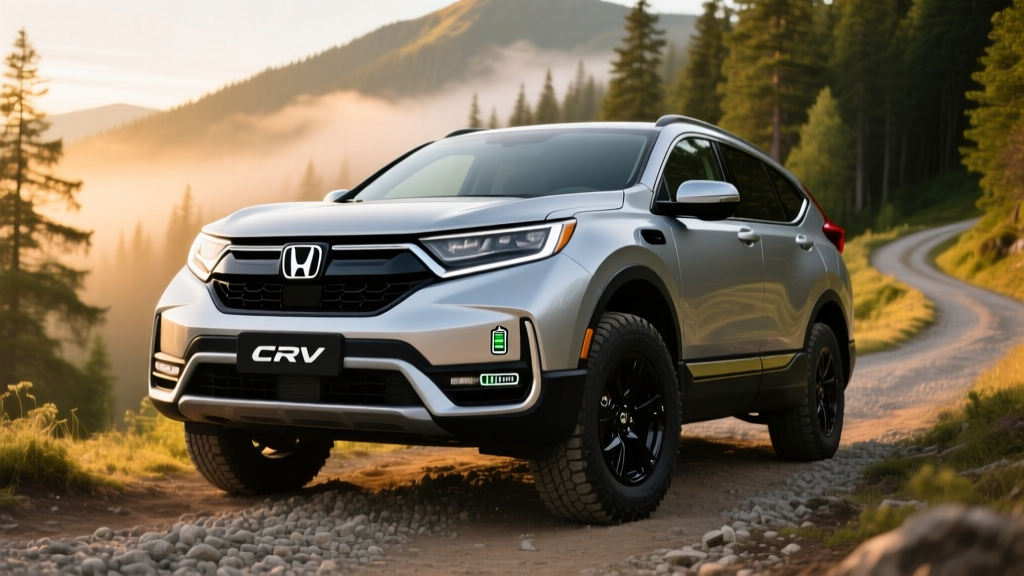
The Honda CR-V Hybrid has long been a default choice for compact-crossover buyers who want electrified efficiency without the commitment of a plug. The 2026 CR-V AWD TrailSport Hybrid takes that formula and wraps it in Honda's ruggedized TrailSport trim — all-terrain tires, retuned suspension, and underbody protection — while retaining the two-motor hybrid system that delivers 40 MPG combined. If you're researching the 2026 CR-V AWD TrailSport Hybrid, this guide covers every spec that matters: real-world fuel economy, powertrain behavior, battery longevity, pricing, and how it stacks up against plug-in hybrids and full EVs.
Quick Verdict: Who the TrailSport Hybrid Is For
The 2026 CR-V AWD TrailSport Hybrid targets a specific buyer: someone who wants above-average fuel economy in a compact SUV with genuine light-off-road capability, but who doesn't have access to home charging or isn't ready for a full battery-electric vehicle. It's a conventional hybrid (HEV), meaning it generates its own electricity through regenerative braking and the gasoline engine — no plug, no charging cable, no range anxiety. The TrailSport trim adds 18-inch all-terrain tires, a 10-mm suspension lift, hill descent control, and cosmetic ruggedness that distinguishes it from the standard Sport Hybrid.
- You want 38-42 MPG real-world without changing your fueling habits
- You need AWD for snow, gravel, or light trail use
- You live in an apartment or lack reliable home charging access
- You want a proven hybrid system with a 10-year battery warranty
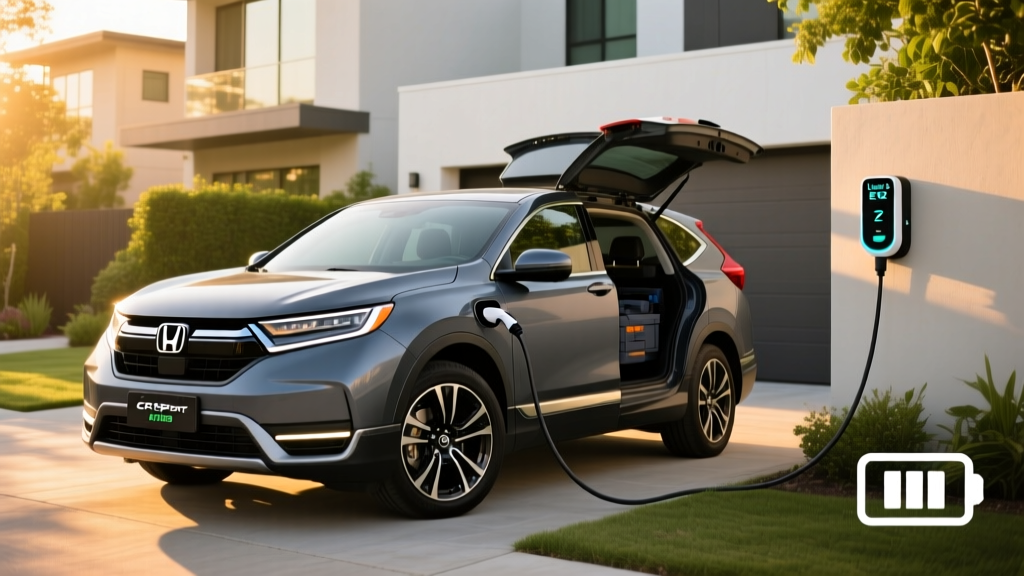
- You can install a Level 2 charger at home and want electric-only commuting
- Your daily commute is under 35 miles and you want zero tailpipe emissions on most drives
- You want access to HOV lanes or federal tax credits (HEVs don't qualify for §30D)
Hybrid vs. Plug-In Hybrid: What the CR-V Lineup Actually Offers
Honda's 2026 CR-V lineup can cause confusion because the brand sells both conventional hybrid (HEV) trims and, in some markets, a plug-in hybrid variant. Here's the critical distinction:
| Feature | CR-V Hybrid (HEV) | Typical Compact SUV PHEV |
|---|---|---|
| Plug-in charging required? | No — self-charging via engine + regen | Yes — plug in for electric-only range |
| Electric-only range | ~1 mile at low speed (EV mode) | 30-40 miles typical |
| Battery size | ~1.1 kWh (small buffer) | 15-20 kWh |
| Combined MPG (gas) | 40 MPG EPA | 30-38 MPG (after battery depletes) |
| Federal tax credit (§30D) | Not eligible | Up to $7,500 if eligible |
| Home charging needed? | No | Yes, for full benefit |
The TrailSport Hybrid uses Honda's fourth-generation two-motor hybrid system, which is a series-parallel HEV. The gasoline engine and electric motors work together seamlessly, but the battery is too small to provide meaningful electric-only driving. If you want 35+ miles of pure EV range before the engine kicks on, you'd need to look at competitors like the Toyota RAV4 Prime (a PHEV) or consider the Hyundai Tucson PHEV. Honda does not currently offer a CR-V PHEV in the U.S. market for the 2026 model year.
Powertrain Specs: 204 Horsepower, Two-Motor Hybrid System
| Specification | 2026 CR-V AWD TrailSport Hybrid |
|---|---|
| Engine | 2.0L Atkinson-cycle 4-cylinder |
| Engine output | 145 hp / 138 lb-ft torque |
| Electric motors | Two-motor system (drive + generator) |
| Combined system output | 204 hp / 247 lb-ft torque |
| Transmission | e-CVT (direct drive, no traditional gears) |
| Drivetrain | AWD (rear motor-driven) |
| Hybrid battery | ~1.1 kWh lithium-ion |
| 0-60 mph (est.) | ~7.8 seconds |
| Towing capacity | 1,000 lbs |
Honda's hybrid system operates differently from a traditional Toyota Hybrid Synergy Drive setup. At low speeds and in stop-and-go traffic, the CR-V Hybrid runs primarily on its electric drive motor, with the gasoline engine acting as a generator to feed electricity — essentially operating as a series hybrid. At highway speeds (above ~45 mph), a lockup clutch connects the engine directly to the wheels for more efficient cruising. The result is smooth, EV-like acceleration from stops with strong mid-range passing power from the 247 lb-ft of electric torque.
The AWD system uses a dedicated rear electric motor rather than a mechanical driveshaft from the front axle. This means the rear wheels receive torque instantly when the system detects slip, without the lag of a traditional mechanical AWD coupling. For the TrailSport trim specifically, Honda adds a revised AWD torque distribution map that can send more torque rearward on loose surfaces, complementing the all-terrain tires.
Fuel Economy: EPA Ratings and Real-World MPG
| Driving Condition | EPA Estimate | Real-World Expectation |
|---|---|---|
| City | 40 MPG | 41-44 MPG (hybrids excel in city driving) |
| Highway | 39 MPG | 35-38 MPG (hybrid advantage diminishes at sustained speed) |
| Combined | 40 MPG | 38-42 MPG depending on conditions |
According to fueleconomy.gov, the 2026 CR-V AWD Hybrid is rated at 40 MPG combined. That figure holds for the TrailSport trim despite its all-terrain tires, thanks to Honda's careful tuning of the hybrid system and tire rolling-resistance optimization.
Real-world context: Hybrid vehicles typically exceed their EPA city rating because regenerative braking recovers energy that would otherwise be lost in stop-and-go traffic. In our experience with Honda's two-motor system across multiple model years, expect 42-44 MPG in urban and suburban driving during mild weather (55-80°F). Highway fuel economy is where hybrids lose their edge — at sustained 70-80 mph speeds, the engine is doing most of the work directly, and the TrailSport's all-terrain tires add rolling resistance and road noise. Expect 35-38 MPG on the highway, and potentially 32-34 MPG in sustained cold weather (below 30°F) when the engine runs more frequently for cabin heat.
TrailSport-Specific Features: What the Trim Adds
The TrailSport Hybrid isn't just an appearance package. For 2026, Honda equips this trim with functional off-road hardware that distinguishes it from the Sport and Sport Touring Hybrid trims:
- 18-inch wheels with all-terrain tires — more sidewall for gravel and rutted trails, at a slight cost to highway noise
- 10-mm suspension lift — modest ground clearance increase for approach/departure angles
- Hill descent control — maintains set speed on steep declines without brake pedal input
- Retuned AWD torque mapping — sends more torque to rear wheels on low-traction surfaces
- Underbody skid plates — engine and fuel tank protection for rocky terrain
- Orange recovery hooks (front) — TrailSport signature styling element
- Unique interior trim — orange contrast stitching, all-weather floor mats
Ground clearance measures approximately 8.3 inches, which is competitive with the Subaru Forester Wilderness (9.2 inches) and Toyota RAV4 TRD Off-Road (8.6 inches). This is light-duty off-road capability — suitable for forest service roads, snowy driveways, and maintained trails, but not for rock crawling or deep mud.
Pricing, Trims, and Tax Credit Eligibility
The 2026 CR-V AWD TrailSport Hybrid is positioned in the upper-middle of the CR-V lineup. Based on Honda's announced 2026 pricing:
- CR-V AWD TrailSport Hybrid: ~$38,350 MSRP (including destination)
- CR-V AWD Sport Touring Hybrid: ~$41,350 MSRP (adds premium audio, leather, panoramic roof)
- The conventional CR-V Hybrid (HEV) does NOT qualify for the federal plug-in EV tax credit under IRS §30D
- §30D credits apply only to plug-in electric vehicles (BEVs and PHEVs) with battery capacity ≥7 kWh
- Some states may offer rebates for conventional hybrids — check your state energy office or AFDC state incentive database
- Dealer incentives, Honda Financial Services loyalty rebates, or military discounts may apply at point of sale
The absence of a federal tax credit is the main financial disadvantage of choosing an HEV over a qualifying PHEV or BEV. However, the CR-V Hybrid's lower purchase price compared to PHEV competitors (the RAV4 Prime starts around $44,500) and the lack of any home charging installation cost partially offset this. Your break-even analysis should factor in your annual mileage, local gas prices, and how long you plan to keep the vehicle.
Battery Longevity, Warranty, and Replacement Cost
- Duration: 10 years / 150,000 miles (whichever comes first) in CARB states; 8 years / 100,000 miles in non-CARB states
- Coverage: Defects in materials/workmanship and capacity loss below a defined threshold
- Hybrid system components: Inverter, electric motors, and control electronics covered under same terms
Honda's hybrid battery is a relatively small ~1.1 kWh lithium-ion pack that operates within a narrow state-of-charge window (roughly 40-60% SoC in normal driving). This shallow cycling is the primary reason hybrid batteries tend to outlast PHEV and BEV batteries — the cells experience far less stress from deep charge-discharge cycles. Based on historical data from Honda's hybrid lineup (Insight, Accord Hybrid, CR-V Hybrid since 2020), most hybrid batteries show minimal degradation over 150,000+ miles.
Replacement cost if out of warranty: A CR-V hybrid battery replacement currently runs between $2,500 and $4,000 including labor at a Honda dealership. Independent hybrid-battery specialists may offer refurbished units for $1,500-$2,500. However, given the shallow cycling and Honda's track record, out-of-pocket battery replacement is uncommon within the first 12-15 years of ownership.
Is this hybrid reliable? Honda's two-motor hybrid system has been in production since 2017 (U.S. market) and has demonstrated strong reliability in consumer surveys. The system eliminates the traditional transmission entirely — there are no gears, bands, or torque converters to fail. The e-CVT is mechanically simpler than a conventional automatic. According to Consumer Reports reliability data and owner forums, the most common hybrid-specific complaints involve minor software glitches rather than hardware failures.
Real-World Ownership: What Daily Driving Feels Like
The 2026 CR-V AWD TrailSport Hybrid drives like a slightly firmer, more responsive version of the standard CR-V. The hybrid system provides instant electric torque from a stop, making it feel quicker than its 204-hp rating suggests in city driving. The transition between electric-only and engine-assisted modes is nearly imperceptible — most drivers won't notice when the gasoline engine activates unless they're watching the power-flow display.
On the highway, the TrailSport's all-terrain tires generate more road noise than the standard Sport Hybrid's all-season tires, particularly on coarse-grain asphalt. This is the trade-off for off-road capability. Cabin insulation is otherwise solid, and the hybrid system's ability to shut off the engine during coasting and gentle cruising contributes to a quieter experience than you'd expect.
Cargo space is unaffected by the hybrid system — the battery pack is mounted under the rear cargo floor, preserving 36.3 cubic feet behind the rear seats and 76.5 cubic feet with seats folded. This is competitive with the Toyota RAV4 Hybrid (37.5 / 69.8 cu ft) and slightly ahead of the Hyundai Tucson Hybrid (38.7 / 80.3 cu ft).
- 40 MPG combined — excellent for an AWD SUV with off-road hardware
- No plug-in charging required — works with your existing fueling routine
- Strong low-end torque from electric motors makes city driving effortless
- 10-year hybrid battery warranty in CARB states
- Genuine light-off-road capability with all-terrain tires and skid plates
- Competitive cargo space and rear-seat room
- No federal tax credit (HEVs don't qualify for §30D)
- All-terrain tires increase highway road noise vs. standard hybrid trims
- Towing limited to 1,000 lbs (gas CR-V can tow 1,500 lbs)
- No meaningful electric-only driving range
- TrailSport trim priced higher than Sport Hybrid with similar fuel economy
- 1.0L less highway MPG than FWD Sport Hybrid due to AWD + AT tires
CR-V TrailSport Hybrid vs. the Competition
| Spec | 2026 CR-V AWD TrailSport Hybrid | 2026 RAV4 Hybrid Woodland Edition | 2026 Tucson Hybrid SEL Convenience |
|---|---|---|---|
| Combined MPG (EPA) | 40 MPG | 39 MPG | 38 MPG |
| Combined HP | 204 hp | 219 hp | 226 hp |
| AWD system | Rear electric motor | Rear electric motor | Mechanical AWD |
| Starting MSRP (est.) | ~$38,350 | ~$36,825 | ~$37,550 |
| Battery warranty | 10 yr/150k mi (CARB) | 10 yr/150k mi | 10 yr/100k mi |
| Cargo (behind rear seats) | 36.3 cu ft | 37.5 cu ft | 38.7 cu ft |
| Federal tax credit | None | None | None |
Against the RAV4 Hybrid Woodland Edition (Toyota's off-road-oriented hybrid trim), the CR-V TrailSport Hybrid offers slightly better fuel economy and a more refined interior, while the RAV4 counters with more horsepower and a lower starting price. The Tucson Hybrid offers the most cargo space and a conventional automatic transmission feel (its 6-speed auto avoids the e-CVT drone some drivers dislike), but its mechanical AWD system is less responsive on low-traction surfaces.
Hybrid vs. PHEV vs. Full EV: Which Powertrain Fits You?
Choosing between a conventional hybrid, a plug-in hybrid, and a full battery-electric vehicle depends on three variables: your charging access, your daily mileage, and your budget flexibility.
Conventional Hybrid (HEV) — like the CR-V TrailSport Hybrid: Best for buyers without reliable home charging who want better fuel economy with zero lifestyle change. You'll save $600-$800/year on fuel vs. a gas-only equivalent. No plug, no behavior change, no tax credit.
Plug-in Hybrid (PHEV) — like the RAV4 Prime: Best for buyers with home charging who commute 30-40 miles round-trip and want electric-only daily driving with gas-engine backup for road trips. You'll use almost no gasoline on weekdays, but pay $5,000-$8,000 more upfront (partially offset by the §30D tax credit if eligible). Requires a Level 2 home charger ($500-$1,500 installed) for practical daily use.
Full EV (BEV) — like the Hyundai Ioniq 5 or Tesla Model Y: Best for buyers with home charging who want the lowest operating cost, zero tailpipe emissions, and minimal maintenance. Upfront cost is higher, but total cost of ownership over 5 years can be lower than a hybrid when factoring in fuel savings, tax credits, and reduced maintenance. Requires comfort with public charging infrastructure for road trips.
Frequently Asked Questions
How many MPG does the 2026 CR-V AWD TrailSport Hybrid get?
The EPA rates it at 40 MPG combined (40 city / 39 highway). In real-world driving, expect 41-44 MPG in city and suburban conditions and 35-38 MPG on sustained highway trips. Cold weather below 30°F can reduce these figures by 3-5 MPG due to increased engine operation for cabin heating.
Does the CR-V Hybrid need to be plugged in?
No. The CR-V Hybrid is a conventional hybrid (HEV), not a plug-in hybrid. It charges its small battery through regenerative braking and the gasoline engine. You fuel it exactly like a standard gas car — at any gas station, with regular 87-octane unleaded.
Can the TrailSport Hybrid drive on electric power only?
Only in very limited circumstances. At low speeds (under ~25 mph) with light throttle input, the system can operate in EV mode for roughly 1 mile or less before the engine must restart to recharge the battery. This is useful for creeping through a parking garage or a quiet neighborhood, but it is not a substitute for a PHEV's 30-40 mile electric-only range.
Is the hybrid battery reliable and what does replacement cost?
Honda's hybrid battery is covered for 10 years/150,000 miles in CARB states (California, New York, and 13 others) and 8 years/100,000 miles elsewhere. The ~1.1 kWh battery operates in a shallow charge window, which dramatically extends cell life. Out-of-warranty replacement costs $2,500-$4,000 at a dealer, but real-world failure rates are very low within the first 15 years of ownership.
Does the 2026 CR-V Hybrid qualify for any tax credits?
The CR-V Hybrid does not qualify for the federal §30D plug-in vehicle tax credit because it is a conventional hybrid, not a plug-in. Some states and local utilities offer rebates for hybrid purchases — check the Alternative Fuels Data Center for your state. Honda dealer incentives or loyalty programs may also reduce the effective purchase price.
How does the TrailSport Hybrid compare to the gas-only CR-V AWD?
The gas-only 2026 CR-V AWD (1.5L turbo, 190 hp) is rated at 28 MPG combined — 12 MPG less than the TrailSport Hybrid. At 15,000 miles/year, that's roughly $600-$800 in additional annual fuel costs. The hybrid also provides smoother acceleration and quieter low-speed driving. The gas model does offer a higher towing capacity (1,500 lbs vs. 1,000 lbs) and a lower starting price on base trims.
What maintenance does the hybrid system require?
Honda's hybrid system requires no scheduled maintenance beyond what a standard CR-V needs. There is no hybrid-battery coolant flush on the normal service schedule, no electric motor service, and no e-CVT fluid change interval. You'll follow the standard Honda maintenance minder for oil changes (typically every 7,500-10,000 miles), tire rotations, and cabin/engine air filters. The hybrid system actually reduces brake wear because regenerative braking handles much of the deceleration.