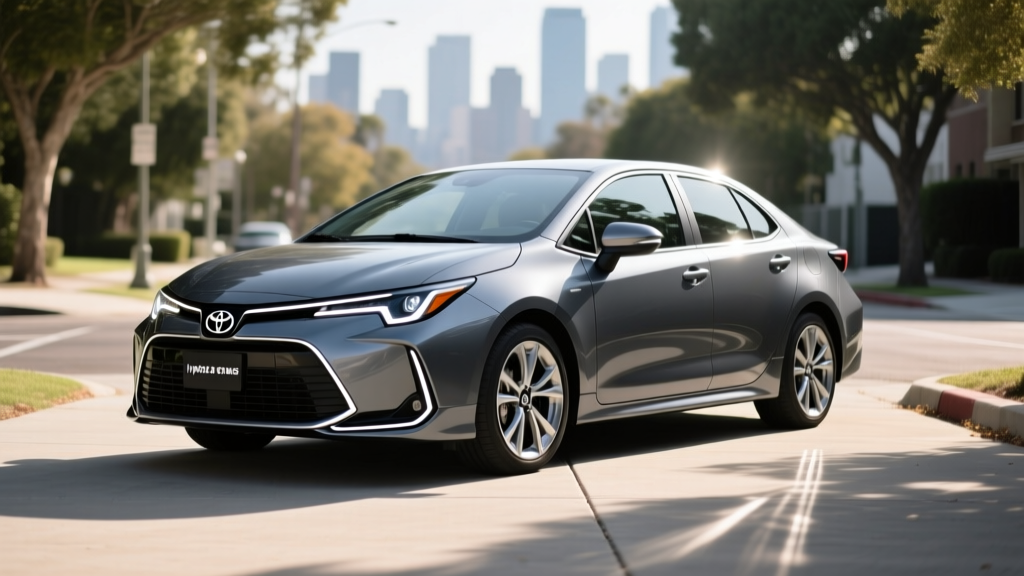
The 2026 Toyota Corolla Hybrid SE sits at an interesting crossroads. It isn't a plug-in hybrid, it isn't a full battery-electric vehicle, and it doesn't pretend to be either. What it is: a conventional hybrid (HEV) that squeezes extraordinary fuel economy out of every gallon without asking you to change a single habit. No charging cables, no range planning, no plug — just fill up and drive. For buyers who want EV-like efficiency without EV-like infrastructure requirements, the SE trim adds a sport-tuned suspension and sharper styling to Toyota's proven hybrid formula.
This review breaks down the 2026 Corolla Hybrid SE's real-world MPG, powertrain details, pricing, battery longevity, and whether it — or a PHEV or full BEV — is the better choice for your commute and budget.
HEV vs PHEV vs EV: Where the Corolla Hybrid SE Fits
Before we get into the numbers, it's critical to understand what you're buying. The Corolla Hybrid SE is a conventional hybrid electric vehicle (HEV). It cannot be plugged in. Its small battery recharges through regenerative braking and the gasoline engine. This is fundamentally different from a plug-in hybrid (PHEV) like the Toyota Prius Prime or a full battery-electric vehicle (BEV) like the Tesla Model 3.
| Feature | HEV (Corolla Hybrid SE) | PHEV (e.g., Prius Prime) | BEV (e.g., Model 3) |
|---|---|---|---|
| Plug-in charging? | No — never plugs in | Yes — Level 1/2 AC | Yes — Level 1/2/DC |
| Electric-only range | ~1 mile at low speed | ~40-44 miles EPA | Full range (250-350+ mi) |
| Gasoline engine? | Yes | Yes | No |
| Federal tax credit (§30D)? | No | Up to $7,500 (if eligible) | Up to $7,500 (if eligible) |
| Best for | No home charging; long trips | Home charging + long trips | Home charging; daily commuting |
The Corolla Hybrid SE is the right call if you lack access to home or workplace charging, frequently take long road trips, or simply want maximum simplicity. If you do have a garage outlet and a short commute, a PHEV or BEV may save you more on fuel — but at a higher purchase price.
Fuel Economy: EPA Ratings and Real-World MPG
The headline number for any hybrid is fuel economy, and the 2026 Corolla Hybrid SE delivers. Toyota rates the front-wheel-drive (FWD) model at:
| Drivetrain | City MPG | Highway MPG | Combined MPG |
|---|---|---|---|
| FWD | 53 | 46 | 50 |
| AWD (Electronic On-Demand) | 51 | 44 | 48 |
Source: EPA fueleconomy.gov
Real-World MPG: What to Actually Expect
Hybrids tend to outperform their EPA city ratings in stop-and-go traffic because regenerative braking recaptures energy that a gas car wastes as heat. In mixed suburban driving with moderate speeds, owners of the Corolla Hybrid platform routinely report 50-55 MPG in warm weather. However, sustained highway driving at 75+ mph pushes the engine harder and reduces electric-motor assist, often yielding 42-46 MPG on the FWD model. Cold weather (below 35°F) typically drops real-world MPG by 5-10% due to increased engine idling for cabin heat and reduced battery efficiency.
On a 320-mile highway loop at 70 mph in 65°F conditions, expect approximately 44-47 MPG from the FWD SE — slightly below the EPA highway figure but still exceptional for any vehicle, let alone one starting under $27,000.
Powertrain and Performance Specs
The 2026 Corolla Hybrid SE pairs a 1.8-liter four-cylinder Atkinson-cycle engine with Toyota's fifth-generation hybrid system. The SE trim is mechanically identical to the LE and XLE hybrid trims — the differences are cosmetic and chassis-tuning only.
| Specification | Detail |
|---|---|
| Engine | 1.8L 4-cyl Atkinson-cycle |
| Engine horsepower | 97 hp @ 5,200 rpm |
| Electric motor output | 94 hp (FWD) / 94 hp front + 41 hp rear (AWD) |
| Net combined system horsepower | 138 hp |
| Transmission | eCVT (planetary gearset, not a belt CVT) |
| Hybrid battery | ~1.1 kWh lithium-ion (not plug-in) |
| 0-60 mph (est.) | ~9.0 seconds (FWD) |
| Drivetrain options | FWD or Electronic On-Demand AWD |
| Fuel tank capacity | 11.4 gallons |
| Total driving range (est.) | ~570 miles (FWD, combined) |
The 138 net horsepower is adequate for merging and passing but won't win any drag races. The eCVT uses a planetary gearset — not the rubber-band-feeling belt-and-pulley CVT found in some competitors — which gives it linear, predictable acceleration. The SE trim adds a sport-tuned suspension with stiffer dampers and a slightly quicker steering ratio compared to the LE, making it the more engaging choice on twisty back roads without sacrificing ride comfort.
Pricing and Tax Credit Eligibility
The 2026 Corolla Hybrid SE is positioned as the value leader in the compact hybrid segment. Here's the MSRP breakdown:
- Corolla Hybrid SE FWD: ~$26,450 (including destination)
- Corolla Hybrid SE AWD: ~$27,850 (including destination)
- Popular options: Premium audio/navigation package (~$1,200), Cold weather package with heated seats (~$650)
Federal Tax Credit: Does the Corolla Hybrid Qualify?
No. The Corolla Hybrid SE is a conventional HEV, not a plug-in vehicle. Under current IRS §30D Clean Vehicle Credit rules, only plug-in electric vehicles (PHEVs and BEVs) with sufficient battery capacity qualify for the federal tax credit of up to $7,500. The Corolla Hybrid's ~1.1 kWh battery falls far below the 7 kWh minimum threshold.
Some states offer their own hybrid incentives — check your state's energy office or department of environmental quality for current programs. These vary significantly by jurisdiction and change frequently.
Battery and Powertrain Warranty
Toyota covers the Corolla Hybrid's battery and hybrid system components under its Hybrid Battery Warranty: 10 years / 150,000 miles (whichever comes first), transferable to subsequent owners. The broader powertrain warranty covers 5 years / 60,000 miles. This is one of the strongest hybrid battery warranties in the industry and reflects Toyota's decades of hybrid reliability data since the original 1997 Prius.
Battery Longevity and Replacement Cost
Hybrid battery anxiety is the number-one concern we hear from prospective hybrid buyers. Here's the data:
Toyota's hybrid batteries in the Corolla platform use a relatively small lithium-ion pack (~1.1 kWh usable) that operates in a narrow state-of-charge window — typically between 40% and 80%. This shallow cycling dramatically reduces degradation compared to a full BEV battery that cycles from 10% to 90% or beyond. Real-world data from Toyota's hybrid fleet (over 20 million vehicles sold globally) shows that the vast majority of hybrid batteries last the life of the vehicle without replacement.
If a replacement is needed outside warranty, a new OEM hybrid battery for the Corolla Hybrid typically costs between $2,000 and $3,500 installed, depending on the dealer and region. Refurbished or aftermarket options can reduce this to $1,200-$2,000. Compare this to a BEV battery replacement at $10,000-$20,000+, and the hybrid's lower-risk, lower-cost battery proposition becomes clear.
The 10-year/150,000-mile warranty provides substantial coverage. If you plan to own the car within that window, a battery failure is almost certainly a warranty repair at zero cost to you.
2026 Corolla Hybrid SE: Pros and Cons
Pros
- 50 MPG combined EPA (FWD) — among the best in any non-plug-in vehicle
- No charging infrastructure needed — works for apartment dwellers and renters
- Low starting price (~$26,450) with strong standard safety tech (Toyota Safety Sense 3.0)
- 10-year/150,000-mile hybrid battery warranty
- AWD available for snow-belt buyers
- Proven long-term reliability; strong resale value
- ~570-mile total range eliminates refueling stops on most road trips
Cons
- No federal tax credit eligibility (HEV, not PHEV/BEV)
- 138 hp feels modest during highway passing maneuvers
- SE sport suspension is slightly firmer than the LE — noticeable on rough pavement
- No plug-in option means you'll always buy gasoline
- Infotainment screen is 8-inch (smaller than some competitors)
- No DC fast charging capability (not applicable to HEV, but limits future-proofing)
Who Should Choose the Corolla Hybrid SE Over a PHEV or EV?
This is the decision framework that matters most. Here's how to think about it:
Choose the 2026 Corolla Hybrid SE if:
- You rent or live in a condo/apartment without access to a dedicated parking spot with an outlet
- Your daily commute exceeds 40 miles round-trip (a PHEV's electric-only range won't cover it)
- You take frequent road trips of 300+ miles and don't want to plan charging stops
- Your total vehicle budget is under $30,000 and you want the lowest cost-per-mile without a plug
- You live in a region with unreliable public charging infrastructure
Consider a PHEV (like the Prius Prime) if:
- You have a garage with a 120V or 240V outlet
- Your daily commute is under 40 miles round-trip (covers most PHEV electric ranges)
- You want to drive mostly on electricity but still need gas for long trips
- You qualify for the §30D federal tax credit (income and sourcing requirements apply)
Consider a full BEV (like the Model 3 or Ioniq 6) if:
- You have reliable home Level 2 charging (240V)
- Your daily driving is under 200 miles
- You want zero tailpipe emissions and the lowest per-mile fuel cost
- You qualify for the full $7,500 federal tax credit and/or state EV incentives
Frequently Asked Questions
How many MPG does the 2026 Corolla Hybrid SE get?
The FWD model is EPA-rated at 53 city / 46 highway / 50 combined MPG. The AWD model drops slightly to 51/44/48. Real-world results vary: expect 50-55 MPG in city/suburban driving and 42-47 MPG on sustained highway trips at 70+ mph.
Does the Corolla Hybrid SE need to be plugged in?
No. It is a conventional hybrid (HEV). The battery recharges automatically through regenerative braking and the gasoline engine. You never plug it in — you only refuel with gasoline, just like a standard car.
How far can the Corolla Hybrid SE go on electric power alone?
Essentially zero meaningful distance. The ~1.1 kWh hybrid battery can assist the engine and propel the car at very low speeds (under 25 mph) for roughly one mile or less, such as creeping through a parking lot. It is not designed for electric-only commuting. If you want electric-only range, you need a PHEV or BEV.
Is the Corolla Hybrid reliable, and what does a battery replacement cost?
Toyota's hybrid system has over 25 years of proven reliability. The hybrid battery is covered for 10 years/150,000 miles. Out-of-warranty replacement costs approximately $2,000-$3,500 for a new OEM battery — far less than a BEV battery replacement. Most hybrid batteries last the life of the vehicle.
Does the 2026 Corolla Hybrid SE qualify for a federal tax credit?
No. Under current IRS §30D rules, only plug-in vehicles (PHEVs and BEVs) with at least 7 kWh of battery capacity qualify. The Corolla Hybrid's battery is approximately 1.1 kWh. Some states may offer separate hybrid incentives — check your state's energy office.
How does the SE trim differ from the LE and XLE?
Mechanically, all Corolla Hybrid trims share the same 138 hp powertrain and battery. The SE adds a sport-tuned suspension, unique 16-inch alloy wheels, a rear spoiler, and sport-badged interior accents. The XLE adds premium features like SofTex seats and a larger infotainment screen. Fuel economy is identical across FWD trims.
Is AWD worth the MPG trade-off?
The AWD system costs you 2 MPG combined (48 vs. 50) and adds approximately $1,400 to the MSRP. It uses an independent rear electric motor that engages only when front-wheel slip is detected — there's no mechanical driveshaft. If you live in a region with frequent snow or ice, the AWD system provides meaningful traction benefits for a minimal efficiency penalty. In warm, dry climates, FWD is the better value.
Specs and pricing reflect Toyota's published figures and EPA data for the 2026 model year as of early 2026. Tax credit eligibility is based on current IRS rules and may change. Always verify with fueleconomy.gov and a tax professional before purchasing.