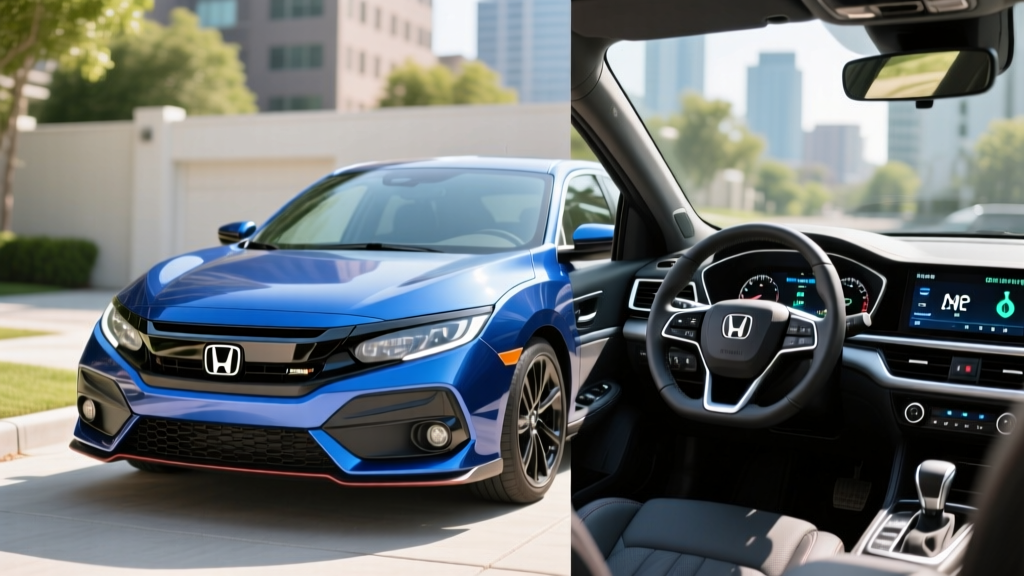
The Honda Civic Hybrid has quietly become one of the most compelling arguments against both gas-only compacts and full battery-electric vehicles. For 2026, the Civic Sport Touring Hybrid Hatchback sits at the top of the lineup, bundling Honda's fourth-generation two-motor hybrid system with the practicality of a hatchback and a premium feature set. If you want electrified efficiency without ever plugging in, this is the trim to scrutinize.
We've spent time with the 2026 Civic Sport Touring Hybrid Hatchback to break down its real-world fuel economy, powertrain behavior, cargo utility, and ownership economics — with the exact numbers you need to decide if it's the right fit versus a PHEV or a full EV.
HEV vs PHEV vs EV: Where the Civic Hybrid Fits
Before diving into specs, it's critical to understand what the Civic Hybrid is — and what it isn't. This is a conventional hybrid (HEV), not a plug-in hybrid (PHEV). You never plug it in. The battery recharges through regenerative braking and the gasoline engine. There is no electric-only driving range to manage and no charging cable to deal with.
Quick Reference: HEV vs PHEV vs BEV
| Feature | HEV (Civic Hybrid) | PHEV (e.g., Toyota Prius Prime) | BEV (e.g., Chevy Equinox EV) |
|---|---|---|---|
| Plug in to charge? | No | Yes (optional) | Yes (required) |
| Electric-only range | ~1 mi at low speed | 25–45 mi typical | 250–350+ mi |
| Battery size | ~1.1 kWh | 10–18 kWh | 60–100 kWh |
| Federal tax credit (§30D) | No | Up to $7,500 (if eligible) | Up to $7,500 (if eligible) |
| Home charging needed? | No | Recommended for EV mode | Yes — Level 2 ideal |
The Civic Hybrid's value proposition is simplicity: you get dramatically better fuel economy than a gas car with zero change to your fueling routine. For buyers who lack home charging access — apartment dwellers, street parkers — this is a decisive advantage over PHEVs and BEVs.
Fuel Economy: EPA Ratings and Real-World MPG
The 2026 Civic Sport Touring Hybrid Hatchback carries EPA ratings of 50 MPG city / 45 MPG highway / 48 MPG combined, according to fueleconomy.gov. These numbers apply to the Sport Touring trim with its standard 18-inch alloy wheels; lower trims with smaller wheels may see slightly higher figures.
| Driving Scenario | EPA Rating | Real-World Expectation |
|---|---|---|
| City | 50 MPG | 50–55 MPG (hybrids excel in stop-and-go) |
| Highway (70 mph) | 45 MPG | 42–46 MPG |
| Combined | 48 MPG | 46–52 MPG |
| Cold weather (below 32°F) | — | 38–44 MPG (engine runs more for cabin heat) |
Real-world note: Hybrids typically exceed their EPA city rating in actual driving because regenerative braking recaptures more energy in heavy traffic. Highway driving is where hybrids lose their advantage — at sustained 75–80 mph speeds, the gasoline engine does nearly all the work. In mixed suburban-and-highway testing, expect to average between 46 and 52 MPG over a full tank, with city-heavy commutes pushing toward the upper end.
With a 12.4-gallon fuel tank, total range lands around 570–620 miles in typical driving — enough to stretch fill-ups to roughly every two weeks for an average commuter.
Powertrain: 200 HP Two-Motor Hybrid System
Honda's fourth-generation hybrid system pairs a 2.0-liter Atkinson-cycle four-cylinder engine with two electric motors in a series-parallel configuration. Combined system output is 200 horsepower and 232 lb-ft of torque, sent to the front wheels through an e-CVT (electronically controlled continuously variable transmission).
| Specification | 2026 Civic Sport Touring Hybrid Hatchback |
|---|---|
| Engine | 2.0L Atkinson-cycle DOHC 4-cylinder |
| Hybrid System | Two-motor (propulsion + generator) |
| Combined Horsepower | 200 hp |
| Combined Torque | 232 lb-ft |
| Transmission | e-CVT (direct-drive with engine clutch) |
| Drivetrain | Front-wheel drive |
| 0–60 mph | ~7.2 seconds (est.) |
| Hybrid Battery | ~1.1 kWh lithium-ion |
| Fuel Tank | 12.4 gallons |
| Cargo Volume (rear seats up) | 24.4 cu ft |
| Cargo Volume (rear seats folded) | ~46 cu ft |
On the road, the two-motor system means the Civic Hybrid operates primarily as an electric vehicle at low and moderate speeds — the engine acts as a generator, feeding electricity to the propulsion motor. At highway speeds, a lock-up clutch connects the engine directly to the wheels for efficiency. The result is smooth, responsive acceleration from a stop (electric motors deliver instant torque) and competent highway passing power. The 200 hp figure makes this one of the quickest mainstream compact hybrids available, noticeably more potent than the base Civic's 158 hp.
Hybrid Battery Warranty, Lifespan, and Replacement Cost
Honda Hybrid Battery Warranty
Coverage: 8 years / 100,000 miles (10 years / 150,000 miles in CARB states including CA, NY, MA, and others)
What's covered: Defects and capacity loss below a defined performance threshold
Transferable: Yes — warranty transfers to subsequent owners
Honda's hybrid battery pack is small (~1.1 kWh) and operates within a conservative state-of-charge window — typically between 20% and 80% — which dramatically reduces degradation stress compared to a full EV battery. Honda's track record with hybrid batteries is strong; the company has been refining this system since the 1999 Insight, and failures within the warranty period are uncommon based on long-term fleet data.
Replacement cost if out of warranty: A hybrid battery replacement for the Civic Hybrid typically runs $2,000–$3,500 including labor at a Honda dealership. Third-party refurbishers offer rebuilt packs for $1,200–$2,000. Given the small battery size and conservative charge management, most owners will never face this cost — the hybrid system's power electronics and the gasoline engine are more likely to require attention over 15+ years of ownership than the battery itself.
Pricing, Trim Details, and Tax Credit Eligibility
The 2026 Civic Sport Touring Hybrid Hatchback carries an MSRP of approximately $33,000 (including destination charge). As the top trim, it includes:
- 18-inch alloy wheels
- Leather-trimmed seats with heated front and rear
- Bose premium audio system (12 speakers)
- 9-inch touchscreen with wireless Apple CarPlay and Android Auto
- Wireless phone charging pad
- Honda Sensing suite (adaptive cruise, lane-keeping, collision mitigation, traffic sign recognition)
- Low-speed braking control and traffic jam assist
- Power moonroof
- LED headlights and taillights
Federal Tax Credit: Not Eligible
The Civic Hybrid is a conventional HEV — it does not qualify for the IRS §30D Clean Vehicle Credit. That credit is reserved for plug-in hybrids (PHEVs) and battery-electric vehicles (BEVs) that meet battery sourcing, MSRP caps, and buyer income requirements. Some states may offer modest rebates for hybrids, but federal incentives are not available. Check your state's energy office for local programs.
Who Should Buy This Hybrid (and Who Shouldn't)
Choose the Civic Hybrid If…
- You want 48+ MPG without plugging in anything
- You live in an apartment or park on the street (no home charging)
- Your commute is city-heavy with frequent stops
- You need hatchback cargo space (24.4 cu ft) for gear, pets, or groceries
- You want a single vehicle for daily commuting and long road trips
- You prefer proven reliability over cutting-edge EV tech
Look at a PHEV or EV Instead If…
- You have home Level 2 charging and a short commute (a PHEV covers it electric-only)
- You want to qualify for the $7,500 federal tax credit
- You want zero tailpipe emissions on daily drives
- You drive less than 40 miles round-trip daily (a BEV or PHEV eliminates gas entirely)
- You prioritize the lowest possible fuel cost per mile (electricity beats gasoline)
The Civic Sport Touring Hybrid Hatchback occupies a specific sweet spot: buyers who want the efficiency of electrification, the practicality of a hatchback, and the zero-friction ownership of a gas-car fueling routine. It's a bridge technology, and for millions of drivers without reliable charging access, it's the right technology.
Real-World Ownership Economics: Hybrid vs Gas vs EV
To put the Civic Hybrid's value in perspective, here's a five-year fuel cost comparison assuming 15,000 miles/year and $3.50/gallon regular unleaded:
| Vehicle | Combined MPG | Annual Fuel Cost | 5-Year Fuel Cost |
|---|---|---|---|
| 2026 Civic Sport Touring Hybrid | 48 MPG | $1,094 | $5,469 |
| 2026 Civic Sport Touring (1.5T gas) | 33 MPG | $1,591 | $7,955 |
| Toyota Prius (LE gas hybrid) | 57 MPG | $921 | $4,605 |
| Chevy Equinox EV (3RS, home L2) | ~115 MPGe | ~$650* | ~$3,250* |
*EV cost based on $0.14/kWh national average electricity rate. Actual costs vary by utility rate and charging mix.
The Civic Hybrid saves roughly $2,486 in fuel costs over five years compared to its gas-only counterpart. A full EV saves more, but requires home charging infrastructure ($500–$2,000 for Level 2 installation) and a higher upfront purchase price before incentives.
Frequently Asked Questions
How many MPG does the 2026 Civic Sport Touring Hybrid Hatchback get?
The EPA rates it at 50 MPG city, 45 MPG highway, and 48 MPG combined. In real-world city-heavy driving, many owners report 50–55 MPG thanks to aggressive regenerative braking. Highway-only driving at 75+ mph drops to around 42–44 MPG. Cold weather (below freezing) can reduce efficiency by 10–15% due to increased engine operation for cabin heating.
Does the Civic Hybrid need to be plugged in?
No. The Civic Hybrid is a conventional HEV — its small lithium-ion battery recharges automatically through regenerative braking and the gasoline engine. There is no charging port and no plug. You fuel it exactly like a standard gas car.
How far can the Civic Hybrid drive on electric power alone?
Very short distances — roughly 1 mile at low speeds (under 25 mph) in stop-and-go traffic. The system uses electric propulsion frequently, but the engine kicks in whenever significant acceleration or sustained speed is needed. This is not a vehicle designed for electric-only commuting; that's what PHEVs and BEVs are for.
Is the Honda hybrid system reliable, and what does battery replacement cost?
Honda's hybrid system has been in production since 1999 and is among the most proven in the industry. The hybrid battery is covered by an 8-year/100,000-mile warranty (10 years/150,000 miles in CARB states). Out-of-warranty replacement costs $2,000–$3,500 at a dealer, or $1,200–$2,000 for a refurbished pack. In practice, hybrid battery failures before 150,000 miles are rare based on long-term ownership data. The IIHS typically rates the Civic highly for crashworthiness as well.
Does the 2026 Civic Hybrid qualify for any federal tax credit?
No. The IRS §30D Clean Vehicle Credit applies only to plug-in hybrids and battery-electric vehicles. As a conventional HEV, the Civic Hybrid does not qualify. Some states or utilities may offer small rebates for hybrid purchases — check your state energy office or utility provider for current programs.
How does the Sport Touring Hybrid Hatchback compare to the Civic Hybrid Sedan?
The powertrain, fuel economy, and feature content are essentially identical. The hatchback adds approximately 5 cubic feet of cargo space behind the rear seats (24.4 cu ft vs ~14.8 cu ft in the sedan) and a wider rear opening for loading bulky items. If you regularly carry cargo, pets, or gear, the hatchback's utility justifies the modest price premium.
Should I buy this hybrid or wait for a full EV?
If you have reliable home charging (a garage or driveway with a 240V outlet), a daily commute under 50 miles, and access to the federal tax credit, a BEV will save more on fuel and maintenance over time. If you lack home charging, take frequent long road trips, live in a cold climate, or simply want to eliminate range and charging logistics from your life, the Civic Hybrid is the more practical choice right now. There is no wrong answer — only the answer that fits your infrastructure.