Quick Verdict: The 2026 Civic Sedan Hybrid at a Glance
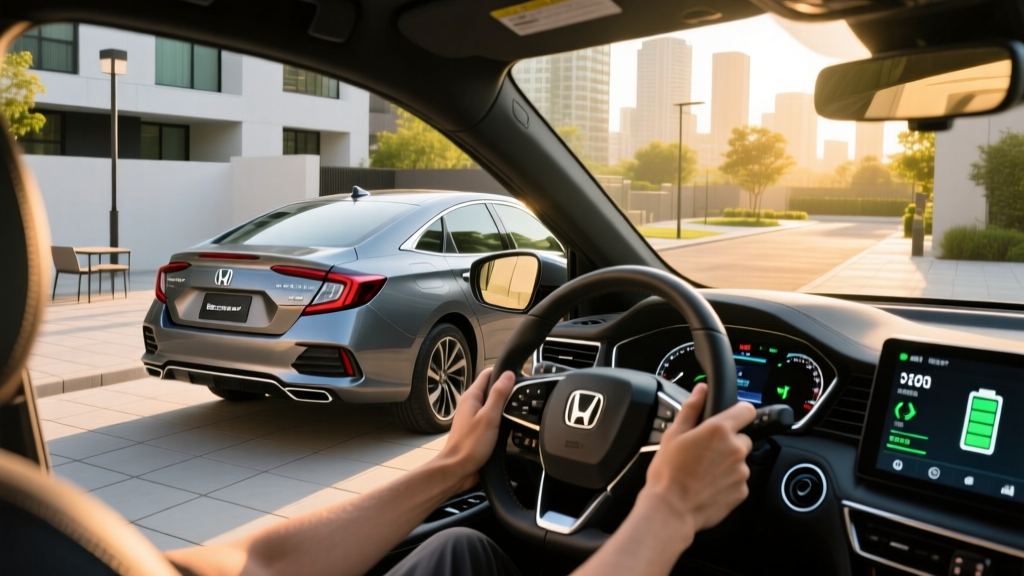
The 2026 Honda Civic Sedan Hybrid continues to anchor Honda's electrified lineup as a conventional hybrid (HEV) — meaning it never needs to be plugged in. Built around Honda's fourth-generation two-motor hybrid system, the Civic Hybrid delivers an EPA-estimated 50 MPG combined, making it one of the most fuel-efficient compact sedans available without a charging cable. For buyers who want dramatic fuel savings without altering their daily routine, the Civic Hybrid occupies a pragmatic sweet spot between a gas-only compact and a full battery-electric vehicle.
But how does it stack up in real-world driving, and does it make more sense than a plug-in hybrid or a dedicated EV? This guide covers every number that matters — from MPG to MSRP to battery warranty — so you can decide with confidence.
HEV vs. PHEV: What the 2026 Civic Sedan Hybrid Actually Is
Conventional Hybrid (HEV): The 2026 Civic Sedan Hybrid is a self-charging hybrid. Its small lithium-ion battery (approximately 1.1 kWh) is recharged entirely through regenerative braking and the gasoline engine. You never plug it in. There is no meaningful electric-only driving range — the electric motor assists the engine and enables brief low-speed EV mode, but the gas engine remains the primary energy source.
Plug-In Hybrid (PHEV): A PHEV like the Toyota Prius Prime carries a much larger battery (13.6 kWh) and can travel 30–44 miles on electricity alone before the gas engine engages. PHEVs require plugging in to realize their efficiency advantage. Honda does not currently offer a Civic PHEV in the U.S. market.
This distinction matters because buyers sometimes assume "hybrid" means they can drive on electric power alone for commutes. With the Civic Hybrid, you'll always use gasoline — you'll just use far less of it than a conventional gas car.
Fuel Economy: EPA Ratings and Real-World MPG
The 2026 Civic Sedan Hybrid's fuel economy varies by trim, with the Sport Hybrid achieving slightly lower numbers due to larger wheels and sport-tuned suspension tuning. Here are the official EPA figures via fueleconomy.gov:
| Trim | City MPG | Highway MPG | Combined MPG |
|---|---|---|---|
| Sport Hybrid | 50 | 47 | 49 |
| Sport Touring Hybrid | 49 | 46 | 48 |
Real-World MPG: What to Actually Expect
Honda's two-motor hybrid system excels in stop-and-go city driving, where the electric motor handles most low-speed propulsion and the engine acts primarily as a generator. In real-world city commuting, many owners report exceeding the EPA city estimate, hitting 52–55 MPG in warm weather with moderate traffic. This is a hallmark of Honda's e:HEV architecture — city efficiency often beats the sticker number.
Highway driving tells a different story. At sustained 70–80 mph speeds, the engine is directly coupled to the wheels via a clutch, and aerodynamic drag dominates. Expect 43–46 MPG on the highway in real-world conditions. Cold weather (below 35°F) reduces efficiency by roughly 8–12% due to increased engine warm-up cycles, cabin heating demands, and reduced battery chemical efficiency.
Total range: With a 12.4-gallon fuel tank and 49 MPG combined, the Civic Hybrid can travel approximately 607 miles between fill-ups under ideal conditions. Real-world mixed driving yields a realistic 520–570 miles per tank.
Powertrain Specs: What's Under the Hood
The 2026 Civic Hybrid pairs a 2.0-liter Atkinson-cycle four-cylinder engine with Honda's two-motor hybrid system. Here are the key specifications:
| Specification | Value |
|---|---|
| Engine | 2.0L Atkinson-cycle 4-cylinder |
| Engine Power | 146 hp @ 6,000 rpm |
| Electric Motor Power | 184 hp / 232 lb-ft torque |
| Combined System Output | 200 hp / 232 lb-ft torque |
| Hybrid Battery | ~1.1 kWh lithium-ion (self-charging) |
| Transmission | e-CVT (no traditional gears) |
| Drivetrain | Front-wheel drive |
| 0–60 mph | ~7.2 seconds (est.) |
| Towing Capacity | Not rated for towing |
The electric motor provides the majority of the thrust, especially from a stop. The gasoline engine primarily generates electricity for the motor at lower speeds, then mechanically engages via a lock-up clutch at highway cruising speeds for direct-drive efficiency. This architecture delivers smooth, linear acceleration without the rubber-band feel that older CVTs produced. The 200 combined horsepower is genuinely competitive with turbocharged gas rivals and makes highway merging effortless.
Pricing, Trims, and Tax Credit Eligibility
The 2026 Civic Sedan Hybrid is offered in two trims. Pricing below reflects Honda's MSRP before destination charges:
| Trim | MSRP (est.) | Key Features |
|---|---|---|
| Sport Hybrid | ~$29,845 | 18" wheels, sport pedals, wireless CarPlay/Android Auto, Honda Sensing suite |
| Sport Touring Hybrid | ~$32,645 | Leather seats, Bose 12-speaker audio, wireless charging, heated rear seats, low-speed braking control |
Does the 2026 Civic Hybrid Qualify for a Federal Tax Credit?
No. The federal §30D Clean Vehicle Credit applies exclusively to plug-in electric vehicles (BEVs and PHEVs) with batteries meeting specific capacity, critical-mineral sourcing, and battery-component manufacturing requirements outlined by the IRS. Because the Civic Hybrid is a conventional HEV that cannot be plugged in, it does not qualify for the §30D credit or any federal point-of-sale incentive.
Some states or local utilities may offer small rebates for hybrid purchases, but these vary widely by jurisdiction and change frequently. Check your state energy office or utility provider for current programs. A tax professional can confirm eligibility for any regional incentives.
Battery Warranty, Reliability, and Replacement Costs
Hybrid Battery Warranty: Honda covers the Civic Hybrid's lithium-ion battery pack with an 8-year/100,000-mile warranty (extended to 10 years/150,000 miles in California Air Resources Board states including CA, CT, MA, NJ, NY, OR, and others adopting CARB standards). This warranty covers defects and capacity loss below a functional threshold.
How Long Will the Hybrid Battery Last?
Honda's hybrid batteries are engineered to last the life of the vehicle under normal use. Unlike full EVs with large batteries that undergo deep charge-discharge cycles, the Civic Hybrid's small battery operates in a narrow state-of-charge window — typically between 40% and 80%. This shallow cycling dramatically reduces degradation. Real-world data from previous-generation Civic and Accord Hybrids shows battery packs routinely lasting 150,000–200,000+ miles without significant capacity loss.
Battery Replacement Cost
If a hybrid battery does fail outside warranty, replacement costs for Honda's compact hybrid battery packs typically range from $2,000 to $4,000 including parts and labor at a dealership. Independent hybrid specialists may offer refurbished units for $1,500–$2,500. This is substantially less than a full EV battery replacement ($8,000–$20,000+) because the pack is small and the labor is straightforward. Honda's overall reliability ratings remain strong, with the Civic nameplate consistently ranking well in long-term dependability surveys tracked by organizations like IIHS.
Who Should Choose the Civic Hybrid vs. a PHEV or Full EV?
Choose the 2026 Civic Sedan Hybrid if:
- You lack access to home or workplace charging (apartment dwellers, street parkers)
- You want maximum simplicity — no plugs, no charging apps, no range planning
- Your daily commute is under 50 miles and you want 500+ mile total range for road trips
- You want lower fuel costs without a significant upfront price premium over gas models
- You live in a region with limited public charging infrastructure
Consider a PHEV (like the Prius Prime) instead if:
- You can charge at home and your daily commute is under 40 miles (drive mostly on electricity)
- You want to reduce gasoline consumption to near-zero on weekdays while keeping gas for road trips
- You qualify for the §30D federal tax credit on eligible PHEVs (up to $7,500 depending on sourcing rules)
Consider a full EV (like the Chevy Equinox EV or Hyundai Ioniq 5) instead if:
- You have reliable Level 2 home charging and want zero tailpipe emissions
- Your daily driving is under 250 miles and you want the lowest per-mile "fuel" cost
- You want to take advantage of the full §30D tax credit (up to $7,500 on eligible models, subject to MSRP caps, income limits, and battery sourcing rules)
- You want minimal maintenance — no oil changes, no spark plugs, no engine coolant
The Civic Hybrid's advantage is its zero lifestyle change proposition. You drive it exactly like a gas car, fill up at any gas station, and simply enjoy 40–55 MPG without thinking about it. For many buyers — especially those in apartments, rural areas, or cold climates where EV range loss is a concern — that simplicity is the entire point.
Pros and Cons at a Glance
Pros
- 50 MPG combined EPA — among the best in the compact sedan class
- No plug-in required; zero lifestyle adjustment from a gas car
- 200 hp combined — genuinely quick for the segment
- 600+ mile total range eliminates refueling stops on road trips
- 8-year/100,000-mile hybrid battery warranty (10/150k in CARB states)
- Honda Sensing ADAS suite standard on all trims
- Strong resale value and reliability track record
Cons
- No electric-only driving range — always uses gasoline
- No federal tax credit eligibility (HEV, not a PHEV or BEV)
- Highway MPG drops to low-to-mid 40s at 75+ mph
- Cold weather reduces efficiency by 8–12%
- Only two trims available — limited customization
- FWD only — no AWD option for snow-belt buyers
Frequently Asked Questions
How many MPG does the 2026 Civic Sedan Hybrid get?
The EPA rates the 2026 Civic Sport Hybrid at 50 city / 47 highway / 49 combined MPG. The Sport Touring Hybrid is rated at 49/46/48. In real-world city driving, expect to match or slightly exceed EPA city numbers. Highway driving at 70–80 mph typically yields 43–46 MPG.
Does the 2026 Civic Hybrid have an electric-only mode?
The Civic Hybrid can operate in EV mode for very short distances at low speeds (typically under 1 mile at speeds below 25 mph), such as creeping through a parking lot. It is not designed for meaningful electric-only commuting. The battery is too small (~1.1 kWh) and recharges only through regenerative braking and the engine — you cannot plug it in.
Is the 2026 Civic Hybrid reliable?
Honda's hybrid powertrains have demonstrated strong long-term reliability. The e:HEV two-motor system has fewer wear components than a traditional automatic transmission, and the hybrid battery operates in a narrow charge window that minimizes degradation. Honda backs the hybrid battery with an 8-year/100,000-mile warranty (10 years/150,000 miles in CARB states).
What does it cost to replace the Civic Hybrid battery?
Out-of-warranty hybrid battery replacement typically costs $2,000–$4,000 at a Honda dealership, including parts and labor. Refurbished batteries from independent hybrid specialists may be available for $1,500–$2,500. In practice, Honda hybrid batteries routinely last 150,000–200,000+ miles, so replacement during typical ownership is uncommon.
Does the 2026 Civic Hybrid qualify for any tax credit?
No. The federal §30D Clean Vehicle Credit applies only to plug-in vehicles (BEVs and PHEVs). As a conventional hybrid that cannot be plugged in, the Civic Hybrid does not qualify for federal EV tax incentives. Some state or utility programs may offer small hybrid rebates — check your local jurisdiction.
Hybrid vs. PHEV vs. EV — which should I choose?
Choose the Civic Hybrid if you can't charge at home and want maximum simplicity. Choose a PHEV if you can charge at home and commute under 40 miles daily — you'll drive mostly on electricity. Choose a full EV if you have home charging, want the lowest operating costs, and your daily driving fits within 250 miles. The Civic Hybrid is the right answer when charging access is the limiting factor.
How does the Civic Hybrid compare to the Toyota Corolla Hybrid?
The Corolla Hybrid offers comparable EPA ratings (up to 50/43/47 MPG for FWD) and is available with AWD. The Civic Hybrid delivers more horsepower (200 vs. 138 combined) and a more engaging driving experience. The Corolla Hybrid starts at a lower MSRP. Both are strong choices — prioritize the Civic for performance and interior refinement, the Corolla for AWD availability and lower entry price.