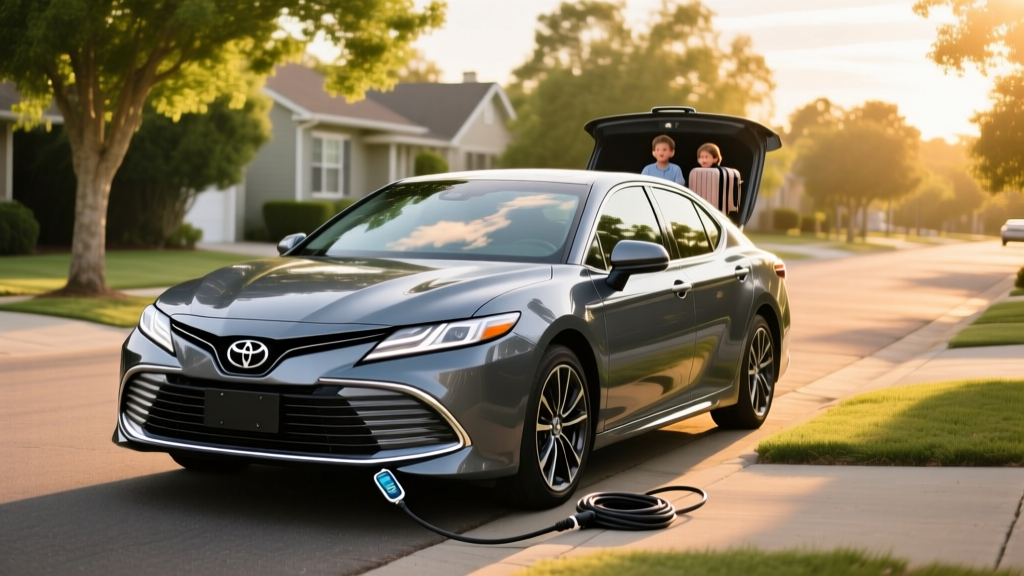
The 2026 Toyota Camry Hybrid arrives at a moment when buyers are recalculating everything: fuel costs, EV charging access, and whether a full battery-electric vehicle actually fits their daily routine. Toyota's answer is a fifth-generation hybrid system paired exclusively with a 2.5-liter four-cylinder engine—no gas-only variant in the lineup. The result is a midsize sedan that posts EPA ratings up to 51 MPG combined while offering standard all-wheel drive across every trim.
This guide covers the exact specs, real-world fuel economy expectations, powertrain details, pricing by trim, battery warranty terms, and how the Camry Hybrid stacks up against plug-in hybrids and full EVs for different buyer profiles.
2026 Camry Hybrid Powertrain and Performance Specs
Toyota dropped the V6 and the gas-only four-cylinder from the Camry lineup entirely for this generation. Every 2026 Camry is a hybrid. The fifth-generation Toyota Hybrid System (THS) pairs a 2.5-liter Dynamic Force inline-four with one or more electric motor-generators, depending on drivetrain.
| Specification | FWD Trims | AWD Trims |
|---|---|---|
| Engine | 2.5L inline-4 + 2 motor-generators | 2.5L inline-4 + 3 motor-generators |
| Combined Horsepower | 225 hp | 232 hp |
| Drivetrain | Front-wheel drive | Electronic AWD (rear motor) |
| Transmission | eCVT | eCVT |
| 0-60 mph (est.) | ~7.2 sec | ~6.9 sec |
| Hybrid Battery | Lithium-ion, ~1.6 kWh (self-charging HEV) | |
| EPA Combined MPG | 51 MPG (LE) | 44 MPG (SE/XLE) |
| Towing Capacity | Not rated for towing | |
The AWD system uses a separate rear-mounted electric motor (40 hp) that engages automatically for traction—there is no mechanical driveshaft connecting the front and rear axles. This is the same electronic on-demand approach Toyota uses in the RAV4 Hybrid and Highlander Hybrid.
EPA Fuel Economy vs. Real-World MPG
Toyota publishes distinct EPA ratings depending on trim and wheel size. The LE trim, with its 16-inch wheels and lighter equipment load, posts the highest numbers. Sportier and more luxurious trims sacrifice a few MPG for larger wheels, heavier content, and AWD.
| Trim | Drivetrain | City MPG | Highway MPG | Combined MPG |
|---|---|---|---|---|
| LE | FWD | 53 | 50 | 51 |
| LE | AWD | 51 | 49 | 50 |
| SE / SE Nightshade | AWD | 44 | 43 | 44 |
| XLE | AWD | 44 | 43 | 44 |
Real-world expectations: Toyota's hybrid system excels in stop-and-go city driving, where regenerative braking recaptures energy and the electric motor handles low-speed propulsion. In our experience and consistent with fueleconomy.gov owner submissions, drivers who do mostly city commuting often match or slightly exceed the EPA city number—53 to 56 MPG is achievable on the LE in warm weather with moderate acceleration.
Highway driving tells a different story. At sustained 75-80 mph speeds, aerodynamic drag dominates, and the gasoline engine carries most of the load. Expect 42-46 MPG on the highway in the LE and 37-41 MPG in AWD trims during cold weather or at high altitude. If your commute is 90% freeway, the real-world combined figure will land closer to 44-46 MPG for the LE rather than the EPA's 51.
HEV vs. PHEV vs. EV: Which Powertrain Fits You?
The Camry Hybrid is a conventional hybrid electric vehicle (HEV)—it cannot be plugged in. The small lithium-ion battery charges exclusively through regenerative braking and the gasoline engine. This is fundamentally different from a plug-in hybrid (PHEV) like the Toyota Prius Prime or a full battery-electric vehicle (BEV) like the Tesla Model 3.
| Factor | HEV (Camry Hybrid) | PHEV (e.g., Prius Prime) | BEV (e.g., Model 3) |
|---|---|---|---|
| Plug in required? | No | Yes (for EV range) | Yes (always) |
| Electric-only range | None (EV assist only) | 30-44 mi typical | 250-360 mi typical |
| Home charging needed | No | Recommended (Level 2) | Essential (Level 2) |
| Fuel cost per mile | ~$0.07-$0.09 | ~$0.03 EV / $0.08 gas | ~$0.03-$0.05 |
| Upfront price premium | Lowest | Mid | Highest |
| Federal tax credit (§30D) | Not eligible | Up to $7,500 (if eligible) | Up to $7,500 (if eligible) |
| Best for | No home charging access; long highway commutes | Home charging + short daily commute + road trips | Home charging + daily driving under 250 mi |
Choose the Camry Hybrid if you lack reliable access to home or workplace charging, you regularly drive more than 400 miles in a single day, or you simply want maximum simplicity with no plug-in routine. The Camry Hybrid trades the lowest per-mile fuel cost of a BEV for zero charging infrastructure dependency.
Consider a PHEV instead if you can install a Level 2 charger at home and your daily round-trip commute is under 40 miles. A PHEV lets you drive on electricity most days while retaining a gas engine for weekend road trips—best of both worlds, but at a higher purchase price.
Pricing, Trims, and Tax Credit Eligibility
The 2026 Camry Hybrid is offered in three core trims—LE, SE, and XLE—with the SE Nightshade edition as an appearance package. All trims come standard with Toyota Safety Sense 3.0, a 12.3-inch touchscreen (SE and above), wireless Apple CarPlay and Android Auto, and an 8-way power driver's seat on XLE.
| Trim | Drivetrain | MSRP (approx.) |
|---|---|---|
| LE | FWD | $29,990 |
| LE | AWD | $31,390 |
| SE | AWD | $33,290 |
| SE Nightshade | AWD | $34,090 |
| XLE | AWD | $35,590 |
Federal Tax Credit: Does the Camry Hybrid Qualify?
No. Under current IRS §30D rules, the federal clean vehicle credit applies only to plug-in electric vehicles—battery-electric vehicles (BEVs) and plug-in hybrids (PHEVs) with a minimum battery capacity of 7 kWh. The Camry Hybrid's ~1.6 kWh battery is far below this threshold, and as a conventional HEV, it does not meet the plug-in requirement. You will not receive the up-to-$7,500 federal credit for purchasing a Camry Hybrid.
Some states offer their own incentives for hybrid vehicles, though these are increasingly rare as state programs shift focus to zero-emission vehicles. Check your state's energy or environmental agency website for current programs. A few utilities also offer rebates for hybrid purchases, though amounts are typically modest ($250-$500).
Battery Warranty, Lifespan, and Replacement Cost
Hybrid battery longevity remains the top concern for first-time hybrid buyers. Toyota addresses this with one of the strongest hybrid battery warranties in the industry.
• Hybrid battery: 10 years / 150,000 miles (whichever comes first)
• Hybrid system components (inverter, motor-generators, control module): 8 years / 100,000 miles
• Transferable to subsequent owners at no cost
• Coverage applies in all 50 states (not limited to CARB states as in prior years)
The lithium-ion hybrid battery in the Camry is small (~1.6 kWh) and operates within a narrow state-of-charge window—Toyota's battery management system never fully charges or fully depletes it. This shallow-cycling strategy dramatically extends cell life. Based on data from prior-generation Camry Hybrids and the Prius fleet, hybrid batteries routinely last 150,000-200,000+ miles before meaningful capacity loss.
What Does Replacement Cost?
If the hybrid battery fails outside warranty, expect to pay $2,500-$4,000 for a new OEM battery pack installed at a Toyota dealer. Refurbished or reconditioned packs from independent hybrid specialists typically cost $1,200-$2,200 installed. Individual cell module replacement (if only a few modules are weak) can run $500-$1,000 at a specialist shop.
For context, the hybrid battery in a conventional HEV like the Camry is far less expensive to replace than a BEV traction battery (which can run $8,000-$20,000+). The small capacity and mature nickel-metal-hydride/lithium-ion supply chain keep costs manageable.
Driving Impressions and Daily Usability
The 2026 Camry Hybrid prioritizes efficiency and comfort over sportiness, but the 225-232 hp output means merging and passing maneuvers are handled confidently. The eCVT delivers seamless, stepless acceleration—there are no gear shifts to feel, just a smooth ramp of power. The trade-off is a characteristic engine drone under hard acceleration as the engine holds at peak RPM, a trait common to all Toyota hybrids using the planetary-gear eCVT.
Ride quality is firm but well-damped, particularly on the XLE with its tuned comfort suspension. The SE trim's sport-tuned suspension and 19-inch wheels (on Nightshade) trade some ride compliance for sharper turn-in. Steering is light and precise—ideal for commuting, less engaging on back roads.
Interior space remains competitive: 15.1 cubic feet of trunk volume, rear seat room sufficient for two adults on long trips, and a straightforward dashboard layout with physical climate controls (a welcome carryover). The 12.3-inch infotainment screen on SE and XLE trims runs Toyota's latest interface with wireless phone mirroring and over-the-air updates.
Pros
- 51 MPG EPA combined (LE) — best-in-class for midsize sedans
- Standard AWD available across all trims
- No plug-in charging required — zero infrastructure dependency
- 10-year / 150,000-mile hybrid battery warranty
- Toyota Safety Sense 3.0 standard on every trim
- Strong resale value and proven reliability track record
Cons
- No federal tax credit eligibility (HEV, not PHEV/BEV)
- Engine drone under hard acceleration (eCVT characteristic)
- AWD trims drop to 44 MPG combined
- No DC fast charging capability (not applicable to HEV)
- Not rated for towing
- XLE pricing approaches PHEV territory without EV-mode benefit
5-Year Ownership Cost Estimate
Here's a rough five-year, 75,000-mile ownership comparison for the Camry Hybrid LE versus a comparable gas-only midsize sedan averaging 28 MPG combined and a BEV averaging 3.5 miles/kWh. Electricity and gas prices vary by region—these figures use national averages as of early 2026.
| Cost Factor | Camry Hybrid (51 MPG) | Gas Sedan (28 MPG) | BEV (home charging) |
|---|---|---|---|
| Fuel / energy cost | ~$4,960 | ~$9,040 | ~$3,210 |
| Maintenance (oil, brakes, tires) | ~$2,800 | ~$3,600 | ~$1,800 |
| Federal tax credit | $0 | $0 | Up to -$7,500* |
| Estimated insurance (5 yr) | ~$7,500 | ~$7,200 | ~$8,400 |
| Net fuel + maint. + credit | ~$7,760 | ~$12,640 | ~$-2,490* |
*BEV tax credit assumes full §30D eligibility including income caps, MSRP caps, and critical mineral/battery sourcing requirements. Actual credit varies by buyer and vehicle. Source: IRS Clean Vehicle Tax Credits.
The Camry Hybrid splits the difference: substantially cheaper to fuel than a gas sedan, but without the upfront credit or lowest per-mile energy cost of a BEV. Over five years, the Camry Hybrid saves roughly $4,880 in fuel and maintenance versus the gas-only alternative—a meaningful offset against any trim-level price premium.
Reliability and Safety Ratings
Toyota's hybrid powertrain is among the most proven in the industry, with over 25 years of continuous production since the original Prius. The 2.5-liter Dynamic Force engine (A25A-FXS) has been in production since 2018 and is shared across the RAV4 Hybrid, Highlander Hybrid, and Camry Hybrid, meaning parts availability and technician familiarity are excellent.
For safety, the 2026 Camry comes standard with Toyota Safety Sense 3.0, which includes:
- Pre-Collision System with Pedestrian Detection
- Full-Speed Range Dynamic Radar Cruise Control
- Lane Departure Alert with Steering Assist
- Lane Tracing Assist
- Road Sign Assist
- Automatic High Beams
The previous-generation Camry earned an IIHS Top Safety Pick+ rating and a 5-star overall NHTSA rating. The 2026 model is expected to undergo updated crash testing; check iihs.org and nhtsa.gov for the latest scores as they're published.
Frequently Asked Questions
How many MPG does the 2026 Camry Hybrid actually get?
The EPA rates the Camry Hybrid LE at 53 city / 50 highway / 51 combined. AWD trims (SE, XLE) are rated at 44 combined. In real-world driving, city-heavy commuters in FWD trims often see 48-54 MPG, while highway-dominant driving in AWD trims yields 38-44 MPG depending on speed, temperature, and terrain.
Does the Camry Hybrid need to be plugged in?
No. The Camry Hybrid is a conventional hybrid (HEV). Its small battery charges entirely through regenerative braking and the gasoline engine. There is no plug, no charging cable, and no need for any charging infrastructure.
Does the 2026 Camry Hybrid qualify for a federal tax credit?
No. Under IRS §30D rules, only plug-in electric vehicles (BEVs and qualifying PHEVs) are eligible for the federal clean vehicle credit. The Camry Hybrid, as a conventional HEV, does not qualify. Some state or utility incentives may apply—check local programs.
How long will the Camry Hybrid battery last, and what does it cost to replace?
Toyota warranties the hybrid battery for 10 years / 150,000 miles. Real-world data from Toyota's hybrid fleet shows batteries commonly lasting 150,000-200,000+ miles. Out-of-warranty replacement costs $2,500-$4,000 for a new OEM pack, or $1,200-$2,200 for a refurbished unit from a hybrid specialist.
Is AWD worth the MPG trade-off?
If you live in a region with snow, ice, or frequent rain, the AWD system's traction benefit is tangible—and the cost is 7 MPG combined (51 vs. 44). For buyers in mild climates who rarely encounter low-traction surfaces, the FWD LE delivers the best fuel economy and the lowest price. The AWD system adds roughly 100 lbs and engages only when front-wheel slip is detected, so there is no efficiency penalty during dry, steady-state driving beyond the weight and drivetrain losses.
Camry Hybrid vs. Prius: which should I buy?
The Prius (up to 57 MPG combined, FWD) is more efficient and starts at a lower price, but it offers less interior space, a smaller trunk, and a firmer ride. The Camry Hybrid trades 6-13 MPG for significantly more rear-seat room, a larger trunk (15.1 vs. ~12.5 cu ft), and a more refined highway ride. If you regularly carry rear passengers or prioritize comfort over maximum efficiency, the Camry is the stronger choice.