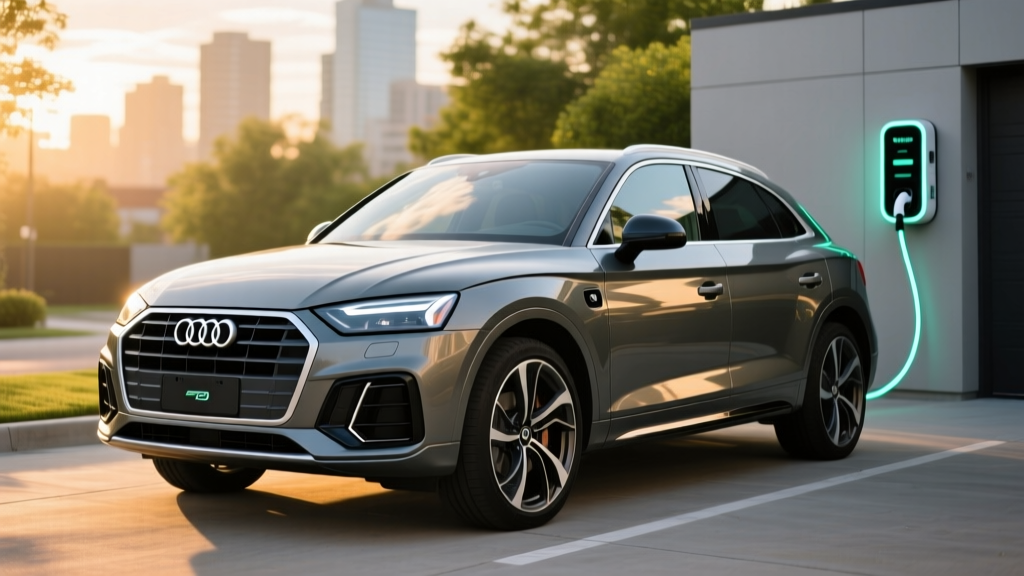
If you want luxury compact SUV refinement but aren't ready to commit to a full battery-electric vehicle, the 2026 Audi Q5 55 TFSI e plug-in hybrid threads a practical needle. It delivers a modest electric-only commute range, seamless gas-engine backup for road trips, and the premium cabin Audi is known for — all without the charging-infrastructure anxiety that still plagues many EV buyers.
This guide breaks down the 2026 Audi Q5 hybrid lineup with a focus on the PHEV variant: real-world MPG, electric-only range, battery specs, charging logistics, and whether this compact luxury PHEV fits your garage — or whether a conventional hybrid or full EV makes more sense.
2026 Audi Q5 Hybrid: HEV vs PHEV Explained
Audi's Q5 lineup for 2026 includes two electrified options, and confusing them is the single most common buyer mistake:
Q5 45 TFSI (Mild Hybrid / HEV)
- Powertrain: 2.0L turbo-4 + 48V mild-hybrid system
- Combined output: 261 hp
- Plugs in? No — regenerative braking only
- Electric-only driving: None (assist only)
- EPA MPG: 25 city / 31 highway / 27 combined
- Federal tax credit: None
Q5 55 TFSI e (Plug-In Hybrid / PHEV)
- Powertrain: 2.0L turbo-4 + electric motor
- Combined output: 362 hp
- Plugs in? Yes — J1772 / Type 2 AC charging
- Electric-only driving: Up to 23 miles (EPA)
- EPA MPG: 26 combined (gas) / 61 MPGe (with charge)
- Federal tax credit: Up to $3,750 (see eligibility below)
The mild-hybrid Q5 45 TFSI uses a small 48-volt battery and integrated starter-generator to smooth stop-start events and recover minor braking energy. It cannot drive on electricity alone. The 55 TFSI e is the true plug-in hybrid with a larger traction battery, a dedicated electric motor, and the ability to complete short commutes without burning a drop of gas.
For this review, we focus on the Q5 55 TFSI e PHEV — the model most shoppers mean when searching for the "2026 Audi Q5 hybrid."
Spec Table: 2026 Audi Q5 55 TFSI e at a Glance
| Specification | 2026 Audi Q5 55 TFSI e |
|---|---|
| Powertrain | 2.0L turbocharged I4 + electric motor, 7-speed S tronic, quattro AWD |
| Combined Horsepower | 362 hp / 369 lb-ft torque |
| Battery Capacity | 17.9 kWh (gross) / ~14.1 kWh usable |
| Battery Chemistry | NMC (nickel manganese cobalt) |
| EPA Electric-Only Range | 23 miles |
| EPA MPGe (charge-sustaining + EV) | 61 MPGe combined |
| EPA MPG (gas-only, charge-sustaining) | 26 city / 27 highway / 26 combined |
| Total Combined Range | ~410 miles (gas + electric) |
| 0–60 mph | 5.0 seconds |
| AC Charging (Level 2) | 7.4 kW max, ~2.5 hours (0–100%) |
| DC Fast Charging | Not supported |
| Cargo Volume | 23.8 cu ft (rear seats up) / 47.6 cu ft (folded) |
| Base MSRP | $58,595 (Premium) / $62,495 (Premium Plus) |
| Battery/Powertrain Warranty | 8 years / 100,000 miles (hybrid components) |
Fuel Economy & Electric-Only Range: Real-World Expectations
| Driving Mode | EPA Estimate | Real-World Expectation |
|---|---|---|
| Electric-only (EV mode) | 23 miles | ~18–21 mi (highway); ~22–25 mi (city, mild weather) |
| Gas-only (charge-sustaining) | 26 combined MPG | ~24–27 MPG mixed; up to 29 highway at steady 65 mph |
| MPGe (EV + gas combined) | 61 MPGe | Varies widely by charging frequency |
The EPA's 23-mile electric range assumes moderate temperatures and mixed driving. In practice, PHEV range behaves much like EV range: highway speeds above 70 mph, winter temperatures below 40°F, and aggressive acceleration all compress it. Expect roughly 18–21 miles of electric driving on a highway commute in winter, and up to 25 miles on a gentle city loop in spring weather.
The 26 MPG combined gas figure is competitive for a 4,700-pound luxury SUV. Because hybrids recapture energy during braking, you'll often see city MPG match or slightly exceed highway MPG — the opposite of a conventional gas car. Owners who never plug in will average around 24–27 MPG depending on driving style, which is only marginally better than the non-hybrid Q5 45 TFSI's 27 combined.
Powertrain, Battery & Charging Logistics
The Q5 55 TFSI e pairs Audi's proven 2.0-liter turbocharged four-cylinder (261 hp on its own) with a 100 kW (134 hp) electric motor integrated into the 7-speed S tronic dual-clutch transmission. Combined system output is 362 hp and 369 lb-ft of torque, routed through quattro all-wheel drive. The 0–60 mph time of 5.0 seconds places it firmly in sporty territory for the segment.
The 17.9 kWh gross lithium-ion battery (NMC chemistry) sits beneath the rear cargo floor, which slightly reduces under-floor storage compared to the gas Q5 but preserves the main cargo area. Usable capacity is approximately 14.1 kWh — Audi buffers the top and bottom of the pack to protect long-term State of Health (SoH).
Charging: What You Need to Know
| Charging Level | Power (kW) | 0–100% Time | Availability |
|---|---|---|---|
| Level 1 (120V household) | ~1.4 kW | ~10–12 hours | Any standard outlet |
| Level 2 (240V home/public) | 7.4 kW max | ~2.5 hours | Home wallbox, public AC stations |
| DC Fast Charge | N/A | N/A | Not supported |
The Q5 55 TFSI e uses a standard J1772 connector for AC charging. The onboard charger maxes out at 7.4 kW, meaning a full charge from a Level 2 home station takes roughly 2.5 hours. On a standard 120V household outlet (Level 1), expect an overnight top-up to take 10–12 hours — adequate if your daily electric consumption is under 15 miles.
Critical limitation: This PHEV does not support DC fast charging. You cannot use Electrify America, Tesla Supercharger, or any CCS/NACS DC station. For a PHEV with a small battery, this is typical and generally not a dealbreaker — the gas engine covers long trips — but it means public charging options are limited to slower AC destinations.
Pricing, Trims & Federal Tax Credit Eligibility
The 2026 Audi Q5 55 TFSI e is offered in two trims:
- Premium: $58,595 MSRP (before destination)
- Premium Plus: $62,495 MSRP (before destination)
Both trims come well-equipped with Audi's Virtual Cockpit, MMI infotainment, leather upholstery, power liftgate, and the full suite of Audi Pre Sense safety systems.
Does the Q5 PHEV Qualify for a Tax Credit?
- Maximum credit for PHEVs: Up to $3,750 (battery capacity & sourcing-dependent; PHEVs rarely qualify for the full $7,500)
- MSRP cap: SUVs must be under $80,000 — both Q5 PHEV trims qualify
- Buyer income caps: AGI ≤ $150,000 (single) / $300,000 (joint)
- Battery sourcing: Critical minerals and battery components must meet phased-in domestic/FtA-sourcing thresholds — Audi's supply chain compliance varies by build date
- Point-of-sale transfer: Eligible buyers can apply the credit as a down-payment reduction at the dealer
Source: IRS §30D Clean Vehicle Credit. Eligibility rules change — verify current sourcing compliance on fueleconomy.gov before purchasing.
In practice, the Q5 55 TFSI e has historically qualified for a partial credit of up to $3,750, not the full $7,500 available to some full EVs. This is because the PHEV's smaller battery often fails the critical-minerals or battery-component sourcing thresholds required for the second $3,750 half. Always confirm the specific VIN's eligibility via the IRS Clean Vehicle report at the point of sale.
Hybrid vs PHEV vs EV: Which Fits Your Garage?
Choose the Q5 PHEV if:
- Your daily commute is under 20 miles and you can charge at home nightly
- You take frequent road trips where EV charging infrastructure is sparse
- You want one vehicle for both electric city driving and gas highway freedom
- You value 362 hp and quattro AWD in a compact luxury package
Choose the Q5 Mild Hybrid (45 TFSI) if:
- You cannot install a home charger (apartment, no garage outlet)
- Your daily driving exceeds 30+ miles, making the PHEV's EV range irrelevant
- You want a lower purchase price and simpler ownership
Choose a Full EV (e.g., Audi Q4 e-tron, Tesla Model Y) if:
- You have reliable home Level 2 charging and want zero gasoline costs
- Your daily driving is under 250 miles and you rarely tow
- You want the full $7,500 federal tax credit and lower maintenance costs
- You plan to keep the vehicle 8+ years and want fewer powertrain components to fail
The PHEV's sweet spot is narrow but valuable: short commutes plus home charging plus occasional long trips. If any of those three conditions isn't met, you're either better served by a cheaper conventional hybrid or a more efficient full EV.
Reliability, Battery Warranty & Replacement Cost
- Duration: 8 years / 100,000 miles (whichever comes first)
- Coverage threshold: Battery capacity must not fall below ~70% of original capacity
- What's covered: High-voltage battery pack, electric motor, power electronics, onboard charger
Audi's hybrid-component warranty matches the industry standard set by federal emissions regulations, which mandate 8-year/100,000-mile coverage on PHEV battery packs. If the battery degrades below approximately 70% of its original capacity within that window, Audi will repair or replace it at no cost.
Real-world degradation data for Audi's PHEV battery packs suggests roughly 1–2% capacity loss per year under normal use, meaning after 8 years you'd expect roughly 85–92% State of Health — well above the warranty threshold. The buffer Audi engineers into the pack (keeping ~3.8 kWh in reserve at top and bottom) significantly reduces stress on the cells.
Out-of-warranty replacement cost: A full high-voltage battery replacement for the Q5 55 TFSI e currently runs between $8,000 and $12,000 including labor at an Audi dealer. However, given the PHEV's relatively small pack and conservative charge/discharge cycling, outright failure before 150,000 miles is uncommon based on historical data from the previous-generation Q5 PHEV.
The 12-volt auxiliary battery (which powers electronics, lights, and infotainment) is a separate consumable item, typically lasting 4–6 years and costing $200–$400 to replace — standard for any modern vehicle.
Pros & Cons: The Honest Assessment
Pros
- 362 hp delivers genuinely quick acceleration (5.0s to 60 mph)
- Premium cabin quality, quiet ride, and standard quattro AWD
- 23-mile EV range covers most daily commutes without gas
- Seamless transitions between electric and gas power
- No range anxiety — 410+ miles total range for road trips
- Eligible for partial federal tax credit (up to $3,750)
Cons
- No DC fast charging — limits public charging utility
- EV range drops to ~18 miles in cold weather or highway driving
- Only ~1 MPG better than the gas Q5 if you never plug in
- Higher MSRP than the mild-hybrid Q5 45 TFSI (~$7,000 premium)
- Cargo floor is raised slightly due to battery placement
- Tax credit is only partial ($3,750 max), not the full $7,500
Frequently Asked Questions
How many MPG does the 2026 Audi Q5 hybrid get?
The Q5 55 TFSI e PHEV earns an EPA-estimated 26 MPG combined when running on gasoline alone (26 city / 27 highway). When regularly charged, it achieves 61 MPGe combined. The mild-hybrid Q5 45 TFSI gets 27 MPG combined (25 city / 31 highway). Real-world results vary: expect 24–29 MPG from the PHEV in gas-only mode depending on conditions.
How far can the Q5 PHEV go on electric only?
The EPA rates the 2026 Q5 55 TFSI e at 23 miles of electric-only range. In real-world driving, expect 18–21 miles at highway speeds or in cold weather, and up to 25 miles during gentle city driving in mild temperatures. This is sufficient for most daily commutes if you charge at home overnight.
Does the 2026 Audi Q5 PHEV qualify for a tax credit?
It may qualify for a partial federal tax credit of up to $3,750 under IRS §30D rules, depending on battery-sourcing compliance at the time of manufacture. Buyer income must be under $150,000 (single) or $300,000 (joint), and the MSRP must be under $80,000 — both trims clear the cap. Always verify the specific VIN's eligibility on fueleconomy.gov or via the IRS Clean Vehicle report before purchase. State incentives vary by jurisdiction — check your local DMV or energy office.
Is the Q5 hybrid reliable? What does battery replacement cost?
Audi's PHEV powertrain has proven reliable in the previous-generation Q5, with no widespread battery failure reports. The hybrid battery is warrantied for 8 years / 100,000 miles against degradation below ~70% capacity. Out-of-warranty replacement costs $8,000–$12,000, but given conservative cycling and the built-in buffer, most packs should last well beyond 150,000 miles.
Can the Q5 PHEV charge at Tesla Superchargers or DC fast stations?
No. The 2026 Q5 55 TFSI e supports only AC charging (Level 1 and Level 2) via a J1772 connector. It cannot use DC fast chargers including Tesla Superchargers, Electrify America CCS stations, or any NACS-equipped DC station. Home Level 2 charging at 7.4 kW fills the battery in about 2.5 hours.
Should I buy the Q5 PHEV or a full EV like the Audi Q4 e-tron?
Choose the Q5 PHEV if you need gas-engine flexibility for frequent road trips, live in an area with sparse DC charging, or regularly drive in extreme cold where EV range drops significantly. Choose the Q4 e-tron (265-mile EPA range) if you have home Level 2 charging, want zero gasoline costs, prefer the full $7,500 tax credit, and your daily driving stays under 200 miles.
Sources: EPA fueleconomy.gov, IRS §30D Clean Vehicle Credit, Audi USA official specifications. Pricing and credit eligibility reflect 2026 model-year data and are subject to change. Consult a tax professional for personal credit eligibility.