Quick Verdict: The Accord Hybrid Touring in 2026
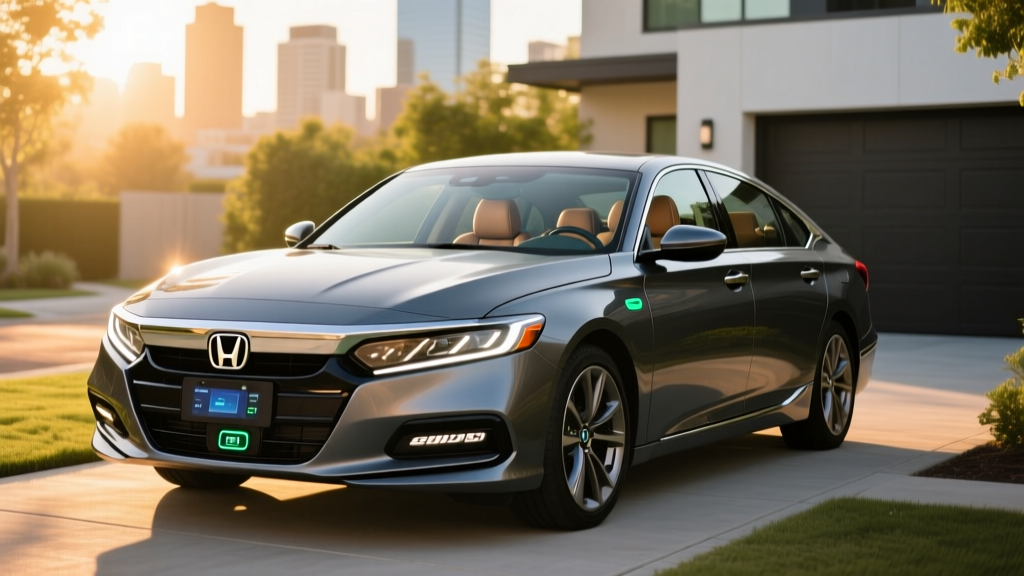
The 2026 Honda Accord Hybrid Touring remains one of the most compelling midsize sedans for buyers who want electric-motor efficiency without ever plugging in. Honda's two-motor hybrid system delivers 48 MPG EPA combined, a well-equipped luxury-grade cabin, and a sub-$40,000 price tag — making it a serious alternative to both full battery-electric vehicles and conventional gas sedans. This is a conventional hybrid (HEV), not a plug-in hybrid (PHEV): it generates and recovers all its own electricity, so there is no charging cable, no plug, and no range anxiety.
| Specification | Value |
|---|---|
| Powertrain | 2.0L DOHC 4-cyl + two-motor hybrid system |
| Combined Horsepower | 204 hp |
| Combined Torque | 247 lb-ft (electric motor) |
| Transmission | e-CVT (direct-drive with lock-up clutch) |
| Drivetrain | Front-wheel drive |
| EPA MPG (City / Hwy / Combined) | 51 / 44 / 48 |
| Fuel Tank Capacity | 12.8 gallons |
| Total Driving Range | ~614 miles (EPA est.) |
| Hybrid Battery | Lithium-ion, ~1.1 kWh (self-charging, no plug) |
| 0-60 mph | ~7.3 seconds |
| Cargo Volume | 16.7 cu ft |
| MSRP (Touring Trim) | $39,990 (incl. destination) |
| Hybrid Battery Warranty | 8 years / 100,000 miles (10 yr/150K in CARB states) |
HEV vs PHEV: Where the Accord Hybrid Fits
A common point of confusion for sedan shoppers is the difference between a conventional hybrid and a plug-in hybrid. The 2026 Accord Hybrid Touring is a conventional hybrid (HEV). Here is what that means in practice:
| Feature | HEV (Accord Hybrid) | PHEV (e.g., Prius Prime) | BEV (e.g., Tesla Model 3) |
|---|---|---|---|
| Plug-in Charging | No — self-charging via engine & regen | Yes — Level 1/2 AC charging | Yes — Level 1/2/DC fast charging |
| Electric-Only Range | ~1 mile at low speed | 25-45 miles typical | 250-400+ miles |
| Gasoline Engine | Yes (always available) | Yes (always available) | No |
| EPA Combined MPG / MPGe | 48 MPG | 48-52 MPG (gas) / 114-127 MPGe (electric) | 120-140 MPGe |
| Battery Size | ~1.1 kWh | 13-18 kWh | 55-100 kWh |
| Federal Tax Credit (§30D) | Not eligible | Up to $7,500 (if eligible) | Up to $7,500 (if eligible) |
| Home Charging Needed | No | Recommended for full benefit | Essential |
| Starting Price Range | ~$34K-$40K | ~$33K-$43K | ~$38K-$55K+ |
The Accord Hybrid's small lithium-ion battery (approximately 1.1 kWh) is charged exclusively through regenerative braking and the gasoline engine. You never plug it in. The electric motor assists the engine during acceleration and can propel the car solo at low speeds for very short distances — typically under one mile in EV mode at parking-lot speeds. This is fundamentally different from a PHEV, which carries a much larger battery and can complete daily commutes entirely on grid electricity.
Fuel Economy: EPA Ratings and Real-World MPG
The 2026 Accord Hybrid Touring carries EPA ratings of 51 MPG city / 44 MPG highway / 48 MPG combined, per fueleconomy.gov. These figures apply to the Sport, Sport-L, and Touring trims equipped with the 19-inch wheels and two-motor system. The lower trims (LX, EX) with 17-inch wheels rate slightly higher at 51/44/48 as well in the current generation, though Honda has historically offered a slight bump on lighter trims.
| Trim | City MPG | Highway MPG | Combined MPG |
|---|---|---|---|
| LX / EX | 51 | 44 | 48 |
| Sport / Sport-L | 51 | 44 | 48 |
| Touring | 51 | 44 | 48 |
Real-World MPG: What Owners Actually See
Honda's two-motor hybrid system is one of the best in the industry at exceeding its EPA city rating in real-world driving. The system operates primarily as a series hybrid at city speeds — the engine acts as a generator while the electric motor drives the wheels — which is inherently efficient in stop-and-go traffic. Many Accord Hybrid owners report 52-56 MPG in city and suburban driving when using normal or ECON drive modes.
Highway driving tells a different story. At sustained 75-80 mph speeds, the engine engages its direct-drive clutch and operates without electric assist. Expect 40-43 MPG on the highway, which is below the EPA highway estimate. Cold weather (below 40°F) can reduce combined economy by 5-8 MPG due to increased engine runtime for cabin heat and reduced battery efficiency. In mixed real-world use across seasons, a realistic year-round average is 44-48 MPG combined.
Powertrain and Performance
The Accord Hybrid uses Honda's fourth-generation two-motor hybrid system paired with a 2.0-liter Atkinson-cycle inline-4 engine. The combined system output is 204 horsepower, with the electric motor producing 247 lb-ft of torque — available nearly instantly from a stop. This gives the Accord Hybrid a responsive, torque-rich feel in city driving that belies its efficiency focus.
The e-CVT transmission is not a traditional belt-and-pulley CVT. It uses a direct-drive layout where the engine connects to the wheels through a single fixed gear ratio at highway speeds via a lock-up clutch. This eliminates the "rubber band" drone common in older CVTs. Acceleration from 0-60 mph takes approximately 7.3 seconds, which is adequate for confident highway merging but not sporty by modern standards.
Drive modes include ECON, Normal, Sport, and Individual. Sport mode increases regenerative braking aggressiveness and sharpens throttle response. The steering paddle selectors offer four levels of regen deceleration, approaching (but not fully achieving) one-pedal driving in its strongest setting.
Pricing, Tax Credits, and Ownership Cost
The 2026 Honda Accord Hybrid Touring carries an MSRP of approximately $39,990 including destination charges. The full Accord Hybrid lineup starts at roughly $34,000 for the LX Hybrid, with the Sport Hybrid around $35,500 and the Sport-L Hybrid near $37,000.
Federal Tax Credit Eligibility
Because the Accord Hybrid is a conventional HEV (not a PHEV or BEV), it does not qualify for the federal §30D clean vehicle tax credit of up to $7,500. That credit, governed by IRS rules, applies only to plug-in electric vehicles meeting battery-sourcing, critical-mineral, MSRP cap, and buyer income requirements.
However, some states offer their own incentives for hybrid vehicles. Check your state's energy or DMV website for potential rebates. Additionally, the Accord Hybrid's lower fuel cost versus a gas-only midsize sedan effectively recoups a portion of the hybrid premium over time. At $3.40/gallon and 15,000 miles/year, the Accord Hybrid (48 MPG) saves approximately $530/year versus a comparable gas sedan averaging 30 MPG.
Pros
- 48 MPG combined EPA; often exceeds city rating in real-world use
- No plug-in charging required — works for apartment dwellers and street parkers
- Spacious cabin with premium Touring features (leather, Bose audio, wireless CarPlay/Android Auto)
- Strong reliability reputation; hybrid battery covered 8-10 years
- Over 600 miles of total range per tank
- Excellent Honda Sensing ADAS suite standard on all trims
Cons
- No federal tax credit eligibility (HEV, not PHEV/BEV)
- Highway MPG falls short of EPA estimate at sustained 75+ mph
- 0-60 time of ~7.3 seconds is adequate, not quick
- Touring trim pushes $40K — close to some PHEV and EV territory
- No all-wheel-drive option (FWD only)
- EV mode limited to ~1 mile at very low speeds
Battery Warranty, Reliability, and Replacement Cost
Honda provides an 8-year / 100,000-mile warranty on the hybrid battery pack nationwide. In states that follow California Air Resources Board (CARB) emissions standards — including California, New York, Massachusetts, Oregon, Washington, and several others — that coverage extends to 10 years / 150,000 miles.
Accord Hybrid Battery Warranty at a Glance
- National: 8 years / 100,000 miles
- CARB states: 10 years / 150,000 miles
- Coverage: Defects and capacity loss below functional threshold
- Replacement cost (out of warranty): Estimated $2,500-$4,000 for the hybrid battery pack, plus labor
Honda's hybrid system has proven highly reliable across multiple generations. The Accord Hybrid's battery is small (~1.1 kWh) and operates within a narrow state-of-charge window — typically between 20% and 80% — which minimizes degradation stress. The battery management system (BMS) prevents deep discharge and overcharge cycles, the two leading causes of lithium-ion wear.
Real-world data from owners of prior-generation Accord Hybrids (2018-2025) suggests that hybrid battery failures before 150,000 miles are uncommon. When replacement is eventually needed, the cost is significantly lower than a full EV battery replacement ($8,000-$20,000) because the pack is much smaller. Independent hybrid specialists often offer refurbished replacement packs for $1,500-$2,500, providing an even more affordable out-of-warranty option.
Accord Hybrid vs PHEV vs EV: Which Should You Buy?
Choosing between the Accord Hybrid, a plug-in hybrid sedan, and a full battery-electric vehicle depends on your driving patterns, charging access, and budget. Here is a practical decision framework:
Choose the Accord Hybrid (HEV) If:
- You cannot charge at home (apartment, street parking, no garage outlet)
- You drive more than 400 miles between fill-ups regularly
- You want maximum simplicity — no plug, no app, no charging planning
- Your daily commute involves heavy stop-and-go city traffic (where hybrids shine)
- You want a proven, low-risk powertrain with a long track record
Choose a PHEV (e.g., Toyota Prius Prime, Hyundai Sonata PHEV) If:
- You can install a Level 2 home charger and want to run most commutes on electricity
- Your daily round-trip commute is under 40 miles
- You want federal tax credit eligibility (up to $7,500, subject to IRS §30D rules)
- You still want a gas engine for longer road trips
Choose a Full EV (e.g., Tesla Model 3, Hyundai Ioniq 6) If:
- You have reliable home Level 2 charging
- Your daily driving is under 250 miles and you can plan road-trip charging
- You want the lowest per-mile fuel cost and minimal maintenance
- You want federal tax credit eligibility and the smoothest, quietest drivetrain
For many midsize sedan buyers, the Accord Hybrid Touring occupies a practical sweet spot: it delivers EV-like city efficiency with the infrastructure-free convenience of a gas car. If you have home charging and a short commute, a PHEV will save more on fuel. If you drive primarily in the city and lack charging access, the Accord Hybrid is hard to beat.
Touring Trim: What You Get for $39,990
The Touring is the top-of-the-line Accord Hybrid trim, and it is comprehensively equipped. Standard features include:
- Perforated leather-trimmed seats with heated and ventilated front seats, heated rear seats
- 12-speaker Bose premium audio system
- 12.3-inch touchscreen with wireless Apple CarPlay and Android Auto
- 10.2-inch digital instrument cluster
- Wireless phone charger
- Head-up display (HUD)
- Low-speed braking control and front/rear parking sensors
- Honda Sensing suite: adaptive cruise control with low-speed follow, lane-keeping assist, road departure mitigation, traffic sign recognition, blind-spot monitoring with rear cross-traffic alert
- 19-inch alloy wheels
- LED headlights with auto high-beam
- Rain-sensing windshield wipers
The Honda Sensing ADAS suite is a SAE Level 2 driver-assistance system. This means it can manage steering, acceleration, and braking under certain conditions, but the driver must remain fully engaged with hands on the wheel and eyes on the road at all times. It is not a self-driving system. For more on SAE automation levels, see NHTSA's guidance on automated vehicles.
Frequently Asked Questions
How many MPG does the 2026 Accord Hybrid Touring get?
The EPA rates it at 51 MPG city, 44 MPG highway, and 48 MPG combined. In real-world city driving, many owners see 52-56 MPG. Highway driving at 75+ mph typically yields 40-43 MPG. A realistic year-round combined average is 44-48 MPG.
How far can the Accord Hybrid go on electric only?
Approximately 1 mile at very low speeds (under 25 mph) in EV mode. This is a conventional hybrid, not a plug-in — its small battery is designed for assist and regenerative efficiency, not sustained electric-only driving. If you need meaningful electric-only range, consider a PHEV with 25-45 miles of EV capability.
Does the Accord Hybrid qualify for any tax credit?
No. The federal §30D clean vehicle tax credit applies only to plug-in electric vehicles (PHEVs and BEVs) that meet battery sourcing, MSRP, and income requirements. The Accord Hybrid, as a conventional HEV, does not qualify. Some states may offer separate hybrid incentives — check your state energy office.
Is the Accord Hybrid reliable, and what does battery replacement cost?
Honda's hybrid system has a strong reliability record spanning multiple generations. The hybrid battery is warranted for 8 years/100,000 miles (10 years/150,000 miles in CARB states). Out-of-warranty replacement costs are estimated at $2,500-$4,000 for a new pack, or $1,500-$2,500 for a refurbished unit from an independent specialist. The small battery size keeps replacement costs far below those of a full EV battery.
Does the Accord Hybrid need to be plugged in?
No. The Accord Hybrid is a conventional (self-charging) hybrid. Its battery is charged through regenerative braking and the gasoline engine. There is no plug, no charging cable, and no need for any electrical infrastructure.
How does the Accord Hybrid compare to the Toyota Camry Hybrid?
The 2026 Camry Hybrid (now exclusively hybrid) offers comparable EPA ratings around 51/44/48 MPG combined on LE trims, with available all-wheel drive — something the Accord Hybrid does not offer. The Accord Hybrid Touring counters with a more premium interior, larger trunk (16.7 cu ft vs ~15.1 cu ft), and Honda's well-regarded driving dynamics. Both are excellent choices; the Camry Hybrid wins on AWD availability, while the Accord Hybrid Touring wins on cabin refinement and tech features at the top trim.
What is the total driving range of the Accord Hybrid?
With a 12.8-gallon fuel tank and 48 MPG combined, the EPA-estimated total range is approximately 614 miles. In real-world mixed driving at 44-48 MPG, expect 560-615 miles between fill-ups — enough to cover most road trips with just one fuel stop.