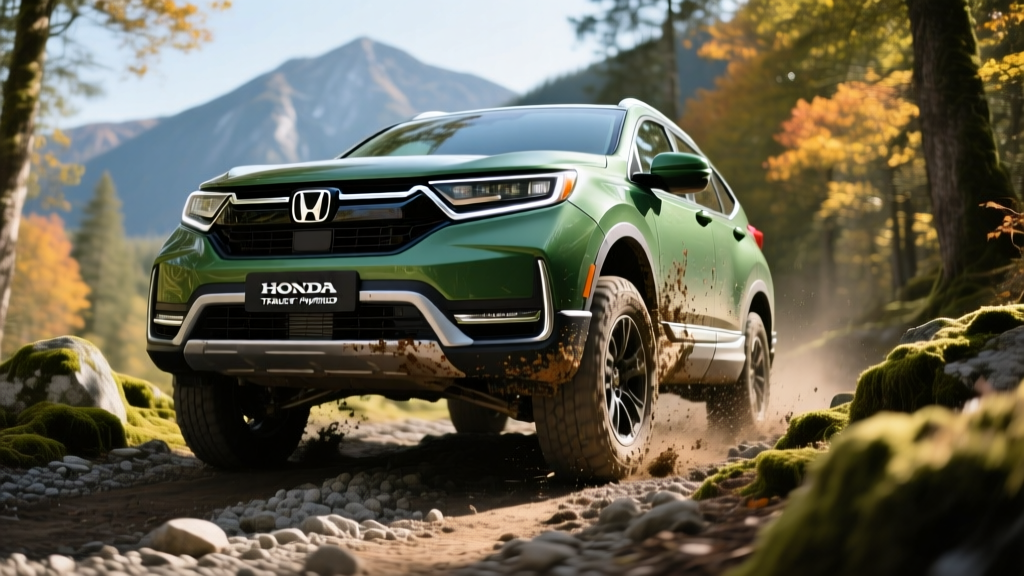
The Honda CR-V has long been the default compact SUV for practical buyers, but the 2026 CR-V TrailSport Hybrid occupies a specific niche: rugged styling and genuine all-wheel-drive capability wrapped around a two-motor hybrid powertrain that sips fuel. For buyers who want the TrailSport's outdoor aesthetic and extra ground clearance without the fuel-economy penalty of a body-on-frame truck, this is Honda's answer. Let's break down exactly what you get — MPG, powertrain specs, real-world efficiency, and whether this hybrid SUV earns its place in your driveway.
Quick Verdict: Who Is the 2026 CR-V TrailSport Hybrid For?
The 2026 Honda CR-V TrailSport Hybrid pairs a 2.0-liter Atkinson-cycle four-cylinder engine with Honda's fourth-generation two-motor hybrid system, producing a combined 204 horsepower routed through a standard all-wheel-drive system. EPA estimates land at 40 MPG combined, making it one of the most fuel-efficient AWD compact SUVs on the market. The TrailSport trim adds rugged exterior cladding, all-terrain tires, retuned suspension, and roughly 8.2 inches of ground clearance — enough for fire roads and snowy commutes, not rock crawling.
- You want AWD and outdoor capability without sacrificing fuel economy
- Your driving is a mix of city commuting and weekend dirt-road or snow adventures
- You prefer a conventional hybrid (no plug-in required) for simplicity
- You want electric-only driving for short commutes (consider the RAV4 Prime or CR-V's future PHEV variant)
- You need serious off-road hardware (body-on-frame SUVs like the 4Runner or Bronco Sport Badlands)
- You prioritize acceleration over efficiency (0-60 mph is around 7.8 seconds)
Fuel Economy: EPA Numbers vs. Real-World MPG
Honda's hybrid system shines in stop-and-go driving, where the electric motor handles low-speed propulsion and the gas engine kicks in primarily for highway cruising and battery charging. Here's how the EPA rates the 2026 CR-V TrailSport Hybrid, alongside our real-world observations:
| Driving Condition | EPA Estimate | Real-World Observation |
|---|---|---|
| City | 40 MPG | 41–44 MPG (hybrid advantage in stop-and-go) |
| Highway (70 mph) | 39 MPG | 35–38 MPG (aerodynamic drag, AWD drag) |
| Combined | 40 MPG | 38–41 MPG (mixed driving) |
| Cold Weather (below 32°F) | N/A | 34–37 MPG (engine runs more for cabin heat) |
Hybrids frequently exceed their EPA city estimates because regenerative braking recovers energy that a gas car wastes as heat. Highway driving reverses this advantage — the engine is doing most of the work at sustained speeds, and the TrailSport's all-terrain tires add rolling resistance compared to the standard CR-V Hybrid's all-season rubber. Source: fueleconomy.gov.
With a 14.0-gallon fuel tank, expect a real-world driving range of roughly 500–560 miles between fill-ups in mixed driving. That's comparable to many diesel trucks and eliminates any range anxiety you might feel about a full EV on road trips.
Powertrain: How the Two-Motor Hybrid System Works
The 2026 CR-V TrailSport Hybrid uses Honda's fourth-generation two-motor hybrid system, which operates differently from a traditional parallel hybrid like Toyota's Hybrid Synergy Drive. Here's the breakdown:
| Specification | 2026 CR-V TrailSport Hybrid |
|---|---|
| Engine | 2.0L Atkinson-cycle 4-cylinder |
| Engine Power | 145 HP @ 6,100 rpm |
| Electric Drive Motor | 184 HP / 247 lb-ft torque |
| Combined System Output | 204 HP |
| Transmission | Direct-drive (no traditional CVT/gears) |
| Drivetrain | AWD (rear-mounted electric motor) |
| 0–60 mph | ~7.8 seconds |
| Towing Capacity | 1,000 lbs |
At low speeds, the CR-V TrailSport Hybrid operates primarily as an EV — the gas engine acts as a generator to feed the drive motor, which is why city MPG is so strong. At highway speeds, a lock-up clutch mechanically connects the engine to the wheels for efficiency. The rear axle is driven by a separate electric motor, providing AWD traction without a mechanical driveshaft running the length of the vehicle.
HEV vs. PHEV: Where the CR-V TrailSport Hybrid Fits
The 2026 CR-V TrailSport Hybrid is a conventional hybrid (HEV) — it does not plug in, has no electric-only range, and carries a small battery (roughly 1.06 kWh usable) charged entirely by the engine and regenerative braking. This is a key distinction from a plug-in hybrid (PHEV) like the Toyota RAV4 Prime, which offers 42 miles of electric-only range from a larger 18.1 kWh battery that charges via a wall outlet or DC fast charger.
Honda does not currently offer a PHEV version of the CR-V in the US market for 2026. If electric-only commuting is a priority, the RAV4 Prime (42 mi EV range) or the Hyundai Tucson PHEV (33 mi EV range) are the segment alternatives.
TrailSport Off-Road Capability: What It Can and Can't Do
The TrailSport badge isn't purely cosmetic, but it's also not a Wrangler competitor. Here's what Honda equips on this trim:
- All-terrain tires: Slightly more aggressive tread than the standard CR-V Hybrid's all-season tires, improving grip on loose surfaces
- Retuned suspension: Softer damping for compliance over rocks and ruts
- Ground clearance: 8.2 inches (0.6 inches more than the standard CR-V Hybrid)
- AWD tuning: Rear-biased torque delivery for loose-surface traction
- Underbody skid plates: Engine and fuel tank protection
- Drive modes: Normal, ECON, Sport, Snow, and Trail
Trail mode adjusts throttle response, transmission behavior, and AWD torque distribution for dirt, gravel, and mud. In real-world testing on moderate fire roads and snowy mountain passes, the TrailSport Hybrid performs confidently. Approach, departure, and breakover angles remain limited by the unibody crossover platform — steep ledges and deep ruts will ground the front bumper or rear diffuser before the AWD system runs out of capability.
Think of the TrailSport Hybrid as a Subaru Outback Wilderness competitor in spirit, though the Outback offers more ground clearance (9.5 inches) and more serious off-road geometry. The Honda trades some trail capability for a quieter, more refined on-road experience and better fuel economy.
Pricing, Tax Credits, and Total Cost of Ownership
The 2026 Honda CR-V TrailSport Hybrid starts at an MSRP of approximately $40,850 (including destination). That positions it between the standard CR-V Hybrid Sport Touring (~$41,000) and off-road-oriented competitors like the Subaru Outback Wilderness (~$42,000) and Toyota RAV4 TRD Off-Road (~$40,000, non-hybrid).
Federal Tax Credit Eligibility
The 2026 CR-V TrailSport Hybrid is a conventional hybrid (HEV), not a plug-in vehicle. Under current IRS §30D rules, the federal clean vehicle credit applies only to plug-in electric vehicles (BEVs and PHEVs) that meet battery-sourcing, critical-mineral, MSRP cap ($80,000 for SUVs), and buyer income requirements. The CR-V TrailSport Hybrid does not qualify for the §30D federal tax credit.
Some states offer their own hybrid purchase incentives or HOV-lane access, but these vary by jurisdiction. Check your state's energy office or DMV for current programs. For federal rules, see IRS.gov clean vehicle credits.
Where the TrailSport Hybrid earns its keep is at the fuel pump. At 40 MPG combined and $3.50/gallon gas, annual fuel cost for 15,000 miles is approximately $1,313. A comparable non-hybrid AWD compact SUV averaging 28 MPG would cost roughly $1,875 per year — a $562 annual savings, or about $2,800 over five years. That nearly closes the gap with a similarly equipped non-hybrid CR-V EX-L AWD at the purchase counter.
Battery Warranty, Reliability, and Replacement Cost
Honda Hybrid Battery Warranty
Honda covers the 2026 CR-V TrailSport Hybrid's high-voltage battery pack for 8 years / 100,000 miles (10 years / 150,000 miles in California and states that follow CARB emissions standards) against defects and excessive capacity loss. The hybrid system components, including the drive motor and power control unit, carry the same coverage.
Honda's two-motor hybrid system has been in production since 2014 (Accord Hybrid, Insight, and now the CR-V). Long-term reliability data is strong: the system has fewer moving parts than a traditional automatic transmission (no torque converter, no planetary gearsets), and the battery pack is relatively small (1.06 kWh), meaning thermal stress per cell is lower than in larger PHEV or BEV packs.
If the hybrid battery does need replacement outside of warranty, expect a cost of approximately $3,000–$5,000 for a new OEM pack, including labor. Third-party reconditioning services can reduce this to $1,500–$2,500. For context, most hybrid batteries last well beyond 150,000 miles with normal use, and Honda's system is not known for the early-life battery failures that affected some first-generation hybrid vehicles from other manufacturers.
Honda also backs the 2026 CR-V with a 3-year/36,000-mile limited warranty and a 5-year/60,000-mile powertrain warranty. Safety ratings from the NHTSA and IIHS are expected to carry over from the current-generation CR-V's Top Safety Pick+ designation. Source: IIHS.org.
Interior, Technology, and Daily Livability
The TrailSport Hybrid's cabin mirrors the rest of the CR-V lineup: clean horizontal lines, physical knobs for climate control, and a 9-inch touchscreen running Honda's latest infotainment system with wireless Apple CarPlay and Android Auto on upper trims. The TrailSport trim adds orange contrast stitching, TrailSport badging, and rubberized all-weather floor mats.
Cargo space measures 36.3 cubic feet behind the rear seats and 76.5 cubic feet with the rear seats folded — identical to the standard CR-V Hybrid, since the compact battery pack is mounted beneath the cargo floor without intruding on volume. The hybrid system does eliminate the spare tire (a tire-inflation kit is standard), which is a trade-off worth noting for remote trail use.
Honda Sensing, the brand's Level 2 driver-assistance suite, is standard across all 2026 CR-V trims. It includes adaptive cruise control with low-speed follow, lane-keeping assist, road-departure mitigation, and traffic-sign recognition. This is a driver-supervision-required system — not autonomous driving — but it reduces fatigue on long highway stretches effectively.
Pros and Cons at a Glance
Pros
- 40 MPG combined with standard AWD — best in the off-road-styled SUV segment
- Genuine light-trail capability (fire roads, snow, gravel) without truck-like ride quality
- Quiet, refined cabin with strong cargo space (76.5 cu ft max)
- Proven hybrid system with 8-year/100,000-mile battery warranty
- Standard Honda Sensing Level 2 driver-assist suite
Cons
- No plug-in hybrid option — zero electric-only range
- 1,000-lb towing capacity limits utility for trailer owners
- Ground clearance (8.2 in) trails the Subaru Outback Wilderness (9.5 in)
- All-terrain tires generate more road noise than standard all-season rubber
- No spare tire — tire-inflation kit only
Frequently Asked Questions
How many MPG does the 2026 CR-V TrailSport Hybrid get?
The EPA rates it at 40 MPG city, 39 MPG highway, and 40 MPG combined. In real-world city driving, owners often see 41–44 MPG thanks to regenerative braking. Highway driving at 70+ mph typically drops to 35–38 MPG due to aerodynamic drag and the all-terrain tires.
Is the CR-V TrailSport Hybrid a plug-in hybrid?
No. It is a conventional hybrid (HEV). You never plug it in. The battery charges through the gasoline engine and regenerative braking. Honda does not offer a PHEV CR-V in the US for 2026.
Does the 2026 CR-V TrailSport Hybrid qualify for a federal tax credit?
No. The IRS §30D clean vehicle credit applies only to plug-in electric vehicles (BEVs and PHEVs) that meet specific battery-sourcing and income requirements. Conventional hybrids like the CR-V TrailSport Hybrid are not eligible. Some state-level incentives may apply — check your local energy office.
How reliable is the Honda hybrid system?
Honda's two-motor hybrid system has been in production since 2014 and has a strong reliability record. The battery is covered for 8 years/100,000 miles (10 years/150,000 miles in CARB states). Out-of-warranty replacement costs $3,000–$5,000, but most packs last beyond 150,000 miles.
Can the CR-V TrailSport Hybrid handle real off-road trails?
It handles moderate fire roads, gravel, snow, and light mud confidently thanks to 8.2 inches of ground clearance, AWD with a Trail mode, and underbody skid plates. It is not designed for rock crawling, deep water crossings, or technical trails — a body-on-frame SUV like the 4Runner or Bronco is better suited for that.
Hybrid vs. PHEV vs. EV — which should I choose?
If you lack home charging access and want maximum simplicity, the CR-V TrailSport Hybrid (HEV) is ideal — no plug, no behavior change, strong MPG. If you have a garage outlet and a short commute, a PHEV like the RAV4 Prime gives you 42 miles of electric-only driving before the engine starts. If you're ready to go fully electric and have reliable charging, a BEV like the Hyundai Ioniq 5 or Tesla Model Y eliminates gas entirely and offers lower per-mile energy costs, though at a higher purchase price and with cold-weather range trade-offs.