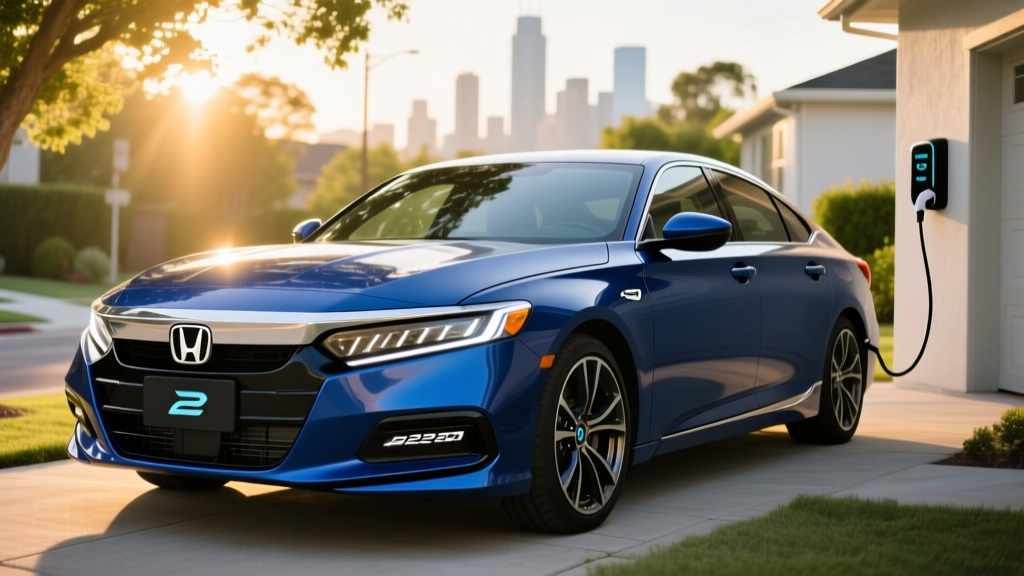
The midsize sedan segment has thinned out, but the Honda Accord remains a benchmark—and the hybrid variant is now the volume seller for good reason. For 2026, the Accord Hybrid continues with Honda's proven two-motor e-CVT powertrain, delivering strong city efficiency without ever needing to plug in. If you're researching the 2026 Accord Hybrid, this guide covers every spec that matters: EPA MPG breakdowns, real-world fuel economy, powertrain output, battery longevity, warranty coverage, and whether a conventional hybrid (HEV), plug-in hybrid (PHEV), or full battery-electric vehicle (BEV) is the right move for your driveway.
2026 Accord Hybrid Powertrain and Performance Specs
The 2026 Accord Hybrid uses Honda's fourth-generation two-motor hybrid system, pairing a 2.0-liter Atkinson-cycle four-cylinder engine with two electric motors integrated into an electronically controlled continuously variable transmission (e-CVT). One motor primarily generates electricity from the engine; the other drives the front wheels. The system seamlessly switches between EV drive (battery-only at low speeds), hybrid drive (engine generates electricity for the drive motor), and engine direct-drive (at steady highway cruising where the gas engine is most efficient).
| Spec | Value |
|---|---|
| Powertrain | 2.0L Atkinson I-4 + 2-motor e-CVT |
| Combined System Output | 204 hp / 247 lb-ft torque |
| Drive Type | Front-wheel drive |
| 0–60 mph | ~7.3 seconds |
| Battery Type | Lithium-ion (approx. 1.1 kWh usable) |
| Plug-In Required? | No — self-charging HEV |
| EPA MPG (City / Hwy / Combined) | 51 / 44 / 48 mpg |
| Fuel Tank Capacity | 12.8 gallons |
| Total Driving Range | ~614 miles |
| Base MSRP (Sport Hybrid) | ~$34,990 |
| Hybrid Battery Warranty | 8 years / 100,000 miles (10 yr/150k in CARB states) |
The 204-horsepower combined output puts the Accord Hybrid in a comfortable middle ground—brisk enough for confident highway merging and passing, but tuned for efficiency rather than sportiness. The electric motor's instant torque (247 lb-ft available from low RPM) gives it a responsive feel around town that belies its four-cylinder underpinnings.
Fuel Economy: EPA Ratings vs. Real-World MPG
According to EPA data on fueleconomy.gov, the 2026 Accord Hybrid is rated at 51 mpg city, 44 mpg highway, and 48 mpg combined. These figures apply to the Sport, EX-L, and Sport-L Hybrid trims, which share the same powertrain and wheel/tire package.
| Condition | EPA Rating | Real-World Expectation |
|---|---|---|
| City | 51 mpg | 48–55 mpg (hybrids often beat EPA in stop-and-go) |
| Highway | 44 mpg | 40–46 mpg (varies with speed, terrain, wind) |
| Combined | 48 mpg | 44–50 mpg |
HEV vs. PHEV vs. EV: Which Powertrain Fits Your Life?
A common question from Accord Hybrid shoppers is whether they should consider a plug-in hybrid (PHEV) like the Toyota Prius Prime or a full battery-electric vehicle instead. Here's a direct comparison framework.
| Factor | HEV (Accord Hybrid) | PHEV (e.g., Prius Prime) | BEV (e.g., Tesla Model 3) |
|---|---|---|---|
| Plug-In Required? | No | Yes (for EV range) | Yes (always) |
| Electric-Only Range | ~1 mile at low speed | 35–44 miles | 250–360+ miles |
| Combined MPG / MPGe | 48 mpg | 48–52 mpg (hybrid mode) / 114–127 MPGe (EV) | 120–132 MPGe |
| Home Charging Needed? | No | Recommended (Level 2) | Essential (Level 2) |
| Federal Tax Credit (§30D) | Not eligible | Up to $7,500 (varies) | Up to $7,500 (varies) |
| Upfront Price Range | $35,000–$40,000 | $33,000–$42,000 | $38,000–$55,000+ |
| Maintenance Cost | Low (oil changes, no plug) | Low–Moderate | Lowest (no engine) |
| Best For | No home charging access; long road trips | Short commutes + home charging + road trip flexibility | Home charging + mostly under 250 mi/day |
2026 Accord Hybrid Trims, Pricing, and Tax Credit Eligibility
Honda offers the 2026 Accord Hybrid across multiple trims. Pricing below reflects approximate MSRP (destination included). Always verify current pricing with your dealer, as mid-year adjustments occur.
| Trim | Approx. MSRP | Key Features |
|---|---|---|
| Sport Hybrid | $34,990 | 19" wheels, sport styling, wireless CarPlay/Android Auto, Honda Sensing suite |
| EX-L Hybrid | $36,990 | Leather seats, heated front seats, power moonroof, wireless charging pad |
| Sport-L Hybrid | $37,490 | Sport styling + leather interior, heated front seats |
| Sport Touring Hybrid | $39,990 | All Sport-L features + Bose 12-speaker audio, navigation, heated rear seats, wireless charging |
Battery Longevity, Warranty, and Replacement Cost
Hybrid battery reliability is consistently one of the top concerns for first-time hybrid buyers. The 2026 Accord Hybrid uses a compact lithium-ion battery pack (approximately 1.1 kWh usable capacity) that operates within a narrow state-of-charge window managed by Honda's battery management system. This shallow cycling strategy significantly reduces degradation compared to the deeper cycles seen in PHEVs and BEVs.
Real-world longevity data: Honda's hybrid systems have accumulated well over a decade of field data across the Accord, Civic, and CR-V lineups. Third-generation Accord Hybrid batteries (2018–2022 models) have demonstrated strong longevity, with the majority of units lasting well beyond 150,000 miles without significant capacity loss. The lithium-ion pack in the current generation is expected to match or exceed this track record.
Replacement cost: If the hybrid battery does require replacement outside of warranty, expect a cost in the range of $2,000 to $4,000 (parts and labor) through a Honda dealer. Independent hybrid specialists may offer refurbished or reconditioned packs for $1,500–$2,500. For context, this is significantly less than a BEV traction battery replacement ($8,000–$20,000+) because the Accord Hybrid's pack is much smaller.
Driving Impressions: Efficiency Meets Everyday Comfort
The Accord Hybrid's two-motor system operates differently from a traditional automatic or even a Toyota-style power-split hybrid. At low speeds and light loads, it drives like an EV—the electric motor propels the car while the engine stays off or spins as a generator. Under harder acceleration, both the engine and motor contribute. At steady highway speeds (roughly 65–75 mph), a lockup clutch connects the engine directly to the wheels for maximum mechanical efficiency.
The result is a driving experience that feels smooth and electric around town, with none of the rubber-band sensation associated with older CVTs. The transition between EV, hybrid, and engine-direct modes is nearly imperceptible from the driver's seat. Road noise is well-managed, and the Accord's chassis tuning prioritizes ride comfort over sportiness—a sensible choice for a midsize family sedan that will spend most of its life commuting.
The Honda Sensing suite comes standard across all trims and includes adaptive cruise control, lane-keeping assist, collision mitigation braking, and traffic sign recognition. This is an SAE Level 2 driver-assist system—it supports the driver but does not replace active supervision.
Ownership Costs: Fuel Savings vs. Gas-Only Sedans
At 48 mpg combined and a national average regular gasoline price of approximately $3.20/gallon (as of early 2026), the Accord Hybrid costs roughly $0.067 per mile in fuel. A comparable gas-only midsize sedan averaging 30 mpg combined would cost about $0.107 per mile—a difference of roughly $600 per year at 15,000 miles driven annually.
Over a typical 5-year/75,000-mile ownership period, that translates to approximately $3,000 in fuel savings versus a 30 mpg gas sedan. The Accord Hybrid's modest price premium over non-hybrid competitors is typically recouped within 3–4 years through fuel savings alone, before accounting for potentially higher resale values that hybrids have demonstrated in recent market cycles.
Insurance costs for the Accord Hybrid are generally in line with or slightly above gas-powered Accord trims. Maintenance costs are comparable to a conventional Accord, with standard oil changes (the engine still runs frequently) and no additional hybrid-specific service items beyond periodic inverter coolant checks.
Frequently Asked Questions
How many MPG does the 2026 Accord Hybrid get?
The EPA rates the 2026 Accord Hybrid at 51 mpg city, 44 mpg highway, and 48 mpg combined. Real-world results typically range from 44 to 52 mpg depending on driving conditions, with city and suburban driving often yielding numbers at or above the EPA estimate thanks to frequent regenerative braking.
Does the Accord Hybrid need to be plugged in?
No. The 2026 Accord Hybrid is a conventional hybrid (HEV). Its small lithium-ion battery recharges automatically through regenerative braking and the gasoline engine. You never plug it in—just fill up at any gas station.
How far can the Accord Hybrid drive on electric power alone?
Only about 1 mile at very low speeds (under 25 mph) in ideal conditions. This is not a plug-in hybrid—it's designed for electric assist, not electric-only driving. If you want meaningful EV-only range (35+ miles), look at PHEVs like the Toyota Prius Prime or a full BEV.
Is the 2026 Accord Hybrid reliable?
Honda's two-motor hybrid system has a strong reliability track record spanning multiple generations. The hybrid battery is warrantied for 8 years/100,000 miles (10 years/150,000 miles in CARB states). The system has fewer wear components than a traditional automatic transmission (no torque converter, no conventional gear shifts), and real-world data from prior-generation Accord Hybrids shows strong longevity well past 150,000 miles.
What does a replacement hybrid battery cost?
Out-of-warranty hybrid battery replacement runs approximately $2,000–$4,000 at a Honda dealer, or $1,500–$2,500 through independent hybrid specialists using refurbished packs. Given the battery's small size and shallow cycling, most owners never face this expense.
Does the 2026 Accord Hybrid qualify for a federal tax credit?
No. The federal §30D Clean Vehicle Credit (up to $7,500) applies only to plug-in electric vehicles—battery-electric vehicles (BEVs) and plug-in hybrids (PHEVs) that meet specific battery sourcing, MSRP cap, and buyer income requirements. The Accord Hybrid is a conventional HEV and is not eligible. Check your state's energy office for any local hybrid incentives.
Accord Hybrid vs. Toyota Camry Hybrid—which is better?
Both are excellent choices with similar EPA ratings (the Camry Hybrid is rated around 52 mpg combined for its LE FWD trim). The Accord Hybrid offers a slightly more premium interior feel and a larger trunk, while the Camry Hybrid undercuts on base price. Test-drive both to compare ride quality, tech interfaces, and seat comfort—these subjective factors often decide the matchup more than the spec sheet.