Quick Verdict: The 2025 Volvo S60 Recharge T8
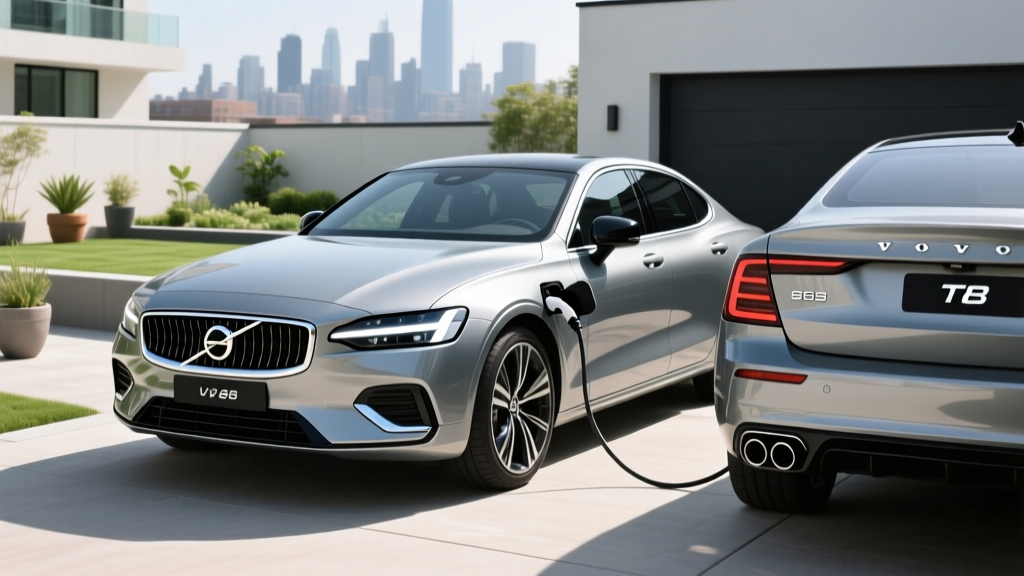
The 2025 Volvo S60 plug-in hybrid (badged as the S60 Recharge T8 eAWD) occupies a specific niche: a luxury sport sedan that can handle most daily commutes on electric power alone while retaining a turbocharged gas engine for longer trips. With an EPA-estimated 41 miles of electric-only range and a combined 455 horsepower, it threads the needle between a conventional hybrid and a full battery-electric vehicle. For buyers who want to drive electric most days without committing to charging infrastructure dependence, the S60 Recharge delivers — but at a premium starting price that demands scrutiny.
This guide covers the exact specs, real-world efficiency data, charging logistics, and total ownership costs you need before signing a lease or purchase agreement.
HEV vs PHEV vs EV: Where the S60 Recharge Fits
Volvo offers the S60 exclusively as a plug-in hybrid (PHEV) in the U.S. market for 2025 — there is no conventional hybrid (HEV) variant and no fully electric S60 (that role falls to the upcoming EX60). Understanding the distinction matters:
| Feature | Conventional Hybrid (HEV) | Plug-In Hybrid (PHEV) | Battery Electric (BEV) |
|---|---|---|---|
| Plugs in to charge? | No — charges via regen and engine | Yes — has a charge port | Yes — charge port required |
| Electric-only range | 0–2 miles at low speed | 20–50+ miles typical | 200–400+ miles |
| Gas engine | Yes (always available) | Yes (always available) | No |
| Battery size | 1–2 kWh | 10–25 kWh | 60–120+ kWh |
| Tax credit eligible? | No | Some qualify (up to $7,500) | Some qualify (up to $7,500) |
The 2025 S60 Recharge is a PHEV. It has a charge port, a meaningfully large battery, and enough electric range to cover most commutes without burning a drop of gasoline. When the battery depletes, the turbocharged four-cylinder engine takes over seamlessly.
Electric-Only Range and Total Driving Range
| Specification | 2025 Volvo S60 Recharge T8 eAWD |
|---|---|
| EPA electric-only range | 41 miles |
| Real-world electric range (mixed driving) | 33–38 miles |
| Real-world electric range (highway/cold) | 25–30 miles |
| EPA MPGe (electric mode) | 74 MPGe combined |
| Total combined range (electric + gas) | ~490 miles |
| Gas tank capacity | 15.9 gallons |
| EPA combined MPG (gas only, battery depleted) | 30 MPG combined |
| EPA city MPG (gas only) | 28 MPG |
| EPA highway MPG (gas only) | 33 MPG |
| Usable battery capacity | 14.9 kWh (18.8 kWh gross) |
| Battery chemistry | NMC (Nickel Manganese Cobalt) |
The 41-mile electric range is competitive within the luxury PHEV sedan segment. It covers the average American one-way commute of 16 miles (fueleconomy.gov) with room to spare, meaning many owners can complete round-trip commutes entirely on electricity.
Powertrain: 455 Horsepower with Electric Torque Fill
The S60 Recharge T8 powertrain pairs a 2.0-liter turbocharged and supercharged four-cylinder engine with an electric motor integrated into the rear axle, creating an all-wheel-drive system Volvo calls eAWD.
| Powertrain Component | Specification |
|---|---|
| Gas engine | 2.0L turbocharged + supercharged I-4 |
| Engine output | 312 hp / 295 lb-ft torque |
| Rear electric motor | 143 hp / 228 lb-ft torque |
| Combined system output | 455 hp / 523 lb-ft torque |
| 0–60 mph | 4.3 seconds |
| Transmission | 8-speed automatic |
| Drivetrain | eAWD (engine drives front, motor drives rear) |
| Drive modes | Pure (EV), Hybrid, Power, Off-Road, AWD |
The "Pure" drive mode forces electric-only operation (up to roughly 80 mph), while "Hybrid" mode lets the car intelligently blend both power sources. "Power" mode deploys everything simultaneously for maximum acceleration. The electric motor on the rear axle provides instant torque fill at low RPMs, eliminating the lag typical of turbocharged engines.
Charging: Level 1, Level 2, and What You Need at Home
The 2025 S60 Recharge uses a standard J1772 charge port (the same connector used by most non-Tesla PHEVs and EVs). It does not support DC fast charging — a common limitation among plug-in hybrids due to their smaller battery packs and onboard charger constraints.
| Charging Level | Power (kW) | Time to Full (0–100%) | Where You'll Use It |
|---|---|---|---|
| Level 1 (120V household outlet) | ~1.4 kW | ~10–12 hours | Overnight at home, emergency top-ups |
| Level 2 (240V, home wallbox or public) | ~3.7 kW (onboard charger limit) | ~4–5 hours | Primary home charging, workplace, shopping centers |
| DC Fast Charging | Not supported | N/A | N/A |
The S60 Recharge's onboard charger is limited to approximately 3.7 kW. Even if you plug into a 7.2 kW or 11.5 kW Level 2 station, the car will only draw 3.7 kW. This means a full charge from empty takes about 4–5 hours on Level 2. For most owners, this is perfectly adequate: plug in when you get home, and the battery is full by morning. The 14.9 kWh usable battery is small enough that even a standard 120V outlet can replenish it overnight.
Home charging setup: If you have a 240V outlet (like a dryer outlet) in your garage, a simple Level 2 cord costs $200–$400. A dedicated hardwired Level 2 station with professional installation typically runs $500–$1,500 total depending on your electrical panel's capacity and distance from the panel to the garage. Consult a licensed electrician for your specific situation.
How Many MPG Does the 2025 Volvo S60 Plug-In Hybrid Get?
| Driving Mode | City | Highway | Combined |
|---|---|---|---|
| Electric mode (MPGe) | 78 MPGe | 71 MPGe | 74 MPGe |
| Gas only (battery depleted) | 28 MPG | 33 MPG | 30 MPG |
Real-world MPG vs. EPA: Plug-in hybrids are uniquely sensitive to how you use them. If you charge daily and your commute falls within the 41-mile electric range, you may burn almost no gasoline for weeks — effectively achieving infinite MPG for daily driving. On a long road trip where the battery depletes within the first 41 miles, you'll see the gas-only rating of 30 MPG combined. Real-world highway cruising at 75 mph with a depleted battery typically yields 29–32 MPG based on owner reports.
One advantage of the PHEV architecture: unlike a conventional hybrid, you're not forced to rely solely on regenerative braking and engine optimization for efficiency. You can genuinely drive electric for short trips and gas for long ones.
Pricing, Trims, and Federal Tax Credit Eligibility
| Trim Level | Starting MSRP (2025) |
|---|---|
| Core | ~$52,450 |
| Plus | ~$55,950 |
| Ultimate | ~$60,950 |
Destination charges add approximately $1,195. The S60 Recharge is also available in the sportier R-Design and ultra-luxurious Polestar Engineered trims at higher price points (R-Design ~$58,000; Polestar Engineered ~$67,000).
Does the 2025 Volvo S60 Recharge Qualify for a Federal Tax Credit?
Under current IRS §30D rules (irs.gov), the Volvo S60 Recharge T8 is not currently eligible for the full $7,500 federal clean vehicle tax credit. The §30D credit has strict requirements around battery component manufacturing origin and critical mineral sourcing, and as of 2025, the S60 Recharge's battery supply chain does not meet all thresholds.
- Vehicle MSRP cap: $55,000 for sedans (S60 Core may qualify on price; Plus and Ultimate exceed the cap)
- Buyer income cap: $150,000 single / $225,000 head of household / $300,000 joint
- Battery components must be manufactured/assembled in North America (phased percentages by year)
- Critical minerals must be sourced from the U.S. or free-trade-agreement countries
- Vehicle must be assembled in North America
- Point-of-sale transfer available for eligible vehicles (reduces purchase price at the dealer)
Even if a specific trim meets the MSRP cap, the battery sourcing and component manufacturing rules are the binding constraint. Always verify current eligibility on the fueleconomy.gov tax credit tracker before purchasing, as manufacturer sourcing can change mid-year. Consult a tax professional for your specific situation.
State incentives: Several states offer additional rebates or HOV lane access for PHEVs. California's Clean Vehicle Rebate Project (CVRP), for example, has offered rebates for qualifying PHEVs, though amounts and eligibility change frequently. Check your state's energy or DMV website for current programs.
Battery Warranty, Reliability, and Replacement Cost
Is the S60 Recharge reliable? Volvo's PHEV powertrain has been in production since 2015 (the T8 architecture debuted in the XC90), and the system is now in its second generation with the extended-range battery. Long-term reliability data is generally positive for the electric motor and battery pack, though some owners have reported issues with the onboard charger and software glitches in earlier model years. The 2025 model benefits from years of iterative refinement.
Battery replacement cost: If the high-voltage battery requires replacement outside of warranty, expect a cost in the range of $8,000–$12,000 including parts and labor. However, PHEV batteries are smaller and less stressed than full EV batteries, and degradation tends to be modest. Because the battery is only 18.8 kWh gross, even a 20% capacity loss over a decade would reduce electric range from 41 to roughly 33 miles — still useful for most commutes.
The 12V auxiliary battery (which powers electronics, not the drivetrain) is a separate maintenance item and typically needs replacement every 4–6 years at a cost of $200–$400.
Who Should Buy the 2025 Volvo S60 Plug-In Hybrid?
- Your daily round-trip commute is under 40 miles and you can charge at home
- You want a luxury sport sedan with serious acceleration (4.3 seconds to 60 mph)
- You take regular road trips and don't want to plan around charging stations
- You want AWD capability for snow or rain without the efficiency penalty of a traditional AWD gas car
- You value Volvo's safety reputation and Scandinavian interior design
- Your commute is longer than 40 miles round-trip (you'll burn gas daily)
- You want zero tailpipe emissions and minimal maintenance (no oil changes, no engine)
- You want DC fast charging for road trips (150–250 kW capability)
- You're eligible for the full $7,500 tax credit on a qualifying BEV
- You cannot charge at home or at work
- Your budget is under $35,000
- You want maximum simplicity with no plug-in routine
- 41 miles electric range covers most commutes
- 455 hp / 4.3-second 0–60 is genuinely quick
- Premium Scandinavian interior with Google built-in
- Standard AWD via rear electric motor
- Can run on gasoline when needed — no range anxiety
- Strong safety ratings (IIHS Top Safety Pick+)
- No DC fast charging capability
- Likely ineligible for $7,500 federal tax credit
- Starting MSRP above $52,000 — luxury pricing
- Only 30 MPG combined on gas — not class-leading efficiency
- Rear seat and trunk space slightly compromised by battery placement
- Onboard charger limited to 3.7 kW (slow Level 2)
Ownership Costs: Fuel, Insurance, and Maintenance
The financial case for the S60 Recharge hinges on how much you drive on electricity versus gasoline. At a national average electricity rate of $0.16/kWh and gasoline at $3.40/gallon:
| Cost Factor | S60 Recharge T8 (PHEV) | Gas-Only Sedan Baseline (30 MPG) |
|---|---|---|
| Annual fuel/electricity (12,000 mi/yr) | $900–$1,400 (depends on EV vs gas ratio) | $1,360 |
| 5-year fuel cost | $4,500–$7,000 | $6,800 |
| Estimated annual insurance | $2,200–$2,800 | $1,600–$2,000 |
| Maintenance (5 years) | $2,500–$3,500 | $3,000–$4,000 |
| Oil changes needed? | Yes (but less frequent if driving mostly on EV) | Yes (every 5,000–10,000 mi) |
Insurance premiums for the S60 Recharge tend to run 15–25% higher than a comparable gas sedan due to the higher MSRP and specialized repair costs for the high-voltage system. Get quotes from your insurer before committing.
Frequently Asked Questions
How far can the 2025 Volvo S60 plug-in hybrid go on electric only?
The EPA rates the S60 Recharge T8 at 41 miles of electric-only range. In real-world mixed driving, expect 33–38 miles. Highway driving or cold weather can reduce this to 25–30 miles.
Does the 2025 Volvo S60 Recharge qualify for the $7,500 federal tax credit?
As of 2025, the S60 Recharge is likely not eligible for the full §30D federal clean vehicle tax credit due to battery sourcing requirements. Some trims may also exceed the $55,000 MSRP cap for sedans. Always verify on fueleconomy.gov before purchasing and consult a tax professional.
Can I charge the S60 Recharge at a DC fast charger?
No. The S60 Recharge only supports AC charging (Level 1 at 120V or Level 2 at 240V). The onboard charger is limited to approximately 3.7 kW, so a full charge takes about 4–5 hours on Level 2.
How long will the PHEV battery last?
Volvo warranties the high-voltage battery for 8 years or 100,000 miles with a 70% capacity retention guarantee. PHEV batteries are smaller and typically experience moderate degradation. Many owners report minimal range loss over 5–7 years of use.
What happens when the battery runs out while driving?
The transition is seamless. When the battery depletes, the turbocharged gas engine automatically takes over, and the car operates as a conventional hybrid with 30 MPG combined. You'll never be stranded — the 15.9-gallon gas tank provides roughly 450 additional miles.
Is the S60 Recharge better than a full EV like the Polestar 2?
It depends on your usage. If you can charge at home and your commute is under 40 miles, the S60 Recharge lets you drive electric daily with a gas backup for road trips. If you want maximum efficiency, lower running costs, and DC fast charging, the Polestar 2 (or Tesla Model 3) may be a better fit. The S60 Recharge is the pragmatic choice for drivers who aren't ready to go fully electric.
How much does it cost to charge the S60 Recharge at home?
A full charge of the 14.9 kWh usable battery costs roughly $2.40 at the national average rate of $0.16/kWh. That works out to approximately $0.06 per electric mile — about one-third the cost of gasoline per mile.
Sources: fueleconomy.gov (EPA range and efficiency data), irs.gov (§30D tax credit rules), Volvo Cars USA official specifications.