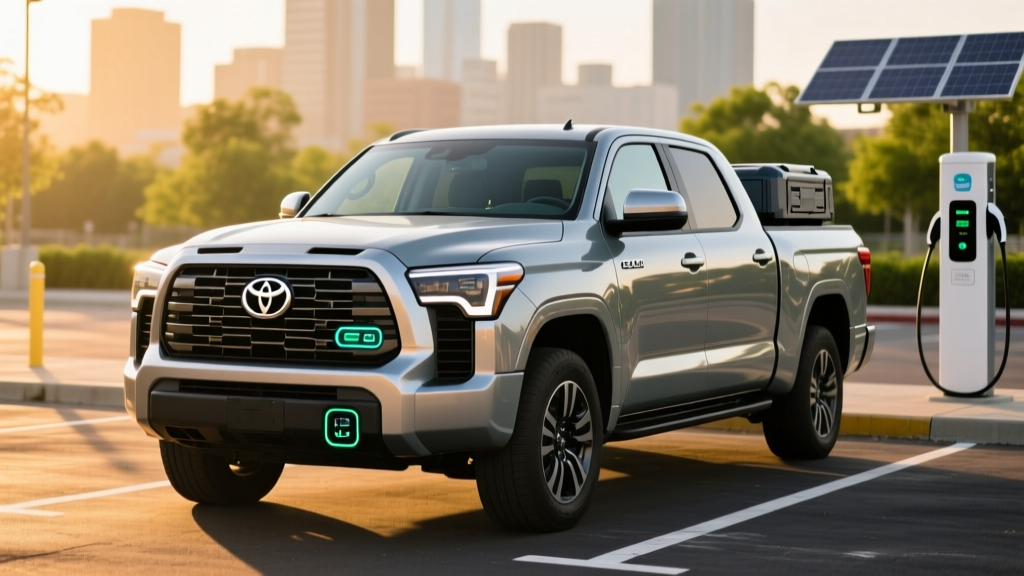
The 2025 Toyota Tundra Hybrid—officially badged as the i-FORCE MAX—promises full-size truck capability with a meaningful efficiency bump over its gas-only sibling. But with no plug-in option, a modest MPG gain, and a $3,000–$5,000 hybrid premium depending on trim, buyers need hard numbers to decide whether the hybrid powertrain earns its place in the driveway. This guide breaks down the 2025 Tundra Hybrid's real-world fuel economy, powertrain specs, towing capacity, pricing, warranty coverage, and where it fits against full-electric trucks and conventional gas models.
HEV vs PHEV: What the Tundra Hybrid Actually Is
Let's clear this up immediately: the 2025 Tundra i-FORCE MAX is a conventional hybrid electric vehicle (HEV), not a plug-in hybrid (PHEV). It cannot be plugged into a wall outlet or charging station, and it has no electric-only driving range.
| Feature | Tundra i-FORCE MAX (HEV) | Plug-In Hybrid (PHEV) Example | Battery EV (BEV) |
|---|---|---|---|
| Plugs in to charge? | No | Yes | Yes |
| Electric-only range | None | 20–50 mi typical | 250–400+ mi |
| Gas engine | Yes (twin-turbo V6) | Yes | No |
| Battery size | 1.87 kWh (NiMH) | 13–20 kWh typical | 75–150+ kWh |
| Regenerative braking | Yes | Yes | Yes |
| Federal EV tax credit | No | Up to $7,500 (if eligible) | Up to $7,500 (if eligible) |
The Tundra's small 1.87 kWh nickel-metal hydride (NiMH) battery pack charges exclusively through regenerative braking and the gasoline engine. Toyota designed it as a power-assist hybrid: the electric motor fills in torque at low RPM and during acceleration, reducing the engine's workload and cutting fuel consumption—especially in stop-and-go city driving.
EPA Fuel Economy: City, Highway, and Combined MPG
The 2025 Tundra i-FORCE MAX is available exclusively in 4WD configuration. According to EPA data on fueleconomy.gov, the official ratings are:
| Driving Cycle | EPA MPG |
|---|---|
| City | 20 MPG |
| Highway | 24 MPG |
| Combined | 22 MPG |
For comparison, the gas-only 2025 Tundra 4WD with the standard i-FORCE twin-turbo V6 (non-hybrid) rates at 17 city / 22 highway / 19 combined MPG. The hybrid delivers a 3 MPG combined improvement—roughly a 16% efficiency gain.
Real-World MPG: What Owners Actually See
Hybrids typically outperform their EPA city estimates in real-world stop-and-go traffic because regenerative braking recovers energy that a gas truck simply wastes as brake heat. Tundra Hybrid owners on Fuelly and other tracking platforms commonly report:
- City/suburban driving: 21–24 MPG (often matching or slightly exceeding the EPA city rating)
- Highway cruising (70–80 mph): 19–22 MPG (aerodynamic drag and the truck's 5,500+ lb curb weight work against it)
- Towing a 5,000–7,000 lb trailer: 12–15 MPG (the hybrid assist helps less under sustained heavy load)
- Combined mixed driving: 20–23 MPG
The hybrid's advantage is most pronounced in urban and suburban conditions. If your daily driving is mostly highway miles at speed, the MPG gap between the hybrid and gas Tundra narrows considerably.
Powertrain Specs: i-FORCE MAX Twin-Turbo V6 Hybrid
The i-FORCE MAX pairs a twin-turbocharged 3.4-liter V6 with an electric motor integrated between the engine and the 10-speed automatic transmission. Here are the exact figures:
| Specification | 2025 Tundra i-FORCE MAX |
|---|---|
| Engine | 3.4L twin-turbo V6 |
| Electric motor | 48 hp / 184 lb-ft (integrated in bell housing) |
| Combined system output | 437 hp @ 5,200 rpm |
| Combined torque | 583 lb-ft @ 2,400 rpm |
| Transmission | 10-speed automatic |
| Drivetrain | 4WD (standard on hybrid) |
| Battery | 1.87 kWh NiMH (under rear seat) |
| 0–60 mph | ~5.7 seconds (est.) |
| Max towing capacity | Up to 11,175 lbs (trim/config dependent) |
| Max payload | Up to 1,760 lbs |
The 583 lb-ft of torque arrives at just 2,400 rpm—a significant advantage for towing and low-speed hauling. The electric motor's instant torque fill eliminates the lag you'd feel from the twin-turbos alone at part throttle. This is the powertrain's strongest practical argument beyond fuel savings: it makes the Tundra feel more responsive and confident when pulling away from stops with a load.
Pricing, Trims, and Tax Credit Eligibility
The 2025 Tundra i-FORCE MAX is available across multiple trims, from Limited up to the range-topping Capstone. Here are approximate starting MSRPs (4WD CrewMax, which is the only cab configuration for the hybrid):
- Limited: ~$59,000
- Platinum: ~$64,000
- TRD Pro: ~$68,000
- 1794 Edition: ~$65,000
- Capstone: ~$73,000
The hybrid powertrain commands a premium over equivalent gas-only trims—typically $3,000 to $5,000 depending on the trim level and whether the hybrid is a standard or optional upgrade within that tier.
Does the Tundra Hybrid Qualify for a Federal Tax Credit?
No. Under current IRS §30D rules, the federal Clean Vehicle Credit applies only to plug-in electric vehicles (PHEVs and BEVs) that meet battery capacity, critical-mineral sourcing, MSRP caps, and buyer income requirements. Conventional hybrids like the Tundra i-FORCE MAX—vehicles that cannot be plugged in—do not qualify for the §30D credit or any federal EV incentive.
Some states may offer modest incentives for hybrid purchases, but these vary widely and change frequently. Check your state's energy office or department of environmental quality for current programs. There is no federal tax benefit for choosing the Tundra Hybrid over the gas model.
Battery Warranty, Reliability, and Replacement Cost
Hybrid battery longevity is the top concern for truck buyers considering the i-FORCE MAX. Toyota addresses this with robust warranty coverage:
| Coverage | Term |
|---|---|
| Hybrid battery warranty | 10 years / 150,000 miles (whichever comes first) |
| Hybrid system components | 8 years / 100,000 miles |
| Powertrain warranty | 5 years / 60,000 miles |
| Basic bumper-to-bumper | 3 years / 36,000 miles |
The 10-year/150,000-mile hybrid battery warranty is among the best in the full-size truck segment and reflects Toyota's confidence in NiMH technology, which has proven durable over two decades of Prius and Camry Hybrid service.
What Does a Tundra Hybrid Battery Replacement Cost?
If the hybrid battery fails outside of warranty, expect a replacement cost in the range of $2,500 to $4,500 including parts and labor at a Toyota dealer. Independent hybrid specialists may offer refurbished or reconditioned packs for $1,500–$2,500. The NiMH chemistry in the Tundra is less expensive to replace than the large lithium-ion packs in PHEVs and BEVs, which can run $8,000–$20,000+.
In practice, Toyota's NiMH hybrid batteries have demonstrated strong longevity. Many Prius and Highlander Hybrid owners have exceeded 150,000 miles on the original pack. The Tundra's battery is relatively small and operates within a conservative state-of-charge window (roughly 40–80%), which minimizes degradation stress.
Who Should Choose the Tundra Hybrid vs Gas, PHEV, or Full EV?
Choose the Tundra i-FORCE MAX (HEV) if:
- You need full-size truck towing and payload (up to 11,175 lbs) and want the best fuel economy available in a body-on-frame truck
- Your driving mix includes significant city and suburban miles where regenerative braking pays dividends
- You cannot install a home charger or lack access to public charging infrastructure (no plug needed)
- You want proven Toyota hybrid reliability with a 10-year battery warranty
- You value the low-RPM torque fill for towing and daily driving responsiveness
Stick with the gas-only Tundra if:
- Your driving is predominantly highway at sustained speeds (the MPG advantage shrinks to ~1–2 MPG)
- You're budget-constrained and the $3,000–$5,000 hybrid premium would take years to recoup at current fuel prices
- You plan to keep the truck under 5 years and won't capture the fuel savings
Consider a PHEV or full EV truck instead if:
- You have home charging and want electric-only commuting (the Ford F-150 Lightning or Rivian R1T offer zero tailpipe emissions with 230–400+ miles of range)
- You want federal tax credit eligibility (up to $7,500 for qualifying EVs under §30D)
- You want to eliminate gasoline entirely for daily driving and have a second vehicle for long road trips
Pros and Cons at a Glance
Pros
- 22 MPG combined is best-in-class for a body-on-frame full-size 4WD truck
- 583 lb-ft torque at 2,400 rpm makes towing effortless off the line
- 10-year/150,000-mile hybrid battery warranty provides long-term peace of mind
- No charging infrastructure required—fills up at any gas station
- 437 hp system output delivers strong acceleration (~5.7 sec 0–60)
- Proven Toyota hybrid system architecture with decades of reliability data
Cons
- No federal tax credit eligibility (HEV, not PHEV/BEV)
- Hybrid premium of $3,000–$5,000 takes years to recoup via fuel savings alone
- Highway MPG advantage over gas Tundra is modest (~2 MPG)
- Available only in CrewMax 4WD—no regular cab or 2WD option
- Towing fuel economy drops to 12–15 MPG under heavy load
- Not eligible for HOV/carpool lane access in most states (unlike PHEVs/BEVs)
Frequently Asked Questions
How many MPG does the 2025 Tundra Hybrid get?
The EPA rates the 2025 Tundra i-FORCE MAX 4WD at 20 city / 24 highway / 22 combined MPG. In real-world driving, owners typically see 20–23 MPG combined, with city driving sometimes reaching 23–24 MPG thanks to regenerative braking.
Does the Tundra Hybrid need to be plugged in?
No. The Tundra i-FORCE MAX is a conventional hybrid (HEV). Its small battery charges through regenerative braking and the gasoline engine. You never plug it in—it refuels at any gas station like a standard truck.
How far can the Tundra Hybrid drive on electric power alone?
The Tundra Hybrid has no meaningful electric-only range. The electric motor assists the gas engine during acceleration and low-speed maneuvers, but it cannot propel the truck on electricity alone for any practical distance. If you want electric-only driving, you need a PHEV or BEV.
Is the Tundra Hybrid reliable?
Toyota's hybrid systems have an extensive track record of reliability, with millions of Prius, Camry Hybrid, and Highlander Hybrid vehicles on the road. The i-FORCE MAX uses a proven NiMH battery and a motor-generator design that adds minimal complexity. The 10-year/150,000-mile hybrid battery warranty provides substantial protection.
What does it cost to replace the Tundra Hybrid battery?
Out-of-warranty replacement runs approximately $2,500–$4,500 at a Toyota dealer, or $1,500–$2,500 through independent hybrid specialists using refurbished packs. This is significantly less expensive than lithium-ion battery replacements in PHEVs and EVs.
Does the Tundra Hybrid qualify for any tax credit?
No federal tax credit is available. The IRS §30D Clean Vehicle Credit applies only to plug-in vehicles (PHEVs and BEVs). Conventional hybrids like the Tundra i-FORCE MAX are not eligible. Check your state's energy office for any local hybrid incentives, though these are uncommon.
How does the Tundra Hybrid compare to the Ford F-150 PowerBoost?
The Ford F-150 PowerBoost is the Tundra Hybrid's direct competitor—also a conventional HEV full-size truck. The PowerBoost rates at 23–25 MPG combined (slightly higher than the Tundra) and offers up to 12,700 lbs of towing. However, it uses a 3.5L twin-turbo V6 with a 1.5 kWh lithium-ion battery producing 430 hp and 570 lb-ft. Both trucks are strong choices; the Ford edges slightly on efficiency while the Toyota leads in hybrid system longevity reputation and battery warranty length.