If you want electric commuting without full-EV range anxiety, the 2025 Toyota RAV4 Plug-In Hybrid XSE occupies a compelling middle ground. With 42 miles of EPA-rated electric-only range, a combined 302 horsepower, and standard all-wheel drive, it's one of the most capable PHEVs in the compact SUV segment. But does the XSE trim's premium over the SE justify the cost, and how does real-world efficiency stack up against the EPA sticker? We break down every number that matters.
2025 RAV4 Plug-In Hybrid XSE: Key Specifications
| Spec | Value |
|---|---|
| Powertrain | 2.5L 4-cyl + front/rear electric motors (AWD-i) |
| Combined Horsepower | 302 hp |
| 0–60 mph | 5.7 seconds |
| Battery (Gross / Usable) | 18.1 kWh / ~14.9 kWh usable |
| Battery Chemistry | Lithium-ion (NMC) |
| EPA Electric-Only Range | 42 miles |
| Total Combined Range | ~440 miles (EV + gas) |
| MPGe (Electric + Gas) | 94 MPGe combined |
| MPG (Gas Only, Combined) | 38 MPG combined |
| Level 2 Charge Time (0–100%) | ~2.5 hours at 6.6 kW |
| DC Fast Charging | Not supported |
| Base MSRP (XSE trim) | $48,775 |
| Federal §30D Tax Credit | Not eligible (sourcing rules) |
| Hybrid Battery Warranty | 10 years / 150,000 miles |
HEV vs PHEV: What's the Difference on the RAV4 Lineup?
Toyota sells the RAV4 in three powertrain flavors for 2025: the conventional gas model, the RAV4 Hybrid (HEV), and the RAV4 Plug-In Hybrid (PHEV, formerly called RAV4 Prime). Understanding the difference is essential before spending thousands more on the plug-in variant.
| Attribute | RAV4 Hybrid (HEV) | RAV4 Plug-In Hybrid XSE (PHEV) |
|---|---|---|
| Plug-in Charging | No — self-charging via regen & engine | Yes — plug in to charge the 18.1 kWh battery |
| Electric-Only Range | ~1 mile at very low speed | 42 miles (EPA) |
| Combined Horsepower | 219 hp | 302 hp |
| EPA Combined MPG/MPGe | 39 MPG | 94 MPGe / 38 MPG (gas only) |
| Battery Size | 1.6 kWh | 18.1 kWh |
| Starting MSRP | ~$33,425 | $48,775 (XSE) |
| 0–60 mph | 7.4 sec | 5.7 sec |
The HEV is ideal if you can't charge at home and want effortless efficiency. The PHEV rewards those with home or workplace Level 2 charging who want to commute mostly on electricity while retaining a gas engine for road trips. The 83-hp advantage and significantly quicker acceleration are bonuses you'll feel every time you merge onto a highway.
Electric-Only Range: 42 EPA Miles in the Real World
The EPA rates the 2025 RAV4 Plug-In Hybrid XSE at 42 miles of electric-only range. That figure holds for both the SE and XSE trims, since they share the same powertrain and battery. In real-world driving, expect some variation:
- Ideal conditions (city, 45–65°F, flat terrain): 40–44 miles. The PHEV's regenerative braking shines in stop-and-go traffic, and mild temperatures keep the battery efficient.
- Highway driving (70+ mph): 30–35 miles. Aerodynamic drag and sustained motor load deplete the battery faster.
- Cold weather (below 32°F): 28–33 miles. Battery chemistry slows in the cold, and cabin heating draws additional energy. Toyota's heat pump helps, but expect 20–25% range loss in deep winter.
For a daily commute under 35 miles round-trip, the RAV4 PHEV can operate as a de facto EV on most days, with the gas engine rarely engaging — provided you plug in nightly. Total combined range (EV + full gas tank) reaches approximately 440 miles, eliminating any road-trip anxiety.
Fuel Economy: MPGe, MPG, and Real-World Numbers
| Mode | City | Highway | Combined |
|---|---|---|---|
| Electric + Gas (MPGe) | — | — | 94 MPGe |
| Gas Only (MPG) | 40 MPG | 36 MPG | 38 MPG |
Once the battery depletes, the RAV4 PHEV operates as a conventional hybrid, and the EPA rates it at 38 MPG combined (40 city / 36 highway). That's slightly below the standard RAV4 Hybrid's 39 MPG combined, owing to the PHEV's extra ~350 lbs of battery mass.
Real-world observation: Hybrid and PHEV vehicles often exceed their EPA city ratings in actual stop-and-go driving because regenerative braking recaptures energy that gas cars waste as heat. Many owners report 41–43 MPG in city-heavy commutes once the battery is depleted. Highway MPG, however, tends to run 1–3 MPG below the sticker due to the boxy SUV profile and AWD drivetrain losses.
When operating in EV mode, the RAV4 PHEV achieves 94 MPGe combined. MPGe (miles per gallon equivalent) translates electricity consumption into a gasoline-equivalent figure; 94 MPGe means the vehicle uses energy at a rate equivalent to burning one gallon of gasoline for every 36 kWh consumed. In practical terms, a full charge costs roughly $2.00–$3.50 depending on your local electricity rate ($0.10–$0.18/kWh), making electric commuting dramatically cheaper than gasoline.
Charging: Level 2 Only, No DC Fast Charging
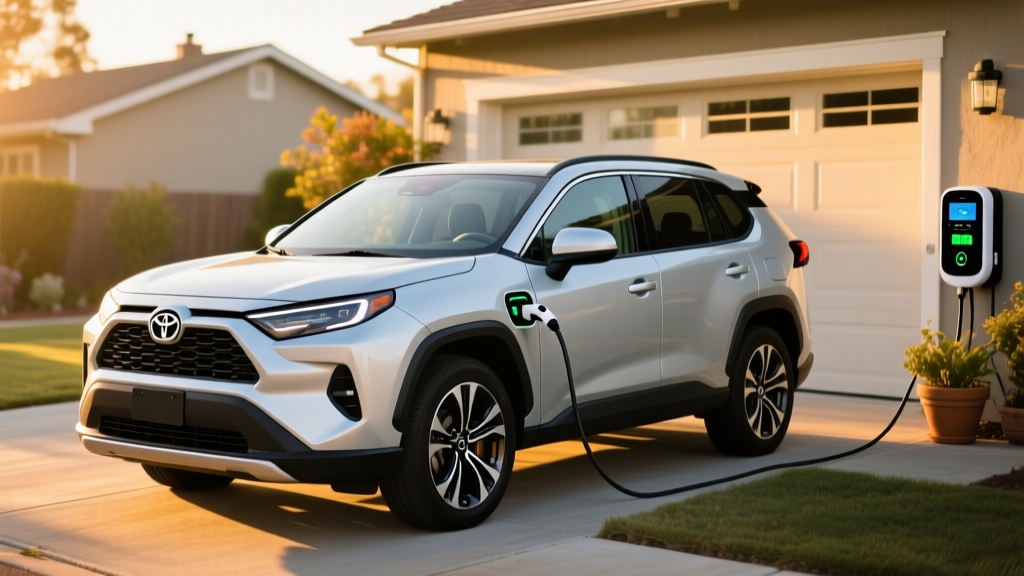
The 2025 RAV4 Plug-In Hybrid uses a J1772 connector for AC charging and accepts up to 6.6 kW on Level 2. There is no DC fast-charging capability — a limitation shared with most PHEVs in this class (the Hyundai Tucson PHEV and Chrysler Pacifica PHEV also lack DCFC).
- Level 1 (120V household outlet, ~1.4 kW): Full charge in approximately 12 hours. Viable for overnight top-ups if your daily EV commute is under 30 miles.
- Level 2 (240V, 6.6 kW onboard charger): Full charge in roughly 2.5 hours. This is the recommended setup for daily PHEV ownership. A home Level 2 charger lets you arrive home, plug in, and have a full battery well before bedtime — or top up during the workday if your employer offers charging.
The lack of DC fast charging means the RAV4 PHEV isn't suited for "charge on the go" road-trip strategies. On longer drives, you'll simply burn gas after the initial 42 EV miles — and that's perfectly fine given the 440-mile total range and 38 MPG hybrid efficiency.
Powertrain Performance: 302 HP and 5.7-Second Sprints
The RAV4 Plug-In Hybrid's powertrain pairs a 2.5-liter Atkinson-cycle 4-cylinder engine (177 hp / 165 lb-ft) with two electric motors — one on the front axle (134 kW) and one on the rear (40 kW) — for a combined system output of 302 horsepower. Toyota's AWD-i system provides electronic all-wheel drive without a mechanical driveshaft, using the rear motor to power the rear wheels when traction is needed.
The result is a 0–60 mph time of 5.7 seconds, making the RAV4 PHEV one of the quickest vehicles in Toyota's non-GR lineup. The XSE trim adds a sport-tuned suspension calibration and paddle-shift regenerative braking control, giving it a slightly more engaging feel than the SE trim, though the difference is subtle. Throttle response in EV mode is immediate and smooth — the electric motors deliver full torque from zero RPM, which makes the PHEV feel quicker in daily driving than the 0–60 number alone suggests.
Pricing, Trims, and Tax Credit Eligibility
The 2025 RAV4 Plug-In Hybrid is available in two trims:
- SE: Starting at ~$44,775 MSRP
- XSE: Starting at ~$48,775 MSRP (adds SofTex seats, panoramic moonroof option, premium audio, 9-inch touchscreen, sport-tuned suspension)
Destination charges add approximately $1,350. Fully optioned XSE models with the Premium Package (panoramic view monitor, front and rear parking assist, heated rear seats) can approach $53,000.
Federal Tax Credit: Does It Qualify?
No. Under current IRS §30D rules, the RAV4 Plug-In Hybrid does not qualify for the $7,500 federal clean vehicle tax credit. The credit requires that a specified percentage of battery critical minerals and components be sourced from the U.S. or free-trade-agreement countries, and the RAV4 PHEV's battery supply chain does not meet these thresholds for 2025.
Additionally, §30D has buyer income caps ($150,000 single / $300,000 joint) and an MSRP cap of $80,000 for SUVs — the RAV4 PHEV clears the MSRP cap but fails the sourcing requirement.
State incentives may apply. Several states (notably California, Colorado, Massachusetts, and New York) offer their own PHEV rebates ranging from $1,000 to $4,000. Check your state's energy or environmental agency for current programs. Some utilities also offer $500–$1,500 rebates for installing a Level 2 home charger.
Battery Warranty, Reliability, and Replacement Cost
Toyota Hybrid Battery Warranty: 10 years or 150,000 miles (whichever comes first), covering defects and capacity loss below a specified threshold. This applies to both the traction battery and hybrid system components.
Toyota's hybrid reliability track record is among the strongest in the industry. The RAV4 Hybrid and Plug-In Hybrid share the proven THS II (Toyota Hybrid System) architecture, now in its fifth generation. The 18.1 kWh lithium-ion battery in the PHEV is larger than the HEV's but operates within a conservative state-of-charge window (the system never fully charges or fully depletes the pack), which reduces degradation stress.
Degradation expectations: Based on data from earlier-generation RAV4 Primes and Toyota's broader PHEV fleet, expect approximately 8–12% capacity loss over 10 years under normal use. This translates to perhaps 35–38 EV miles instead of 42 after a decade — a modest reduction that keeps the vehicle highly functional.
Replacement cost: If the battery does require replacement outside of warranty, current estimates for a RAV4 PHEV battery pack range from $8,000 to $12,000 including parts and labor. This is a significant figure, but given Toyota's 10-year/150,000-mile warranty coverage and conservative battery management, most owners will never face this expense. Independent hybrid shops are also increasingly offering refurbished pack replacements at 40–60% of OEM cost.
The broader vehicle reliability outlook is strong. NHTSA has not flagged significant powertrain complaints for the RAV4 PHEV platform, and Toyota consistently ranks at or near the top of J.D. Power and Consumer Reports reliability surveys.
RAV4 PHEV vs Full EV vs Gas: Which Fits You?
The decision between a PHEV, a full battery-electric vehicle (BEV), and a conventional hybrid or gas car depends on your charging access, driving patterns, and budget:
Choose the RAV4 Plug-In Hybrid XSE if:
- You have home or workplace Level 2 charging
- Your daily commute is under 40 miles round-trip (you'll rarely burn gas)
- You take road trips of 200+ miles and don't want to plan around charging stops
- You want AWD and strong acceleration (302 hp) in a compact SUV
- You're not ready to commit to a full EV due to apartment living, unreliable public charging, or frequent long-distance travel
Choose a full EV (e.g., Tesla Model Y, Hyundai Ioniq 5) if:
- You have reliable home charging and your trips rarely exceed 250 miles
- You want to eliminate oil changes, spark plugs, and exhaust system maintenance entirely
- You want access to the $7,500 federal tax credit (many BEVs qualify; this PHEV does not)
- You prioritize the lowest per-mile energy cost and the quietest driving experience
Choose the RAV4 Hybrid (HEV) if:
- You cannot charge at home or work
- You want maximum simplicity — no plugs, no charging routines
- Your budget is tighter (the HEV starts ~$15,000 less than the PHEV)
- You drive mostly city miles where the HEV's 39 MPG combined excels
Frequently Asked Questions
How many MPG does the 2025 RAV4 Plug-In Hybrid XSE get?
Once the battery is depleted, the EPA rates it at 38 MPG combined (40 city / 36 highway). While operating on electric power, it achieves 94 MPGe combined. In real-world city driving, many owners report 40–43 MPG in hybrid mode thanks to aggressive regenerative braking.
How far can the RAV4 Plug-In Hybrid go on electric only?
The EPA rates it at 42 miles of electric-only range. In real-world conditions, expect 30–35 miles on the highway, 40–44 miles in city driving, and 28–33 miles in freezing temperatures. Total range (EV + gas tank) is approximately 440 miles.
Does the 2025 RAV4 Plug-In Hybrid qualify for a federal tax credit?
No. Under current IRS §30D rules, the RAV4 PHEV does not meet the battery component and critical mineral sourcing requirements for the $7,500 federal credit. State-level rebates of $1,000–$4,000 may still be available depending on your location.
Is the RAV4 Plug-In Hybrid reliable, and what does a battery replacement cost?
Toyota's hybrid systems have an excellent long-term reliability record. The hybrid battery is covered by a 10-year / 150,000-mile warranty. Based on historical data, expect 8–12% battery degradation over a decade. Out-of-warranty replacement costs range from $8,000 to $12,000, though most owners will never need one.
Can the RAV4 Plug-In Hybrid DC fast charge?
No. The RAV4 PHEV only supports AC charging — Level 1 (120V) and Level 2 (240V at up to 6.6 kW). A full Level 2 charge takes approximately 2.5 hours. This is standard for PHEVs in this class; DC fast charging is typically reserved for full battery-electric vehicles.
What's the difference between the SE and XSE trims?
The XSE adds a sport-tuned suspension, SofTex synthetic leather seats, a 9-inch touchscreen with wireless Apple CarPlay/Android Auto, ambient interior lighting, and access to the Premium Package (panoramic moonroof, premium JBL audio, panoramic view monitor). The powertrain, battery, and EV range are identical to the SE.
How does the RAV4 PHEV compare to the Hyundai Tucson PHEV?
The Tucson PHEV offers similar electric range (~33 miles EPA) and a lower starting price, but produces less horsepower (261 hp vs. 302 hp) and is slower to 60 mph. The RAV4 PHEV also has a larger battery (18.1 kWh vs. 13.8 kWh) and a stronger reliability reputation. The Tucson does offer a more modern interior design and Hyundai's longer 10-year/100,000-mile powertrain warranty.