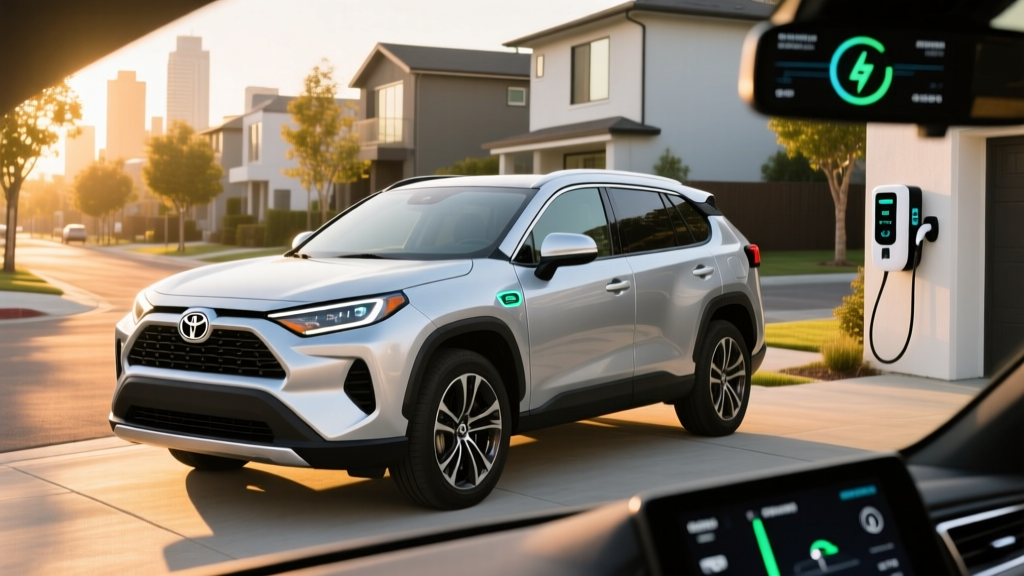
Quick Verdict: The RAV4 Hybrid LE Still Sets the Bar
The 2025 Toyota RAV4 Hybrid LE remains one of the most compelling reasons to choose a conventional hybrid over a gas-only compact SUV. With an EPA-estimated 41 MPG combined, a starting MSRP of $31,900 (including destination), and Toyota's proven hybrid synergy drive system, it delivers genuine fuel savings without requiring a plug, a lifestyle change, or a premium price tag. For buyers who want electrified efficiency without range anxiety or charging logistics, the RAV4 Hybrid LE is the pragmatic benchmark.
But is it the right electrified RAV4 for you? Toyota also offers the RAV4 Prime plug-in hybrid (PHEV) with 42 miles of electric-only range. This guide breaks down the LE trim's real-world fuel economy, powertrain specs, battery longevity, and how it compares to both the PHEV variant and a full battery-electric vehicle.
HEV vs PHEV: What the RAV4 Hybrid LE Actually Is
Before diving into specs, a critical distinction that trips up many shoppers:
Conventional Hybrid (HEV) — RAV4 Hybrid LE
- No plug required. The battery recharges via the gasoline engine and regenerative braking.
- No electric-only driving range beyond very low-speed, short-distance creep (under ~1 mile).
- Smaller battery (~1.6 kWh usable) — lighter, cheaper, less to degrade.
- Fuel savings come from efficiency, not from replacing gas with grid electricity.
Plug-In Hybrid (PHEV) — RAV4 Prime
- Plugs in to a Level 1 or Level 2 charger to fill a larger battery (~18.1 kWh gross).
- 42 miles EPA electric-only range before the gas engine kicks in.
- Can DC fast charge (though slowly — ~50 kW peak, roughly 30 minutes to 80%).
- Fuel savings come from replacing short trips entirely with electricity.
- Eligible for the §30D federal tax credit (subject to income, MSRP, and sourcing rules).
The 2025 RAV4 Hybrid LE is the HEV. You fuel it with gasoline, and the hybrid system makes every gallon go further. You never need to think about charging infrastructure, home electrical upgrades, or public charger reliability. If that sounds like what you want, keep reading.
Fuel Economy: EPA Numbers and Real-World MPG
The EPA rates the 2025 Toyota RAV4 Hybrid LE (and all AWD Hybrid trims) at:
| Driving Cycle | EPA Estimate |
|---|---|
| City | 41 MPG |
| Highway | 38 MPG |
| Combined | 41 MPG |
Source: fueleconomy.gov
Real-World MPG vs. EPA Sticker
EPA Combined: 41 MPG — Expect 38–44 MPG in real-world driving depending on conditions.
Toyota's hybrid system excels in stop-and-go city traffic, where regenerative braking recaptures energy and the engine shuts off at stops. Many owners report exceeding the EPA city estimate in warm-weather urban driving, hitting 43–46 MPG on suburban commutes. Highway-only trips at 75+ MPH tend to drop to 35–37 MPG, since the electric motor assists less at sustained high speeds and aerodynamic drag dominates.
Cold weather (below 30°F) typically reduces hybrid efficiency by 5–10% because the gasoline engine runs more often to provide cabin heat and because battery chemistry is less efficient at low temperatures. Expect 36–38 MPG combined in winter if you live in northern climates.
For comparison, the gas-only 2025 RAV4 LE AWD is rated at 27 MPG combined — a 34% fuel-economy penalty versus the hybrid. Over 15,000 miles per year at $3.50/gallon, that's roughly $650 in annual fuel savings with the hybrid.
Powertrain: Engine, Motors, and 219 Combined Horsepower
| Specification | 2025 RAV4 Hybrid LE |
|---|---|
| Engine | 2.5L 4-cylinder Atkinson cycle |
| Engine Output | 176 hp / 163 lb-ft torque |
| Front Electric Motor | 118 hp / 149 lb-ft |
| Rear Electric Motor (AWD) | 54 hp / 89 lb-ft |
| Net Combined Horsepower | 219 hp |
| Transmission | eCVT (electronically controlled) |
| Drivetrain | Electronic On-Demand AWD (standard) |
| 0–60 MPH | ~7.4 seconds |
| Towing Capacity | 1,750 lbs |
| Hybrid Battery | ~1.6 kWh (NiMH), sealed |
| Fuel Tank | 14.5 gallons |
| Total Driving Range | ~595 miles (at 41 MPG combined) |
The hybrid powertrain pairs a 2.5-liter Atkinson-cycle four-cylinder engine with two electric motors — one driving the front axle, one driving the rear. The rear motor enables electronic all-wheel drive without a mechanical driveshaft, reducing weight and parasitic loss. The eCVT is not a traditional belt-and-pulley CVT; it uses a planetary gearset to seamlessly blend engine and motor power, which is why Toyota hybrids feel smooth rather than rubbery under acceleration.
The 219 combined horsepower is more than adequate for merging and passing. The electric motors deliver instant torque from a standstill, giving the RAV4 Hybrid a punchy feel around town that belies its four-cylinder engine. At highway speeds, the system blends seamlessly — most drivers won't notice when the engine engages or disengages.
Battery Longevity, Warranty, and Replacement Cost
Hybrid Battery Warranty
10 years / 150,000 miles (whichever comes first) — covers the hybrid battery and all hybrid-system components including the inverter, motors, and control electronics.
Source: Toyota Warranty Guide
This is the question that dominates hybrid-buyer forums, and the data is reassuring. Toyota's hybrid battery packs — nickel-metal hydride (NiMH) in the RAV4 Hybrid — have an exceptional longevity track record. The Prius, which shares hybrid architecture DNA, routinely sees original batteries lasting 150,000–200,000+ miles. The RAV4 Hybrid's battery is smaller and less stressed than a PHEV or BEV pack, which works in its favor.
Why NiMH in 2025? Toyota has stuck with NiMH for its conventional hybrids because the chemistry is extremely stable, tolerant of the shallow charge-discharge cycles that HEVs use (the battery typically operates between 40–80% state of charge), and doesn't require the active thermal management that lithium-ion demands. The trade-off is lower energy density, but since the RAV4 Hybrid only carries ~1.6 kWh, weight and volume penalties are negligible.
If the battery does need replacement out of warranty: A new OEM hybrid battery from Toyota currently costs approximately $3,000–$4,000 installed at a dealership. Refurbished/remanufactured units are available from third-party suppliers for $1,500–$2,500 installed. Individual cell-module replacement (a common repair for isolated weak cells) can run $500–$1,200 at a hybrid specialist shop. Given the 10-year/150,000-mile warranty and historical longevity data, most owners will never face this cost.
Pricing, Trims, and Tax Credit Eligibility
The 2025 RAV4 Hybrid LE starts at $31,900 MSRP (including $1,350 destination charge). Key trim pricing:
- Hybrid LE: $31,900
- Hybrid XLE: $33,400
- Hybrid XLE Premium: $35,350
- Hybrid Woodland Edition: $35,850
- Hybrid SE: $36,600
- Hybrid XSE: $37,800
- Hybrid Limited: $40,550
Federal Tax Credit Status: Not Eligible
The RAV4 Hybrid LE is a conventional hybrid (HEV), not a plug-in vehicle. Under IRS §30D rules, only plug-in electric vehicles (BEVs and PHEVs) with a battery capacity of at least 7 kWh qualify for the federal clean vehicle credit.
- The RAV4 Hybrid's ~1.6 kWh battery does not meet the 7 kWh minimum.
- No plug-in capability = no §30D credit.
- The RAV4 Prime (PHEV) does qualify for up to $7,500 in federal credit, subject to buyer income caps ($150K single / $300K joint), MSRP caps ($80K for SUVs), and battery critical-mineral sourcing requirements. Always verify current-year eligibility at IRS.gov or with a tax professional.
Some states offer their own incentives for hybrids — check your state's energy office or department of environmental quality. However, most state-level EV incentives also target plug-in vehicles, so the RAV4 Hybrid LE typically doesn't qualify for those either. The value proposition here is straightforward: you save money at the pump, not at the tax office.
RAV4 Hybrid LE vs. RAV4 Prime vs. Full EV: Which Fits You?
Choose the RAV4 Hybrid LE (HEV) if:
- You don't have access to home or workplace charging (apartment, street parking, no garage).
- You want a lower purchase price ($31,900 vs. $43,690 for the RAV4 Prime SE).
- You drive a mix of city and highway and want consistent fuel savings without behavioral changes.
- You plan to keep the vehicle 8–10+ years and value Toyota's long-term reliability reputation.
- You tow occasionally (1,750 lbs capacity; the Prime is rated similarly but is heavier).
Choose the RAV4 Prime (PHEV) if:
- You can charge at home (even a standard 120V outlet adds ~4 miles/hour, enough for many commutes).
- Your daily driving is under 40 miles and you want to run mostly on electricity.
- You qualify for the $7,500 federal tax credit, which narrows the price gap significantly.
- You want 302 combined horsepower (the Prime's larger battery and motors deliver noticeably more power).
Choose a Full EV (e.g., Tesla Model Y, Hyundai Ioniq 5) if:
- You have reliable home Level 2 charging and your daily driving is under 250 miles.
- You want to eliminate gasoline entirely and minimize maintenance (no oil changes, no engine).
- You qualify for federal and state EV incentives that offset the higher sticker price.
- You're comfortable planning road-trip charging stops and understand DC fast-charging logistics.
Pros, Cons, and the Bottom Line
Pros
- 41 MPG combined EPA — real-world owners often exceed this in city driving
- No plug, no charging infrastructure required
- Standard AWD on every Hybrid trim
- 10-year / 150,000-mile hybrid battery warranty
- Proven reliability; NiMH battery longevity data spanning two decades
- Competitive $31,900 starting price for an AWD compact SUV
- Spontaneous electric-motor torque makes city driving feel responsive
- ~595-mile total range means fewer fill-ups (roughly one tank every 40+ days at 15K mi/yr)
Cons
- No federal tax credit eligibility (HEV, not a plug-in)
- Highway MPG drops to ~35–37 at sustained 75+ MPH speeds
- eCVT drone under hard acceleration (common to all Toyota hybrids)
- 1,750-lb towing capacity is modest for the segment
- LE trim uses a basic 8-inch infotainment screen (upgrade to XLE for larger display)
- No DC fast charging capability (not applicable to HEVs, but worth noting vs. PHEV/EV)
- Dealer markups remain common on RAV4 Hybrids in many markets — negotiate hard
Frequently Asked Questions
How many MPG does the 2025 RAV4 Hybrid LE actually get?
The EPA rates it at 41 city / 38 highway / 41 combined MPG. In real-world driving, most owners report 38–44 MPG combined. City-heavy routes in warm weather can push past 44 MPG thanks to frequent regenerative braking and engine shut-off. Highway-only driving at high speeds drops to the mid-30s.
Does the RAV4 Hybrid LE need to be plugged in?
No. It is a conventional hybrid (HEV). The battery recharges automatically through regenerative braking and the gasoline engine. You simply fill it with gas like any other vehicle.
How far can the RAV4 Hybrid go on electric only?
Essentially zero meaningful electric-only distance. The hybrid system can propel the vehicle at very low speeds (parking lots, creeping in traffic) for a few hundred yards, but the battery is too small (~1.6 kWh) for sustained electric driving. If electric-only range matters to you, look at the RAV4 Prime PHEV (42 miles EV range) or a full BEV.
Is the RAV4 Hybrid battery reliable, and what does replacement cost?
Toyota's hybrid batteries have an outstanding longevity record. The 10-year/150,000-mile warranty covers the battery and hybrid system. Out-of-warranty replacement runs $3,000–$4,000 for a new OEM unit, or $1,500–$2,500 for a refurbished pack. Many original batteries last well beyond 150,000 miles.
Does the 2025 RAV4 Hybrid LE qualify for any tax credit?
It does not qualify for the federal §30D clean vehicle credit, which requires a plug-in vehicle with at least 7 kWh of battery capacity. Some states may offer minor hybrid incentives, but these are uncommon. The RAV4 Prime (PHEV) is the electrified RAV4 that qualifies for up to $7,500 in federal credit, subject to income and sourcing rules.
How does the RAV4 Hybrid compare to a full EV like the Tesla Model Y?
Different tools for different situations. The RAV4 Hybrid costs ~$13,000 less upfront, needs no charging infrastructure, and has no range limitations on road trips. A full EV like the Model Y eliminates gasoline entirely, has lower per-mile "fuel" costs when charging at home, and requires less maintenance — but demands home charging access and road-trip planning around DC fast chargers. If you can charge at home and drive under 250 miles daily, an EV saves more long-term. If charging access is uncertain or you road-trip frequently, the hybrid is the lower-risk choice.
Is AWD standard on the 2025 RAV4 Hybrid LE?
Yes. Every 2025 RAV4 Hybrid trim comes standard with electronic on-demand AWD, using a dedicated rear-axle electric motor. There is no FWD-only Hybrid variant. This is a significant advantage over competitors that charge extra for AWD.
Specifications sourced from Toyota's official 2025 RAV4 Hybrid page, fueleconomy.gov, and IRS.gov §30D guidance. Pricing and incentive rules reflect the 2025 model year and are subject to change. Always confirm current figures with your dealer and a tax professional.