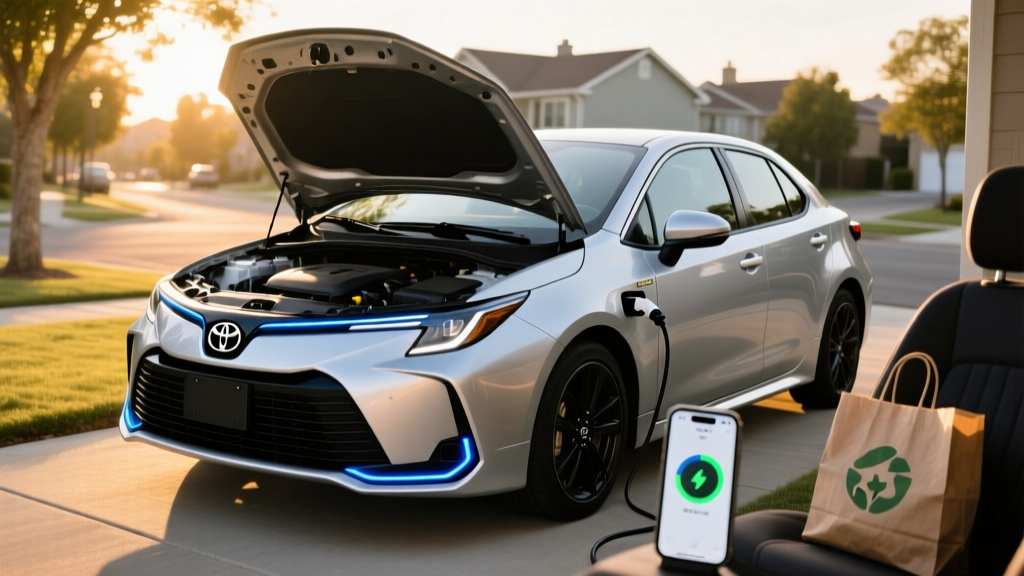
The Toyota Corolla Hybrid occupies a specific niche that full EVs and plug-in hybrids can't easily fill: maximum fuel efficiency with zero lifestyle change. No plugs, no range anxiety, no charging logistics — just a conventional sedan that sips fuel at a rate that embarrasses most competitors. For 2025, Toyota continues the formula that made this car a segment benchmark, pairing a 1.8-liter Atkinson-cycle engine with electric motors for an EPA-estimated 50 MPG combined.
But spec sheets don't tell the whole story. Below, we break down the 2025 Toyota Corolla Hybrid specs that matter — real-world fuel economy, powertrain details, AWD trade-offs, pricing by trim, battery longevity, and whether this HEV makes more financial sense than a PHEV or full BEV for your daily driving.
HEV vs PHEV vs EV: Where the Corolla Hybrid Fits
Before examining specs, it's critical to understand what the Corolla Hybrid is — and isn't. This is a conventional hybrid electric vehicle (HEV), not a plug-in hybrid (PHEV). You never plug it in. The battery charges exclusively through regenerative braking and the gasoline engine. There is no electric-only driving mode of any meaningful distance.
| Feature | HEV (Corolla Hybrid) | PHEV (e.g., Prius Prime) | BEV (e.g., Tesla Model 3) |
|---|---|---|---|
| Plug-in Required? | No | Yes (Level 1 or 2) | Yes (Level 2 or DC) |
| Electric-Only Range | ~1 mile at low speed | 25–44 miles typical | 250–400+ miles |
| Gasoline Engine | Yes (primary) | Yes (backup) | No |
| Federal Tax Credit (§30D) | No | Up to $7,500* | Up to $7,500* |
| Home Charging Needed | No | Recommended | Essential |
| Best For | Aptment dwellers, no-plug buyers | Home chargers, short commutes | Home chargers, low running cost |
*§30D credit eligibility depends on MSRP caps, buyer income limits, and battery critical-mineral sourcing. See IRS.gov for current-year rules.
If you have access to home or workplace Level 2 charging and your commute falls under 40 miles, a PHEV like the Toyota Prius Prime (44 miles electric-only, EPA-estimated) may save more fuel overall. If you can't plug in at all — apartment living, street parking, no garage — the Corolla Hybrid is the efficiency ceiling you can reach without infrastructure changes.
2025 Toyota Corolla Hybrid Powertrain and Performance Specs
The 2025 Corolla Hybrid uses Toyota's fifth-generation hybrid system, a proven architecture shared with the Prius but tuned for this sedan's slightly different weight and packaging. Here are the exact numbers:
| Engine | 1.8L 4-cylinder Atkinson-cycle |
| Engine Horsepower | 96 hp @ 5,200 rpm |
| Engine Torque | 105 lb-ft @ 3,600 rpm |
| Electric Motor (FWD) | 70 kW (94 hp) front motor |
| Electric Motor (AWD-e) | Front 70 kW + rear 30 kW (40 hp) |
| Net Combined Horsepower | 138 hp |
| Transmission | Electronically controlled CVT (eCVT) |
| Drivetrain Options | FWD or electronic AWD (AWD-e) |
| 0–60 mph (est.) | ~9.5 seconds (FWD) |
| Hybrid Battery | ~1.3 kWh lithium-ion (sealed NiMH on some trims) |
| Battery Location | Under rear seat |
A few things worth noting. The 138 combined horsepower is modest — this is not a performance car, and highway merging requires planning. The eCVT isn't a traditional belt-and-pulley CVT; it's a planetary gearset that seamlessly blends engine and motor power, which is why Toyota hybrids avoid the rubber-band drone associated with Nissan or Subaru CVTs.
The AWD-e system deserves specific attention. Unlike mechanical AWD with a driveshaft, Toyota uses a small independent rear motor that engages only when front-wheel slip is detected — typically during acceleration from a stop or on low-traction surfaces. It disengages above ~43 mph. This preserves most of the FWD model's fuel economy while adding genuine foul-weather capability.
EPA Fuel Economy: City, Highway, and Combined MPG
Fuel economy is the reason this car exists. The 2025 Corolla Hybrid's EPA estimates break down as follows, per fueleconomy.gov:
| Drivetrain | City MPG | Highway MPG | Combined MPG |
|---|---|---|---|
| FWD (LE) | 53 | 46 | 50 |
| AWD-e (LE, SE) | 47 | 41 | 44 |
The FWD model's 50 MPG combined is exceptional for a non-plug-in vehicle. For context, the non-hybrid 2025 Corolla with the 2.0L engine returns 32–35 MPG combined. That's a 40–55% improvement in fuel consumption for roughly $1,500–$2,000 in additional upfront cost depending on trim.
Real-World MPG: What Owners Actually See
Toyota's hybrid system is one of the few powertrains where real-world results frequently exceed EPA estimates in city driving. Here's why: the EPA city cycle involves moderate stops and accelerations. In heavy stop-and-go traffic — the kind hybrids are designed for — regenerative braking captures more energy, and the engine shuts off more often. Owners in dense urban environments like New York, Chicago, or Los Angeles routinely report 52–55 MPG on the FWD model in warm weather.
Highway driving tells a different story. At sustained 70–80 mph speeds, the electric motor contributes less and the 1.8L engine carries most of the load. Expect 40–43 MPG highway on the FWD model — slightly below the EPA's 46 MPG estimate, particularly in winter or with roof cargo. Cold weather reduces battery efficiency and increases engine idling for cabin heat, dropping city MPG by roughly 5–8 MPG in sub-freezing temperatures.
- City (warm weather, stop-and-go): 50–55 MPG
- City (cold weather, short trips): 44–48 MPG
- Highway (65–70 mph cruise): 42–46 MPG
- Highway (75–80 mph cruise): 38–42 MPG
- Annual fuel cost (15,000 mi @ $3.30/gal): ~$990 (FWD, combined)
2025 Corolla Hybrid Trims, Pricing, and Tax Credit Eligibility
Toyota offers the 2025 Corolla Hybrid in three trims, with AWD-e available on LE and SE:
| Trim | Drivetrain | MSRP | Key Features |
|---|---|---|---|
| LE | FWD | $23,500 | 8" touchscreen, TSS 3.0, wireless CarPlay/Android Auto |
| LE | AWD-e | $24,900 | Same as FWD LE + electronic AWD |
| SE | AWD-e | $26,400 | Sport-tuned suspension, 18" alloy wheels, Smart Key |
| XLE | FWD | $27,900 | SofTex seats, heated front seats, 7" digital cluster, ambient lighting |
Federal Tax Credit: Does the Corolla Hybrid Qualify?
No. The Corolla Hybrid is a conventional HEV, and the IRS §30D Clean Vehicle Credit applies only to plug-in electric vehicles (PHEVs and BEVs) with a minimum battery capacity of 7 kWh. The Corolla Hybrid's ~1.3 kWh battery falls far short of this threshold.
There is no federal purchase incentive for conventional hybrids in 2025. Some states and municipalities offer minor rebates or HOV-lane access for hybrids, but these vary significantly by jurisdiction. Check your state energy office or department of environmental quality for local programs. A few states, such as Colorado, have offered state-level credits for efficient vehicles, but amounts and eligibility change annually.
For buyers who specifically want federal incentive eligibility, the Toyota Prius Prime (PHEV, starts ~$33,445) may qualify for up to $3,750 in §30D credit depending on battery-sourcing compliance and buyer income caps. That credit narrows the price gap between a Corolla Hybrid and a Prius Prime substantially — though the Prius Prime requires home charging access to realize its electric-range advantage.
Hybrid Battery Warranty, Longevity, and Replacement Cost
Battery longevity is the single most common concern among first-time hybrid buyers. Toyota has built more hybrids than any other automaker — over 25 million globally since 1997 — and the data on battery lifespan is well-established.
- Hybrid Battery Warranty: 10 years / 150,000 miles (whichever comes first)
- Hybrid System Components: 8 years / 100,000 miles
- Powertrain Warranty: 5 years / 60,000 miles
- Basic Bumper-to-Bumper: 3 years / 36,000 miles
- Warranty Capacity Threshold: Battery covered if capacity drops below ~60% of original
In practice, Toyota hybrid batteries routinely last 150,000–200,000+ miles before significant degradation. The battery management system keeps the lithium-ion (or NiMH, depending on production batch) pack within a conservative state-of-charge window — roughly 40–80% — which dramatically reduces cell stress compared to the full 0–100% cycles seen in BEVs.
If replacement is eventually needed out of warranty, a refurbished Toyota hybrid battery pack typically costs $2,000–$3,500 installed at an independent hybrid specialist, or $3,500–$5,000 at a Toyota dealership for a new OEM pack. Given that most Corolla Hybrids will exceed 150,000 miles before battery failure, and the 10-year/150,000-mile warranty covers the vast majority of ownership, battery replacement is rarely a first- or second-owner expense.
Reliability and Safety Ratings
The Corolla nameplate carries one of the strongest reliability records in the industry, and the hybrid variant benefits from a powertrain with fewer wear components than a conventional gasoline car. There's no starter motor, no alternator, no traditional transmission with clutch packs or bands, and regenerative braking significantly extends brake pad life (many owners report 80,000+ miles on original pads).
For 2025, the Corolla Hybrid comes standard with Toyota Safety Sense 3.0, which includes:
- Pre-Collision System with Pedestrian Detection
- Full-Speed Range Dynamic Radar Cruise Control
- Lane Departure Alert with Steering Assist
- Lane Tracing Assist
- Automatic High Beams
- Road Sign Assist
- Proactive Driving Assist (low-speed braking support)
The 2025 Corolla sedan earned a Top Safety Pick rating from the IIHS and a 5-Star overall rating from NHTSA, making it one of the safest vehicles in its price bracket. Note that Toyota Safety Sense 3.0 is a Level 2 driver-assist system per SAE classification — it supports steering and speed but requires full driver attention at all times. It is not self-driving.
Who Should Buy the 2025 Corolla Hybrid?
- 50 MPG combined (FWD) — best-in-class for non-plug-in sedans
- No plug-in charging required — works for apartments and street parking
- 10-year / 150,000-mile hybrid battery warranty
- TSS 3.0 standard on all trims (no upgrade packages needed)
- Low annual fuel cost: ~$990/year at 15,000 miles
- AWD-e available for snow-belt buyers
- Strong resale value and proven reliability
- 138 hp — slow acceleration; 0–60 in ~9.5 seconds
- No federal tax credit (HEV, not PHEV)
- Rear seat and trunk slightly smaller than non-hybrid Corolla
- AWD-e reduces MPG to 44 combined
- No DC fast charging (not applicable — HEV)
- Modest infotainment screen; no wireless charging pad on LE
Decision Framework: Corolla Hybrid vs Alternatives
Choose the 2025 Corolla Hybrid if:
- You cannot plug in at home or work (apartment, street parking, no garage)
- Your budget is $23,000–$28,000 and you want maximum MPG per dollar
- You drive 12,000–20,000+ miles per year and want to minimize fuel cost
- You want AWD for winter but don't want an SUV
- You plan to own the car 8–12 years and value proven reliability
Consider a PHEV instead (Prius Prime, RAV4 Prime) if:
- You have home Level 2 charging and a commute under 40 miles
- You want to drive mostly on electricity with gas backup for road trips
- You may qualify for the §30D federal tax credit (up to $7,500)
Consider a full EV instead (Tesla Model 3, Hyundai Ioniq 6) if:
- You have reliable home charging and want near-zero fuel/maintenance cost
- Your daily driving is under 250 miles and you want instant torque
- You qualify for the §30D credit and want to eliminate gas entirely
Frequently Asked Questions
How many MPG does the 2025 Toyota Corolla Hybrid get?
The FWD model achieves an EPA-estimated 53 city / 46 highway / 50 combined MPG. The AWD-e model drops to 47 city / 41 highway / 44 combined. In real-world city driving with frequent stops, many owners exceed the EPA city estimate by 2–5 MPG. Highway cruising at 75+ mph typically yields 38–42 MPG.
Does the Corolla Hybrid need to be plugged in?
No. The Corolla Hybrid is a conventional HEV. Its small battery recharges through regenerative braking and the gasoline engine. You fuel it exactly like any other car — at a gas station. There is no plug, no charging cable, and no electric-only driving range to manage.
Does the 2025 Corolla Hybrid qualify for any tax credit?
The Corolla Hybrid does not qualify for the federal §30D Clean Vehicle Credit because it is a conventional hybrid with a battery well under the 7 kWh minimum. Some state or local utility rebates may apply to efficient vehicles, but these vary by jurisdiction. Check IRS.gov and your state energy office for current programs.
How long will the hybrid battery last, and what does replacement cost?
Toyota covers the hybrid battery for 10 years or 150,000 miles. Real-world data shows Toyota hybrid batteries commonly lasting 150,000–200,000+ miles before significant degradation. Out-of-warranty replacement runs $2,000–$3,500 for a refurbished pack or $3,500–$5,000 for a new OEM unit, but most owners will never need one within typical ownership periods.
Is the Corolla Hybrid AWD system good in snow?
The AWD-e system provides genuine traction benefits for light snow and wet roads by engaging an independent rear motor when front-wheel slip is detected. It's not a substitute for dedicated winter tires in deep snow or ice, but it significantly improves launch traction and low-speed stability compared to FWD. The system disengages above ~43 mph, so it doesn't aid high-speed handling.
Hybrid vs PHEV vs EV — which should I choose?
If you can't plug in, the Corolla Hybrid (HEV) is your best efficiency option with zero infrastructure requirements. If you have home charging and a short commute, a PHEV like the Prius Prime lets you drive electrically most days while keeping gas for road trips — and may qualify for a federal tax credit. If you have reliable charging and want the lowest per-mile cost, a full EV eliminates gas entirely but requires a higher upfront investment and charging planning for long trips.
How does the Corolla Hybrid compare to the Prius?
The 2025 Prius (redesigned for 2023) offers up to 57 MPG combined (FWD), 194 hp, and a more modern interior — but starts ~$28,545, roughly $5,000 more than the Corolla Hybrid LE. The Corolla Hybrid sacrifices some power and a few MPG for a lower entry price and a more traditional sedan design. Both share Toyota's hybrid reliability and warranty coverage.