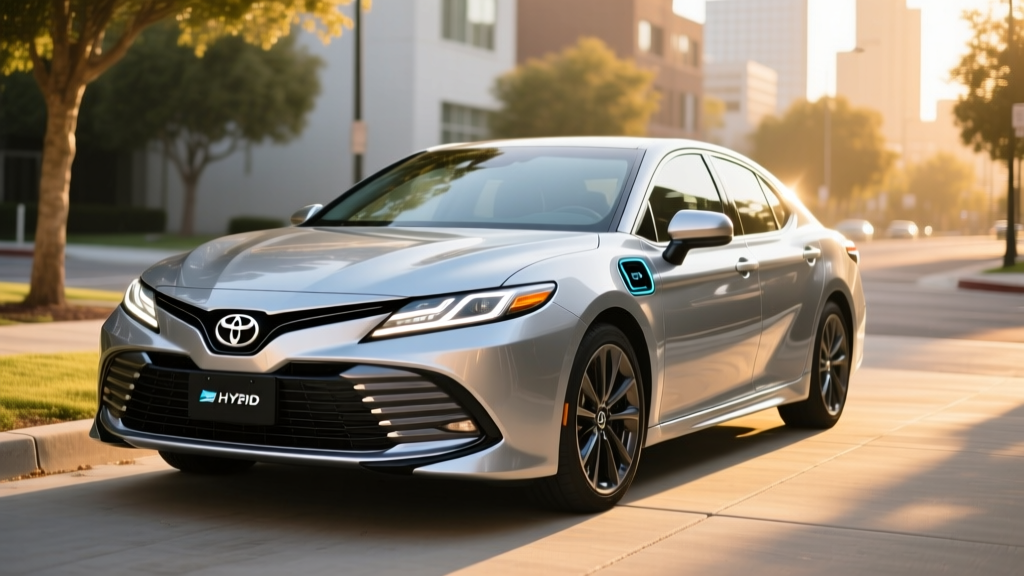
The 2025 Toyota Camry enters its ninth generation with a bold move: every model is now a hybrid. Toyota dropped the four-cylinder gas-only option entirely, betting that its fifth-generation hybrid system delivers the performance and efficiency buyers actually want. For a midsize sedan that has topped US sales charts for decades, this is a significant powertrain shift worth examining in detail.
If you're researching the 2025 Toyota Camry hybrid powertrain, you likely want hard numbers — not marketing copy. This guide covers the exact specs, EPA ratings, real-world fuel economy expectations, battery longevity, warranty coverage, and total cost of ownership to help you decide whether this HEV fits your garage.
Fifth-Generation Hybrid System: What's Under the Hood
The 2025 Camry uses Toyota's latest fifth-generation Toyota Hybrid System (THS), a parallel hybrid architecture that pairs a 2.5-liter four-cylinder engine with one or two electric motor-generators depending on drivetrain. Here's the critical distinction: this is a conventional hybrid (HEV), not a plug-in hybrid. You never plug it in. The 1.1 kWh lithium-ion battery charges through regenerative braking and the gasoline engine.
| Specification | FWD Models | AWD Models |
|---|---|---|
| Engine | 2.5L 4-cylinder Atkinson cycle | 2.5L 4-cylinder Atkinson cycle |
| Front Electric Motor | 1x motor-generator (MG2) | 1x motor-generator (MG2) |
| Rear Electric Motor | None | 1x independent motor (40 hp) |
| Net Combined Horsepower | 225 hp | 232 hp |
| Hybrid Battery | 1.1 kWh lithium-ion | 1.1 kWh lithium-ion |
| Transmission | eCVT (planetary gearset) | eCVT (planetary gearset) |
| 0-60 mph (est.) | ~7.0 sec | ~6.7 sec |
| Drivetrain | Front-wheel drive | Electronic AWD |
The AWD system deserves specific attention. Unlike mechanical AWD with a driveshaft, the Camry's electronic AWD uses a dedicated 40-horsepower rear electric motor that engages automatically when the system detects front-wheel slip. It operates up to approximately 43 mph for traction assistance, then disengages to preserve efficiency. This adds roughly 7 horsepower to the combined system output but costs you 3 MPG on the EPA combined cycle.
EPA Fuel Economy: City, Highway, and Combined
Fuel economy is the headline metric for any hybrid buyer. The 2025 Camry delivers strong numbers across the lineup, with FWD trims achieving some of the best ratings in the midsize sedan segment.
| Trim / Drivetrain | City MPG | Highway MPG | Combined MPG |
|---|---|---|---|
| LE (FWD) | 53 | 50 | 51 |
| SE / XLE / XSE (FWD) | 48 | 47 | 47 |
| SE / XLE / XSE (AWD) | 51 | 49 | 50 |
| LE (AWD) | 51 | 49 | 50 |
Source: EPA Fuel Economy
The LE trim's 51 MPG combined rating stands out. The higher trims (SE, XLE, XSE) sacrifice a few MPG due to larger 18- or 19-inch wheels, wider tires, and additional weight from premium features. Interestingly, AWD models with the LE trim return 50 MPG combined — only 1 MPG less than FWD — making the AWD option a minimal efficiency penalty for buyers in snow-belt states.
Real-World MPG: What to Actually Expect
EPA numbers are a starting point, not a guarantee. Hybrids behave differently than gas cars in real-world conditions, and the Camry's Atkinson-cycle engine combined with electric motor assist produces some counterintuitive results.
City driving: Expect 48–56 MPG. Hybrids shine in stop-and-go traffic where regenerative braking recaptures energy and the electric motor handles low-speed acceleration. Many owners report exceeding the EPA city rating on commutes with frequent stops.
Highway driving (65–75 mph): Expect 42–48 MPG. Sustained high speeds reduce hybrid advantage because the engine runs continuously and aerodynamic drag dominates. You'll likely fall short of the EPA highway rating on long interstate trips.
Cold weather (below 32°F): Expect a 10–20% reduction, dropping to roughly 40–46 MPG combined. The engine runs longer to heat the cabin and bring the catalytic converter to operating temperature. Battery efficiency also decreases in cold conditions.
Mixed daily driving: Most owners averaging a mix of suburban and highway miles report 46–52 MPG combined over thousands of miles.
The hybrid battery's small 1.1 kWh capacity means electric-only propulsion is limited to very low speeds (typically under 25 mph for short distances). Unlike a PHEV, you won't complete neighborhood loops on electric power alone. The system uses the battery for assist and recapture, not sustained electric driving.
HEV vs PHEV vs EV: Which Powertrain Fits You?
The Camry is available only as a conventional HEV — Toyota does not offer a plug-in hybrid variant for 2025. Here's how the three electrified powertrain types compare for a midsize sedan buyer:
| Factor | HEV (Camry Hybrid) | PHEV (e.g., Prius Prime) | Full EV (e.g., Tesla Model 3) |
|---|---|---|---|
| Plug in to charge? | No — self-charging | Yes — for electric range | Yes — always |
| Electric-only range | ~1 mile at low speed | 35–44 miles (typical) | 250–360+ miles |
| Home charging needed | No | Recommended (Level 2) | Essential (Level 2) |
| Combined efficiency | 47–51 MPG | 48–52 MPG + 120+ MPGe | 120–140 MPGe |
| Fuel cost per mile | ~$0.08–0.10 | ~$0.04–0.08 (varies) | ~$0.03–0.05 |
| Federal tax credit | None | Up to $7,500 (§30D) | Up to $7,500 (§30D) |
| Upfront price premium | Lowest | Moderate | Highest |
| Best for | No home charging, long trips | Short commutes + road trips | Home charging, daily driving |
Choose the Camry HEV if: You lack access to home or workplace charging, drive more than 50 miles daily with mixed city/highway routes, want the lowest purchase price among electrified sedans, or take frequent road trips where charging infrastructure is sparse.
Choose a PHEV if: You have home charging and a commute under 40 miles round-trip, want electric-only daily driving with gas backup for long trips, and qualify for the federal tax credit to offset the higher purchase price.
Choose a full EV if: You have reliable Level 2 home charging, your daily driving is under 200 miles, you want the lowest per-mile operating cost, and you're ready to plan road trips around DC fast charging.
Pricing, Trims, and Tax Credit Eligibility
The 2025 Camry Hybrid lineup starts at an accessible price point and scales up with luxury and performance features. Here's the MSRP breakdown by trim:
| Trim | FWD MSRP | AWD MSRP |
|---|---|---|
| LE | $28,700 | $30,700 |
| SE | $30,440 | $32,440 |
| XLE | $33,400 | $35,400 |
| XSE | $34,600 | $36,600 |
Source: Toyota.com
Federal Tax Credit: What You Need to Know
The conventional Camry Hybrid (HEV) does not qualify for the federal §30D clean vehicle tax credit. Under current IRS rules, only plug-in electric vehicles (PHEVs and BEVs) with sufficient battery capacity are eligible. The Camry's 1.1 kWh battery falls far below the §30D threshold.
However, the Camry Hybrid may qualify for:
- State-level incentives: Some states offer rebates or HOV lane access for hybrids. Check your state's energy office or DMV for current programs — these vary widely by jurisdiction.
- Employer or utility rebates: Some utilities and employers offer incentives for purchasing any electrified vehicle, including HEVs.
- Lower total cost of ownership: The fuel savings versus a comparable gas-only midsize sedan (typically 25–30 MPG combined) can amount to $600–$900 annually at current fuel prices, partially offsetting the lack of tax incentives.
Battery Warranty, Reliability, and Replacement Costs
Battery longevity is the top concern for first-time hybrid buyers. Toyota's track record here is one of the strongest in the industry, dating back to the 2001 Prius.
Hybrid Battery Warranty: 10 years / 150,000 miles (whichever comes first). This covers the hybrid battery pack against defects and capacity loss below a defined threshold. In states that follow California Air Resources Board (CARB) standards, hybrid-related emissions components carry extended coverage as well.
Hybrid System Components: 8 years / 100,000 miles. Covers the inverter, motor-generators, and associated control electronics.
Powertrain Warranty: 5 years / 60,000 miles. Covers the gasoline engine and transaxle.
Basic Bumper-to-Bumper: 3 years / 36,000 miles.
Real-World Battery Longevity
Toyota hybrid batteries routinely last well beyond the warranty period. Fleet data and owner reports from the Prius and previous-generation Camry Hybrid show many batteries reaching 180,000–250,000 miles before significant degradation. The 1.1 kWh battery in the 2025 model is small and conservatively managed — the system never fully charges or fully depletes it, which reduces stress on the cells.
Toyota's hybrid battery uses a nickel-metal hydride (NiMH) or lithium-ion chemistry depending on the specific production batch. The fifth-generation system has moved toward lithium-ion for improved energy density and reduced weight, but Toyota's battery management strategy prioritizes longevity over maximum utilization.
Battery Replacement Cost
If the hybrid battery does eventually fail outside warranty:
- New OEM battery from Toyota: $2,000–$3,500 installed (varies by dealer and region)
- Refurbished/remanufactured battery: $1,000–$2,000 installed from independent hybrid specialists
- Individual cell/module replacement: $500–$1,200 if only specific modules have failed (a common repair at specialist shops)
These costs are significantly lower than EV battery replacements ($5,000–$20,000+) because the Camry's hybrid battery is small — 1.1 kWh versus 60–100 kWh in a full EV.
Driving Experience and Performance
The 225-horsepower combined output (232 hp with AWD) places the 2025 Camry Hybrid firmly in adequate territory for a midsize sedan. The 0-60 mph time of approximately 7.0 seconds won't win any stoplight races, but it's competitive with turbocharged four-cylinder rivals and noticeably quicker than the previous-generation Camry Hybrid's 7.5-second run.
The eCVT transmission — which is not a traditional belt-and-pulley CVT but rather a planetary gearset that seamlessly blends engine and motor power — operates smoothly without the rubber-band sensation some drivers associate with CVTs. Under hard acceleration, the engine note is more present than in a conventional automatic, but Toyota has improved sound insulation for 2025.
The AWD system's electric rear motor provides genuine traction benefits in rain and light snow. It engages instantly without the mechanical lag of a traditional AWD coupling. For buyers in northern climates, this system offers a compelling alternative to a dedicated AWD gas sedan that would sacrifice 5–8 MPG for the same capability.
Total Cost of Ownership: 5-Year Outlook
| Cost Category | Camry Hybrid LE (51 MPG) | Gas Sedan (28 MPG) |
|---|---|---|
| Purchase Price (MSRP) | $28,700 | $27,500 |
| Federal Tax Credit | $0 | $0 |
| Fuel (75,000 mi @ $3.40/gal) | $5,000 | $9,107 |
| Maintenance (5 years) | $2,200 | $2,800 |
| Insurance (est. avg) | $6,500 | $6,200 |
| Estimated Depreciation | $12,500 | $13,000 |
| 5-Year Total | $54,900 | $58,607 |
The Camry Hybrid's fuel savings — approximately $4,100 over five years at 15,000 miles/year — more than offset its slightly higher purchase price. Maintenance costs trend lower because regenerative braking extends brake pad life (many owners report 70,000+ miles on original pads), and the hybrid system has no additional fluid changes or belts beyond standard engine maintenance.
Insurance premiums may run 3–5% higher than a gas equivalent due to higher repair costs for hybrid-specific components after a collision, though this varies by insurer and driver profile.
Pros, Cons, and the Bottom Line
- 51 MPG combined (LE FWD) — best-in-class for midsize sedans
- No plug-in charging required — works with any lifestyle
- 10-year/150,000-mile hybrid battery warranty
- Available electronic AWD with minimal MPG penalty
- Strong resale value and Toyota reliability reputation
- 225–232 hp is competitive for the segment
- Low 5-year total cost of ownership
- No federal tax credit eligibility (HEV, not PHEV)
- Highway MPG falls below EPA sticker at sustained 75+ mph
- eCVT engine drone under hard acceleration
- No plug-in hybrid option in the Camry lineup
- AWD system disengages above ~43 mph (traction only at low speed)
- 1.1 kWh battery means negligible electric-only driving
Frequently Asked Questions
How many MPG does the 2025 Toyota Camry Hybrid get?
The FWD LE trim achieves an EPA-rated 53 city / 50 highway / 51 combined MPG. Higher trims (SE, XLE, XSE) with FWD return 48 city / 47 highway / 47 combined. AWD models earn 51 city / 49 highway / 50 combined on the LE trim. Real-world results typically match or slightly exceed EPA city ratings but may fall 3–5 MPG short on sustained highway driving.
Does the Camry Hybrid need to be plugged in?
No. The 2025 Camry Hybrid is a conventional HEV. Its 1.1 kWh battery charges through regenerative braking and the gasoline engine. There is no plug, no charging port, and no electric-only range to manage. You fuel it like any other car at a gas station.
Is the 2025 Camry Hybrid reliable?
Toyota's hybrid system has over two decades of proven reliability. The fifth-generation THS uses fewer wear-prone components than a conventional automatic transmission (no torque converter, no traditional friction brakes at low speed). The hybrid battery carries a 10-year/150,000-mile warranty, and real-world data shows many Toyota hybrid batteries lasting 200,000+ miles.
What does it cost to replace the Camry Hybrid battery?
A new OEM hybrid battery replacement runs $2,000–$3,500 installed at a Toyota dealer. Refurbished units from independent specialists cost $1,000–$2,000. Individual module repairs can be as low as $500–$1,200. Given the 10-year warranty and typical longevity, most owners will never face this expense.
Does the 2025 Camry Hybrid qualify for any tax credit?
The Camry HEV does not qualify for the federal §30D clean vehicle credit — that credit applies only to plug-in vehicles (PHEVs and BEVs). Some states and utilities offer hybrid-specific incentives, but these vary by jurisdiction. Check your state energy office for current programs.
Camry Hybrid vs Prius: which should I choose?
The 2025 Prius offers up to 57 MPG combined and a more distinctive design, but it's smaller inside — particularly rear legroom and cargo space. The Camry provides a midsize sedan cabin with more rear seat room, a larger trunk (15.1 cu ft vs 13.7 cu ft in the Prius), and available AWD. If you need family-sedan space, the Camry wins. If maximum MPG in a compact package is the priority, the Prius edges ahead.
Can the Camry Hybrid run on electric power alone?
Only in very limited circumstances — typically under 1 mile at speeds below 25 mph, such as creeping through a parking lot or in heavy stop-and-go traffic. The 1.1 kWh battery is too small for sustained electric driving. This is by design: the system prioritizes seamless engine-motor blending over electric-only range.