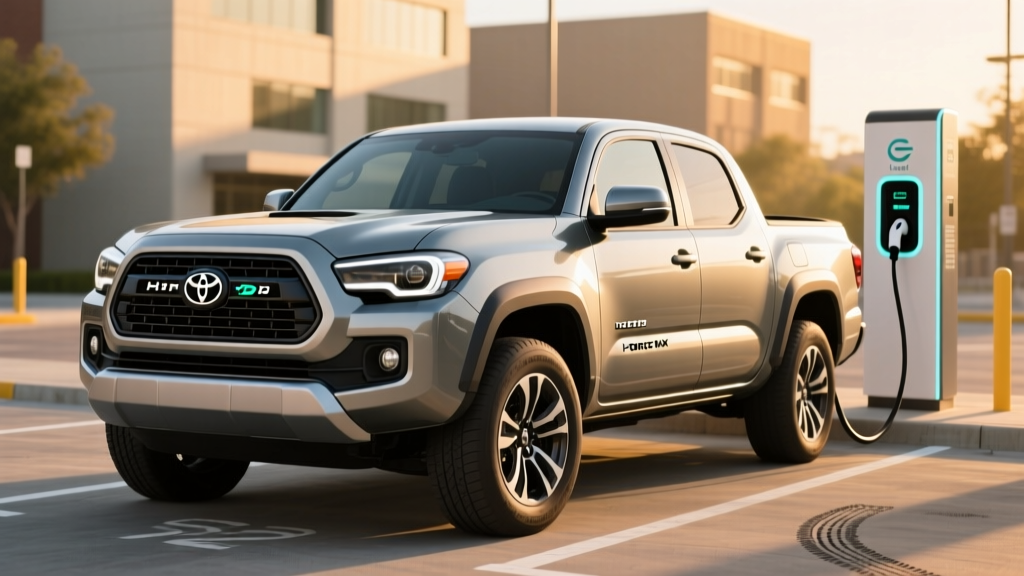
The midsize truck segment has historically offered a binary choice: fuel-efficient four-cylinders that lack towing muscle, or V6 engines that guzzle fuel. The 2025 Toyota Tacoma Hybrid — officially badged as the i-FORCE MAX — attempts to bridge that gap with a turbocharged 2.4-liter four-cylinder paired with an electric motor integrated into the transmission. But what does that mean at the pump? Here's a data-driven look at the 2025 Tacoma Hybrid MPG, real-world efficiency, and whether Toyota's hybrid truck powertrain delivers on its promises.
2025 Toyota Tacoma Hybrid (i-FORCE MAX) Specifications
| Spec | Value |
|---|---|
| Powertrain | 2.4L Turbo 4-Cyl + Electric Motor (i-FORCE MAX) |
| Combined Horsepower | 326 hp |
| Combined Torque | 465 lb-ft |
| Transmission | 8-Speed Automatic |
| Drivetrain | 4WD (standard on i-FORCE MAX) |
| Hybrid Battery | 1.87 kWh (NiMH, sealed) |
| Towing Capacity (max) | 6,000 lbs |
| Payload Capacity (max) | ~1,709 lbs |
| Base MSRP (TRD Off-Road) | $47,195 |
| Battery Warranty | 10 years / 150,000 miles |
EPA Fuel Economy: What the Sticker Says
The 2025 Tacoma Hybrid's EPA fuel economy ratings vary by trim and cab configuration. The most popular configuration — the TRD Off-Road Double Cab with the 5-foot bed — earns the following ratings according to fueleconomy.gov:
| Configuration | City MPG | Highway MPG | Combined MPG |
|---|---|---|---|
| TRD Off-Road Double Cab (5-ft bed) | 23 | 27 | 25 |
| Limited Double Cab (5-ft bed) | 23 | 26 | 24 |
| TRD Pro Double Cab (5-ft bed) | 22 | 24 | 23 |
These numbers represent a meaningful improvement over the non-hybrid i-FORCE turbo four-cylinder, which returns roughly 20 city / 24 highway / 22 combined in 4WD configurations. The hybrid system's electric motor assist is most effective in city driving, where regenerative braking recaptures energy and the engine can shut off at stops.
Real-World MPG: Highway, City, and Towing
EPA estimates are a starting point, not a guarantee. Hybrid trucks often exceed their EPA city ratings in stop-and-go traffic — the exact conditions where the electric motor does the most work. Conversely, highway cruising at 70-80 mph relies more heavily on the turbocharged engine, narrowing the hybrid's advantage.
- City driving: 24–27 MPG (often exceeds EPA due to regen braking)
- Highway (65-70 mph): 23–26 MPG
- Highway (75-80 mph): 20–23 MPG (aero drag dominates)
- Towing (~4,000 lb trailer): 13–16 MPG
- Cold weather (below 32°F): Expect 10-15% reduction (21–23 combined)
The i-FORCE MAX's 1.87 kWh battery pack is small by PHEV or BEV standards — and that's by design. It's a conventional hybrid (HEV), meaning it never plugs in. The battery charges exclusively through regenerative braking and engine-driven generation. You'll never see a charging cable for this truck.
HEV vs PHEV: Why the Tacoma Hybrid Doesn't Plug In
A common point of confusion: the Tacoma Hybrid is a conventional hybrid (HEV), not a plug-in hybrid (PHEV). Understanding the difference is critical for setting expectations.
| Feature | HEV (Tacoma i-FORCE MAX) | PHEV (e.g., Toyota RAV4 Prime) |
|---|---|---|
| Plug-in charging? | No — charges via regen + engine | Yes — Level 1/Level 2 |
| Electric-only range | None (motor assists engine only) | 25–42 miles typical |
| Battery size | ~1.87 kWh (NiMH) | ~18.1 kWh (Li-ion) |
| DC fast charging? | N/A | Rarely (most PHEVs lack DC) |
| EV mode at low speeds | Brief, limited to ~1 mile at low speed | Full EV driving to 60+ mph |
| Federal tax credit (§30D) | Not eligible | Eligible (if criteria met) |
The Tacoma's hybrid system uses its electric motor primarily for torque fill at low RPM, regenerative braking, and engine stop-start smoothing. It cannot drive the truck on electric power alone for meaningful distances. If you're looking for electric-only commuting in a Toyota truck, you'll need to wait — Toyota has not announced a Tacoma PHEV as of early 2026.
i-FORCE MAX Powertrain: How the Hybrid System Works
Toyota's i-FORCE MAX pairs a turbocharged 2.4-liter inline-four with a 48-hp electric motor sandwiched between the engine and the 8-speed automatic transmission. Combined output reaches 326 horsepower and 465 lb-ft of torque — figures that rival the outgoing V6 Tacoma and compete directly with the Ford Maverick Hybrid (191 hp combined) and the Chevrolet Colorado's turbo four (310 hp, no hybrid assist).
The electric motor's primary contributions:
- Torque fill: Instant electric torque from 0 RPM eliminates turbo lag off the line
- Regenerative braking: Captures kinetic energy during deceleration to recharge the hybrid battery
- Engine stop-start: Seamlessly shuts off the engine at stops and restarts via the electric motor
- Low-speed assist: Reduces engine load in parking lots and crawling traffic
The result is a truck that feels responsive in daily driving while returning fuel economy closer to a midsize SUV than a traditional body-on-frame truck.
Pricing, Trims, and Tax Credit Eligibility
The i-FORCE MAX hybrid powertrain is not available on the base SR trim. For 2025, Toyota restricts it to higher trims, which pushes the entry price well above the non-hybrid Tacoma.
| Trim (i-FORCE MAX) | Starting MSRP |
|---|---|
| TRD Off-Road | $47,195 |
| Limited | $52,095 |
| TRD Pro | $64,330 |
Because the 2025 Tacoma Hybrid is a conventional HEV (not a PHEV or BEV), it does not qualify for the IRS §30D Clean Vehicle Credit. That credit requires a plug-in vehicle with a battery capacity of at least 7 kWh and meeting critical-mineral and battery-component sourcing rules. The Tacoma's 1.87 kWh NiMH pack falls far short. No federal purchase incentive applies to this truck. Some states may offer rebates for hybrid vehicles — check your state energy office for current programs.
Battery Warranty, Reliability, and Replacement Cost
Hybrid battery longevity remains a top concern for truck buyers considering the i-FORCE MAX. Toyota addresses this with an industry-leading warranty:
10 years or 150,000 miles (whichever comes first), covering capacity loss and defects. This applies to all 2025 Toyota hybrids, including the Tacoma i-FORCE MAX. Toyota's hybrid battery warranty has been 10/150k since the 2020 model year, up from the previous 8-year/100,000-mile coverage.
On reliability: Toyota's hybrid systems have a long track record. The Prius, Camry Hybrid, and RAV4 Hybrid have demonstrated hybrid battery lifespans exceeding 200,000 miles in many real-world cases. The Tacoma's NiMH pack is smaller and less stressed than those in Toyota's passenger hybrids, which works in its favor for longevity.
If the hybrid battery does eventually need replacement out of warranty, expect costs in the range of $2,000–$3,500 for the NiMH pack (parts and labor). This is significantly less than the $10,000–$20,000+ replacement costs for large BEV traction batteries. Independent hybrid specialists can often refurbish or replace individual cells for less.
Tacoma Hybrid vs. Full EV vs. Gas Truck: Which Fits You?
The Tacoma i-FORCE MAX occupies a specific niche. Here's a decision framework based on how you actually use your truck:
- You want better fuel economy than a gas truck without plug-in infrastructure
- You tow or haul regularly and need the 6,000-lb capacity
- You live in an apartment or lack home charging access
- You want Toyota's hybrid reliability track record in a truck
- You drive a mix of city and highway and value the torque-fill responsiveness
- You have reliable Level 2 home charging
- Your daily driving is under 250 miles and you rarely tow heavy loads
- You want the lowest per-mile energy cost (electricity vs. gasoline)
- You qualify for the $7,500 federal tax credit, narrowing the price gap
- Budget is the primary concern (base SR starts ~$10,000 less than the cheapest i-FORCE MAX)
- You drive mostly highway where the hybrid advantage narrows to 2-3 MPG
- You want the widest trim and configuration selection
Frequently Asked Questions
How many MPG does the 2025 Tacoma Hybrid get?
The EPA rates the 2025 Tacoma Hybrid (i-FORCE MAX) at 23 city / 27 highway / 25 combined for the TRD Off-Road trim. Real-world city driving often yields 24–27 MPG thanks to regenerative braking, while sustained highway driving at 75+ mph may drop to 20–23 MPG.
Does the Tacoma Hybrid need to be plugged in?
No. The 2025 Tacoma Hybrid is a conventional hybrid (HEV). Its small 1.87 kWh battery charges through regenerative braking and the gasoline engine. There is no charging port and no electric-only driving range.
How far can the Tacoma Hybrid drive on electric power alone?
Effectively zero miles in any practical sense. The electric motor assists the gas engine but cannot propel the truck independently at normal speeds. This is not a plug-in hybrid — it has no EV-only mode for commuting.
Is the Tacoma Hybrid reliable, and what does battery replacement cost?
Toyota's hybrid systems have demonstrated strong long-term reliability across multiple model lines. The Tacoma's hybrid battery is covered by a 10-year / 150,000-mile warranty. Out-of-warranty replacement is estimated at $2,000–$3,500 — far less than a full EV battery swap.
Does the 2025 Tacoma Hybrid qualify for a federal tax credit?
No. The federal §30D Clean Vehicle Credit requires a plug-in electric vehicle with a minimum 7 kWh battery. The Tacoma Hybrid's 1.87 kWh NiMH pack does not qualify. Check IRS guidelines for current credit rules and your state for any local hybrid incentives.
How does the Tacoma Hybrid MPG compare to the Ford Maverick Hybrid?
The Ford Maverick Hybrid (FWD) earns an EPA-estimated 42 city / 33 highway / 37 combined — significantly higher than the Tacoma. However, the Maverick is a unibody compact truck with 1,500-lb payload and 2,000-lb towing capacity. The Tacoma Hybrid offers far more off-road capability, towing (6,000 lbs), and ground clearance at the cost of fuel economy.
What is the towing MPG for the Tacoma Hybrid?
Expect 13–16 MPG when towing a trailer in the 3,500–4,500 lb range. The hybrid system provides minimal fuel savings under heavy load, where the turbocharged engine operates at high output continuously. Towing range on the Tacoma's ~18.5-gallon tank drops to approximately 240–290 miles.