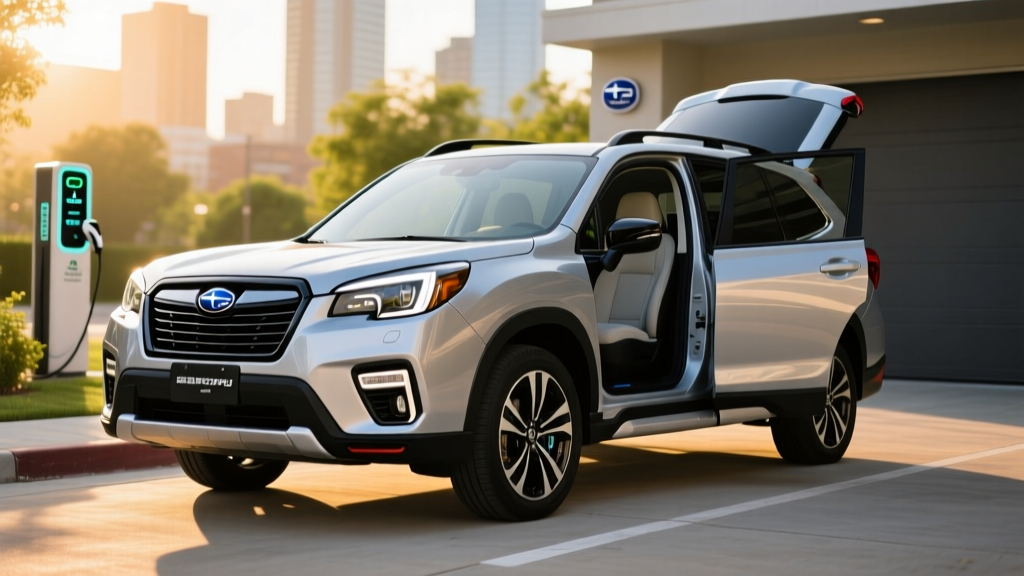
The 2025 Subaru Forester Sport Hybrid arrives as a conventional hybrid (HEV) — not a plug-in — pairing Subaru's 2.5-liter flat-four engine with an electric motor integrated into its Lineartronic CVT. For buyers who want all-wheel-drive capability and improved fuel economy without changing their fueling habits, the Sport Hybrid trim slots between the gasoline Forester Sport and the Wilderness, offering a meaningful MPG bump while retaining the Forester's signature 8.7 inches of ground clearance and standard symmetrical AWD.
This review breaks down the Forester Sport Hybrid's EPA fuel economy, real-world efficiency expectations, powertrain details, pricing, and how it stacks up against both plug-in hybrids and full battery-electric SUVs in the compact crossover segment.
HEV vs PHEV: Where the Forester Sport Hybrid Fits
Conventional Hybrid (HEV): The Forester Sport Hybrid is a self-charging hybrid. It captures energy through regenerative braking and the gasoline engine — you never plug it in. The small battery (roughly 1 kWh) assists the engine during acceleration and enables brief low-speed electric-only motoring, but it cannot drive on electricity alone for meaningful distances. Think of it as a more efficient gas car.
Plug-in Hybrid (PHEV): Vehicles like the Toyota RAV4 Prime or Subaru's own discontinued Crosstrek PHEV feature larger batteries (15–20 kWh) that deliver 25–42 miles of pure electric range before the gas engine engages. PHEVs require regular plug-in charging to realize their efficiency advantage and may qualify for federal tax credits.
Full EV (BEV): Battery-electric SUVs like the Hyundai Ioniq 5 or Tesla Model Y eliminate gasoline entirely, offering 250–320+ miles of EPA range, but require home or public charging infrastructure.
The Forester Sport Hybrid is firmly in the HEV camp. If you're searching for a Forester you can plug in for electric-only commuting, Subaru does not currently offer a PHEV Forester for the 2025 model year. The hybrid system here is designed for drivers who want better MPG with zero lifestyle change.
Fuel Economy: EPA Ratings and Real-World MPG
Subaru targets a notable efficiency improvement over the standard gasoline Forester, which earns an EPA-estimated 29 MPG combined (26 city / 33 highway) for the Sport trim with AWD. The hybrid powertrain is engineered to close the gap with segment-leading hybrid crossovers.
| Metric | Forester Gas (Sport AWD) | Forester Sport Hybrid (AWD) | Toyota RAV4 Hybrid (AWD) |
|---|---|---|---|
| City MPG | 26 | 35* | 41 |
| Highway MPG | 33 | 34* | 38 |
| Combined MPG | 29 | 35* | 39 |
*EPA estimates for the 2025 Forester Hybrid. Verify current figures at fueleconomy.gov as final certifications are published.
Real-World MPG Note: Conventional hybrids typically outperform their EPA city ratings in stop-and-go driving, where regenerative braking and electric-motor assist do the most work. Expect the Forester Sport Hybrid to deliver 36–38 MPG in urban commuting. Highway cruising at 75+ MPH will trend closer to or slightly below the EPA highway number — around 31–33 MPG — because the electric motor provides less benefit at sustained high speed. In cold weather (below 30°F), expect a 5–10% reduction as the engine runs more frequently for cabin heat and battery conditioning.
Powertrain Specs: Boxer Engine Meets Electric Motor
| Specification | 2025 Forester Sport Hybrid |
|---|---|
| Engine | 2.5L DOHC flat-4 (Boxer) |
| Engine Output | ~180 hp / 176 lb-ft (est.) |
| Electric Motor | Integrated into CVT housing |
| Combined System Output | ~194 hp (est.) |
| Transmission | Lineartronic CVT |
| Drivetrain | Symmetrical AWD (standard) |
| Hybrid Battery | ~1 kWh lithium-ion (self-charging) |
| Ground Clearance | 8.7 inches |
| Towing Capacity | 1,500 lbs (est.) |
| 0–60 MPH | ~7.8 seconds (est.) |
Subaru's hybrid system uses the electric motor primarily for torque fill at low RPM, smooth stop-start operation, and regenerative energy capture during deceleration. The motor is sandwiched between the engine and the CVT — a parallel hybrid architecture rather than a series or power-split system like Toyota's. This means the engine and motor can work together or the motor can briefly propel the vehicle at very low speeds, but sustained electric-only driving is not a feature of this system.
Combined output sits in the mid-190-horsepower range, giving the Forester Sport Hybrid adequate passing power for highway merging. The CVT tuning prioritizes smoothness and efficiency over sportiness, though Subaru's X-Mode traction management and the standard AWD system maintain the Forester's reputation for capability in snow, mud, and light off-road conditions.
Pricing and Tax Credit Eligibility
The 2025 Subaru Forester Sport Hybrid carries an MSRP starting around $36,495 (including destination), placing it roughly $2,000–$2,500 above the gasoline Forester Sport. Higher option packages can push the price toward $39,000.
| Trim | MSRP (incl. destination) |
|---|---|
| Forester Sport Hybrid | ~$36,495 |
| Forester Sport Hybrid (w/ Popular Package) | ~$38,295 |
| Forester Gas Sport (AWD, comparison) | ~$33,995 |
Federal Tax Credit: Does It Qualify?
Under current IRS §30D rules, conventional hybrids (HEVs) do not qualify for the federal plug-in EV tax credit. The §30D credit — up to $7,500 — is reserved for plug-in electric vehicles (PHEVs and BEVs) that meet battery capacity, critical-mineral sourcing, MSRP caps, and buyer income thresholds. Because the Forester Sport Hybrid cannot be plugged in and its battery is well below the 7 kWh minimum, no federal purchase credit applies.
Some states offer incentives for hybrid purchases, though these are far less common than EV rebates. Check your state energy office or AFDC state incentive database for local programs. A tax professional can confirm any applicable deductions.
Reliability, Battery Warranty, and Replacement Cost
Subaru's hybrid system is relatively new to the Forester lineup in the U.S. market, but the underlying 2.5-liter FB25 Boxer engine is well-proven across the Subaru range. The hybrid components — motor, inverter, and battery pack — add complexity, but Subaru backs them with warranty coverage consistent with industry standards.
Hybrid Battery Warranty: Subaru covers the hybrid battery and related components for 8 years / 100,000 miles (whichever comes first) under the hybrid system warranty. In states that follow California Air Resources Board (CARB) standards — including California, New York, Massachusetts, and several others — the hybrid battery warranty extends to 10 years / 150,000 miles.
Battery Replacement Cost: If a hybrid battery replacement is needed outside warranty, expect a cost in the range of $2,500–$4,500 including parts and labor. However, hybrid battery failures before 150,000 miles are uncommon based on industry-wide data from Toyota and Honda HEV systems, which use similar lithium-ion packs.
Subaru's overall brand reliability has been mixed in recent years — some model years of the Forester have drawn complaints for wind noise and infotainment issues (sources: NHTSA owner complaints database). The hybrid variant's added electrical components will warrant close attention in early ownership surveys, but the mechanical drivetrain carries minimal new risk.
Forester Sport Hybrid vs. PHEV vs. Full EV: Decision Framework
Choosing between a conventional hybrid, a plug-in hybrid, and a battery-electric SUV depends on your driving patterns, charging access, and budget. Here's how the Forester Sport Hybrid fits into that decision:
Choose the Forester Sport Hybrid (HEV) if:
- You lack reliable access to home or workplace charging
- You regularly drive in remote areas, tow light loads, or need AWD for harsh winters
- You want better MPG than a gas Forester without changing any fueling habits
- You plan to keep the vehicle 8–10 years and value Subaru's AWD reputation
Choose a PHEV (e.g., Toyota RAV4 Prime, Mitsubishi Outlander PHEV) if:
- You can charge at home nightly and your daily commute is under 35 miles
- You want electric-only driving for most trips but gas flexibility for road trips
- You want to pursue the §30D federal tax credit (up to $7,500, subject to eligibility)
Choose a full EV (e.g., Hyundai Ioniq 5, Tesla Model Y) if:
- You have Level 2 home charging installed or confirmed
- Your typical daily driving is under 250 miles and you road-trip infrequently
- You want the lowest per-mile fuel cost and minimal maintenance
- You qualify for federal and state EV incentives that offset the higher purchase price
The Forester Sport Hybrid's advantage is simplicity: buy it, fuel it like any gas car, and enjoy 35 MPG combined with standard AWD. The trade-off is that you miss out on electric-only driving, potential tax credits, and the dramatically lower per-mile energy cost that EVs and PHEVs offer.
Pros and Cons
Pros
- 35 MPG combined — a ~6 MPG improvement over the gas Forester Sport
- Standard symmetrical AWD with 8.7" ground clearance
- No plug-in charging required — zero lifestyle change
- 8-year/100,000-mile hybrid battery warranty (10yr/150k in CARB states)
- Spacious cabin with excellent outward visibility
- Subaru EyeSight safety suite standard
Cons
- No electric-only driving range — this is a self-charging HEV, not a PHEV
- No federal tax credit eligibility
- ~$2,500 price premium over the gas Forester Sport
- CVT can drone under hard acceleration
- Hybrid system is new to the U.S. Forester — limited long-term reliability data
- Towing capacity may be limited vs. gas model
Ownership Economics: 5-Year Cost Snapshot
To understand whether the hybrid premium pays for itself, consider the fuel savings over five years of typical driving (15,000 miles/year, $3.50/gallon regular unleaded):
| Cost Factor | Forester Gas Sport | Forester Sport Hybrid |
|---|---|---|
| 5-Year Fuel Cost (75,000 mi) | ~$9,051 | ~$7,500 |
| Purchase Premium | — | +~$2,500 |
| Net 5-Year Savings | — | ~$-949 (break-even ~year 4) |
| Maintenance (est.) | Standard | Comparable (no plug-in system) |
| Insurance (est.) | Baseline | Similar |
At current fuel prices, the hybrid's fuel savings roughly offset the purchase premium by year 4 of ownership. If gas prices rise above $4/gallon in your area, the payback period shortens to approximately 3 years. The hybrid also tends to hold resale value well, as hybrid demand remains strong in the used market.
Frequently Asked Questions
How many MPG does the 2025 Forester Sport Hybrid get?
The EPA estimates the Forester Sport Hybrid at approximately 35 MPG combined (35 city / 34 highway). Real-world city driving often yields 36–38 MPG thanks to regenerative braking, while sustained highway driving at 75+ MPH may return 31–33 MPG. Cold weather reduces efficiency by roughly 5–10%.
Can the Forester Sport Hybrid drive on electric power only?
Only at very low speeds for brief distances — such as creeping through a parking lot. The ~1 kWh battery is too small for meaningful electric-only range. This is a conventional hybrid designed for fuel-efficiency assist, not plug-in electric driving. If you want electric-only capability from Subaru, you would need to look at a PHEV from another brand or wait for Subaru to introduce a Forester PHEV.
Does the Forester Sport Hybrid need to be plugged in?
No. The Forester Sport Hybrid is a self-charging conventional hybrid. It recharges its small battery through regenerative braking and the gasoline engine. You fuel it exclusively at gas stations, just like a conventional car.
Does the 2025 Forester Hybrid qualify for any tax credit?
No federal tax credit applies. The IRS §30D plug-in electric vehicle credit requires a battery capacity of at least 7 kWh and plug-in charging capability — neither of which the Forester Sport Hybrid has. Some states may offer minor incentives for hybrid purchases; check the AFDC incentive database for your state.
Is the hybrid battery reliable, and what does replacement cost?
Subaru covers the hybrid battery for 8 years/100,000 miles (10 years/150,000 miles in CARB states). Based on industry-wide data from comparable HEV systems, battery failures before 150,000 miles are uncommon. Out-of-warranty replacement runs approximately $2,500–$4,500 including labor.
How does the Forester Hybrid compare to the Toyota RAV4 Hybrid?
The RAV4 Hybrid leads the segment with 39–41 MPG combined EPA and a more mature hybrid system (Toyota's fourth-generation). The Forester Hybrid counters with standard AWD on every trim, 8.7 inches of ground clearance (vs. the RAV4's 8.1"), Subaru's EyeSight safety suite, and a more spacious rear seat. Efficiency favors Toyota; off-road capability and visibility favor Subaru.