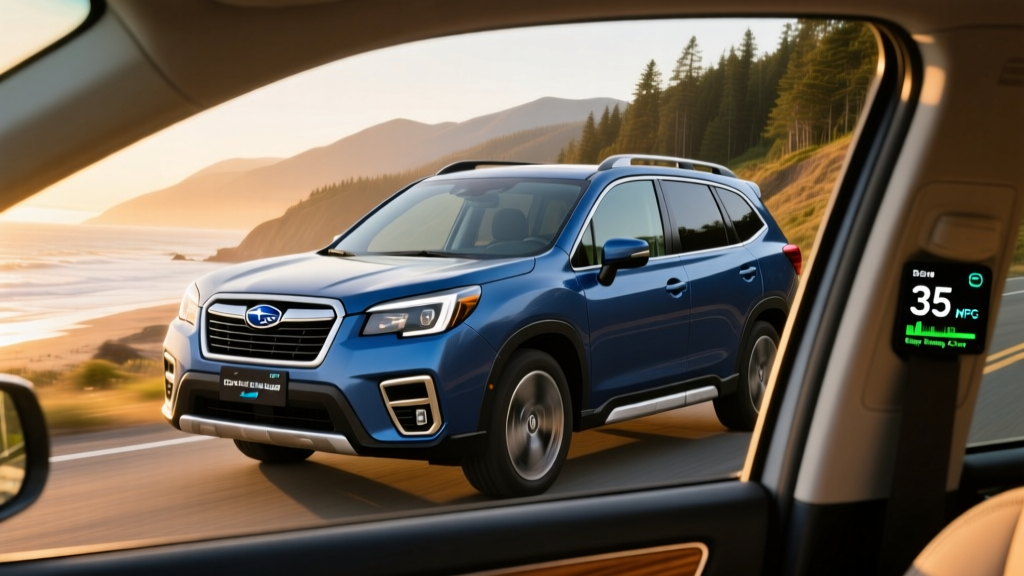
The 2025 Subaru Forester Hybrid Touring arrives as a conventional hybrid (HEV) — no plug required — built on Subaru's latest global platform with a revised 2.5-liter boxer engine paired with an electric motor integrated into the CVT. For buyers who want electrified efficiency without the charging logistics of a PHEV or full EV, the Forester Hybrid fills a specific niche: a practical, all-wheel-drive compact SUV that squeezes more miles from every gallon while keeping Subaru's hallmark traction and safety tech intact.
This review breaks down the real-world efficiency, powertrain details, pricing, and ownership economics of the top-trim Touring model — the one with the most features and the highest sticker price in the Forester Hybrid lineup.
How Many MPG Does the 2025 Subaru Forester Hybrid Get?
The EPA rates the 2025 Forester Hybrid at 35 MPG combined, with a city/highway split that favors urban driving — a hallmark of Toyota-derived hybrid systems (Subaru licenses hybrid tech from Toyota under their long-standing partnership).
| Metric | MPG |
|---|---|
| City | 35 MPG |
| Highway | 34 MPG |
| Combined | 35 MPG |
Source: fueleconomy.gov
Powertrain: 194 HP With Standard Symmetrical AWD
The Forester Hybrid uses a 2.5-liter naturally aspirated flat-four (boxer) engine producing 163 horsepower, augmented by an electric motor integrated into the Lineartronic CVT that contributes an additional 31 horsepower. Combined system output is 194 horsepower.
| Specification | Detail |
|---|---|
| Engine | 2.5L DOHC boxer 4-cylinder |
| Engine HP | 163 hp @ 5,600 rpm |
| Electric Motor | Integrated in CVT, 31 hp (23 kW) |
| Combined System HP | 194 hp |
| Transmission | Lineartronic CVT |
| Drivetrain | Symmetrical AWD (standard) |
| Towing Capacity | 1,500 lbs |
| Ground Clearance | 8.7 inches |
Unlike the gas-only Forester's 180-hp output, the hybrid gains 14 net horsepower and substantially more low-end torque from the electric motor, which makes a noticeable difference in city acceleration and merging onto highways. The CVT is tuned for smoothness rather than sportiness — there are no simulated gear steps that feel particularly convincing, but the powertrain is refined and quiet under normal loads.
HEV vs PHEV vs EV: Where Does the Forester Hybrid Fit?
Before going further, it's critical to understand what this vehicle is — and what it isn't. The 2025 Forester Hybrid is a conventional hybrid (HEV), not a plug-in hybrid (PHEV). It has no charging port, no electric-only driving mode of meaningful distance, and no eligibility for federal EV tax credits.
| Feature | HEV (Forester Hybrid) | PHEV (e.g., RAV4 Prime) | BEV (e.g., Ioniq 5) |
|---|---|---|---|
| Plugs in? | No | Yes | Yes |
| Electric-only range | <1 mile at low speed | 25-42 miles typical | 200-350+ miles |
| Battery size | ~1.1 kWh (small buffer) | 13-20 kWh | 60-100 kWh |
| Fuel/energy source | Gasoline only | Gasoline + electricity | Electricity only |
| Federal tax credit | None (§30D is EV/PHEV only) | Up to $7,500 (if eligible) | Up to $7,500 (if eligible) |
| Home charging needed? | No | Recommended (Level 2) | Essential |
Who should choose the Forester Hybrid (HEV)? Drivers who want better fuel economy without changing their fueling habits. If you live in an apartment without charging access, drive in a region with sparse public charging infrastructure, or simply don't want to think about plugging in, a conventional hybrid delivers meaningful MPG gains with zero lifestyle adjustment.
Who should look at a PHEV instead? If you have access to home or workplace Level 2 charging and your daily commute is under 35 miles round-trip, a PHEV like the Toyota RAV4 Prime (42 miles electric range) can operate as an EV most days while retaining a gas engine for road trips. PHEVs also qualify for the federal §30D tax credit (up to $7,500, subject to income caps, MSRP limits, and battery sourcing requirements — consult a tax professional).
Who should go full EV? If you have reliable home charging, drive under 250 miles daily, and want the lowest per-mile fuel cost plus zero tailpipe emissions, a battery-electric SUV eliminates gasoline entirely. The trade-off is higher upfront cost and the need to plan around charging on road trips.
2025 Forester Hybrid Touring: Pricing and Tax Credits
The Touring trim sits at the top of the Forester Hybrid lineup. Based on Subaru's announced pricing structure:
| Trim | MSRP (est.) |
|---|---|
| Hybrid Premium | ~$33,495 |
| Hybrid Sport | ~$35,495 |
| Hybrid Limited | ~$37,495 |
| Hybrid Touring | ~$39,995 |
Pricing includes destination charge. Final MSRP subject to Subaru's official release; verify at subaru.com.
The Touring trim adds Nappa leather upholstery, a Harman Kardon premium audio system, a 12.3-inch digital instrument cluster, wireless phone charging, a power panoramic moonroof, and Subaru's EyeSight driver-assist suite with enhanced pre-collision braking. It's well-equipped, but at roughly $40,000, it overlaps with some PHEV competitors that do qualify for federal credits — a factor worth considering in your total-cost calculation.
Hybrid Battery Warranty and Reliability
Hybrid battery longevity is one of the most common concerns from first-time hybrid buyers. Subaru backs the Forester Hybrid's battery pack with a warranty that meets or exceeds industry standards.
Real-world reliability context: Subaru's hybrid system is derived from Toyota's proven architecture, which has accumulated billions of real-world miles across the Prius, RAV4 Hybrid, and Camry Hybrid lineups since the early 2000s. Hybrid battery failure before 150,000 miles is uncommon. When replacement is eventually needed out of warranty, a new OEM hybrid battery for a Subaru typically costs between $2,000 and $3,500 installed — far less than a full EV traction battery replacement. Refurbished batteries are also available from third-party suppliers for $1,200-$2,000.
The 2025 Forester carries over Subaru's reputation for strong build quality. The brand consistently earns above-average marks in IIHS crash testing, and the EyeSight suite (standard on all trims) includes adaptive cruise control, lane-keep assist, pre-collision braking, and reverse automatic braking. Note that EyeSight is a Level 2 driver-assist system per SAE classifications — the driver must remain fully engaged at all times.
What the Touring Trim Gets You (and What It Doesn't)
Pros
- 35 MPG combined with standard AWD — no plug-in required
- 8.7 inches of ground clearance for snow and light trails
- Excellent outward visibility and spacious rear seat
- Proven hybrid powertrain derived from Toyota architecture
- Comprehensive EyeSight safety suite standard on all trims
- Touring trim adds premium features without luxury-brand pricing
Cons
- No federal tax credit (HEV, not PHEV/BEV)
- ~$40K Touring price approaches PHEV competitors with tax credit eligibility
- CVT drone under hard acceleration — not a sporty drive
- 1,500-lb towing capacity limits utility for trailers
- Hybrid battery is small (~1.1 kWh) — no meaningful electric-only driving
- Infotainment learning curve for wireless CarPlay/Android Auto pairing
Who Should Buy the 2025 Forester Hybrid Touring?
This SUV is the right pick if you:
- Drive 12,000-18,000 miles per year and want to reduce fuel spending without plugging in
- Live in a climate with harsh winters where AWD and ground clearance matter
- Don't have access to home or workplace EV charging
- Want a compact SUV with strong safety ratings and proven reliability
- Prefer a conventional ownership experience — gas station fill-ups, no charging apps, no range planning
Look elsewhere if you:
- Have home charging and a short commute (a PHEV will save more on fuel and may qualify for $7,500 in federal credits)
- Need more than 1,500 lbs of towing capacity
- Want the lowest possible per-mile energy cost (a BEV at ~$0.04/mile on home electricity beats ~$0.10/mile on gas at 35 MPG)
Frequently Asked Questions
How far can the Forester Hybrid drive on electric only?
Effectively less than one mile, and only at very low speeds (under 25 MPH) in stop-and-go traffic. This is a conventional hybrid — the electric motor assists the gas engine and recaptures braking energy, but the ~1.1 kWh battery is far too small for meaningful electric-only driving. If you want 25-40 miles of electric range, you need a PHEV.
Does the Forester Hybrid need to be plugged in?
No. The hybrid battery charges exclusively through regenerative braking and the gasoline engine. You fuel it exactly like a conventional gas car — at any gas station, using regular 87-octane fuel.
How much does it cost to fill up vs. the gas-only Forester?
The gas-only 2025 Forester is EPA-rated at 29 MPG combined. At 15,000 miles per year and $3.40/gallon, that's roughly $1,759 annually in fuel. The Forester Hybrid at 35 MPG costs approximately $1,457 per year — a savings of about $300/year, or $1,500 over five years. The hybrid premium on the Touring trim (roughly $3,000-$4,000 over an equivalently equipped gas Limited) takes several years to recoup through fuel savings alone, so the purchase decision should factor in the premium features and environmental benefit, not just payback math.
Is the hybrid battery expensive to replace?
If replacement is needed outside the 8-year/100,000-mile warranty, expect to pay $2,000-$3,500 for a new OEM battery installed. Refurbished options run $1,200-$2,000. Given the Toyota-derived architecture's track record, premature failure is rare — most hybrid batteries last well beyond 150,000 miles with normal use.
Does it qualify for any tax credit?
No federal tax credit applies to the Forester Hybrid. The IRS §30D Clean Vehicle Credit is available only for plug-in electric vehicles (PHEVs and BEVs) that meet battery component sourcing, critical mineral, MSRP cap ($80,000 for SUVs), and buyer income requirements. Some state or utility programs may offer small rebates for hybrid purchases — check your state energy office or electric cooperative for current offers.
How does the Forester Hybrid compare to the Toyota RAV4 Hybrid?
The RAV4 Hybrid (EPA 39 MPG combined) edges out the Forester Hybrid on fuel economy by about 4 MPG and offers a PHEV variant (RAV4 Prime, 42 miles electric range). The Forester counters with more ground clearance (8.7" vs 8.1"), standard EyeSight on every trim, and Subaru's reputation for winter-weather capability. If fuel economy is your top priority, the RAV4 Hybrid wins. If you prioritize visibility, ground clearance, and Subaru's safety suite, the Forester Hybrid is the stronger pick.