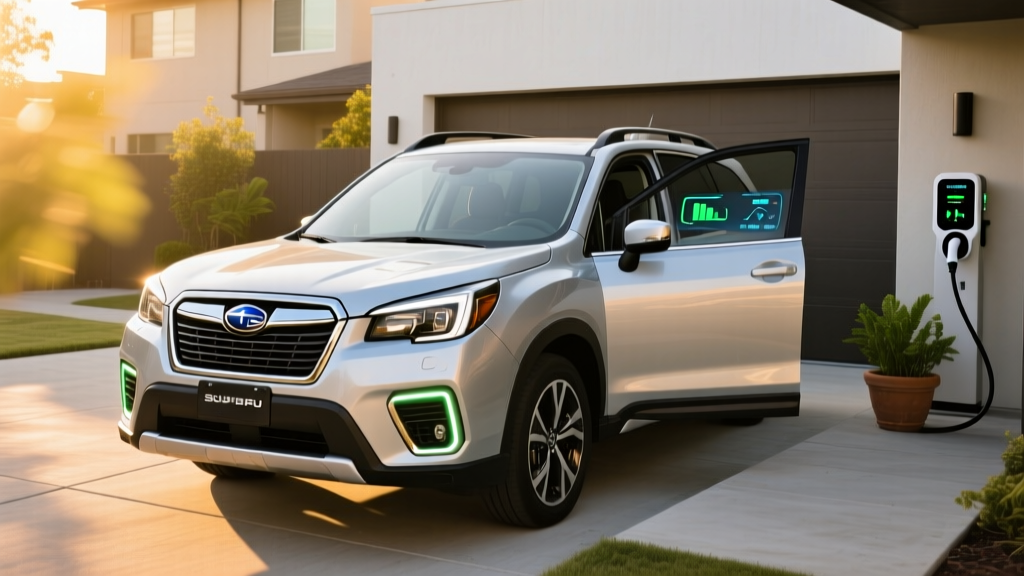
The 2025 Subaru Forester returns with a redesigned sixth generation, and for the first time in years, Subaru has brought back a hybrid option. The 2025 Subaru Forester Hybrid Premium sits in the middle of the lineup, pairing a 2.5-liter boxer engine with a hybrid electric motor and Subaru's signature symmetrical all-wheel drive. It's a conventional hybrid (HEV) — not a plug-in — meaning you never need to plug it in. You just fill it with gas and drive, while the hybrid system recovers energy during braking and deceleration to boost fuel economy.
For buyers weighing a compact SUV that can slash fuel costs without the lifestyle changes of a plug-in hybrid or full EV, the Forester Hybrid Premium is a compelling middle ground. Here's everything you need to know about its MPG, powertrain, pricing, battery longevity, and how it stacks up against electrified alternatives.
Fuel Economy: EPA Ratings and Real-World MPG
The headline number for the 2025 Subaru Forester Hybrid is its EPA-estimated fuel economy. Subaru's hybrid system is tuned for city efficiency, where the electric motor can assist heavily at low speeds and during stop-and-go driving.
| Metric | EPA Estimate | Real-World Expectation |
|---|---|---|
| City MPG | 35 MPG | 34–37 MPG (hybrids often exceed EPA in city) |
| Highway MPG | 34 MPG | 31–33 MPG (sustained highway speeds reduce hybrid benefit) |
| Combined MPG | 35 MPG | 33–35 MPG |
| Annual Fuel Cost* | ~$1,650 | Varies by local gas prices and driving mix |
*Based on 15,000 miles/year and $3.50/gallon regular unleaded per fueleconomy.gov.
HEV vs. PHEV vs. EV: Which Electrified SUV Fits You?
Before going further, it's critical to understand what the Forester Hybrid is — and what it isn't. The 2025 Forester Hybrid is a conventional hybrid (HEV). It does not have a plug, it cannot drive on electric power alone for meaningful distances, and it does not qualify for the federal §30D EV tax credit. Here's how the three electrified categories compare:
| Feature | HEV (Forester Hybrid) | PHEV (e.g., Toyota RAV4 Prime) | BEV (e.g., Tesla Model Y) |
|---|---|---|---|
| Plug-in Required? | No — gas only | Yes — for electric range | Yes — sole energy source |
| Electric-Only Range | ~1 mile at low speed | 25–42 miles typical | 250–330 miles typical |
| Fuel Economy (Combined) | 35 MPG | 38–94 MPGe (electric) / 35–40 MPG (gas) | 100–130 MPGe |
| Federal Tax Credit | Not eligible | Up to $7,500 (§30D, if eligible) | Up to $7,500 (§30D, if eligible) |
| Upfront Cost Premium | +$1,500–$2,500 vs gas | +$5,000–$8,000 vs gas | +$5,000–$15,000 vs gas |
| Home Charging Needed? | No | Recommended (Level 2) | Essential (Level 2) |
The Forester Hybrid makes sense if you want better fuel economy with zero lifestyle changes — no plug, no range planning, no charging app. A PHEV is the upgrade path if you have home charging and a short commute. A full EV maximizes savings but requires reliable charging access.
Powertrain: Boxer Engine Meets Hybrid Electric Motor
The 2025 Forester Hybrid Premium uses a series-parallel hybrid system built around Subaru's familiar 2.5-liter flat-four (boxer) engine. An electric motor is integrated into the drivetrain, providing assist during acceleration and enabling regenerative braking to recharge the hybrid battery pack.
| Specification | Detail |
|---|---|
| Engine | 2.5L DOHC 4-cylinder boxer |
| Engine Output | ~180 hp / 178 lb-ft torque |
| Electric Motor | Integrated hybrid assist motor |
| Combined System Output | ~194 hp |
| Transmission | Lineartronic CVT (continuously variable) |
| Drivetrain | Symmetrical All-Wheel Drive (standard) |
| Hybrid Battery | ~1.1 kWh lithium-ion (self-charging, no plug) |
| 0–60 mph | ~8.5 seconds (estimated) |
| Towing Capacity | 1,500 lbs |
The combined 194 hp is adequate for daily driving and highway merging, though it won't feel sporty. The CVT prioritizes smoothness and efficiency over snap-shift responsiveness. Subaru's AWD system remains a differentiator in the compact SUV segment — it's standard on every Forester Hybrid trim, which matters for buyers in snow-belt states.
Importantly, the hybrid battery is small (~1.1 kWh) because it only needs to buffer energy for short assist bursts and regenerative capture. It is not designed for sustained electric-only driving. You will never need to plug this vehicle in — the gasoline engine and regenerative braking keep the hybrid battery charged automatically.
Pricing and Tax Credit Eligibility
The 2025 Subaru Forester Hybrid Premium carries an MSRP of approximately $34,495 (including destination). That represents roughly a $2,000 premium over the gas-only Forester Premium trim, which starts around $32,495.
| Trim | MSRP (incl. destination) |
|---|---|
| Hybrid Premium | $34,495 |
| Hybrid Sport | $37,495 |
| Hybrid Touring | $39,995 |
However, the fuel savings partially offset the hybrid premium. At 35 MPG combined versus the gas-only Forester's ~29 MPG combined, and assuming 15,000 miles per year at $3.50/gallon:
- Gas Forester: ~517 gallons/year = ~$1,810/year
- Hybrid Forester: ~429 gallons/year = ~$1,500/year
- Annual savings: ~$310/year
- Payback on $2,000 hybrid premium: ~6.5 years
The payback period is moderate. If gas prices rise above $4.00/gallon, payback shortens to around 5 years. If your priority is fuel savings alone, the math is marginal. But the hybrid also delivers smoother low-speed driving, reduced brake wear (thanks to regen), and a lower carbon footprint — benefits that don't show up in a simple payback calculation.
Reliability, Battery Warranty, and Replacement Cost
Hybrid battery longevity is consistently the top concern for buyers considering their first hybrid. Here's what you need to know about the Forester Hybrid's battery and overall reliability.
Conventional hybrid batteries are among the most durable components in modern vehicles. Toyota and Honda hybrids routinely exceed 200,000 miles on original battery packs, and Subaru's hybrid system — which has roots in the Toyota partnership (Subaru previously used Toyota-derived hybrid hardware in the XV Crosstrek Hybrid) — follows similar engineering principles. The small 1.1 kWh battery undergoes shallow charge-discharge cycles (it never fully depletes or fully charges), which dramatically extends its lifespan compared to a full EV battery.
If the hybrid battery does need replacement out of warranty, expect a cost in the range of $2,000–$4,000 for parts and labor. This is significantly less than EV battery replacement ($5,000–$20,000) because the pack is small. Refurbished or remanufactured hybrid batteries are also available from third-party suppliers for $1,500–$2,500.
For overall reliability, the 2025 Forester is a first-year redesign, so long-term data is still accumulating. However, Subaru's 2.5-liter FB25 engine has been in production for over a decade with a strong track record. The CVT has improved significantly since Subaru's early-generation units. IIHS testing should be monitored as results are published for the new generation.
Who Should Buy the 2025 Forester Hybrid Premium?
The Forester Hybrid Premium occupies a specific niche. Here's a decision framework:
- You want AWD and solid ground clearance (8.7 inches) for snow, dirt roads, or outdoor adventures
- You don't have access to home or workplace charging and a PHEV/EV isn't practical
- You want better fuel economy without changing any habits — no plugs, no apps, no planning
- You value Subaru's safety reputation (EyeSight driver-assist is standard) and excellent outward visibility
- Your commute is city-heavy, where hybrid efficiency shines brightest
- You have reliable Level 2 home charging and want to maximize fuel savings
- You want federal tax credit eligibility ($7,500 for qualifying PHEVs/BEVs under IRS §30D)
- Your commute is under 30 miles — a PHEV like the Toyota RAV4 Prime (42 miles electric range) could eliminate gas use on weekdays
- You want one-pedal driving, instant electric torque, or zero tailpipe emissions
Pros and Cons at a Glance
- 35 MPG combined — a meaningful upgrade over the gas Forester's 29 MPG
- Standard symmetrical AWD on every trim
- No plug required — zero lifestyle changes
- 8.7 inches of ground clearance for light off-road and snow
- EyeSight safety suite standard (pre-collision braking, adaptive cruise, lane centering)
- Strong cargo space and visibility (Forester's traditional strengths)
- Hybrid battery warranty up to 10 years/150,000 miles in CARB states
- No federal tax credit eligibility (HEV, not PHEV/BEV)
- ~$2,000 hybrid premium with a ~6.5-year fuel payback period
- CVT can feel sluggish during hard acceleration
- Towing limited to 1,500 lbs (same as gas model)
- No electric-only driving capability beyond very low-speed creep
- First-year redesign — long-term reliability data TBD
- Highway MPG advantage over gas model is modest (34 vs 33 highway)
2025 Subaru Forester Hybrid Premium — Frequently Asked Questions
How many MPG does the 2025 Subaru Forester Hybrid get?
The EPA rates the 2025 Forester Hybrid at 35 MPG city, 34 MPG highway, and 35 MPG combined. In real-world city driving with frequent stops, owners often see 34–37 MPG thanks to regenerative braking. Highway driving at sustained speeds above 70 mph typically yields 31–33 MPG.
Does the Forester Hybrid need to be plugged in?
No. The Forester Hybrid is a conventional hybrid (HEV). The small hybrid battery charges automatically through the gasoline engine and regenerative braking. There is no plug and no electric-only driving range to manage.
Does the 2025 Forester Hybrid qualify for any tax credit?
It does not qualify for the federal §30D Clean Vehicle Credit, which is limited to plug-in vehicles (PHEVs and BEVs). Some states or utilities may offer small hybrid rebates — check the Alternative Fuels Data Center for your area.
How long will the Forester Hybrid battery last?
Subaru warranties the hybrid battery for 8 years/100,000 miles (10 years/150,000 miles in CARB states). Based on industry data from similar hybrid systems, the battery should last 150,000–200,000+ miles under normal use. Replacement cost, if needed out of warranty, is estimated at $2,000–$4,000.
Is the Forester Hybrid better than the gas Forester?
It depends on your priorities. The hybrid delivers 6 MPG more in combined driving (35 vs 29), smoother low-speed operation, and slightly reduced brake wear. The trade-off is a ~$2,000 price premium and a 6.5-year fuel payback. If you plan to keep the vehicle 7+ years and drive mostly in the city, the hybrid is the stronger choice.
How does the Forester Hybrid compare to the Toyota RAV4 Hybrid?
The RAV4 Hybrid is rated at 39–41 MPG combined, giving it a 4–6 MPG advantage. The RAV4 Hybrid also has a more mature hybrid system with extensive long-term reliability data. However, the Forester offers more ground clearance (8.7" vs 8.1"), standard AWD with Subaru's torque-vectoring rear axle, and class-leading outward visibility. If maximum MPG is the priority, the RAV4 wins. If off-road capability and visibility matter more, the Forester holds its own.
Is the Forester Hybrid good in snow?
Yes. Subaru's symmetrical AWD, 8.7 inches of ground clearance, and standard winter-driving features (X-Mode, hill descent control) make the Forester Hybrid one of the more capable compact SUVs in winter conditions. The hybrid system adds no penalty to snow performance.