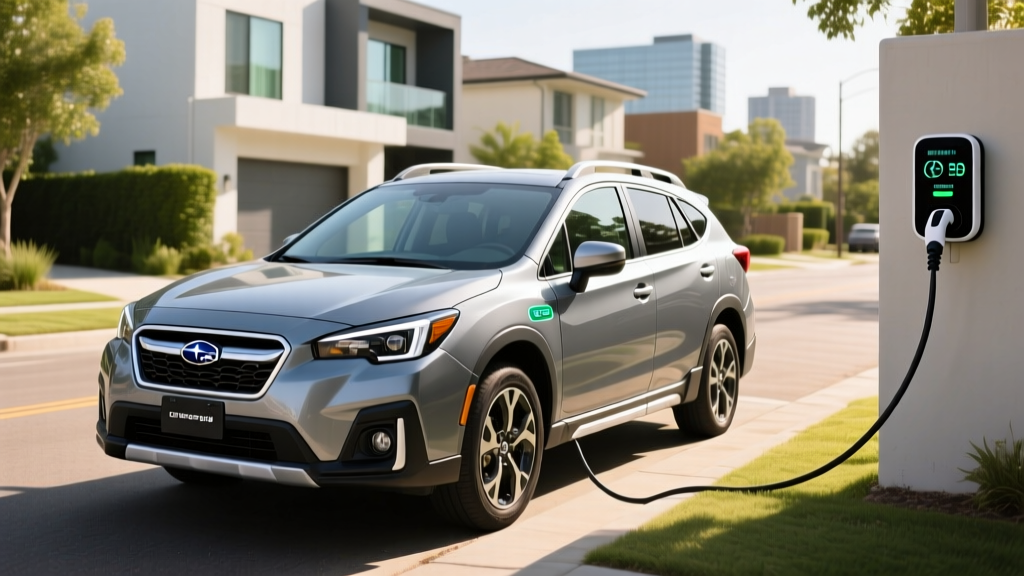
Subaru discontinued the Crosstrek Plug-in Hybrid after the 2023 model year, leaving the 2025 Crosstrek lineup as a gasoline-only subcompact SUV. For buyers searching for a 2025 Subaru Crosstrek Hybrid, the reality is straightforward: no factory hybrid or PHEV variant exists for the current model year. That doesn't mean Subaru has abandoned electrification — it means the hybrid conversation for the Crosstrek requires looking at what was, what is, and what alternatives make sense in 2025 and beyond.
This guide breaks down the 2025 Crosstrek's actual fuel economy, explains the HEV vs. PHEV distinction that mattered for earlier Crosstrek Hybrid models, and helps you decide whether the current gas Crosstrek, a used Crosstrek PHEV, or a competing hybrid SUV better fits your needs.
2025 Subaru Crosstrek Fuel Economy: EPA MPG by Trim
Since no hybrid powertrain is available, every 2025 Crosstrek runs Subaru's 2.0-liter or 2.5-liter flat-four (boxer) engine paired with a continuously variable transmission (CVT) and standard symmetrical all-wheel drive. Here is exactly what the EPA rates each configuration for:
| Trim / Engine | City MPG | Highway MPG | Combined MPG |
|---|---|---|---|
| Base, Premium (2.0L, 152 hp) | 27 | 34 | 29 |
| Sport, Limited, Wilderness (2.5L, 182 hp) | 26 | 33 | 29 |
| Wilderness (2.5L, revised gearing) | 25 | 29 | 27 |
HEV vs. PHEV: What the Crosstrek Hybrid Was (and Wasn't)
Understanding the earlier Crosstrek Hybrid requires a clear distinction between the two hybrid architectures:
Conventional Hybrid (HEV)
- Small battery (typically 1–2 kWh) charged only by the engine and regenerative braking
- Never plugged in — fuel is the sole energy input
- Electric motor assists the gas engine; brief low-speed EV driving possible
- Goal: improve MPG, reduce fuel cost, no behavior change required
Plug-in Hybrid (PHEV)
- Larger battery (8–20+ kWh) charged via plug (Level 1 or Level 2)
- Delivers meaningful electric-only range before the gas engine engages
- Functions as a conventional hybrid once the battery depletes
- Goal: electrify daily short commutes while retaining gas range for longer trips
The 2014–2015 Crosstrek Hybrid was a conventional HEV with a 13.4 kWh nickel-metal hydride battery pack and a 13-hp electric motor integrated into the drivetrain. It added roughly 2–3 MPG over the gas model (EPA combined 31 vs. 28 MPG for the era). It could not be plugged in and offered no electric-only highway driving.
The 2019–2023 Crosstrek Plug-in Hybrid was a true PHEV built on Toyota's hybrid synergy drive architecture (a product of the Subaru-Toyota partnership). It featured an 8.8 kWh lithium-ion battery, delivered 17 miles of EPA electric-only range, and returned 35 MPG combined in hybrid mode after battery depletion. Subaru discontinued the PHEV after 2023, citing slow sales relative to the gas-only lineup.
What Happened to the Crosstrek PHEV?
Subaru confirmed the Crosstrek PHEV's discontinuation for the 2024 model year when the third-generation Crosstrek launched without an electrified variant. The reasons were market-driven:
- Limited electric-only range: 17 miles on a 2023 PHEV fell well short of competitors like the Toyota RAV4 Prime (42 miles) and Hyundai Tucson PHEV (33 miles).
- No DC fast charging: The 8.8 kWh pack topped out at 3.3 kW on Level 2 AC — roughly 2.5 hours from empty. No DC fast-charge capability.
- Price premium: The PHEV started near $37,000, a $10,000+ jump over the gas Crosstrek, even after accounting for the federal tax credit (which was $4,502 at the time due to partial battery-sourcing compliance).
- Packaging compromises: The battery reduced cargo volume and eliminated the spare tire.
As of early 2026, Subaru has not announced a replacement Crosstrek Hybrid or PHEV. The brand's electrification strategy currently focuses on the Solterra (a BEV co-developed with Toyota) and upcoming next-generation EVs on a dedicated platform.
2025 Crosstrek Pricing and Tax Credit Eligibility
| Trim | Engine | Base MSRP |
|---|---|---|
| Base | 2.0L / 152 hp | $25,195 |
| Premium | 2.0L / 152 hp | $27,195 |
| Sport | 2.5L / 182 hp | $30,295 |
| Limited | 2.5L / 182 hp | $32,195 |
| Wilderness | 2.5L / 182 hp | $33,095 |
Federal tax credit: The 2025 Crosstrek is a gasoline vehicle and does not qualify for the IRS §30D New Clean Vehicle Credit, which applies only to new battery-electric vehicles (BEVs) and plug-in hybrids (PHEVs) meeting battery-sourcing and critical-mineral requirements. There is no federal hybrid tax credit for conventional HEVs or gas-only vehicles.
If you locate a used 2019–2023 Crosstrek PHEV, the IRS §25E Used Clean Vehicle Credit may apply: up to $4,000 (30% of sale price, capped) for qualified used PHEVs purchased from a dealer, subject to buyer income limits ($75,000 single / $150,000 joint) and a $25,000 maximum sale price. Verify eligibility on IRS.gov before purchasing.
Battery Warranty and Reliability: What to Expect
- 8 years / 100,000 miles (10 years / 150,000 miles in CARB states: CA, CO, CT, ME, MD, MA, NJ, NY, OR, RI, VT, WA)
- Covers capacity loss below 70% of original, defects, and module failure
- Replacement cost (out of warranty): estimated $4,000–$6,000 including labor for the 8.8 kWh pack
Subaru's gasoline Crosstrek lineup carries a strong reliability reputation — the brand consistently scores well in Consumer Reports and J.D. Power assessments. The boxer engine and CVT have proven durable, though CVT shudder on high-mileage examples (100k+ miles) has been a known issue in earlier generations.
For the PHEV, the Toyota-sourced hybrid system is among the most proven in the industry. The Prius and RAV4 Hybrid share the same fundamental architecture, with battery packs routinely lasting 150,000–200,000+ miles before meaningful degradation. The Crosstrek PHEV's smaller production volume means fewer long-term data points, but the underlying components are well-established.
Per NHTSA, the 2025 gas Crosstrek carries a 5-star overall safety rating, and the IIHS has named it a Top Safety Pick+ when equipped with EyeSight driver assistance.
Competing Hybrid SUVs: What to Cross-Shop
If hybrid fuel economy is your priority, these 2025 models deliver what the Crosstrek cannot:
| Model | Type | EPA Combined MPG | EV Range (PHEV) | Starting MSRP |
|---|---|---|---|---|
| Toyota RAV4 Hybrid | HEV | 39 MPG | N/A | $33,425 |
| Toyota RAV4 Prime | PHEV | 38 MPG (hybrid) / 94 MPGe | 42 miles | $43,690 |
| Honda CR-V Hybrid | HEV | 37 MPG | N/A | $36,200 |
| Hyundai Tucson PHEV | PHEV | 35 MPG (hybrid) / 80 MPGe | 33 miles | $38,725 |
| Subaru Crosstrek (2.0L) | Gas | 29 MPG | N/A | $25,195 |
The RAV4 Hybrid delivers 10 MPG more than the Crosstrek combined while offering AWD and comparable cargo space, though at a $8,000+ price premium. The RAV4 Prime is the PHEV benchmark but commands over $43,000 before incentives.
Decision Framework: Should You Buy the Crosstrek or a Hybrid?
Choose the 2025 Subaru Crosstrek (gas) if:
- You want standard AWD and 8.7 inches of ground clearance (9.3" on Wilderness) for under $30,000
- Your annual mileage is under 12,000 miles, making the MPG gap less financially significant
- You prioritize low purchase price and proven mechanical simplicity over fuel optimization
- You don't have reliable home charging access (rules out PHEV benefit)
Choose a competing hybrid SUV if:
- You drive 15,000+ miles annually — the 10 MPG improvement saves $400–$600/year in fuel
- You have a short commute (under 35 miles) and home Level 2 charging — a PHEV like the Tucson or RAV4 Prime can run on electricity most days
- You plan to keep the vehicle 8+ years and want to hedge against fuel price increases
- You want to reduce tailpipe emissions without range anxiety
Choose a full EV if:
- You have reliable home or workplace Level 2 charging
- Your typical daily driving is under 250 miles (well within any modern BEV range)
- You want to qualify for the §30D federal tax credit (up to $7,500 at point of sale for eligible BEVs)
- You want near-zero drivetrain maintenance — no oil changes, no CVT fluid, fewer moving parts
Frequently Asked Questions
Does the 2025 Subaru Crosstrek come in a hybrid?
No. Subaru discontinued the Crosstrek Hybrid (PHEV) after the 2023 model year. The 2025 Crosstrek is available only with gasoline engines (2.0L or 2.5L) and all-wheel drive. No conventional hybrid or plug-in hybrid is offered.
How many MPG does the 2025 Subaru Crosstrek get?
The 2025 Crosstrek with the 2.0L engine gets 27 city / 34 highway / 29 combined MPG. The 2.5L trims (Sport, Limited) get 26/33/29 MPG. The Wilderness trim, with its off-road tires and lower gearing, gets 25/29/27 MPG. Real-world results commonly match or slightly exceed these figures in suburban driving.
Can I still buy a used Subaru Crosstrek PHEV?
Yes. The 2019–2023 Crosstrek Plug-in Hybrid is available on the used market. It delivers 17 miles of electric-only range and 35 MPG combined as a hybrid. Expect to pay $22,000–$30,000 depending on mileage and condition. Verify that the hybrid battery warranty (8 yr/100k mi) is still active.
Does the Crosstrek PHEV qualify for a tax credit?
The new Crosstrek PHEV (discontinued in 2023) was eligible for a partial $4,502 federal credit at the time. Today, a used Crosstrek PHEV may qualify for the IRS §25E Used Clean Vehicle Credit — up to $4,000, subject to income caps and a $25,000 maximum sale price. Confirm eligibility at IRS.gov.
Is the Subaru Crosstrek reliable long-term?
The gasoline Crosstrek scores well in long-term reliability surveys. Subaru's boxer engines and CVTs are proven, though high-mileage CVT maintenance is important. For the PHEV, the Toyota-sourced hybrid components have an excellent durability record. The hybrid battery warranty covers 8 years/100,000 miles (10 yr/150k in CARB states).
What hybrid SUV should I consider instead of the Crosstrek?
The Toyota RAV4 Hybrid (39 MPG combined, from $33,425) is the segment leader for AWD hybrid SUVs. The Honda CR-V Hybrid (37 MPG, from $36,200) offers more interior space. For PHEV capability, the RAV4 Prime (42 miles EV range) and Hyundai Tucson PHEV (33 miles) lead the class — but both start $10,000+ above the base Crosstrek.