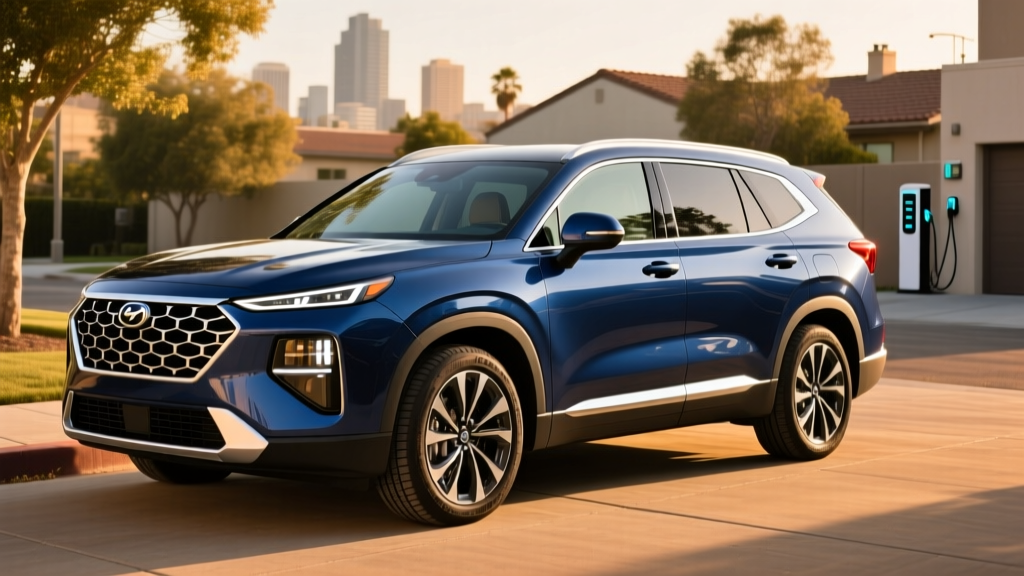
Quick Verdict: The 2025 Santa Fe Hybrid Limited at a Glance
The 2025 Hyundai Santa Fe Hybrid Limited sits at the top of the hybrid trim ladder, pairing a turbocharged 1.6-liter four-cylinder with an electric motor for a combined 230 horsepower and an EPA-estimated 34 MPG combined. It's a three-row midsize SUV that doesn't require plug-in charging, doesn't suffer range anxiety, and delivers the kind of city-heavy efficiency that makes conventional hybrids shine. For buyers who want electrified efficiency without altering their fueling habits, the Santa Fe Hybrid Limited makes a compelling case — especially with Hyundai's industry-leading hybrid battery warranty.
This review breaks down the real-world fuel economy, powertrain specifics, pricing, tax credit eligibility, and ownership considerations you need before signing the paperwork.
HEV vs PHEV: Which Santa Fe Electrified Model Is This?
Hyundai sells the Santa Fe in two electrified flavors for 2025, and confusing them is the most common mistake shoppers make:
| Feature | Santa Fe Hybrid (HEV) | Santa Fe Plug-In Hybrid (PHEV) |
|---|---|---|
| Plug-in charging required? | No — self-charging via regenerative braking | Yes — plug in for electric-only driving |
| Electric-only range | N/A (motor assists engine) | ~30 miles (EPA est.) |
| Battery size | ~1.49 kWh (small buffer) | ~13.8 kWh usable |
| Combined output | 230 hp / 271 lb-ft | 261 hp / 271 lb-ft |
| EPA combined MPG / MPGe | 34 MPG combined | 79 MPGe (electric) / 29 MPG (gas-only) |
| Federal tax credit (§30D) | Not eligible | Up to $7,500 (eligibility varies) |
| Starting MSRP (Limited) | ~$47,400 | ~$49,950 |
Bottom line: The 2025 Santa Fe Hybrid Limited reviewed here is a conventional HEV. You never plug it in. It recovers energy during braking and deceleration to charge its small battery, which then assists the gasoline engine. If you're looking for electric-only commuting, you want the Santa Fe Plug-In Hybrid instead.
Fuel Economy: EPA Ratings and Real-World MPG
The headline number for the 2025 Santa Fe Hybrid Limited is its EPA-estimated fuel economy. Here's the full breakdown from fueleconomy.gov:
| Driving Cycle | EPA Estimate | Real-World Expectation |
|---|---|---|
| City | 35 MPG | 36–39 MPG (hybrids excel in stop-and-go) |
| Highway | 31 MPG | 28–31 MPG (turbo + boxy aero hurt at 75+ mph) |
| Combined | 34 MPG | 32–36 MPG depending on driving mix |
Why city MPG beats highway: Like all conventional hybrids, the Santa Fe HEV recovers kinetic energy during braking and low-speed driving that would otherwise be wasted as heat. In city traffic, the electric motor handles more of the propulsion load at low speeds, and the engine shuts off at stops. On the highway, the turbocharged 1.6L engine does most of the work pushing the SUV's ~4,500-lb curb weight through the air, and the hybrid system contributes less.
Real-world factors that shift MPG:
- Cold weather: Expect a 5–10% drop in winter. The engine runs longer to generate cabin heat, and battery efficiency drops in freezing temperatures.
- Terrain: Mountain driving with long climbs will drop MPG into the mid-20s; regenerative braking on descents partially recovers this.
- Cargo and towing: With a full load of passengers and cargo, or when approaching the 2,000-lb towing capacity, expect combined MPG in the high 20s.
- Driving style: Aggressive acceleration engages the turbo more frequently, which consumes fuel faster than the hybrid system's efficiency envelope.
Powertrain and Performance Specs
| Specification | 2025 Santa Fe Hybrid Limited |
|---|---|
| Engine | 1.6L turbocharged 4-cylinder (Smartstream G1.6T) |
| Engine output | 178 hp / 195 lb-ft |
| Electric motor output | 47.7 kW (~64 hp) / 195 lb-ft |
| Combined system output | 230 hp / 271 lb-ft |
| Transmission | 6-speed automatic (hybrid-optimized) |
| Drivetrain | HTRAC AWD (standard on Limited) |
| 0–60 mph | ~7.8 seconds (est.) |
| Towing capacity | 2,000 lbs |
| Curb weight | ~4,530 lbs |
| Fuel tank | 17.7 gallons |
| Recommended fuel | Regular unleaded (87 octane) |
The hybrid powertrain uses Hyundai's TMED-II (Transmission-Mounted Electric Device) architecture, which places the electric motor between the engine and transmission rather than in a separate e-axle. This means AWD is handled mechanically through a driveshaft to the rear wheels rather than through a dedicated rear electric motor. The result is predictable, competent all-weather traction — but not the instant torque-vectoring you'd find in a dual-motor EV.
The 230 combined horsepower moves the Santa Fe Hybrid Limited adequately rather than energetically. Merging onto highways and passing at speed are confident enough, but this is a comfort-tuned family hauler, not a performance SUV. The 6-speed automatic shifts smoothly and avoids the rubber-band feel of CVTs found in competing hybrids like the Toyota Highlander Hybrid.
Pricing, Trims, and Tax Credit Eligibility
The 2025 Santa Fe Hybrid is available in three trims. The Limited sits at the top:
| Trim | MSRP (incl. destination) | Key Additions |
|---|---|---|
| SEL Premium | ~$41,400 | Heated front seats, power liftgate, wireless CarPlay/Android Auto |
| XRT | ~$44,100 | Off-road styling, all-terrain tires, roof cross rails |
| Limited | ~$47,400 | Nappa leather, ventilated front seats, HUD, Highway Driving Assist 2, surround-view monitor |
Does the 2025 Santa Fe Hybrid Limited Qualify for a Federal Tax Credit?
No. Under IRS §30D rules, the federal Clean Vehicle Credit applies only to plug-in electric vehicles (BEVs and PHEVs) with sufficient battery capacity. Conventional hybrids like the Santa Fe HEV do not qualify for the $7,500 federal credit, regardless of buyer income or where the vehicle is assembled. See the IRS Clean Vehicle Credit page for current eligibility rules.
State incentives: Some states offer rebates or HOV-lane access for conventional hybrids, but these vary widely by jurisdiction and change frequently. Check your state's energy office or DMV for current programs.
- Buyer AGI within IRS limits ($150K single / $300K joint)
- Battery critical-mineral and component sourcing requirements
- Vehicle assembled in North America (Santa Fe PHEV is built in Georgia)
- Point-of-sale transfer available at participating dealers
Battery Warranty, Reliability, and Replacement Cost
Hybrid battery longevity is consistently the top concern among first-time hybrid buyers. Here's what Hyundai provides:
- Coverage: 10 years / 100,000 miles (whichever comes first)
- What's covered: Hybrid battery pack, hybrid control unit, electric motor, and related powertrain components
- Capacity threshold: Hyundai warrants against abnormal degradation; specific SoH thresholds are defined in the warranty booklet
- Transferability: Warranty transfers to subsequent owners (some competitors' hybrid warranties do not)
Reliability context: Hyundai's 1.6T hybrid powertrain has been in production across multiple models (Tucson Hybrid, Sonata Hybrid) since 2021, giving it a meaningful track record. The lithium-ion polymer battery pack is relatively small (~1.49 kWh) and operates in a narrow state-of-charge window, which significantly reduces degradation stress compared to a full EV battery. Real-world failure rates for Hyundai/Kia hybrid batteries have been low based on owner surveys and warranty claim data.
Battery replacement cost: If the hybrid battery fails outside warranty, replacement costs for Hyundai's 1.6T hybrid battery pack typically range from $2,000 to $3,500 including labor, based on current dealer parts pricing. This is considerably less than EV battery replacement ($8,000–$20,000+) because the hybrid battery is small. Most hybrid batteries outlast the vehicle itself — the 10-year/100,000-mile warranty is designed to cover the realistic ownership horizon.
Who Should Choose the Santa Fe Hybrid Limited vs. a PHEV or Full EV?
The right choice depends on your daily driving pattern, charging access, and budget. Here's a practical decision framework:
- You don't have access to home or workplace charging
- Your daily driving is a mix of city and highway with no predictable short-commute pattern
- You want better fuel economy without changing any habits — just fill up with gas
- You take regular road trips and don't want to plan around charging stops
- You want three-row seating with AWD under $50K
- You can install a Level 2 charger at home and your commute is under 30 miles round-trip
- You want to drive on electricity most days but need gas flexibility for longer trips
- You qualify for the federal §30D tax credit (income + sourcing requirements)
- You want the most powerful Santa Fe variant (261 hp)
- You have reliable home Level 2 charging
- Your daily driving is under 250 miles and you can plan DC fast-charging stops for road trips
- You want the lowest per-mile fuel cost and minimal maintenance
- You want the full $7,500 federal credit and your income qualifies
Pros and Cons
Pros
- 35 MPG city EPA — excellent for a 4,500-lb three-row AWD SUV
- No plug-in charging required; zero behavior change from a gas car
- 10-year/100,000-mile hybrid battery warranty — best in class
- HTRAC AWD standard on Limited; competent in snow and rain
- Premium Limited trim features: Nappa leather, ventilated seats, HUD, HDA2
- Runs on regular 87-octane fuel
- ~590 miles of real-world range per tank
Cons
- No federal tax credit eligibility (HEV, not PHEV)
- Highway MPG drops to ~28–31 at sustained 75+ mph speeds
- 2,000-lb towing capacity is modest for the class
- ~$47,400 MSRP for Limited is a premium price for a hybrid midsize SUV
- No DC fast-charging capability (not applicable to HEV, but limits electric flexibility vs. PHEV)
- Boxy styling increases aerodynamic drag vs. sleeker competitors
Frequently Asked Questions
How many MPG does the 2025 Santa Fe Hybrid Limited get?
The EPA rates it at 35 MPG city, 31 MPG highway, and 34 MPG combined. In real-world city-heavy driving, many owners report 36–39 MPG thanks to regenerative braking. Highway-only driving at high speeds can drop this to 28–31 MPG.
Do I need to plug in the Santa Fe Hybrid?
No. The Santa Fe Hybrid is a conventional HEV — it charges its small battery through regenerative braking and engine power. You fuel it exclusively at gas stations, just like a traditional vehicle. If you want plug-in capability, look at the Santa Fe Plug-In Hybrid instead.
How far can the Santa Fe Hybrid go on a full tank?
With its 17.7-gallon fuel tank and observed combined economy around 33 MPG, expect approximately 580–590 miles between fill-ups. City-heavy drivers may stretch this past 620 miles.
Is the hybrid battery reliable and what does replacement cost?
Hyundai covers the hybrid battery for 10 years or 100,000 miles, one of the longest warranties in the industry. The small ~1.49 kWh pack operates under low stress, and failure rates are historically low. Out-of-warranty replacement typically costs $2,000–$3,500 — far less than an EV battery.
Does the 2025 Santa Fe Hybrid qualify for any tax credit?
The conventional Santa Fe Hybrid (HEV) does not qualify for the federal §30D Clean Vehicle Credit, which is reserved for plug-in vehicles. The Santa Fe Plug-In Hybrid may qualify for up to $7,500 depending on buyer income, battery sourcing, and assembly location. Some states offer hybrid-specific incentives — check your state's energy office.
How does the Santa Fe Hybrid compare to the Toyota Highlander Hybrid?
The Highlander Hybrid achieves slightly better EPA fuel economy (~35–36 MPG combined) but uses a CVT that some drivers find less engaging. The Santa Fe Hybrid offers a traditional 6-speed automatic, more aggressive styling, and Hyundai's longer 10-year powertrain warranty vs. Toyota's 8-year/100,000-mile hybrid battery coverage. Both are strong choices; the decision often comes down to styling preference, dealer experience, and warranty priorities.
Can the Santa Fe Hybrid Limited tow?
Yes, but modestly. The Hybrid Limited is rated for 2,000 lbs of towing capacity — enough for a small utility trailer, a couple of dirt bikes, or a light pop-up camper, but not a full-size boat or travel trailer. If you need more towing capacity, the non-hybrid Santa Fe with the 2.5T engine is rated for 3,500 lbs.
Sources: EPA fuel economy data from fueleconomy.gov, manufacturer specifications from Hyundai Motor America, and federal tax credit rules from IRS.gov. Pricing reflects MSRP at time of publication and may vary by dealer. Always verify current incentive eligibility with a tax professional.